
How many extra shifts can you pick up before your performance, safety, or life starts to fall apart—and how do you know where that line is before you cross it?
Let me be blunt: most residents and young attendings underestimate the cost of moonlighting and overestimate the benefit. They see the hourly rate, not the downstream damage. You’re probably being told, “Everyone does it,” or “You’d be dumb not to at that pay.” That’s how people end up working 80+ hours a week, barely remember the month, and make a serious error they never forget.
You want a clear framework. Not vibes. Not “see how it feels.” Here it is.
Step 1: Know the Hard Limits (Legal, Contractual, and Program)
Before you even think about “too much,” you need to know what’s not allowed.
There are three non‑negotiable caps:
- ACGME duty hour limits (if you’re a resident)
- Your contract and program-specific rules
- Your malpractice and credentialing rules
If you’re ignoring any of these, you’re already past “too much,” no matter how good you feel.
1. ACGME and duty hours – the floor, not the ceiling
If you’re in ACGME-accredited training, moonlighting counts toward duty hours. Full stop. Internal, external, all of it.
Key rules you cannot ignore:
- Max 80 hours/week, averaged over 4 weeks
- Minimum 1 day off in 7, averaged over 4 weeks
- Minimum 10 hours off between duty periods (with some program-specific flex)
If your “normal” week is already 60–70 hours, you are playing games if you add a bunch of moonlighting. And yes, I’ve seen residents try to hide moonlighting hours. Compliance offices are not amused. Neither are state boards if something serious happens.
So first question:
Q1: If I add this moonlighting, will my 4-week average stay under 80 hours and preserve post‑call and day‑off rules?
If you cannot answer that with actual numbers, you’re guessing.
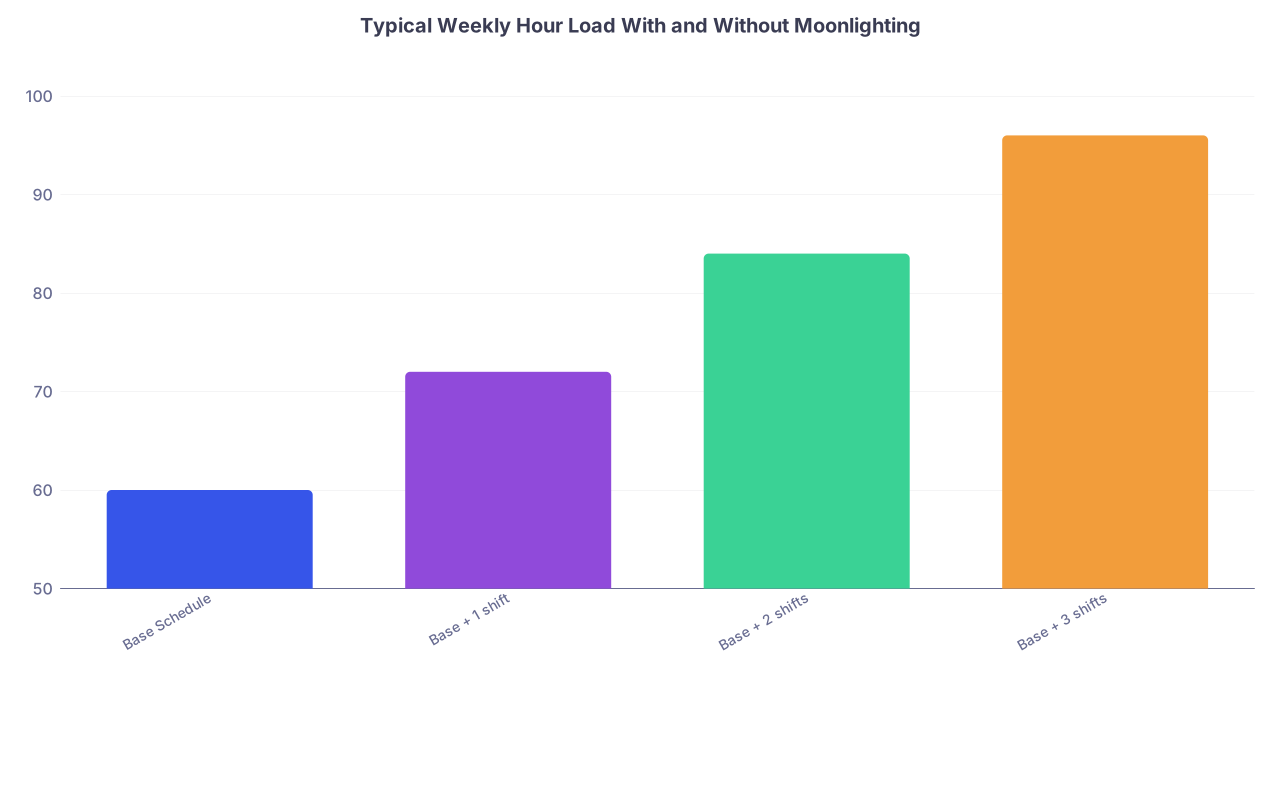
| Category | Value |
|---|---|
| Base Schedule | 60 |
| Base + 1 shift | 72 |
| Base + 2 shifts | 84 |
| Base + 3 shifts | 96 |
Look at that. Base 60-hour week plus “just 2 shifts” and you’re at 84. Past the limit. This is how people get burned.
2. Program and contract rules
Your employment contract and program handbook usually have a moonlighting section. People skip it. Don’t.
You need to know:
- Is moonlighting even allowed at your level (some prohibit it before PGY‑2 or at all)?
- Do you need written approval from the PD or GME office?
- Are internal and external moonlighting treated differently?
- Are there caps like “no more than 24 moonlighting hours per month”?
If you’re an attending, check:
- Non-compete or restricted area clauses
- Requirements to disclose outside employment
- Limits from your main employer on total clinical hours or locations
Q2: Have I read, not skimmed, my program/employment moonlighting policy and gotten explicit approval?
No approval = too much. Because one bad month and suddenly your PD, GME, or employer is involved.
3. Malpractice, licensing, and scope
This is where people get into serious trouble.
Questions you must answer for each moonlighting gig:
- Who provides malpractice coverage? What limits? Tail or occurrence?
- Are you practicing within your level of training and license?
- Are you credentialed for the procedures and responsibilities they expect?
- Do they expect you to act like an attending while you’re still a resident? (Huge red flag.)
If there’s any ambiguity—“I think I’m covered,” “They said not to worry”—you say no.
Q3: Can I clearly explain who covers my malpractice, what I’m allowed to do, and how this is documented?
If you’d mumble through that explanation to a state medical board, it’s too much.
Step 2: Set Your Personal Safety Limits (Before You Need Them)
Legal caps are not your safety limits. They’re the extreme boundary. You need your own ceiling—lower than the legal one.
Here’s the honest question:
How many hours per week can you work consistently without:
- Making noticeably more mistakes
- Snapping at staff, patients, or loved ones
- Dropping your study time or core responsibilities
- Feeling physically wrecked on your “day off”
That number’s rarely 80. For most residents, it’s more like 55–65 total clinical hours. Some can tolerate a bit more, but very few can sustain it without cost.
Build a simple “capacity table” for yourself
Be concrete. Something like this:
| Total Hours/Week | Status | Rule for Myself |
|---|---|---|
| ≤ 60 | Sustainable | Moonlighting allowed if >1 day off |
| 61–70 | Caution | Only 1 extra shift; no post-call |
| 71–80 | High risk | No moonlighting |
| > 80 | Off limits | Something has to be cancelled |
This is not theoretical. I’ve watched people ignore this, then:
- Fail boards or in‑service exams
- Lose letters because their performance slipped
- End up on remediation for “professionalism” after too many late notes or snappy interactions
So you define:
Q4: What is my personal weekly hour ceiling for “sustainable” and what’s my absolute “never exceed” number—even if the money is great?
Write it down. Treat it like a contract with yourself.
Step 3: Understand the Real Cost of Each Extra Shift
Everyone calculates the hourly rate. Almost no one calculates:
- The physical cost
- The opportunity cost
- The risk cost
Let’s break that down. Directly.
1. Physical and mental cost
Ask:
- What time does the shift start and end?
- How many hours after my regular shift does it begin?
- Is it nights stacked on top of days? Or vice versa?
A classic self-sabotage move:
Work your regular 7a–5p, then a 6p–11p moonlighting shift, then be back at 7a. On paper that “works.” In real life you’re useless by 3 p.m. the next day.
Q5: How many total continuous hours will I be “on” (including regular work + commute + moonlighting + back again)?
Anything >16–18 hours of functional wakefulness repeatedly is a no.
2. Opportunity cost (what you say “no” to)
Moonlighting doesn’t just use your free time; it replaces something. Sleep. Study. Exercise. Relationships. That’s not dramatic; that’s arithmetic.
Ask yourself:
- What would I be doing otherwise—sleep? Studying for boards? Being with my family?
- Am I behind or barely on track with in‑training exams, research, or important projects?
If you’re in a fellowship-competitive field and already barely holding research or board prep together, trading that time for $100/hour shifts is a very bad trade long term.
Q6: What exactly am I giving up for this shift, and is the money truly worth that trade?
If you can’t answer that clearly, you’re only seeing half the equation.
Step 4: Use a Simple Decision Framework Before Saying Yes
Here’s the quick-and-dirty flow you should run every single time you’re offered or considering a shift:

| Step | Description |
|---|---|
| Step 1 | Offered Moonlighting Shift |
| Step 2 | Decline - Not Allowed |
| Step 3 | Accept Shift |
| Step 4 | Allowed by policy |
| Step 5 | Within duty hour limits |
| Step 6 | Below personal hour ceiling |
| Step 7 | Adequate recovery time |
| Step 8 | Malpractice and scope clear |
| Step 9 | Trade off worth it now |
If at any step your honest answer is “no” and you still say yes, you are consciously choosing risk. Sometimes that’s fine temporarily. But at least call it what it is.
Step 5: Spot the Red Flags That Mean You’re Already Doing Too Much
You don’t need a formal burnout survey. Your daily life is already giving you data.
You’re doing too much moonlighting if:
- You’ve fallen asleep at work, in your car, or at home sitting up
- Nurses or colleagues say “Are you okay? You look dead” more than once a week
- You’re chronically behind on notes and documentation
- You’re snapping at staff, co‑residents, or patients
- You’ve missed important deadlines: evaluations, modules, research milestones
- Your in‑service or board prep is “I’ll get to it when things slow down” for months
Translate that into a hard question:
Q7: If my PD or department chair secretly watched my last 2 weeks, would they say my performance is clearly worse than usual?
If the answer is yes, you’re already past your safe limit.
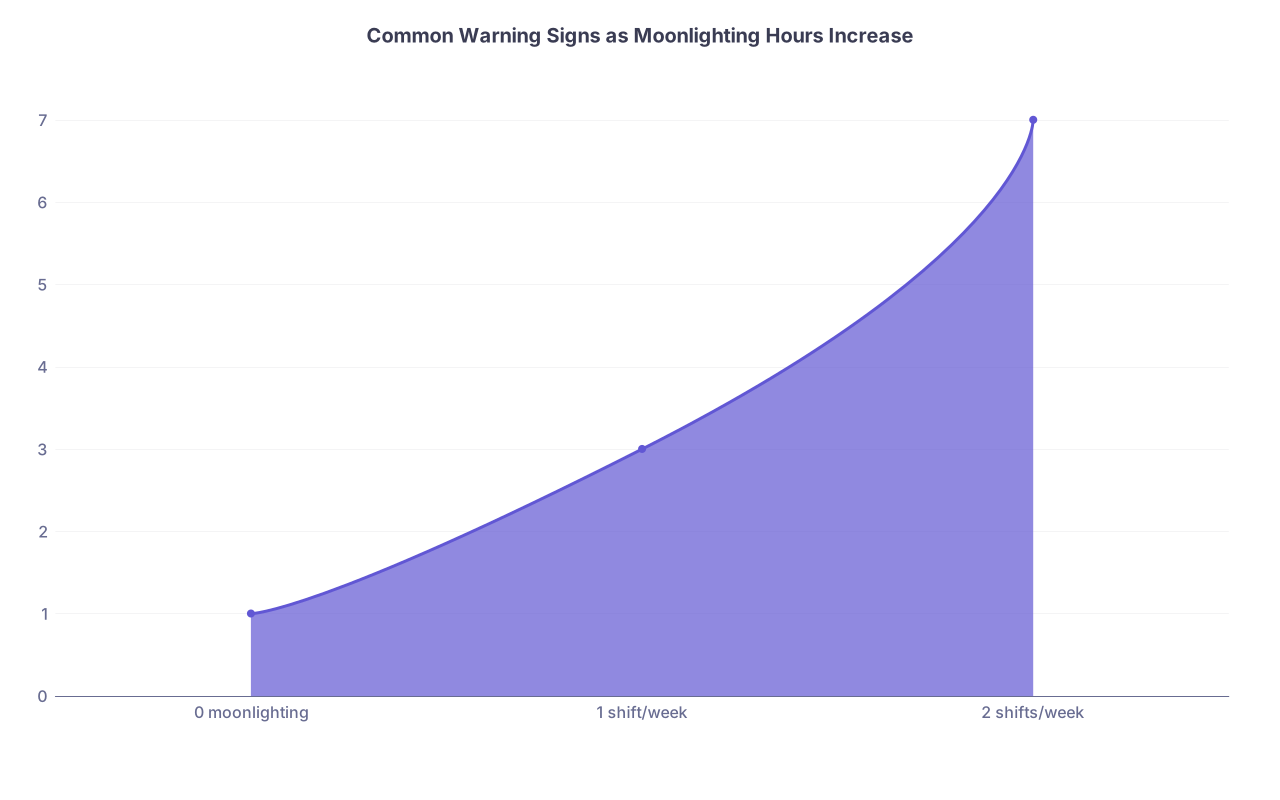
| Category | Value |
|---|---|
| 0 moonlighting | 1 |
| 1 shift/week | 3 |
| 2 shifts/week | 7 |
That “warning sign count” is what I’ve watched happen again and again. At 2 shifts per week on top of full-time residency, the wheels start to come off.
Step 6: Money: Run the Numbers Like an Adult, Not a Resident With FOMO
A lot of residents moonlight reactively:
- “I have loans, I have to.”
- “Everyone else is paying down debt faster.”
- “The hourly pay is insane.”
Calm down. Do the math.
Calculate your actual take-home
- Hourly rate × hours
- Subtract taxes (federal, state, local; often 30–40% marginal)
- Factor commute, parking, meals
Decide the job of this money
- Specific loan payment target
- Building a 3–6 month emergency fund
- Saving for a down payment
- Funding a specific, important purchase (not random lifestyle creep)
Put a cap and a timeline
- “I’m going to moonlight 1 shift per week for 4 months to save $X for Y purpose.”
- Not “I’ll just pick up whatever I can.”
Q8: What is the exact financial goal of this moonlighting, and when will I stop or reassess?
If it’s vague—“more money,” “less debt someday”—you’ll burn yourself with no clear win.
Step 7: Situations Where the Answer Should Almost Always Be “No”
Let me make this easy. These are common scenarios where saying yes is usually a mistake:
- You’re an intern barely keeping your head above water
- You’re struggling clinically or on any kind of remediation
- You’re preparing for Step 3, written boards, or high-stakes exams in the next 3–6 months
- Your regular schedule is already at 65–70 hours/week
- You’re on an intense service (ICU, trauma, busy inpatient) and barely sleeping as is
- You rely on caffeine to function and still feel exhausted
You do not get bonus points for suffering. No program or future employer says, “We love that you burned yourself out moonlighting and your performance slipped.”
When Moonlighting Makes Sense
Moonlighting can be smart when:
- You’re PGY‑3+ or early attending with solid clinical footing
- Your base schedule is more reasonable (e.g., 45–55 hours some weeks)
- You have a clear financial target and an end date
- The shifts are well-supported and within your true comfort zone
- You’re still able to:
- Sleep 6–7 hours most nights
- Keep up with studying or CME
- Show up as a sane human being in your personal life
In those situations, 1–2 shifts per month, sometimes 1 per week during lighter blocks, can be completely reasonable.
Core Questions to Ask Before You Say Yes (Condensed)
If you remember nothing else, run through this list:
Policy & legality
- Is this explicitly allowed by my program/employer and within duty hour rules?
Total workload
- What will my average weekly hours be over the next 4 weeks if I add this?
Recovery & safety
- Will I have at least 10 hours off between shifts and a real day off this week?
Scope & malpractice
- Is my role clearly defined, within my training, and properly covered?
Trade-off & goal
- What am I giving up for this shift, and does it clearly move me toward a defined financial goal?
If any of those answers are fuzzy, pressured, or wishful thinking, the safer answer is no.
FAQ: Moonlighting and “Too Much” – 5 Common Questions
1. Is it ever okay to exceed 80 hours per week if my program “looks the other way”?
No. That’s not edgy; it’s reckless. If there’s a bad outcome and someone audits your hours, nobody is going to defend “we all just ignored the rules.” Your license and your training position are not worth a few extra thousand dollars.
2. How many moonlighting hours per month is “reasonable” for most residents?
For most higher-level residents with moderate base workloads, 8–24 hours per month (1–3 shifts) is the reasonable band. More than that is possible for some, but once you’re pushing 30–40 extra hours routinely, you’re in a danger zone unless your main job is truly light.
3. What if my co-residents are moonlighting way more than I am—am I missing out?
Probably not. You’re seeing their paycheck flex, not their sleep debt, missed studying, or strained relationships. People rarely brag about nearly falling asleep driving home or bombing their in‑service. Compare yourself to your own goals and limits, not their Instagram.
4. Should I ever moonlight if I’m studying for boards?
You can, but it should be very limited and purpose-driven. If you are within 3–6 months of a major exam and not already clearly above passing level on practice tests, I’d strongly restrict or pause moonlighting. Failing boards costs you far more than any short-term shift income.
5. How do I tell a recruiter or department “no” without burning bridges?
Be direct and neutral: “Thanks for thinking of me. My current schedule and duty hour limits don’t allow me to safely take on extra shifts right now. I’ll reach out in the future if that changes.” Reasonable groups respect that. If they pressure you, that’s a preview of what working with them will be like—another reason to say no.
Bottom line:
- “Too much” moonlighting starts the moment you’re bending rules, sacrificing safety, or eroding your core performance—even if you feel fine now.
- Use hard limits (policy, hours, recovery) and clear financial goals to decide when to say yes.
- If you cannot clearly explain your hours, coverage, and trade-offs, you’re not ready for that shift—and the correct answer is no.