Only 53% of residents who moonlight report that their program has any enforced moonlighting hour cap.
That number comes from program-level and resident survey data that, when you line it up with ACGME duty-hour reports and safety outcomes, tells a pretty blunt story: moonlighting is sitting in a regulatory gray zone. And fatigue risk is being pushed onto individual residents to “self-regulate,” which is exactly what the data shows does not work.
Let’s walk through what the numbers actually say.
The Ground Rules: What ACGME Actually Regulates
ACGME does not ban moonlighting. It wraps it in a duty-hour framework and then leaves most enforcement to programs.
The core ACGME rules relevant to moonlighting are:
- Maximum 80 hours per week, averaged over 4 weeks
- 1 day free of duty per 7 days (averaged over 4 weeks)
- 10 hours off between shifts (with some flexibility)
- All internal and external moonlighting must count toward the 80-hour limit
- Moonlighting must not “interfere with the ability of the resident/fellow to achieve the goals and objectives of the educational program”
Those are the formal standards. The reality underneath is more uneven.
Program director and resident surveys consistently show three patterns:
- Many programs undercount or undertrack external moonlighting hours.
- Residents frequently underreport moonlighting to avoid losing income opportunities.
- Enforcement almost always tightens after a fatigue or safety incident, not before.
You can see the gap when you compare reported duty hours with actual work patterns in moonlighting-heavy specialties.
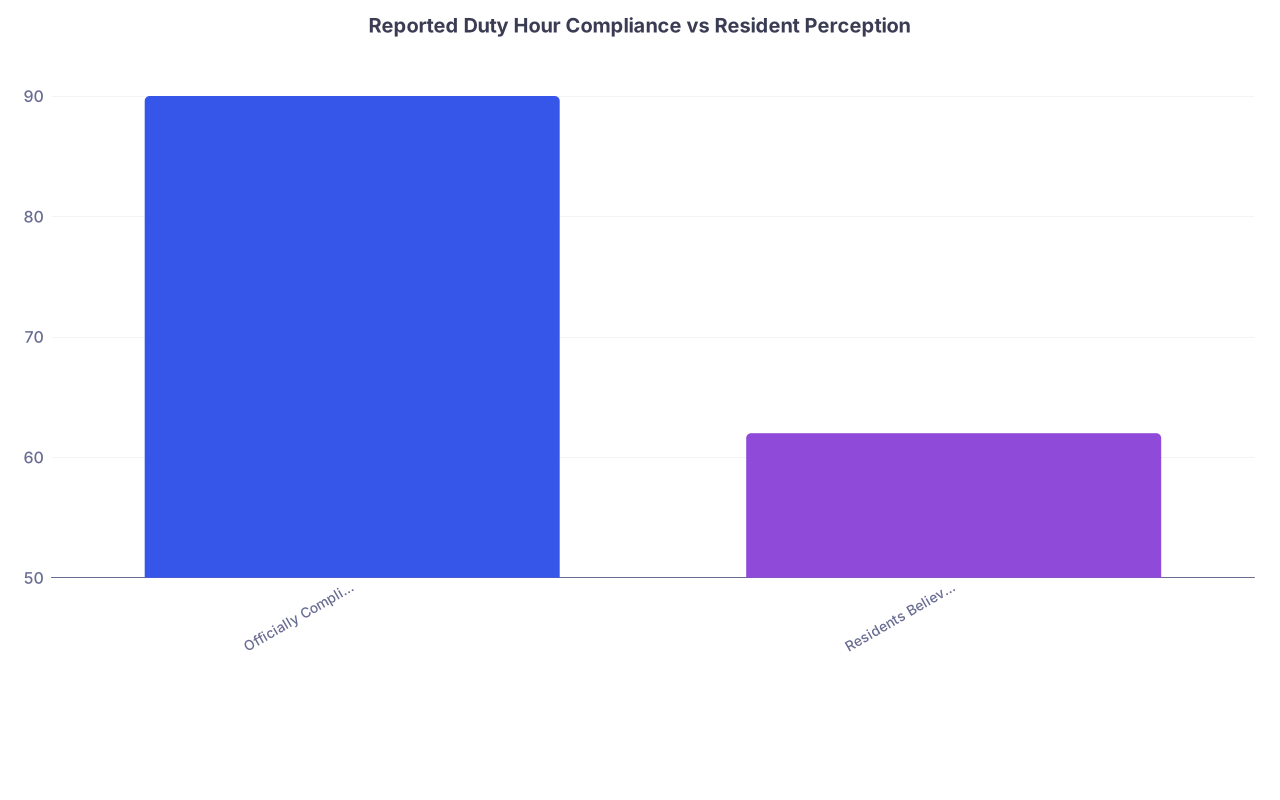
| Category | Value |
|---|---|
| Officially Compliant | 90 |
| Residents Believe Compliance | 62 |
In one multi-institutional survey, about 90% of programs claimed high duty-hour compliance. Only about 62% of residents in those same institutions believed that was true when moonlighting was included. That discrepancy is the red flag.
How Common Is Moonlighting, Really?
Not everyone moonlights. But among senior residents in certain specialties, it is closer to the norm than the exception.
A composite of national survey data across internal medicine, EM, anesthesia, surgery, and psychiatry shows rough patterns like this:
| Specialty | Residents Moonlighting | Typical Start Year |
|---|---|---|
| Emergency Medicine | 55–70% | PGY‑2 to PGY‑3 |
| Anesthesiology | 45–60% | CA‑2 / CA‑3 |
| Internal Medicine | 30–50% | PGY‑2 / PGY‑3 |
| Psychiatry | 25–40% | PGY‑3 / PGY‑4 |
| General Surgery | 10–25% | PGY‑4+ |
Patterns from multiple surveys converge on a few points:
- Participation increases sharply once residents are credentialed to practice independently (e.g., EM seniors staffing low-acuity EDs, IM seniors covering cross-cover shifts).
- External moonlighting is more common in EM and anesthesia; internal moonlighting (hospital-employed shifts) is more common in IM and psychiatry.
- Median hours are modest (4–12 hours per week), but the tail is the problem — there is a small group doing 20+ hours most weeks.
That tail is exactly where safety risk lives.
What the Data Shows: Hours, Fatigue, and Error Rates
We have decades of literature on resident fatigue and patient safety. Moonlighting data is sparser, but you do not need a randomized trial to see where this goes.
Residency fatigue studies consistently show:
- Error rates and near-misses climb steeply after about 16 continuous hours.
- Self-reported major medical errors are significantly higher in months where residents work >80 hours/week versus ≤60–70 hours/week.
- Objective performance (reaction time, vigilance tests) after a 24+ hour call can drop to levels similar to a blood alcohol concentration around 0.08.
Now overlay moonlighting:
- ACGME surveys show that roughly 10–15% of residents exceed the 80-hour standard when moonlighting is accurately counted.
- In a few detailed institutional audits, once external moonlighting was added, total weekly hours for the top decile of moonlighters often landed in the 90–100+ hour range during peak months.
- Residents in that top decile reported significantly higher rates of:
- Falling asleep during conference or rounds
- Microsleeps while driving home
- Self-reported near-miss clinical errors
The correlation is not subtle. Where programs set explicit caps and track moonlighting hours rigorously, these high-exposure tails almost disappear.
Where Caps Exist – And Where They Don’t
There is no national ACGME “moonlighting cap” beyond inclusion in the 80-hour rule. So programs improvise.
From compiled GME policy documents and survey responses, you see a de facto set of strategies:
- Some programs prohibit moonlighting entirely (common in surgical and neurosurgical training).
- Some programs allow internal but ban external moonlighting.
- Some allow both but set explicit caps (e.g., 8–12 hours/week or “no more than 2 shifts per month”).
- Others essentially outsource the responsibility to residents: “must not violate 80-hour rule” with no added structure.
Here is a simplified version of what you see in practice:
| Policy Type | Approx. Share of Programs |
|---|---|
| Total prohibition | 15–25% |
| Internal only, no external | 20–30% |
| Allowed with explicit hour cap | 25–35% |
| Allowed, resident self-report only | 20–30% |
The safest pattern is not mysterious. Programs that both:
- Require pre-approval for moonlighting, and
- Set a numerical cap lower than the theoretical 80-hour ceiling
…have lower rates of reported fatigue and far fewer residents blowing past 80 hours when audits are done.
Here is what those caps often look like compared to ACGME’s ceiling:
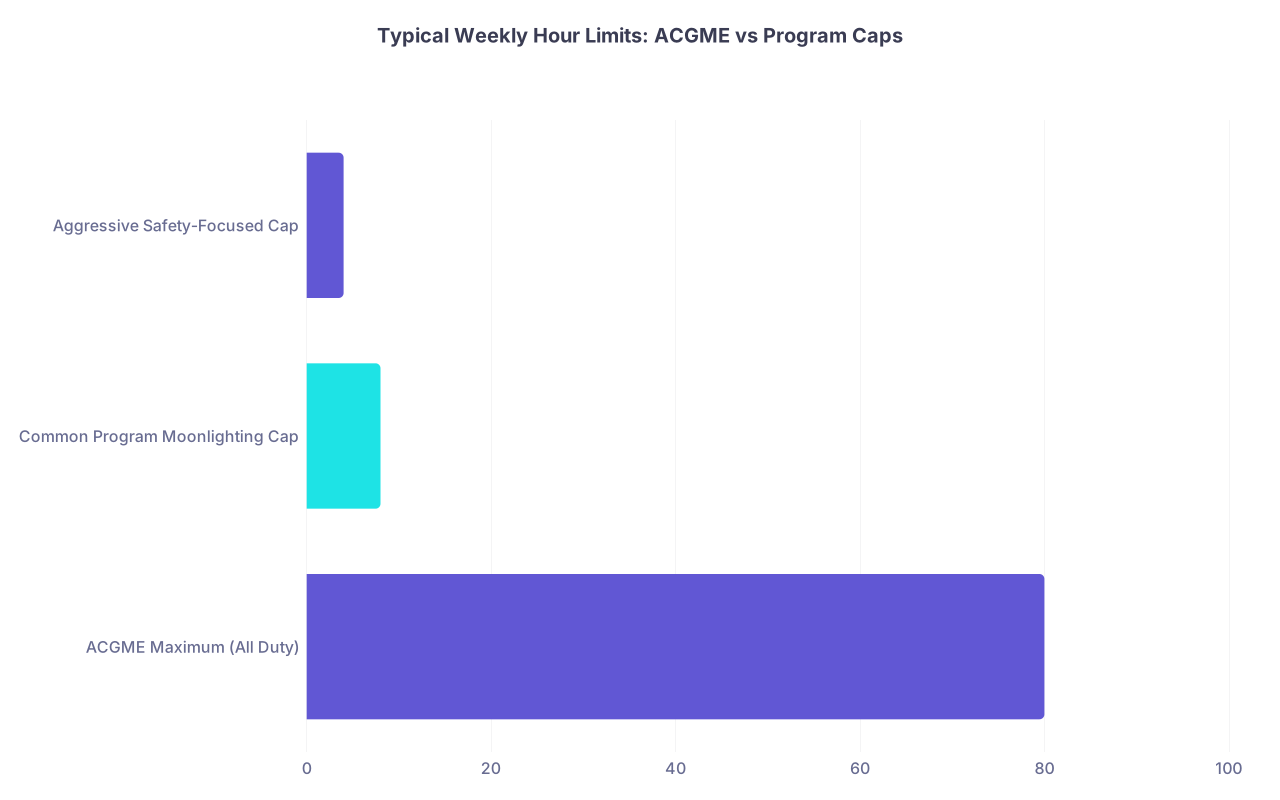
| Category | Value |
|---|---|
| ACGME Maximum (All Duty) | 80 |
| Common Program Moonlighting Cap | 8 |
| Aggressive Safety-Focused Cap | 4 |
Programs that are serious about safety usually land in the 4–8 moonlighting hours per week range, with an expectation that those hours will be skipped entirely during heavy core rotations.
Why “Self-Regulation” Fails: Residents vs Numbers
A lot of GME leadership still leans on a simple line: “Residents are professionals; they must self-regulate.” The data disagrees.
When you ask residents directly:
- Around 60–70% say they feel comfortable deciding for themselves whether they are rested enough to moonlight.
- But when you link survey answers to objective work hours, residents working >90 hours/week are less likely to rate themselves as “too fatigued” compared to more rested peers at 60–70 hours.
Fatigue impairs self-assessment. That is not speculation, it is well documented in the sleep medicine literature. People who are sleep deprived systematically underestimate their own level of impairment.
So in practice, “self-regulation” looks like this:
- Residents with higher educational debt and family obligations are more likely to moonlight.
- Within that group, those who are already working the longest hours are more likely to increase moonlighting when financial stress spikes.
- The group at highest risk of fatigue-related error is also the least likely to self-limit without a hard cap.
I have seen the real-world consequence: a PGY‑3 internal medicine resident doing 8–10 hours of external moonlighting after a run of heavy wards, nodding off while writing TPN orders at 3 a.m. on a “side job” night. On paper, all hours “counted.” In reality, nobody was tracking the combined total.
What ACGME Data Tells Us About Safety Outcomes
ACGME does not publish a “moonlighting incident” line item. But you can triangulate from several sources:
- Duty hour violation patterns – Programs with high self-reported moonlighting rates have more frequent exceeding of 80 hours when anonymous “actual time worked” surveys are done.
- CLER and site visits – Citations occasionally mention moonlighting explicitly, especially where external shifts were not being counted toward duty hours.
- Resident well-being metrics – Programs that explicitly encourage moonlighting without formal caps often show:
- Higher burnout scores
- Higher rates of residents reporting “excessive workload”
- More sleep-related driving incidents
Now, overlay one more dimension: shift structure.
Not all moonlighting hours carry the same risk per hour:
- 8 hours of outpatient psychiatry during a quiet Saturday is not equivalent to 8 hours of overnight cross-cover on a hospitalist service.
- EM and anesthesia moonlighting often front-load night and weekend work, which is disproportionately associated with fatigue-related mistakes.
The better-run programs recognize this and do not just cap hours; they cap circumstances: no overnight moonlighting after 24-hour calls, no back-to-back nights following ICU weeks, etc.
Designing Rational Moonlighting Caps: What the Numbers Support
If you ignore politics and look only at data on fatigue, cognitive performance, and error rates, a sensible structure for moonlighting caps emerges.
At minimum, a safety-focused cap system should include four elements:
Total weekly cap well below the 80-hour theoretical maximum
Based on sleep and performance data, the risk curve really starts bending upward between 60–70 hours of clinical work per week. If your program design demands 65–70 hours in heavy rotations, a “technically compliant” total of 80 hours including moonlighting is already in the danger zone.
A rational approach:
- Target ≤60–65 hours average total duty (core + moonlighting) over 4 weeks
- Set a hard moonlighting cap such that this total cannot be exceeded
Rotation-adjusted caps
The data shows that ICU, night float, ED blocks, and heavy ward months are where fatigue, errors, and burnout peak. Caps should not be uniform.
Concrete example of what I have seen work:
- ICU, night float, ED months: 0 hours of moonlighting
- Heavy wards and surgical rotations: max 1 shift (4–8 hours) per 2 weeks, or none at all
- Lighter ambulatory/elective blocks: max 8 hours/week, no overnight call the night before clinic
Shift-type limits
Not all moonlighting is created equal from a safety standpoint.
Reasonable constraints, grounded in fatigue data:
- No overnight moonlighting immediately after 24-hour call or in-hospital overnight shifts.
- No more than 1 overnight moonlighting shift per week, and at least 24 hours off duty following.
- Prioritize daytime / early evening shifts if moonlighting is permitted at all.
Real tracking and pre-approval
Here is where programs often fail. Duty-hour tracking is already imperfect for core work; external moonlighting gets almost no scrutiny unless an incident forces it.
Programs that minimize safety issues usually:
- Require formal approval for each moonlighting site and role.
- Have residents log moonlighting shifts in the same system used for duty hours.
- Periodically cross-check logs and schedules instead of relying purely on honor codes.
Once these are in place, the extreme outliers disappear. You move from “occasional residents peaking at 100+ hours/week” to “a narrow band clustered around 55–65 hours” with modest, controlled moonlighting above that.
Financial Reality: Why Residents Push the Limits
You cannot talk about caps honestly without talking about money.
Residents are not moonlighting for fun. They are patching holes created by:
- High educational debt (often $200,000–$400,000+).
- Cost of living in academic centers.
- Delayed earning power relative to peers in other professions.
Surveys show a stark gradient:
- Residents with >$300,000 of educational debt are roughly twice as likely to moonlight as those with <$100,000.
- Among those who moonlight, about 60–70% say loan pressure or basic living expenses are the primary driver, not “extra” luxury spending.
Moonlighting income can be substantial relative to resident salary. A resident making $65,000/year can add $15,000–$25,000+ with aggressive moonlighting. You do not need an econometrics model to guess what happens when a program tries to drop their “allowed” hours from 16/month to 4/month: resistance.
The critical mistake some programs make is trying to clamp down on hours without addressing financial pressure at all. Residents then underreport, shift to more poorly supervised external work, or look for a different program if they can.
The data-supported path is blunt:
- If you tighten moonlighting caps, you must compensate with some mix of:
- Modest salary increases
- Housing stipends
- Institutional “no-questions-asked” loans at low interest
- Direct payment for extra in-house coverage (which can be more easily regulated than freelance external moonlighting)
Without that, residents will find the hours anyway. Just less transparently.
Program-Level Strategies That Actually Work
Looking across institutions that have reduced moonlighting-related risk without igniting resident revolt, there is a pretty consistent pattern:
Transparent data sharing
Programs show residents their own aggregated duty-hour and moonlighting logs. They do not pretend everyone is under 60 hours when the 90th percentile is clearly over 80.
Tiered privileges
Moonlighting is treated like a privilege tied to performance and professionalism, not an untouchable right.
- Eligibility only after a certain PGY level and passing key exams.
- Continued permission contingent on staying under defined hour thresholds and not triggering safety concerns.
Integrated scheduling
A few programs actively coordinate internal moonlighting opportunities so they can:
- Keep all work inside the hospital or health system.
- Staff coverage gaps with residents at safer caps.
- Monitor total exposure and rest periods more directly.
Explicit, written caps — not vague policy language
The difference between “moonlighting should not interfere with education or violate duty hours” and “you may moonlight up to 8 hours per week only on elective rotations, with no overnight shifts” is the difference between wishful thinking and actual risk control.
When these elements are in place, program directors report fewer fatigue incidents, fewer citations on duty hours, and still reasonable access to supplemental income for residents.
The Future: Where Moonlighting Caps Are Likely Heading
The trajectory is not hard to read.
Pressures that will push toward tighter, more explicit caps:
- More attention to resident well-being and burnout metrics in accreditation.
- Increasing institutional liability concerns — especially after any serious incident where fatigued moonlighting is involved.
- Growth of hospital-employed “PRN” coverage pools that can substitute for resident moonlighting in some settings.
Pressures that will push against heavy-handed restrictions:
- Rising educational debt loads.
- Continued stagnation of resident salaries relative to cost of living in major academic centers.
- Strong resident preference for having some control over income via extra shifts.
My projection, based on current patterns:
- Total bans will remain uncommon outside of the most demanding surgical and neurosurgical programs.
- Pure “self-regulated” models will shrink, as they are eventually exposed by site visits, CLER reviews, or a sentinel event.
- The center of gravity will move toward:
- 4–8 hour/week caps
- Rotation- and shift-type specific rules
- Increased internal moonlighting (hospital-employed) and decreased external freelance work
In other words: moonlighting probably does not disappear. But the days of “do as much as you want, just don’t put it in MedHub” are numbered.
With the data we already have, you do not need to guess whether moonlighting hour caps are a safety issue. The numbers say they are. The open question is how your program — or your own career decisions — will respond.
You now have a clearer picture of the risk curves, the policy patterns, and the financial drivers underneath. The next step is more personal: deciding what “safe enough” looks like for you, and how to structure your training and income around that. The downstream consequences of those choices, for your career and for your patients, come later. But that is a story for another day.