
The fastest way to lose your moonlighting privileges—and possibly your job—is to pretend the 80‑hour rule is “flexible.”
You’re not the first resident to think, “It’s just one extra shift; nobody will notice.” I’ve watched that thought cost people fellowships, visas, and in one ugly case, their medical license investigation file now has “duty hours falsification” stamped in it. All for an extra $900.
Let’s walk through the landmines before you step on them.
The Biggest Myth: “If It’s Off‑Site, It Doesn’t Count”
This is the lie that gets smart people in real trouble.
Moonlighting hours absolutely count toward your 80‑hour ACGME limit if you’re in an ACGME‑accredited program. It doesn’t matter:
- If it’s “independent” work
- If it’s off‑site
- If your program “doesn’t ask”
- If the hospital credentialing office says it’s separate
If you’re still in training and you’re doing patient care for money, those hours belong in your total duty hours. Period.
The two classic errors:
Treating external moonlighting as invisible
You do 70–75 hours a week in residency. Add 12 hours of ER moonlighting on Saturday night. You tell yourself, “It’s technically not part of residency.” Then:- Your program gets reviewed
- GME pulls call schedules + payroll from the outside hospital
- The math is obvious, and your self‑reported 70 hours suddenly looks like a lie
They don’t care that “everyone does it.” They care that you documented false duty hours.
Splitting hairs on definitions
I’ve heard this sentence too many times:
“But it’s not moonlighting; I’m just doing some extra shifts as a hospitalist with my attending’s blessing.”
If you’re:- Providing clinical care
- Getting paid
- Still a trainee
It walks, quacks, and bills like moonlighting. It counts.
Don’t make this mistake:
If you are ACGME‑accredited and moonlighting, assume every hour counts until your program director, in writing, tells you otherwise—and even then, be suspicious.
Scheduling Mistakes That Blow Up Your 80‑Hour Compliance
You don’t get in trouble because of one shift. You get in trouble because of patterns. These are the ones I see residents stumble into repeatedly.
1. Ignoring the Rolling 4‑Week Average
The 80‑hour limit isn’t per week in isolation. It’s averaged over 4 weeks.
So the trap looks like this:
- Week 1: 84 hours
- Week 2: 82 hours
- Week 3: 78 hours
- Week 4: 76 hours
You tell yourself, “It evens out.” It doesn’t. The average is 80 exactly. One more stray call, a late sign‑out, or a moonlighting shift that runs over, and you’re over.
Here’s where it bites you:
Night float + moonlighting – you’re already clocking 75–78 hours. One “quick” 6‑hour urgent care shift tips your 4‑week block over the 80.
ICU rotation – that 6 day/week schedule with long call days is not compatible with regular moonlighting. People try anyway, then watch their 4‑week average land at 82–85 hours.
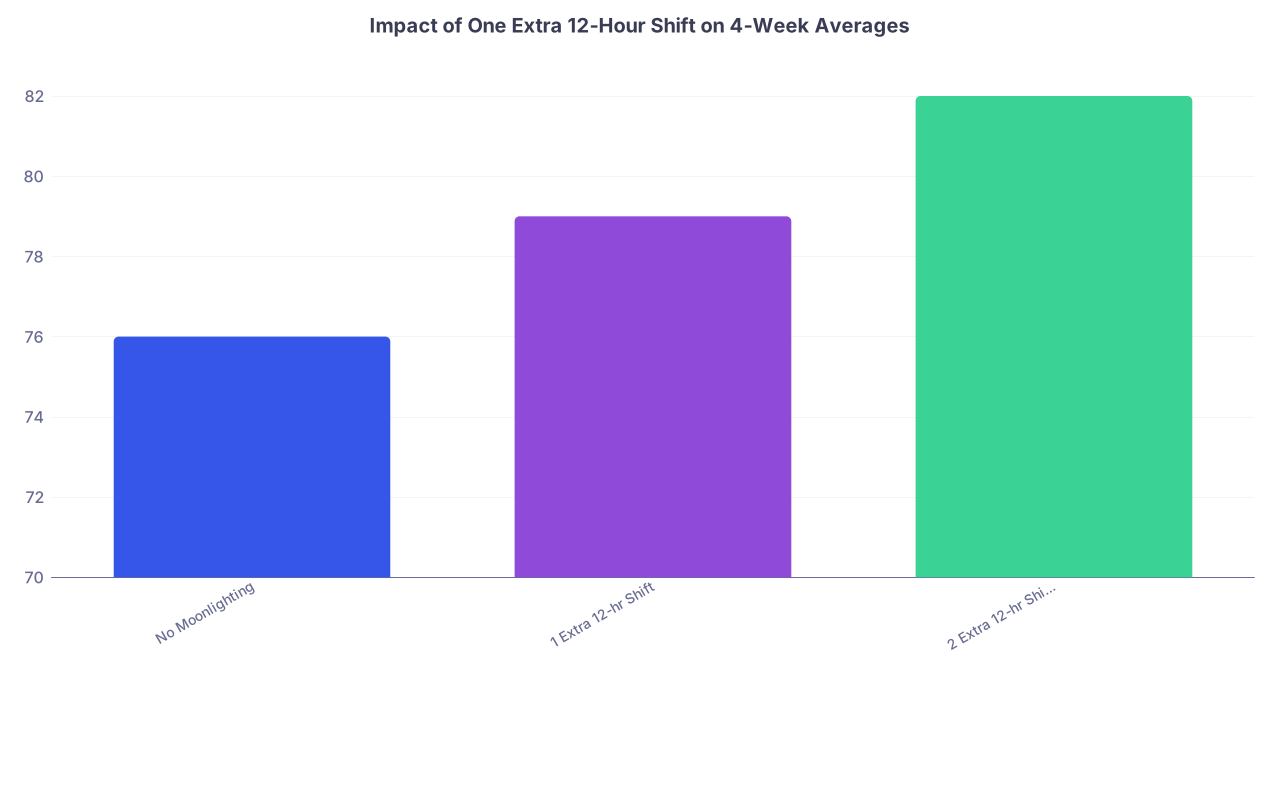
| Category | Value |
|---|---|
| No Moonlighting | 76 |
| 1 Extra 12-hr Shift | 79 |
| 2 Extra 12-hr Shifts | 82 |
Avoid this:
Don’t look at this Friday and next Friday. Look at the whole block. If you’re already sitting at 78 hours/week that month, moonlighting is a bad idea. You’re threading a needle with an ACGME auditor waiting on the other side.
2. Back‑to‑Back Call → Moonlighting → Day Shift
This is the schedule from hell, and people still say yes to it because the money looks too good.
Example I’ve literally seen:
- Friday: 24‑hour call (finish at ~10–11 am Saturday after notes and signout)
- Saturday: Moonlighting 7 pm–7 am
- Sunday: Scheduled regular day shift 7 am–5 pm
On paper, you might try to argue compliance. In reality:
- You blew straight through the 10‑hour rest requirement between duty periods
- You’re dangerously fatigued
- If anything bad happens during that Sunday shift, your schedule will look indefensible
And if you get cute and only log part of this in duty hours, you just added “falsification” to “fatigue.”
Avoid this:
- Never schedule moonlighting immediately after a 24‑hour call.
- Never schedule a regular clinical day immediately after a full overnight moonlighting shift.
- Protect a real off period between heavy duty blocks. No heroic gymnastics with your circadian rhythm.
3. “I’ll Just Lie on My Duty Hours”
Some of you are already thinking this. “Our PD doesn’t care; they told us to just put 70 for everyone.” I’ve heard versions of that conversation. You know who doesn’t care about that handshake agreement? The ACGME. The hospital’s risk management office. The plaintiff’s attorney.
Here’s how this goes bad:
- You’re involved in a bad outcome
- Opposing counsel subpoenas scheduling records, badge swipes, payroll, and your EMR log‑ins
- They line those up against your self‑reported “70 hours a week” and your moonlighting checks
- Now they get to say “resident was overworked and also lied about hours”
You’ve just helped them build their case.

| Step | Description |
|---|---|
| Step 1 | Over-schedule hours |
| Step 2 | Under-report duty hours |
| Step 3 | Bad patient outcome occurs |
| Step 4 | Legal review of records |
| Step 5 | Hours vs logs mismatch |
| Step 6 | Question of resident honesty |
| Step 7 | ACGME and hospital scrutiny |
Avoid this:
If your only way to make the schedule “legal” is to lie in New Innovations or MedHub, the schedule is illegal. Fix the schedule, not the reporting.
Dangerous Assumptions About “Program Approval”
There are two bad extremes here:
- “If I don’t tell them, they can’t say no.”
- “If they vaguely know I moonlight, everything must be fine.”
Both are wrong.
The Shadow Moonlighter
These are the residents who:
- Get independent privileges at a community ED
- Start picking up 1–2 shifts a week
- Never tell their program formally
- Don’t document those hours anywhere
Then, months later, someone in credentialing connects the dots: “Isn’t this person a PGY‑3 at our affiliate?” Cue:
- Email to program director
- Frantic retroactive “explanations”
- Sudden ban on all moonlighting
- Sometimes: formal reprimand for dishonesty
The Rubber‑Stamp Fantasy
On the other side, some residents think:
- “PD signed one form in PGY‑2, so they’re cool with any amount I do.”
- “The GME office has my malpractice certificate, so they know.”
No. Approval is usually:
- Specific to site
- Specific to type of work
- Often implicitly limited by “must comply with duty hour rules”
| Bad Assumption | What Actually Happens |
|---|---|
| PD signed once = unlimited shifts | They expect you to follow 80‑hr rules |
| Off‑site = doesn’t count as duty hours | ACGME counts all clinical paid work |
| “Everyone does it” = it’s protected | One complaint and the practice ends |
| No one asked = I don’t need to disclose | Credentialing eventually exposes it |
Avoid this:
- Get explicit written approval for each moonlighting site.
- Re‑check expectations anytime your rotation schedule changes significantly.
- Assume you’re responsible for staying under 80 hours; “but my PD said it was fine” won’t save you.
Logistical Errors That Will Wreck You
Most residents don’t get burned by dramatic wrong choices. It’s the boring logistics.
1. Not Tracking Actual Hours in Real Time
If your system is “I kind of know I’m around 70–75 hours,” you’re already on thin ice.
Two specific mistakes:
- Forgetting charting time – That “5 pm end time” shift really ends at 6:30 when you finish notes and orders. Those extra 1–2 hours, every shift, add up fast in a 4‑week block.
- Not counting commute when it should count – If you’re required to be on‑site at 6:30 for a 7:00 shift, but you log 7:00, you’re under‑reporting.
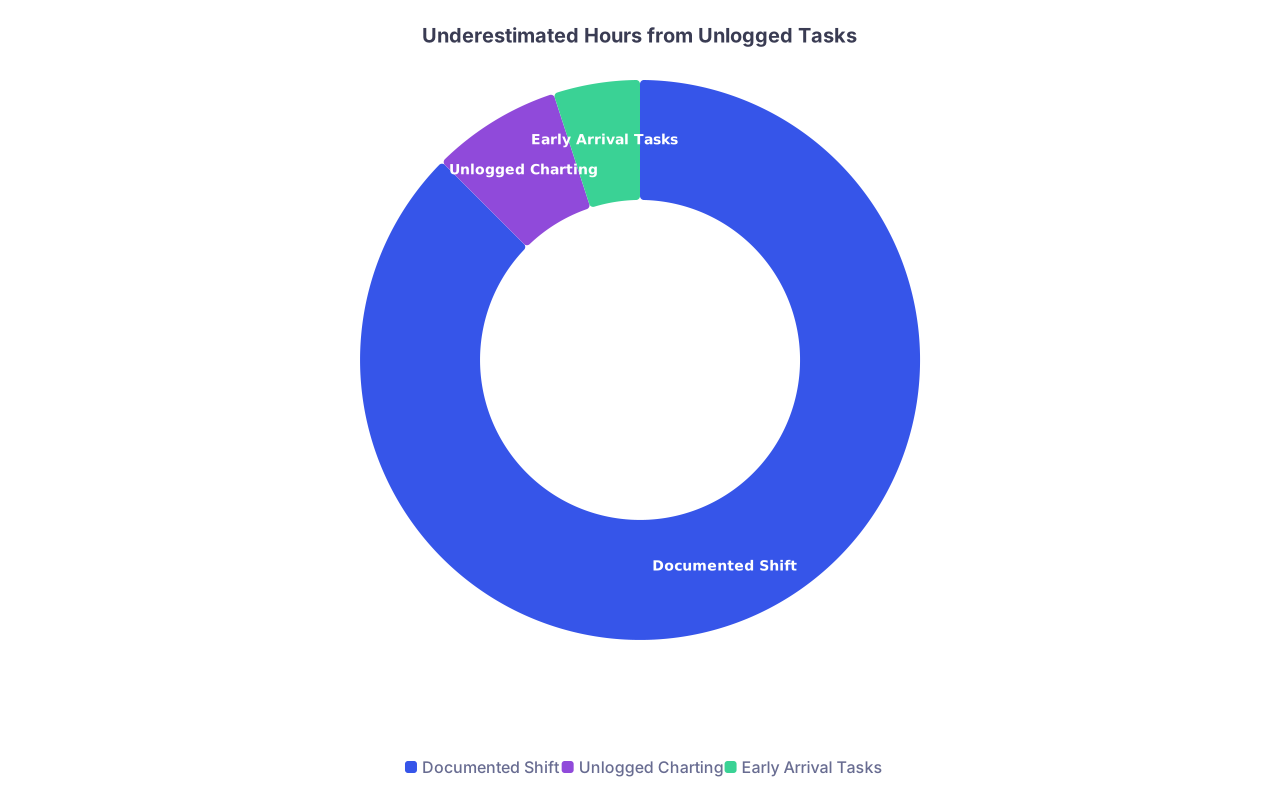
| Category | Value |
|---|---|
| Documented Shift | 70 |
| Unlogged Charting | 6 |
| Early Arrival Tasks | 4 |
You think you’re at 70. You’re actually at 80. One moonlighting shift tips you to 92.
Avoid this:
Use something simple but brutally honest:
- A shared spreadsheet
- A time tracking app on your phone
- Even a running note with start/stop times
And update it daily, not “when I remember.”
2. Forgetting the One‑Day‑Off Rule
You must average one day off in seven, free of all clinical responsibilities, over a 4‑week block. Moonlighting does not magically exempt that.
People screw this up like this:
- Work 6 residency days/week
- Moonlight on “days off”
- Say, “But that’s my choice, not required.”
The rule doesn’t care that it was optional. No patient care. No moonlighting. A true day off means no pager, no PRN shifts, no “quick telehealth.”
Avoid this:
Look at your month and mark:
- Guaranteed residency days off
- Moonlighting days
Make sure there are real, untouched days with zero clinical work. If not, you’re setting yourself up for a violation and burnout.
Legal and License Traps People Don’t Think About
Everybody focuses on the 80‑hour number and forgets the downstream problems. They’re not theoretical.
1. Malpractice Coverage Assumptions
Common bad assumption: “If the hospital granted me privileges, I’m covered.”
Not necessarily.
Common problems:
- The hospital requires you to carry your own malpractice and you did not read the fine print.
- Your program’s malpractice policy excludes independent moonlighting.
- Your moonlighting site is in a different state with different coverage standards and tail requirements.
Then a bad outcome hits. The insurer starts asking:
- Were you over duty hour limits?
- Were you in compliance with your training program’s policy?
If the answer is “no” to either, you’ve just given them ammunition to deny coverage or settle in a way that doesn’t protect you.
2. State Medical Board Questions
Plenty of license applications now ask direct questions along the lines of:
- “Have you ever violated work‑hour regulations?”
- “Have you ever been disciplined or counseled for duty hour non‑compliance?”
If your moonlighting led to:
- A formal letter
- A “professionalism” remediation
- Suspension of moonlighting privileges
That’s potentially reportable. You might end up explaining your 26‑year‑old self’s greed to a licensing board at 40.
Avoid this:
Don’t assume “nobody will ever see this.” Anything in your training file can follow you for years.
Red Flags Your Moonlighting Schedule Is Unsafe (Even If It’s Technically Legal)
Let’s assume you somehow stay under 80 hours. You can still create a schedule that’s clinically dangerous and personally unsustainable.
Here are red flags I’ve seen in people headed toward burnout or safety incidents:
- You’re consistently working 75–79 hours/week with no real valleys
- You have more than 2 overnights/week (residency + moonlighting combined)
- You’re charting at home almost every day to “keep up”
- You find yourself hiding shifts from co‑residents because you know it looks bad
- You’re using moonlighting money primarily to cover fixed expenses (meaning you feel trapped and can’t cut back)

A schedule can be “legal” and still stupid. You don’t get bonus points in life for scraping as close to 80 as possible.
Avoid this:
If your base residency schedule is already >65–70 hours on average, treat moonlighting as a rare exception, not a standing part‑time job.
Smarter Ways to Schedule Moonlighting (Without Cheating the 80 Hours)
Let’s talk strategy. How to avoid predictable errors instead of fixing disasters later.
1. Build a Hard Personal Cap Below 80
If you aim for 79, you’ll hit 85. That’s how fatigue and mission creep work.
Set a personal weekly cap in your head:
- Most resilient residents: 70–72 hours
- If you have major life responsibilities (kids, elder care): 60–65 hours
- Above 75 as a routine? I’ve seen that end badly more often than not
Then back‑solve your moonlighting like this:
- Check your typical rotation hours for the month
- Subtract from your personal cap
- Whatever’s left is the maximum moonlighting time you even consider
Not the minimum you want for extra cash. The maximum ceiling.
2. Use “Light” Rotations Wisely—and Honestly
Some rotations are legitimately lighter: certain electives, outpatient blocks, consult months. Those are the only places where moonlighting makes any rational sense.
Where people screw this up:
- Treating vacation weeks as free‑for‑all moonlighting periods
- Packing every single light day with extra shifts, eliminating all rest
- Underestimating how “light” a rotation actually is once you add commute, notes, and random tasks

| Step | Description |
|---|---|
| Step 1 | Check rotation schedule |
| Step 2 | Skip moonlighting this block |
| Step 3 | Estimate true hours inc. charting |
| Step 4 | Plan 1-2 short shifts max |
| Step 5 | Recalculate 4 week average |
| Step 6 | Request formal approval |
| Step 7 | Avg > 65 hrs? |
| Step 8 | Still < 60 hrs? |
| Step 9 | Under 80 and 1 day off? |
3. Protect Actual Sleep Windows
You can’t safely cram shifts into every possible gap.
Basic rules that people break:
- Don’t do back‑to‑back overnights that cross institutions (residency → moonlighting or vice versa).
- Don’t shrink a 10–12 hour potential sleep window down to 4–5 because you’re “just finishing notes” or “grabbing dinner with friends first.”
- Respect how long it actually takes you to come down after a shift before you sleep.
If your “day off” includes:
- Finishing notes
- Answering work emails
- “Just a quick 6‑hour moonlighting shift”
…it’s not a day off.
The Quiet Cost: When Moonlighting Becomes a Financial Trap
One more subtle error: turning moonlighting from an optional tool into a mandatory crutch.
Patterns I’ve seen:
- PGY‑2 starts moonlighting, loves the income
- Increases fixed expenses: nicer apartment, car payment, childcare choices that assume extra cash
- PGY‑3 ICU block hits—no safe capacity to moonlight
- Suddenly, baseline salary doesn’t cover lifestyle
Now you’re cornered. And cornered people make bad scheduling decisions: picking up shifts on Q4 call, lying on duty hours, working through illness.

Avoid this:
Treat moonlighting income as:
- Temporary
- Variable
- Not something you build fixed monthly obligations around
Use it for:
- High‑interest debt
- One‑time expenses
- Short‑term savings goals
Not for rent you can’t afford without it.
When to Say No (Even If It Hurts Your Wallet)
You’re not weak for turning down a shift. You’re smart.
You should automatically say no to moonlighting when:
- You’re on ICU, night float, or a brutal inpatient month with >70 hr baseline
- You’ve had any recent near‑miss where fatigue played a role
- You’re behind on notes or academic requirements and thinking “I’ll just catch up late at night”
- You’re sick, emotionally drained, or already on the edge of burnout
The common mistake is pretending you’re a robot. You’re not. You’re a human with one nervous system and one malpractice history.
Your Move: Audit Your Next 4 Weeks Right Now
Do this today, not “when things calm down” (they won’t):
- Open your calendar and duty hour system.
- Map out the next 4 weeks:
- Scheduled residency shifts
- Call nights
- Existing or potential moonlighting
- Add realistic start/stop times, including charting and sign‑out.
- Calculate:
- Total hours per week
- 4‑week average
- How many true days off you have
If you’re already above 70–72 hours before moonlighting, your answer is simple: stop trying to squeeze in income you don’t have the bandwidth to earn safely.
If you’re not, then fine—add one moonlighting shift, recalc the numbers honestly, and see if it still makes sense.
Don’t wait for your program, the ACGME, or a lawyer to tell you your schedule was a mistake. Fix it now, while it’s still just math and not a formal complaint.