
The way most programs handle moonlighting restrictions is sloppy, knee‑jerk, and often wrong.
If your program just slammed the brakes on moonlighting, you are not helpless and you are not crazy for being angry. You are dealing with a mix of real constraints (ACGME rules, malpractice risk, finances) and avoidable nonsense (poor communication, overreach, inconsistent enforcement). You need a plan, not a rant.
Here is that plan.
1. First 48 Hours: Get Oriented Before You React
Your worst move is to fire off an emotional email or start a group‑chat rebellion before you actually know what changed.
Step 1: Pin down exactly what the new restriction is
Do not rely on hallway gossip. Get the written version.
Ask for, or pull from:
- Official email from PD / GME
- Updated program moonlighting policy
- GME handbook or institutional policy addendum
- Any attachments that reference ACGME, risk management, or legal
Then answer these questions on paper:
- Is this:
- A total ban on all moonlighting?
- A ban only on external moonlighting?
- A ban only for certain PGY levels?
- A temporary freeze (e.g., “until duty hour monitoring improves”)?
- Does it apply:
- Only to your program?
- To all programs at your institution?
- To specific sites (e.g., off‑site community hospital shifts)?
- What reason is stated in writing?
- Duty hour violations
- ACGME citation / site visit
- Malpractice or credentialing concerns
- “Patient safety”
- “Educational priorities”
You cannot fix what you have not clearly defined.
Step 2: Clarify the financial hit
You need numbers, not vibes.
- List your recent moonlighting shifts:
- Average hours per month
- Average pay rate
- Calculate:
- Monthly income lost
- Annual income lost
- Identify:
- Any specific financial commitments you took on because of moonlighting (childcare, mortgage, loan repayment plans, supporting family members)
You do this for one reason: it becomes the basis for serious, non‑emotional conversations with leadership and, if needed, with an attorney.
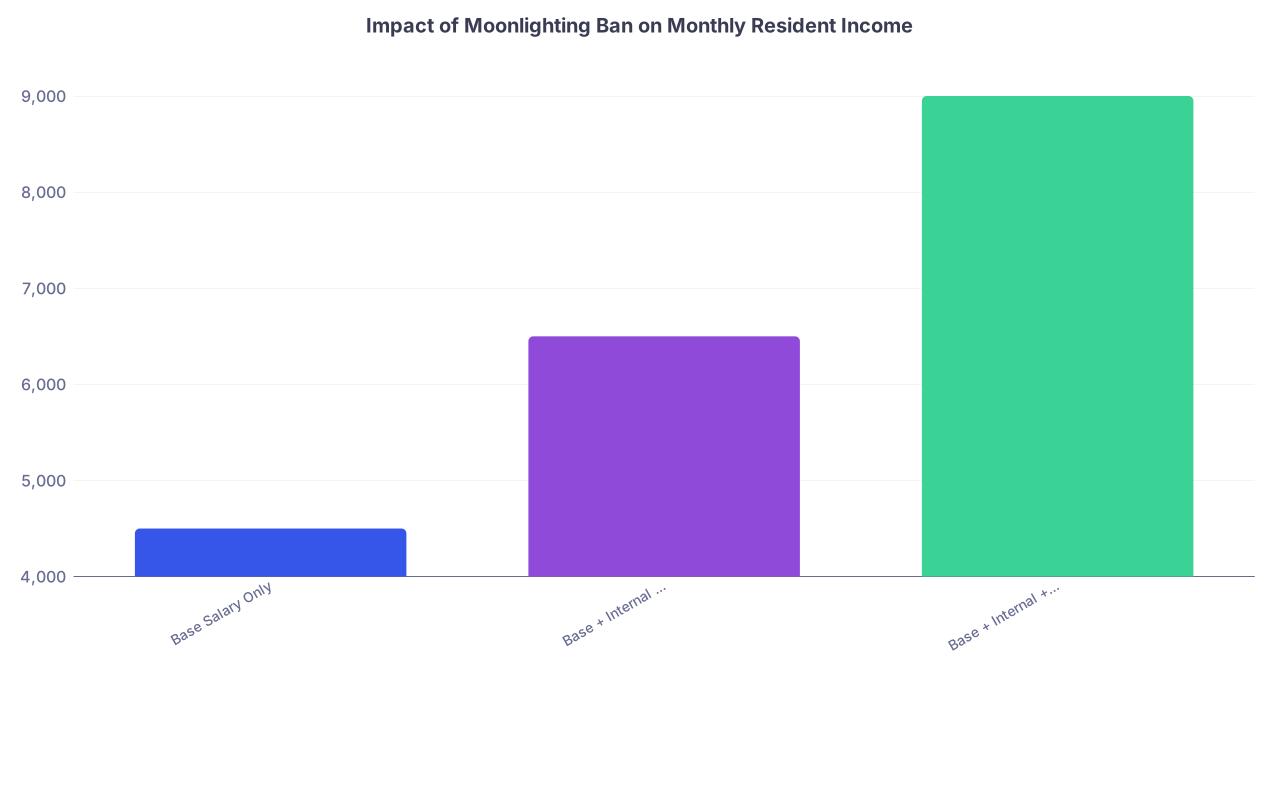
| Category | Value |
|---|---|
| Base Salary Only | 4500 |
| Base + Internal Moonlighting | 6500 |
| Base + Internal + External | 9000 |
Step 3: Document what you had before the change
Programs develop selective amnesia about what “was never officially allowed.”
Write down:
- Old policy language (screenshot or PDF)
- Any prior approvals:
- Emails from PD/APD explicitly approving moonlighting
- Credentialing forms you filled out for moonlighting
- Schedule history showing moonlighting shifts recognized by the department
- How long the prior practice existed (years, not vague “a while”)
This matters if you ever need to argue:
- Reliance interest (“I made financial decisions based on long‑standing approved practice”)
- Inconsistent enforcement
- Retaliation (if restrictions target only certain residents)
2. Understand the Real Constraints (So You Argue the Right Fight)
Some restrictions are fixable. Some are not. You need to know which is which.
The non‑negotiables
You will not win these battles, and you look naive if you try:
- ACGME duty hours.
- All moonlighting (internal and external) counts toward the 80‑hour weekly limit and day‑off rules.
- If your program was sloppy with duty hour reporting and got called out, they will clamp down. Hard.
- Institutional malpractice coverage.
- Most hospitals will not allow their residents to moonlight outside their malpractice umbrella.
- If risk management said no, your PD’s hands may be partially tied.
- Credentialing and privileges.
- Some institutions simply will not credential residents independently for certain roles (e.g., solo hospitalist at an outside hospital). That is not a hill you can take.
Fighting these is like arguing with gravity. Wrong target.
The “soft” justifications that are actually negotiable
These are phrases I have heard in closed‑door meetings that are used as blunt tools:
- “Educational mission”
- “Burnout risk”
- “Protecting you from yourself”
- “Perception that residents are prioritizing outside work”
Those are not laws. Those are opinions and risk tolerance. Which means they can be:
- Negotiated
- Refined
- Made more consistent
- Applied more narrowly
Your strategy: accept the legal/regulatory constraints as given, and challenge the vague, over‑broad justifications where the program has discretion.
3. Map Your Power Channels: Who Can Actually Change This?
You are not going to fix a system‑level change with a single complaint. You need a structured, multi‑front approach.

| Step | Description |
|---|---|
| Step 1 | New Moonlighting Restriction |
| Step 2 | Clarify Policy Details |
| Step 3 | Meet PD/APD |
| Step 4 | Escalate to GME |
| Step 5 | Propose Narrow Solutions |
| Step 6 | Involve Resident Council |
| Step 7 | Consult Legal/Union if Available |
| Step 8 | Implement New Agreement |
| Step 9 | Program Level Issue? |
| Step 10 | No Improvement |
The usual players and what they actually control
| Stakeholder | What They Can Change |
|---|---|
| Program Director | Program-specific rules, approvals |
| GME Office | Institution-wide resident policies |
| Risk Management | Coverage, malpractice requirements |
| Department Chair | Internal opportunities, culture |
| Resident Council | Collective advocacy, data gathering |
| Union (if any) | Contractual rights, grievances |
You should identify:
- Who signed or announced the restriction?
- Was it:
- “Per GME directive…”
- “Per department policy change…”
- “Following a discussion with risk management…”?
That tells you where the decision truly lives:
- Department (more negotiable)
- GME/institution (harder, but not impossible)
- Insurer / legal (usually rigid but can sometimes be worked around with structured internal options)
4. Strategic Response: How to Engage Without Getting Crushed
You need to approach this like you would a complex patient: organized, calm, sequential.
Step 1: Small resident working group
Do not go solo unless you are the only one affected.
Gather 3–6 residents who:
- Regularly moonlighted
- Are directly impacted financially
- Are relatively stable performers (no major professionalism or patient care issues on file)
Tasks for this group:
- Compile data:
- How many residents moonlighted?
- Average hours/month?
- Settings (internal ED, outside urgent care, etc.)?
- Categorize issues:
- Financial hardship
- Visa concerns (if any issues related to J‑1/H‑1B and income reporting)
- Educational impact (e.g., losing procedure opportunities you only saw while moonlighting in ICU/ED)
Keep the group tight. Not a mob, not a venting circle.
Step 2: Targeted, professional meeting with your PD
You are not there to scream. You are there to gather more information and propose concrete solutions.
How to structure that meeting:
Open with clarity, not accusation.
“We want to fully understand the rationale for the new restrictions and see if there are safe, compliant ways to preserve some moonlighting options.”Ask specific questions:
- “Was this driven by a specific incident or citation?”
- “Is this a department decision or GME‑wide?”
- “Is any moonlighting still allowed under certain conditions?”
- “Are there KPI triggers (duty hour violations, etc.) that would allow reconsideration later?”
Present data, not emotions.
- “X residents have been working Y shifts per month, all within reported duty limits.”
- “Average income from moonlighting is $Z/month; several residents have already entered childcare or loan obligations based on that.”
Offer solutions, not just objections.
Examples:- Require monthly duty hour log audits for residents who moonlight.
- Limit moonlighting to:
- PGY‑2 and above
- Residents not on remediation or probation
- Residents who meet defined milestones
- Create an “approved moonlighting site” list under institutional malpractice.
If your PD is reasonable and this was mostly a department‑level panic move, you can sometimes get a refined policy in place within 1–2 months.
Step 3: Escalate smartly if needed
If you get:
- “This came from GME. Our hands are tied.”
- “This is not negotiable. End of discussion.”
Then you escalate. Not with rage. With structure.
Your next steps:
- Request a meeting with:
- Designated Institutional Official (DIO) or equivalent
- GME office representative
- Coordinate:
- Involve a representative from your resident council / Housestaff Association if one exists.
- Prepare a one‑page brief:
- Background: what changed, when, and how
- Impact: financial, educational, morale
- Proposed solutions: 2–3 concrete models (see section below)
5. Concrete Models You Can Propose (Instead of a Free‑For‑All)
Programs and GME respond better to structured proposals than to vague “let us moonlight again” demands. Here are models that I have seen actually adopted.
Model A: Tiered Moonlighting Eligibility
Only residents who meet clear criteria can moonlight.
Possible criteria:
- PGY‑2 or higher
- No active remediation / probation
- No recent unapproved duty hour violations
- PD sign‑off renewed every 6–12 months
You can propose something like:
- Max 16 hours of moonlighting per week
- No moonlighting:
- Post‑call
- Night before a scheduled inpatient long call
- During ICU or heavy inpatient months
Model B: Institution‑Approved Internal Moonlighting Only
If external malpractice and credentialing are the stated obstacles, target them.
Proposal:
- Restrict moonlighting to:
- Internal ED
- Hospitalist night float relief
- Rapid response coverage
- All under the same hospital’s malpractice coverage
- Pre‑defined hourly or per‑shift rate
You can argue:
- Better patient safety oversight (known systems, known EMR)
- Easier monitoring of duty hours
- Financial win‑win: hospital fills shifts, residents earn extra income
Model C: Performance‑Contingent Moonlighting
Tie moonlighting privileges to objective markers.
For example:
- No major professionalism issues
- No failing milestone evaluations
- No repeated late notes / chronic documentation problems
- No pattern of late arrivals post‑moonlighting
This gives the program a lever: if someone abuses moonlighting, they lose the privilege individually instead of nuking it for everyone.
6. Protect Yourself Legally and Financially
You are not just fighting for shifts. You are managing risk—yours, not just theirs.
Legal reality check
Most residency contracts and GME policies:
- Allow the institution to restrict outside employment
- Require disclosure and approval of moonlighting
- Give GME broad discretion in interpreting “educational mission” and “duty hours”
Translation: you probably do not have an absolute right to moonlight.
Where you may have leverage:
- If you are in a unionized environment:
- The CBA (collective bargaining agreement) may have language about outside employment or practice rights.
- You may have a grievance path if they unilaterally change a long‑standing practice without bargaining.
- If the change is selectively enforced:
- Only against certain residents (e.g., foreign grads, women with childcare responsibilities, specific critics of the program)
- Then you have a potential discrimination / retaliation angle.
- If you made big financial commitments based on explicit, documented promises:
- Still not a guaranteed case, but strengthens your position in negotiations.
Do not threaten lawsuits casually. But do quietly:
- Save all emails and policies
- Document conversations (summary emails to yourself right after meetings)
- If it gets ugly, do a one‑time paid consult with an employment attorney familiar with physicians in training.
Personal finance triage
You cannot rely on “we will probably fix this soon.”
Assume the restriction may last 12–24 months. Then:
- Recalculate your realistic annual take‑home on base salary alone.
- Identify:
- Fixed obligations you cannot change (minimum student loan payments, rent under lease, etc.)
- Variable obligations you can adjust (type of housing, car, childcare arrangements, discretionary spending)
- Take immediate defensive actions:
- Pause aggressive loan repayment strategies that assumed moonlighting income.
- If you have a forbearance/IDR option, consider it temporarily.
- Cut recurring luxuries ruthlessly for 3–6 months.
Is this fair? No. But waiting to “see what happens” while your bank account bleeds is worse.
7. Alternative Paths to Replace or Offset Lost Income
Moonlighting is not the only way to survive. Not as lucrative, but there are tactical options.
Internal paid roles
Ask your PD or department admin if any of these exist or could be created:
- Paid teaching shifts (simulation lab, OSCE examiner)
- Paid “admin resident” roles (schedule management, QI project lead, EHR optimization)
- Paid extra call coverage (some departments pay for voluntary extra calls during shortages)
These are often under‑the‑radar and negotiated ad hoc.
Side work that does not count as clinical moonlighting
You must stay clear of anything that violates your contract’s outside work language or visa restrictions (if applicable). But usually safer zones include:
- MCAT/USMLE tutoring (for major companies or independent with clear 1099)
- Question‑bank content writing or editing
- Medical editing or writing for journals or education platforms
- Data analysis or research consulting if you have those skills
You need to:
- Disclose outside work if required by your contract
- Keep it completely outside clinical duty hours and responsibilities
- Avoid clinical decision‑making or practicing medicine for pay without explicit institutional approval
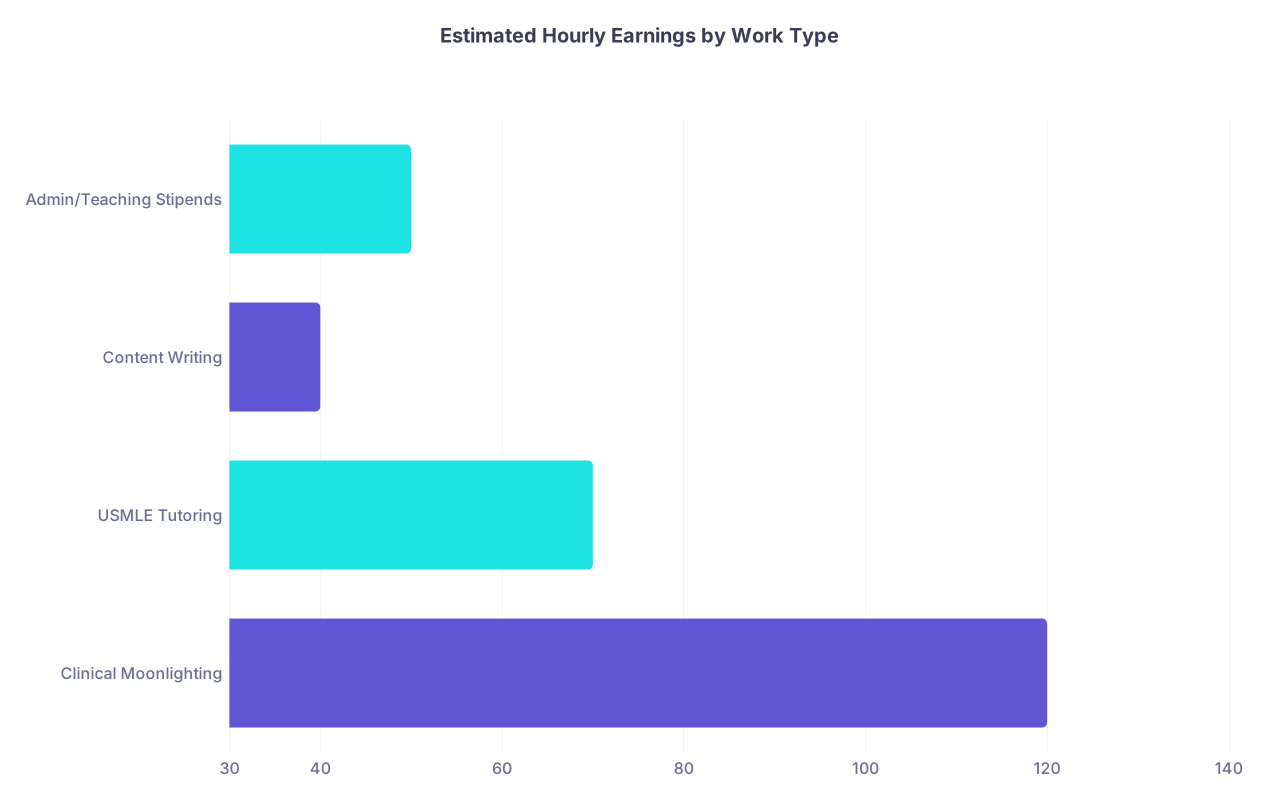
| Category | Value |
|---|---|
| Clinical Moonlighting | 120 |
| USMLE Tutoring | 70 |
| Content Writing | 40 |
| Admin/Teaching Stipends | 50 |
8. Use Data and Time to Your Advantage
Programs overreact after a scare: a citation, a near‑miss, a rumor that “residents are working 120 hours a week.” Then they settle down once the panic fades.
You need to set up the conditions for a revisit in 6–12 months.
Build a monitoring and feedback loop
Propose, in writing:
- Quarterly review of:
- Duty hour violations (actual, documented, not imagined)
- Resident fatigue‑related incidents (if any)
- Turnover / attrition / program morale indicators
- Anonymous survey questions:
- Financial stress since moonlighting restriction
- Impact on burnout
- Interest in structured, safe moonlighting options
This does two things:
- Forces leadership to look at real data, not just anecdotes.
- Creates a time‑point to reopen the conversation when things stabilize.
Align with program incentives
Some departments need residents for service coverage and recruitment:
- Rural programs trying to attract applicants
- Underserved urban hospitals with chronic staffing issues
- Smaller specialties where residents are integral to service lines
You can frame structured moonlighting as:
- A recruitment advantage:
- “Our residents have safe, institution‑approved moonlighting options.”
- A retention tool:
- Less financial desperation, less burnout, fewer transfers or early exits.
If you can show that applications dropped or dissatisfaction rose sharply after the restriction, that is leverage.
9. When You Hit a Hard Wall: Decide How Much This Program Is Worth
Sometimes, the answer is: this is not changing. Not soon. Maybe not ever.
At that point, your question shifts from “How do I fix this?” to “Is this cost acceptable for me?”
You should quietly consider:
- Transfer:
- Hard, but not impossible, especially PGY‑1 to PGY‑2 if you are in IM, FM, psych, peds.
- Moonlighting alone should not be your only reason to transfer, but if it is part of a broader pattern of rigidity and disrespect, pay attention.
- Specialty and fellowship plans:
- If your specialty or planned fellowship leans heavily on your ability to earn more as a resident (e.g., longer training, lower starting salaries), that matters.
- Geographic shift post‑training:
- You may choose to tolerate restricted income now but plan very intentionally for aggressive income recovery after graduation: locums, high‑pay first job, rural stipend programs.
No program is perfect. But a program that unilaterally guts your income, ignores your reality, and dismisses your concerns without transparency is showing you its culture. Believe it.
10. How to Communicate Without Burning Bridges
Last piece: your tone. The way you argue this will follow you.
Do:
- Keep everything in writing professional and fact‑based.
- Use “we” and “our program” more than “you” and “your decision.”
- Send follow‑up emails after meetings summarizing:
- What was discussed
- Any promises of future review
- Any data you offered to gather
Do not:
- Vent in writing on institutional email or Slack channels.
- Make threats (“I will sue,” “I will report you to ACGME”) unless you are actually ready to do so with legal support.
- Turn this into a personal war with the PD. PDs change. Your reputation lives longer.
Key Takeaways
- Treat a sudden moonlighting restriction like a system problem, not a personal attack: define the policy change, understand the real constraints, and target the negotiable pieces.
- Organize: small resident group, structured meetings with PD and GME, data in hand, and concrete alternative models (tiered eligibility, internal only, performance‑based privileges).
- Protect yourself: adjust your finances assuming the restriction may last, explore alternative income streams, document everything, and be honest about whether this program’s culture still fits your long‑term goals.