
That panic is so specific, isn't it? You're rereading your application at 11:47 p.m., your stomach drops, and suddenly one sentence in a dean's letter feels like it could blow up your entire Match. Not a bad grade. Not a failed rotation. A sentence. Something like, “I’m sure they’ll take great care of you there,” or “I fully expect her to match at your program.” And now your brain is off to the races: Did my advisor accidentally write something that breaks NRMP rules? Am I going to get flagged for something I didn't even say? Did I just get sunk by a well-meaning adult with Outlook access?
Breathe. Really.
Most NRMP violations are not born from ordinary letters of support. They usually come from conduct that messes with the integrity of the Match itself: pressure, promises, rank-related bargaining, reciprocity, or direct communication that crosses a clear line. A standard advising or recommendation letter that talks about your work ethic, clinical judgment, reliability, research, or character is usually just that—a letter. Not a scandal.
Still, your anxiety isn't crazy. A dean or advisor letter can become a problem if it starts sounding less like an evaluation and more like matchmaking, deal-making, or ranking coordination. That's the real issue. In this article, I'm going to show you where the actual risk lives, what wording is generally safe, what phrases should make your ears perk up, and what to do if you already submitted and now want to crawl under a blanket forever.
This article is for education only, not legal advice. NRMP policies, school procedures, and outcomes vary, so if you're dealing with actual questionable language, get guidance from your institution's designated compliance or student affairs resource.
Hook: The “One Sentence” Panic—Can a Letter Really Trigger a Rule Violation?
Yes, I know the exact fear. It's not just “What if the letter isn't strong enough?” It's worse. It's “What if someone trying to help me accidentally wrote something that looks improper, and now I'm somehow part of an NRMP problem I didn't create?”
That's the kind of thought that ruins sleep.
Here's the reality check I wish more applicants heard early: ordinary letters of support are usually not the source of Match trouble. Programs and schools exchange plenty of routine information during application season. Faculty write letters. Deans summarize performance. Advisors advocate. None of that is inherently suspicious. The NRMP is concerned with behavior that undermines fair ranking and matching—things like soliciting commitments, implying guarantees, asking for reciprocal ranking, or prying into rank intentions when that communication becomes coercive or transactional.
So no, a normal letter praising your clinical maturity or saying you're a great fit for academic internal medicine does not suddenly become radioactive because it exists.
Where things get messy is when the letter drifts from support into coordination. That's the line. Not tone. Not enthusiasm. Coordination.
NRMP Basics You Actually Need: What Constitutes a Potential Violation?
Let's strip this down to what matters, because applicants get buried under vague warnings and end up afraid of the wrong things.
NRMP rules are aimed at protecting the integrity of the Match. That means the risky stuff usually involves communications or conduct that try to influence ranking through pressure, promises, commitments, or back-channel deals. Think of the bad categories like this: “rank us first and we'll rank you highly,” “tell us where we're on your list,” “we'll make sure you match here,” or “do this and we'll take care of you.” That's the kind of language that should make you sit up straight.
What's generally allowed? Plain old truthful evaluation. A dean, chair, or advisor can describe your academic performance, professionalism, clinical ability, leadership, resilience, mentorship history, scholarship, and fit for a specialty. They can be enthusiastic. They can say you're outstanding. They can say you'd thrive in a rigorous residency. That's what these letters are for.
They can also give you normal advising. Your advisor can say, “Rank based on where you'd be happiest,” or “Don't play games with the algorithm.” That's standard advising, and frankly it's good advising. What crosses the line is when advising becomes rank coordination with a program or reads like an effort to secure a placement through relationship leverage.
And here's the part anxious applicants obsess over: intent versus effect. “What if they didn't mean anything bad, but it sounds bad?” Fair question. In practice, most concerns aren't about innocent warmth or a clumsy phrase in isolation. They're about specific kinds of statements that imply an arrangement, a promise, or a rank-linked expectation. The system doesn't revolve around tone-policing. It revolves around conduct.
So stop catastrophizing over every nice adjective. Save your worry for wording that suggests outcomes are being brokered.
The Letter Itself: What’s Usually Safe to Say (and What Usually Isn’t)
Most letters are boring in the best possible way. They talk about what you did, how you did it, and why someone is willing to stake their reputation on you. Safe content usually includes your clinical reasoning, bedside manner, procedural skill, consistency, professionalism, leadership, reliability, teaching ability, research output, curiosity, and response to feedback. That's standard. That's clean. That's exactly what you want.
A dean or advisor can also explain context. Maybe you worked through a family crisis and still excelled. Maybe you led a curriculum initiative. Maybe you were the intern substitute on sub-I and functioned way above expected level. Fine. Helpful, even.
What usually isn't safe? Language that sounds like the writer is arranging the Match rather than evaluating you for it.
Bad signs include phrases that imply a guarantee, a protected pathway, a favor exchange, or a coordinated ranking plan. If a letter says, in effect, “this applicant is excellent,” that's fine. If it says, in effect, “we expect this applicant to land with you and trust you'll make that happen,” that's not fine. That starts sounding like rank influence or reciprocity, which is exactly the swamp you don't want to step into.
Here's the distinction that matters: describing your strengths for a program is normal; implying a brokered agreement about your rank position is not.
A safe sentence sounds like: this student is among the strongest applicants I've worked with, with excellent judgment, professionalism, and maturity. A risky sentence sounds like: I know she is very interested in your program and I'm confident you will find a place for her. Why? Because the second one starts leaning toward outcome expectation rather than applicant evaluation.
Another example. Safe: “He would thrive in a high-acuity academic environment and has the temperament to be an exceptional resident.” Risky: “We hope your program will take special consideration of him given our longstanding relationship.” That's not advocacy anymore. That's influence-seeking through institutional relationship. Dumb. Avoid it.
And yes, some faculty still use language like “take care of our student” because they think it's just old-school warmth. It's sloppy. Maybe harmless in intent, but sloppy. In Match season, sloppy isn't cute.
Also watch for template junk. I've seen old departmental language recycled for years because no one bothered to update it. Phrases that made sense in some informal pre-Match culture can look terrible now. All it takes is one inherited line like “I expect she will match very well with you” or “we would appreciate your favorable consideration in placing him” to send an applicant into a tailspin. Understandably.
That doesn't mean every awkward phrase equals a formal violation. It means wording matters, and letters should stay in their lane: qualifications, context, performance, character. Not deal signals.
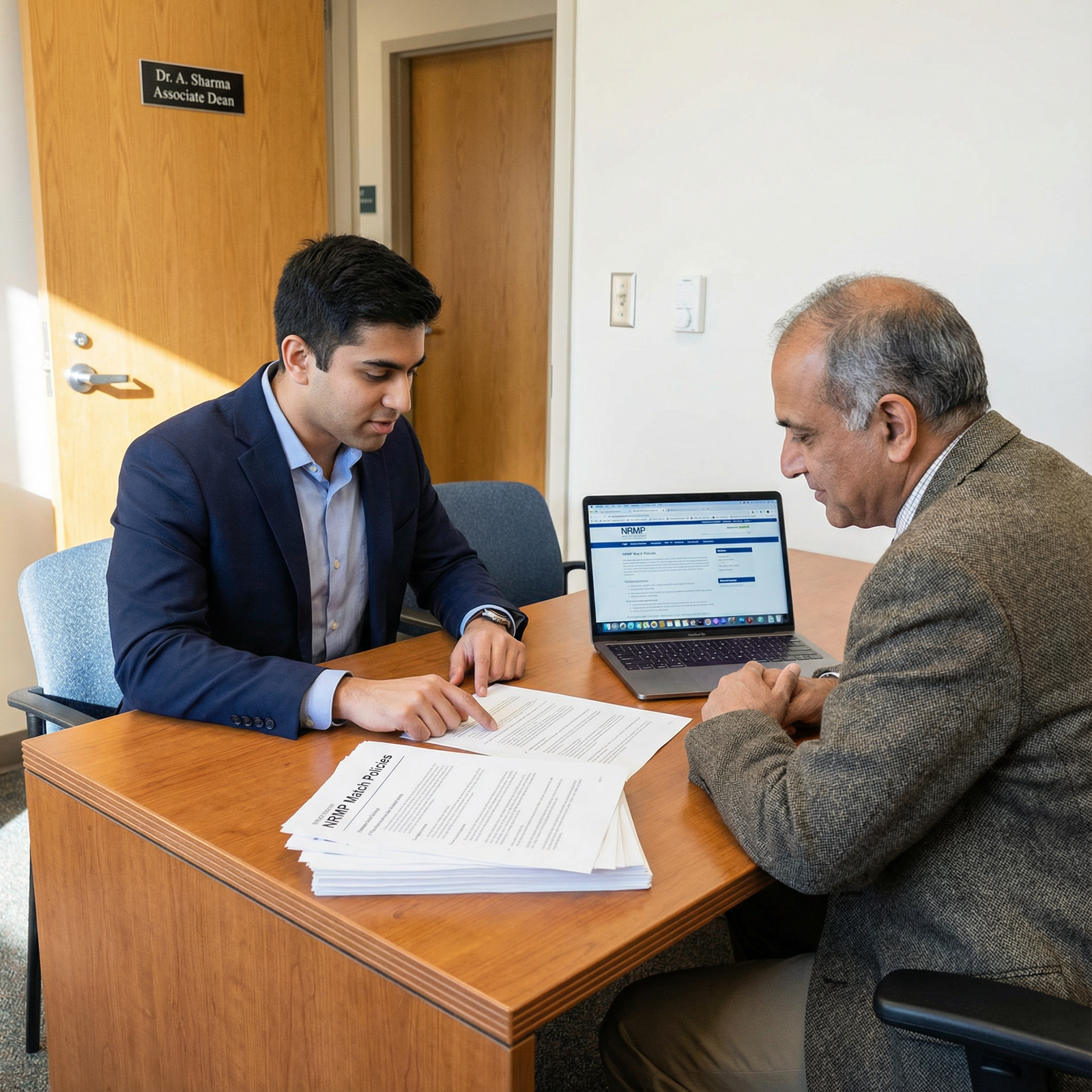
How a Dean/Advisor Letter Could “Accidentally” Become a Problem (Realistic Scenarios)
This is where the panic gets real, because the problem usually isn't cartoonishly obvious. It's usually a well-meaning person writing something they think is supportive.
Scenario one: your advisor includes outcome language they think is harmless. “I expect you to match there.” “They'd be lucky to have you, and I know this will work out.” “We'll take care of you.” These phrases sound conversational, but they can imply expectations about the result. They're not ideal. The risk rises when the wording suggests more than optimism—when it sounds like the writer has influence over placement or expects a certain Match outcome.
Scenario two: the advisor implies reciprocity with a specific program. This is the one that makes me wince. Something like, “Our departments have always worked well together,” or “I hope you'll give this candidate the same consideration we've shown your trainees.” That may feel collegial to the writer. To everyone else, it can sound like institutional horse-trading. Bad look.
Scenario three: the letter bundles “advice” that effectively instructs coordination. Maybe the faculty member says, “If you're serious about them, make sure they know and we'll reinforce it from our side.” That's no longer support. That's strategy drifting into match-influencing behavior. Applicants get trapped here because it sounds like insider wisdom. Sometimes “insider wisdom” is just polished bad judgment.
Scenario four: administrative templates. Honestly, this one is more common than people admit. A departmental letterhead template gets reused for years, with old phrasing no one scrutinizes until one anxious applicant notices it at 1 a.m. and nearly faints. If that template contains outcome-heavy language, it's worth fixing immediately.
Now the reassurance, because you probably need it: most applicants will never be affected by this. Really. The overwhelming majority of letters are standard and low risk. The goal isn't to become paranoid about every supportive phrase. The goal is to recognize patterns that look like matching coordination and clean them up before they become a bigger issue.
What To Do If You’re Worried Your Letter Contains a Red Flag
If you haven't submitted yet, this is fixable. Quietly. Cleanly. Without drama.
Ask for a quick review and frame it as a compliance language check, not an accusation. You do not need to say, “I think your letter may violate NRMP policy,” unless you're trying to give a senior faculty member a blood pressure spike. Say you want to be sure the letter uses neutral, standard recommendation language focused on your qualifications. That's reasonable. Most advisors will understand immediately.
Your checklist is simple: keep strengths, facts, and context; remove promises, expectations about matching, reciprocal wording, and anything that sounds like rank coordination.
If you've already submitted, do not spiral into doing something reckless. This is where applicants make it worse. Don't email the program to “clarify.” Don't send a weird apology. Don't disclose your rank intentions in some attempt to prove you aren't gaming anything. That's how a contained wording issue turns into an actual communication problem.
Instead, document the exact wording if you know it. Not your memory of it. The actual language. Then follow your school's pathway: student affairs, dean's office, GME office, or whoever handles NRMP/compliance concerns. Let them tell you whether the phrase is merely clumsy or worth action. That's their job. Use them.
Your goal isn't to launch a public self-investigation. Your goal is to bring the letter, if needed, back into the lane of normal recommendation writing and then behave impeccably going forward.
How to Prevent It Next Time: A “Compliance-First” Letter Request Script
You do not need to sound paranoid to be smart.
Here's a script I'd actually use:
“Thank you again for supporting my application. If possible, I'd really appreciate standard recommendation language focused on my clinical performance, professionalism, strengths, and fit for residency. My school has encouraged us to avoid wording about Match outcomes, ranking expectations, or promises, so I wanted to mention that up front just to keep everything clean.”
That's it. Calm. Specific. Not accusatory.
You can also attach a short internal checklist if the writer is open to it: focus on qualifications and observed performance; avoid guarantees, expected Match outcomes, reciprocal language, or anything implying a rank-related arrangement. This isn't overkill. It's quality control. Same reason we proofread personal statements instead of launching them into ERAS like chaos confetti.
And if your school uses templates, good. But someone needs to review them periodically. Faculty training on this stuff is not bureaucratic nonsense. It's basic hygiene.
When It’s Not Your Letter: Other Common Applicant Missteps That Feel Similar
A lot of applicants fixate on the letter because it's tangible. It's a document. You can stare at it and panic. But the bigger risk usually isn't the letter. It's conversations.
The higher-risk behaviors are much more direct: asking a program to rank you highly, asking where you are on their rank list, trying to negotiate an outcome, implying you'll rank them first in exchange for something, or fishing for commitments. That's the stuff that actually causes trouble.
Letters are usually static and descriptive. Conversations are messy, emotional, and much easier to screw up. One overeager “I'd absolutely rank you number one if...” can do more damage than a vague sentence in a support letter ever will.
So yes, take the letter seriously. But don't miss the forest for the trees. The safest applicants are the ones who keep all program communication boring, professional, and policy-clean.
Closing CTA: Breathe—You Can Stay Compliant Without Ruining Your Confidence
Here’s my honest take: most letters do not create NRMP violations. The worst-case scenario your brain keeps replaying is uncommon. Not impossible. Just uncommon.
So do the sane thing. Review the wording if you can. If something clearly sounds like outcome prediction, reciprocity, or rank coordination, get help through your school—not through an awkward email to a program. Keep your own communications clean, boring, and professional. That's not weakness. That's survival with judgment.
And yes, save copies of what you can. Keep records. Ask for a compliance check from student affairs or your designated school resource if you're worried. You do not need to carry this alone in your head at 2 a.m.