

It’s late January. You and your partner just finished another round of interviews. Your spreadsheets are open, coffee’s cold, and the “Couples Match” box on NRMP suddenly feels less cute and more like a legal contract.
You want to email a PD you clicked with and say, “If you rank me highly, my partner will rank your linked program highly too.” Your partner is horrified and waving the NRMP rules page at you. They think anything close to discussing rank order is illegal. You’re both tired. You’re both stressed. And now, on top of figuring out your lists, you’re arguing about what you can or cannot say to programs without getting in trouble.
Here’s how to handle this exact situation: what the NRMP rules actually say, what’s allowed, what’s dumb, and how couples can get on the same page when they disagree about communication strategy.
Step 1: Ground Yourself in What NRMP Actually Cares About
Let me be blunt: a lot of couples fight about “NRMP rules” without either person having actually read them recently. You’re arguing about vibes and Reddit posts, not the rulebook.
The NRMP doesn’t care if:
- You’re anxious
- You send a polite thank you email
- You and your partner argue about rank order at 1 a.m.
They do care if you or a program:
- Try to force a commitment about ranking
- Lie about ranking behavior
- Make ranking a condition of an offer or communication
- Misrepresent what was promised to influence ranking
At the 10,000-foot level, the NRMP Match Participation Agreement boils down to:
- Programs and applicants must not solicit or require statements about rank intentions.
- Programs and applicants must not make any commitments about how they’ll rank the other party.
- You’re allowed to express interest and preferences, but not conditional deals tied to ranking.
Where couples get tripped up is mixing three different things:
- What’s legally/ethically allowed by NRMP
- What’s strategically smart or dumb
- What each partner’s comfort level is
Those are three separate conversations. You need to pull them apart.
Step 2: Understand the Core Gray Zones for Couples
Here’s where couples usually fight:
- One partner wants to say “We’ll rank you #1 if…”
- The other thinks that’s illegal
- Or one wants to coordinate with PDs about being in the same city
- The other thinks you can’t mention the couples match at all
Let’s clarify what’s clearly allowed, technically allowed but risky/dumb, and absolutely not allowed.
| Category | NRMP Status |
|---|---|
| Expressing strong interest ("I plan to rank you highly") | Allowed |
| Mentioning you are couples matching | Allowed |
| Discussing geographic preferences | Allowed |
| Asking how couples have fared at that program | Allowed |
| Making promises about rank order ("We will rank you #1") | Not allowed |
| Linking your rank behavior to theirs ("If you rank me X, I will rank you Y") | Not allowed |
Now, layer in the couple dynamic.
Your communication can be about:
- You as an individual applicant
- You as part of a couple seeking to be together geographically
You can say things like:
- “My partner is also applying in [specialty] in this city, and being together is very important to us.”
- “We are couples matching and will be ranking programs in [City X] very highly.”
- “Your program is one of my top choices, and this city works very well for both me and my partner.”
You cross the line when you attach specific rank positions or conditional promises:
- “We will rank you #1 if my partner gets an interview here.”
- “If you rank me highly, we will rank you and your affiliate program first.”
- “We promise to rank your program to match if you rank us to match.”
That’s not “strategic communication.” That’s a clear NRMP violation.
Step 3: Script Out What’s Actually Safe to Say
If you and your partner are disagreeing, half of it is probably about vague language. So stop being vague. Script it.
Here’s how I’d break it down.
Safe, NRMP-compliant phrases (individual)
These are boring, clean, and absolutely allowed:
- “Your program is one of my top choices.”
- “I remain very interested in your program and the training opportunities you offer.”
- “I would be thrilled to train at [Program].”
- “I intend to rank your program highly.”
Notice what’s missing? Numbers. Conditions. Quid pro quo.
Safe, NRMP-compliant phrases (as a couple)
- “My partner and I are couples matching; being in the same city is a high priority for us.”
- “We will be ranking programs in [City/Region] very highly.”
- “A big factor for me is whether my partner can also match in this city; we are both very interested in being here.”
- “Your program and [Partner’s Program/Institution] are both strong contenders for us.”
Again: no ranking positions. No “if you do X, we’ll do Y.”
Phrases that are NRMP-problematic or just plain dumb
Do not argue about these. Just delete them from your drafts:
- “You are my #1 ranked program.”
- “We will rank you to match.”
- “If my partner matches here, I promise I’ll rank you first.”
- “We will put you at the top of our list if you can help my partner.”
- “We guarantee to rank you highly if you rank us highly.”
These statements move from “preference” to “commitment,” and that’s the line NRMP cares about.
Step 4: Separate the Rule Question from the Relationship Question
Here’s where couples melt down: one of you is arguing, “That’s against NRMP rules,” and the other is actually arguing, “I don’t feel comfortable doing that” or “I don’t think that’s smart.”
You have to sort people into their actual objections.
There are three separate questions:
- Is it an NRMP violation?
- Is it strategically smart?
- Is each partner comfortable attaching their name to it?
Do it this way:
- Sit down with one specific email or phone script.
- Read it out loud.
- Ask:
- Are we making any promise or condition about rank order?
- Are we putting specific rank positions in writing?
- Are we tying our ranking behavior to the program’s behavior?
If the answer is yes to any of those, it’s a problem. That’s the rules bucket.
If the answer is no, and it’s just “I’d rank you highly” or “I’m very interested” and “We’re couples matching,” that’s allowed. Now you’re in strategy and comfort territory.
Step 5: Use a Simple Decision Flow for Any Message
To stop fighting every time someone opens Outlook, use a simple mental flowchart. Something like this:

| Step | Description |
|---|---|
| Step 1 | Draft Message |
| Step 2 | Delete or rewrite |
| Step 3 | Likely allowed - discuss comfort and strategy |
| Step 4 | States rank position? |
| Step 5 | Makes conditional deal? |
| Step 6 | Mentions couples match or interest? |
If your partner wants to send something, run it through this structure together. That way you’re arguing about a yes/no at each step, not about nebulous “ethics.”
Step 6: Talking to Programs About Being a Couple – Smart vs. Stupid
The reality: programs are not shocked you want to live in the same city as your partner. They see this every year.
What they hate:
- Being backed into a corner with implicit threats
- Being asked to violate NRMP rules
- Getting emails that sound like used-car negotiation
What can actually help (within reason):
- A clear, respectful email that says:
- You’re couples matching
- This city/institution is a top priority
- You’d appreciate any consideration for co-location
Example of a reasonable email from you:
Dear Dr. Smith,
Thank you again for the opportunity to interview at [Program]. I greatly appreciated learning more about your approach to resident education and the collegial culture among your housestaff.
I wanted to share that my partner and I are participating in the couples match. My partner is applying in [Partner Specialty] at programs in [City/Region], including [Partner Program if at same institution]. Being able to train in the same city is very important to us, and it’s one of the reasons I remain highly interested in [Your Program].
Thank you again for your time and consideration.
Sincerely,
[Your Name]
You’ve:
- Stated you’re a couple
- Stated that this place is important to you
- Not made promises or asked them to make promises
Your partner might want to go further: “Tell them they’re #1. Tell them we’ll rank them first if they help us.” That’s where you say no, not because you’re paranoid but because that crosses into commitment territory.
Step 7: When One Partner Wants to “Push the Envelope”
This is the ugly but common scenario:
- Partner A: “Everyone lies. I’m just going to tell my top program they’re #1.”
- Partner B: “I don’t want to be part of that or risk an NRMP violation.”
Here’s what’s actually going on:
- Partner A is scared and trying to feel in control.
- Partner B is mixing ethics, rules anxiety, and relationship loyalty.
You have to set two boundaries:
- NRMP boundary – “We will not put explicit rank positions or conditional promises in writing. Period.”
- Relationship boundary – “If you independently decide to violate NRMP rules, that’s your license and reputation, but I’m not attaching my name or email to it.”
Be explicit: “I’m not comfortable with any written statement that includes rank numbers or promises. If you choose to say something verbally on your own, that’s your decision, but we are not drafting or approving that together.”
Is verbal promising still a bad idea? Absolutely. But if you try to police each other’s every spoken word, you’ll rip your relationship apart. You can control what you co-sign in writing. Hold that line first.
Step 8: Coordinate Communication So You Don’t Undercut Each Other
Another mess I’ve seen: partner emails that contradict each other.
Example:
- You email Program A: “This is one of my top choices.”
- Your partner emails their associated Program B (same city, same hospital system): “You are my clear #1.”
- Later, someone casually forwards those emails internally. You now look dishonest.
Fix this with one simple rule: no specific rank language from either of you. Ever. That solves 90% of this problem.
Then coordinate:
- Make a shared list of:
- Programs you both really like in the same city
- Programs where only one of you interviewed
- Decide which programs will get:
- A) Strong interest email from one of you
- B) Strong interest emails from both (if same institution/city and both genuinely interested)
- C) No extra communication beyond basic thanks
You don’t need a 20-tab spreadsheet with color codes. You just need to not look like you’re telling five places they’re each your “top choice.”
Step 9: Know the Difference Between Strategy and Superstition
One more honest take: a lot of the “we have to tell them we love them or we won’t match” mindset is superstition.
The NRMP algorithm is applicant-favoring. Your actual rank list matters more than your emails. Programs vary widely in how much they care about “love letters.” Some barely glance at them.
So when you and your partner are fighting about whether to send a “you’re my top choice” style message, you’re probably fighting about a move that:
- Carries non-zero risk if phrased badly
- Has uncertain impact on the outcome
- Is not necessary to match well in most cases
That doesn’t mean you should ghost every program. It does mean you shouldn’t blow up your relationship over whether you both need to send borderline NRMP-compliant love letters.
Focus your energy on:
- Making an honest, thoughtful rank list that reflects both your preferences and reasonable couple-pairings
- Avoiding stupid, obvious violations
- Keeping your relationship intact enough to actually enjoy matching in the same city
Step 10: A Simple Playbook You Can Both Agree On
If you’re exhausted, here’s the minimalist strategy I’d push for most couples:
Basic rule
Neither of you will ever put a specific rank position or rank promise in writing to any program.Couples disclosure rule
You will disclose that you’re couples matching to programs where geography or institutional linkage actually matters. You’ll frame it as “this city/institution is a high priority for us.”Interest language rule
You’ll use only these levels of language:- “Very interested”
- “Remain highly interested”
- “Plan to rank you highly” (if you’re really sure)
No “#1,” no “top 3,” no “above all others.”
Review rule
Any email that mentions “couples match,” “rank,” or “priority” gets reviewed by the other partner before sending. If either of you says, “This feels like a promise,” you rewrite until you both agree it’s safe.Verbal conversation rule
In any PD or faculty conversation, you can say:- “I am very interested in this program”
- “This is one of my top choices”
- “We really want to be in the same city”
You do not say:
- “You are my #1”
- “We will rank you first if…”
- “I promise we will rank you to match”
Let the algorithm do its job
Spend more time on your actual rank combinations as a couple and less time on “gaming” communication.
To visualize where your energy should go, think about your match effort across a month:
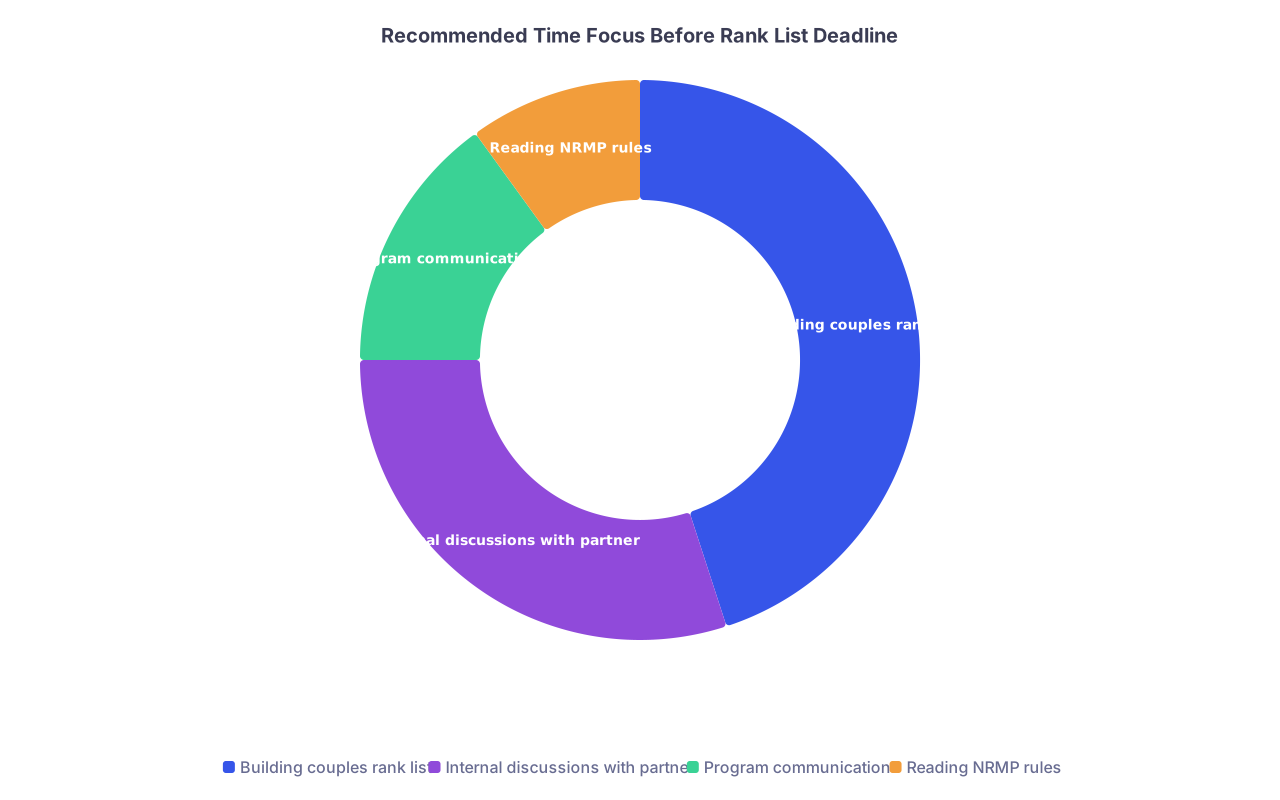
| Category | Value |
|---|---|
| Building couples rank list | 45 |
| Internal discussions with partner | 30 |
| Program communication | 15 |
| Reading NRMP rules | 10 |
If you’re spending 60–70% of your emotional bandwidth on email wording and “what if they think we don’t like them enough,” your priorities are upside down.
Final Thoughts: What Actually Matters Here
Three points to walk away with:
NRMP cares about commitments and conditions, not polite interest.
Don’t promise rank positions. Don’t make deals. Saying you’re “very interested” or “will rank highly” is generally fine; tying it to numbers or “if you do X, we’ll do Y” is not.Separate rules from comfort and strategy.
First ask, “Is this an NRMP violation?” If no, then you can argue about whether it’s smart or feels right. Don’t weaponize “the rules” just because you’re anxious.Your relationship has to survive this.
Agree on a conservative communication playbook you both can live with. Spend most of your time building a rank list that reflects your real preferences as a couple. That’s what decides where you’ll actually end up, not who wrote the more dramatic email.


