
What actually happens if you break an NRMP rule one time — does your career blow up, or does it quietly disappear into the void?
Let me be blunt: the NRMP (National Resident Matching Program) takes rule violations seriously. Much more seriously than most applicants realize. One “small” mistake can follow you for years if it’s an official violation.
But not every misstep becomes a career-ender, and not everything people panic about is actually a violation.
This is the breakdown you’re looking for: what really happens if you break an NRMP rule once — the likely consequences, what’s fixable, what’s not, and what to do if you’re already worried you crossed a line.
First: What Counts as “Breaking an NRMP Rule”?
Before talking punishment, you need to know what they actually care about. People imagine it’s only about rank list shenanigans. It’s not.
Common NRMP-related violations include:
Breach of Match Participation Agreement
Example: Signing a contract with a program outside the Match for the same year in a specialty you’re registered for.Coercion or illegal commitments
Example: A program says, “If you rank us first, we’ll rank you to match,” and pressures you to say the same.Misrepresentation / dishonesty
Example: Lying about USMLE attempts or graduation date in a way that materially affects your eligibility.Improper communication about ranking
- Programs telling you how they’ll rank you in a binding-sounding way.
- You insisting on a “guarantee” or threatening programs based on your rank list.
Violating match outcome
Example: Matching at Program A but trying to abandon that contract to take an off-cycle spot somewhere else.Sharing / misusing NRMP or ERAS system access
Example: Letting someone else log into your NRMP account.
Not everything awkward or annoying is a violation. Cringey post-interview emails? Usually fine. A PD hinting “We like you a lot”? Gray area, but usually just sleazy, not reportable.
What Actually Happens if You Break an NRMP Rule Once?
There are two layers here:
- Is the violation reported to the NRMP?
- Does the NRMP decide it’s an official violation?
Breaking a rule “once” doesn’t automatically trigger a formal process. Someone has to notice and care enough to report it. But when they do, there’s a predictable sequence.

| Step | Description |
|---|---|
| Step 1 | Alleged Violation Occurs |
| Step 2 | Reported to NRMP |
| Step 3 | NRMP Initial Review |
| Step 4 | Case Dismissed |
| Step 5 | Investigation |
| Step 6 | Hearing / Written Response |
| Step 7 | Sanctions |
| Step 8 | Appeal Option |
| Step 9 | Final Decision |
Step-by-step: What you’re actually in for
If a program, school, or applicant reports a concern:
NRMP notifies you
You’ll get an official communication saying there’s an allegation and asking for information. This is the “oh crap” email.You’re allowed to respond
You can submit a written response with your side of the story and evidence.
This is where having your dean’s office or GME office help you is smart. This is not the time for emotional essays.NRMP committee reviews
The NRMP Violations Review Committee (VRC) evaluates the allegation, your response, any documents, and sometimes witness statements.Outcome: either no violation or violation with sanction
- No violation: you’re cleared.
- Violation: they choose a sanction level.
Sanction is recorded and, often, made public
Your name can end up on the NRMP’s “Match Policy Violations” list. Programs do look at this.
NRMP Sanctions: What They Can Actually Do to You
Here’s the menu of bad options if they find a violation. This is where “one-time” breaks matter.
| Sanction Type | Typical Duration | Public Listing? |
|---|---|---|
| Formal Letter of Reprimand | 0 years | Sometimes |
| Probation / Conditions | 1–3 years | Often |
| Bar from Match Participation | 1–3 years | Yes |
| Required Educational Remediation | Varies | Often |
| Permanent Match Ban | Indefinite | Yes |
Let’s translate that into real life consequences.
1. Letter of reprimand (lightest, but not “nothing”)
- You get a formal letter stating you violated a policy.
- It may be shared with:
- Your medical school dean’s office
- Program leadership (if you’re a resident)
- Sometimes your name goes on the NRMP violations page with a brief description.
Impact:
Annoying, a little embarrassing, but usually survivable. Most people recover from this, especially if they’re early in the pipeline.
2. Probation / conditions
This can look like:
- You’re allowed to keep your current position or keep participating in the Match, but:
- You may have to complete professionalism or ethics training.
- You may be on “watch” if something else happens.
- Programs may be informed if you re-enter the Match.
Impact:
Programs can see this as a warning sign. Some won’t care; some will quietly skip you. It doesn’t end your career, but it does raise the bar for how strong the rest of your application has to be.
3. Temporary bar from future Matches
This one hurts.
- You’re banned from participating in the NRMP Match (and sometimes SOAP) for a set period — often 1–3 years.
- If you’re already matched and break a rule like reneging, you might:
- Lose that position.
- Be prohibited from matching again for a period.
Impact:
You may have to:
- Sit out a year (or more).
- Work in research, a prelim year, or non-training roles.
- Deal with visa issues if you’re an IMG.
One-time violations that can trigger this: walking away from a matched spot to take a different PGY-1, double-contracting, or serious lying.
4. Permanent ban (rare, but real)
This is the nuclear option.
- For extreme or repeated violations.
- Think: deliberate fraud, repeated disregard of rules, clear pattern of dishonesty.
Impact:
You’re essentially shut out of NRMP-participating residencies. Some alternatives exist (non-NRMP programs, non-US paths), but this is catastrophic for a typical US-bound applicant.
“But It Was Just Once…” — How Much Does Intent Matter?
Intent matters, but outcome matters more.
Let’s break this down:
Accidental, low-impact, first-time issues
Example: You wrote something slightly too explicit in an email like, “I will rank you #1 if you rank me to match.”
Usually: more likely to get a warning or, at worst, a light sanction, especially if you’re honest and cooperative.“I didn’t know the rules” for serious actions
Example: Signing a pre-match contract outside the Match while still participating.
The NRMP is not sympathetic to “I didn’t read the agreement.” You agreed electronically. That’s enough.Dishonest or harmful behavior
Example: Abandoning a matched position without notice to go elsewhere.
One-time or not, this can trigger significant sanctions.
So yes, being a first-time violator can help, but it’s not a get-out-of-jail-free card. The more your behavior threatens the fairness or integrity of the Match, the harsher the NRMP response.
Common One-Time Scenarios and What Usually Happens
Here’s what people actually get burned for.
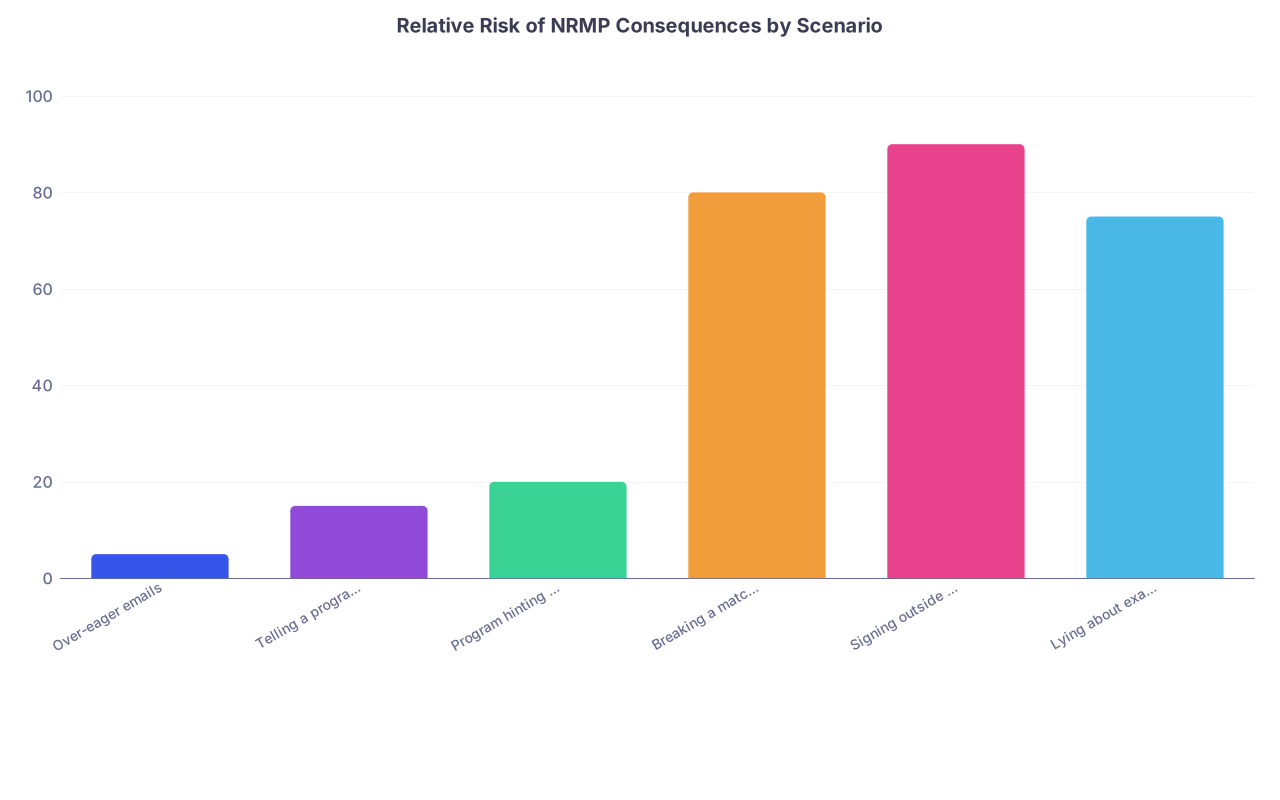
| Category | Value |
|---|---|
| Over-eager emails | 5 |
| Telling a program they are #1 | 15 |
| Program hinting rank | 20 |
| Breaking a matched contract | 80 |
| Signing outside contract while matched | 90 |
| Lying about exam status | 75 |
Scale is approximate “risk of real NRMP trouble” out of 100, based on how often these lead to formal problems.
Scenario 1: You send an overly intense post-interview email
You write something like, “You’re my top choice. I’m confident we’ll work together next year.”
Is that an NRMP violation?
Usually no. It’s awkward but not a reportable offense by itself.
Risk of serious consequence: very low.
Lesson: Chill. Don’t be weird, but you’re probably fine.
Scenario 2: You promise something rank-related you shouldn’t
You say, “If you rank me to match, I’ll rank you #1.”
Or you pressure a program or applicant with quid pro quo language.
This can cross into violation territory, especially for programs. For applicants, NRMP is more focused on coercion from programs, but applicants can still get in trouble for written threats, attempts to manipulate, or harassment.
Risk of consequence: low-to-moderate for a one-off, higher if someone reports and has receipts.
Scenario 3: You walk away from a matched spot
You match into a categorical IM program, then a month later get offered an “informal” PGY-2 spot in something “better” and try to bail.
This is a classic reportable scenario.
Likely outcome if reported:
- Investigation, and if violation found:
- Possible bar from future Matches.
- Your name listed publicly as a violator.
- Potential problems with state licensing later (“failure to complete training,” professionalism questions).
One-time or not, this is serious.
Scenario 4: You sign an off-cycle contract while still in the Match
You accept a non-NRMP position in the same training year and specialty while still participating in the Match.
NRMP sees this as undermining the fairness of the process. They do not like it.
One instance can lead to:
- Violation finding.
- Suspension from future Matches for a set period.
How Long Does a First-Time Violation Follow You?
Sanctions have both time-limited and long-term effects.
Short-term:
- Eligibility bans (1–3 years).
- Required remediation.
Long-term:
- Your name may remain on the NRMP public violation list for years.
- Programs can Google you and find it.
- Licensing, credentialing, and hospital privileging bodies sometimes ask about “disciplinary actions.”
Does it end your career automatically? No.
Does it complicate your next steps? Yes.

What To Do If You Think You Might Have Broken a Rule
If you’re reading this because something already happened, here’s the playbook.
Stop making it worse
Don’t send panic emails or try to “fix” things by lying more. That’s how small issues become giant ones.Talk to someone on your side
- Medical students: your dean’s office / student affairs.
- Residents: your program director or GME office.
They’ve seen this before. They know the language to use.
Collect documentation
- Emails
- Screenshots
- Contracts / offer letters
You want a clear timeline in case there’s an investigation.
If NRMP contacts you, respond deliberately, not emotionally
Be honest, concise, and consistent. If you screwed up, say so clearly, own it, and demonstrate insight.Learn the rules now
Actually read the NRMP Match Participation Agreement and your program’s GME policies. Most people only do this after they’re in trouble. Don’t be that person.
How to Avoid NRMP Problems in the First Place
You prevent 95% of issues by following four simple rules:
Don’t sign any training contract behind NRMP’s back
If you’re in the Match for a given start year and specialty, don’t sign something else for that same year/specialty without clearing it through the right channels.Don’t abandon a matched position to trade up
If you truly can’t start (health, family crisis, visa disaster), work with your program and NRMP formally. Don’t just vanish or secretly jump ship.Be honest in all application materials
No fake scores, no hiding failures, no fictional degrees. People have been caught for this years later.Keep post-interview communication professional and non-binding
You can say:- “You’re one of my top choices.”
- “I’d be thrilled to train at your program.”
Don’t say: - “I will definitely rank you #1 if you rank me to match.”
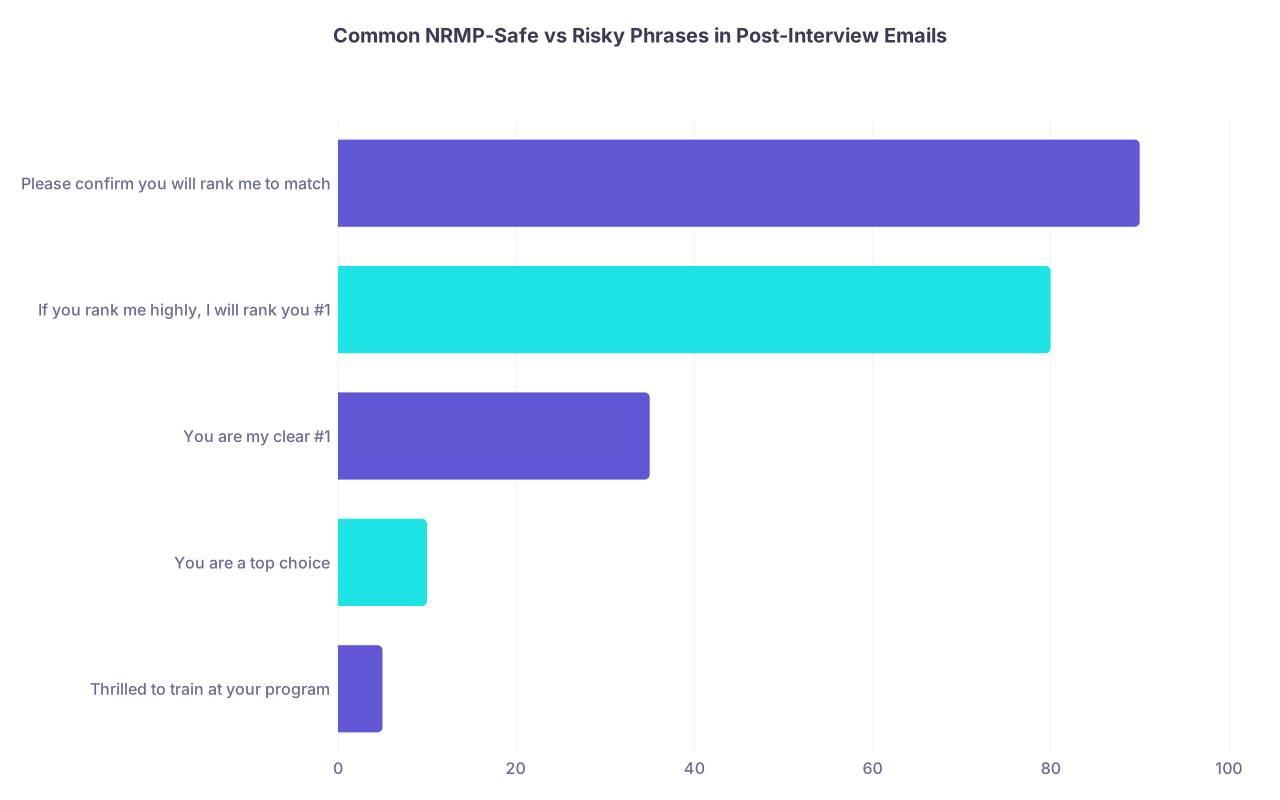
| Category | Value |
|---|---|
| Thrilled to train at your program | 5 |
| You are a top choice | 10 |
| You are my clear #1 | 35 |
| If you rank me highly, I will rank you #1 | 80 |
| Please confirm you will rank me to match | 90 |
Low numbers = usually safe, high numbers = asking for trouble.

FAQ: NRMP Rule Violations – 7 Common Questions
If I break an NRMP rule once, will I automatically be banned from the Match?
No. One violation doesn’t automatically mean a Match ban. The NRMP looks at what you did, how serious it is, whether there was dishonesty, and the impact on others. Minor or technical first-time violations may lead to warnings or lighter sanctions. Serious things like abandoning a matched spot or double-contracting can result in a temporary or even permanent ban, even if it’s your first offense.Can programs see if I’ve had an NRMP violation in the past?
Yes. The NRMP maintains a public list of individuals and programs found to have violated Match policies, often including your name, school, year, and a brief description of the violation and sanction. Programs absolutely look at this list, especially for applicants who’ve previously been in the Match or are reapplying.Is sending a “you’re my #1” email a violation?
Usually no, on its own. It’s not smart and can be misleading, but NRMP focuses more on coercive behavior, contract violations, and dishonesty. That said, you should avoid making promises that sound binding or quid pro quo. Phrase things as enthusiasm, not conditional deals or guarantees.What happens if I match but then decide not to go?
Walking away from a matched position is a serious issue. You’re contractually bound to that program for the first year. If you decide not to go and it’s reported, NRMP can investigate and may sanction you, which can include a ban from future Matches. If you have a legitimate emergency (health, family, visa), work formally with the program and NRMP instead of ghosting or switching secretly.Can an NRMP violation affect my medical license later?
It can. Licensing boards often ask about disciplinary actions, professionalism issues, or contract violations. An NRMP sanction doesn’t automatically block a license, but it’s a red flag. You’ll need to explain what happened, what you learned, and why it won’t happen again. Some hospitals and credentialing committees will also ask about this.What should I do if I’m accused of an NRMP violation but I disagree?
Take it seriously. Don’t ignore the email. Get help from your dean’s office or GME office, gather all relevant documents, and prepare a clear, factual written response. The NRMP does sometimes rule “no violation” when the evidence doesn’t support the allegation or there’s been a misunderstanding. Being organized, honest, and professional in your response helps.Is there any way to “erase” an NRMP violation from my record?
Not really. If the NRMP finds that a violation occurred and imposes a sanction, that’s part of your record. Time-limited sanctions eventually expire in terms of eligibility, but historical listings and documentation often remain. Your best move is to prevent the violation in the first place; if it’s already happened, focus on taking responsibility, complying with sanctions, and building a strong track record of professionalism afterward.
Key takeaways:
- One NRMP rule break can be anything from a minor warning to a multi-year Match ban, depending on what you did and how honest you were.
- The biggest, most career-damaging violations involve contracts: abandoning matched spots, double-signing, or lying about critical facts.
- If you’re in doubt, don’t guess. Ask your dean or GME office, read the Match Participation Agreement, and stay on the safe side.


