

The mythology around NRMP violations is wildly out of proportion to the actual numbers.
Most applicants will never even brush up against a formal National Resident Matching Program (NRMP) sanction. The data show that, each year, the fraction of participants who are actually sanctioned is not just small—it is vanishingly small. But when sanctions do occur, the consequences are very real, especially for applicants.
Let me pull this out of the realm of rumor and into numbers.
The Scale Problem: Millions of Ranks, Dozens of Violations
Start with the denominator.
The NRMP Main Residency Match now involves roughly 45,000–50,000 applicants each year (US MD, DO, and IMGs combined) and over 37,000 residency positions. Each applicant ranks multiple programs; each program ranks dozens to hundreds of applicants. The system processes:
- Tens of millions of rank-ordered pairings over several years
- Tens of thousands of participants each cycle
Yet the NRMP’s published violation and sanction data typically describe, at most, double-digit cases per year.
To put approximate magnitude on it, historical NRMP reporting and match participation numbers support the following conservative ballpark, per Main Match year:
- Applicants participating: ~45,000–50,000
- Programs participating: ~12,000–13,000 (programs, not positions)
- Publicly reported sanctions (all parties combined): often under 100 total in a year, and usually much less
Translate that into probabilities:
If there are, say, 60 total sanctions in a match year and ~60,000 total participants (counting both applicants and program entities), that is roughly:
- 60 / 60,000 = 0.001 = 0.1% sanctioned in a given year
And that 0.1% includes both applicants and programs and multiple violation types. For individual applicants, the actual annual probability of being sanctioned is even lower.
This is why fear-driven narratives about NRMP violations are misleading. The baseline risk of formal sanction is tiny. But the severity of sanctions, when they are imposed, is exactly why you cannot be casual about the rules.
What the NRMP Actually Sanctions (and How Severe It Gets)
You cannot talk intelligently about “violation statistics” without separating categories. The NRMP does not treat all misbehavior the same way. The data and the rules distinguish clear tiers:
- Minor process violations / misunderstandings
- Confirmed Match violations without major harm
- Severe Match violations that impact other participants
- Fraudulent or egregious cases (e.g., falsified credentials)
Applicants care most about two questions:
- How likely is it that something I say or do will be escalated into a formal NRMP complaint?
- If that happens, what are the odds it leads to a public sanction that damages my future applications?
The pattern from NRMP outcomes and case examples is consistent:
- A large amount of questionable behavior never gets reported.
- Of reported issues, many are resolved informally (warning, education).
- Only a subset becomes confirmed violations with published sanctions.
- Among those, only a smaller subset involve truly career-altering penalties (multi-year bans, permanent annotations).
Think of it as a funnel. At each stage, the numbers shrink dramatically.

| Step | Description |
|---|---|
| Step 1 | Questionable behavior occurs |
| Step 2 | No one reports |
| Step 3 | Reported to NRMP |
| Step 4 | No violation found |
| Step 5 | Minor violation - warning |
| Step 6 | Confirmed violation - sanction |
| Step 7 | Short restriction or probation |
| Step 8 | Multi year match ban |
The data available from NRMP disciplinary summaries (and patterns that recur year over year) show several common themes.
Applicant vs Program: Who Gets Hit More Often?
Both applicants and programs can be sanctioned, but the distribution of consequences is skewed.
Programs are larger institutional entities. A program censured for illegal interviewing practices or coercive statements will get a formal reprimand, sometimes public listing, possibly a temporary loss of privileges (e.g., can’t participate in a future Match cycle for a specific track). That matters for reputation, but individuals within the program can rotate out.
Applicants do not have that buffer. A sanction attaches directly to one person’s record and can affect:
- Participation in the next 1–3 Match cycles
- How programs view them when they see “NRMP Match participation restriction” on their history
- Visa timing, graduation plans, gap years
So even if the count of sanctions is similar or even slightly higher on programs in some years, the impact density is far higher on applicants.
| Party Type | Common Sanctions | Typical Duration | Visibility |
|---|---|---|---|
| Applicant | Match ban, participation restriction, annotation | 1–3 years | High (programs see it) |
| Program | Reprimand, report to ACGME/institution, temporary participation bar | 1–3 years | Moderate (NRMP listing, professional circles) |
| Institution | Probation or requirement to implement policy changes | 1–3 years | Mainly internal/NRMP |
The takeaway from the data: yes, programs can and do get sanctioned. But the applicant side is where sanctions hit the hardest and are most feared, even if numerically rare.
How Often Applicants Actually Get Sanctioned: A Data-Driven Estimate
The NRMP publishes annual or periodic violation reports and lists of sanctioned participants. They do not give a neat single spreadsheet of “number of applicants sanctioned per year for each type of offense,” but combining several years of public data and match volumes, you can approximate.
Reasonable ranges, based on historical reporting and current match sizes:
- Total number of publicly identified sanctions (all parties) in a year: often between 20 and 80
- Percentage of all participants receiving any sanction: often around 0.05–0.15%
- Applicant-specific sanctions: typically some fraction of the above (e.g., low dozens in a big year, often fewer)
Translate that to your personal probability as a single applicant:
- Probability of even being the subject of a formal NRMP complaint: extremely low
- Probability of that progressing to a confirmed violation: lower still
- Probability of receiving a multi-year match ban: very low, but non-trivial if you engage in egregious behavior (withdrawing post-Match without cause, signing multiple contracts, fraud)
The numbers are small enough that you will probably never meet a peer who has been formally sanctioned. But if you read the NRMP violation case summaries, the same patterns repeat, over and over, with painful predictability.
The Violations That Actually Lead to Applicant Sanctions
Let’s cut through noise. The data and case histories point to a small cluster of behavior categories that disproportionately generate sanctions for applicants:
Reneging on a binding commitment after the Match
- Withdrawing from a program you matched to
- Failing to start your program without approved waiver
- Signing another contract after Match results are out
Signing multiple binding contracts for the same period
- Entering into separate binding commitments with two Match-participating positions for the same start date
Misrepresenting credentials or eligibility
- False claims about graduation, exams, visas, or licensure
- Applying when you know you will not meet eligibility requirements and failing to disclose
Improper solicitation or coercion tied to ranking
- Explicit quid pro quo statements violating the Communication Code of Conduct, when documented and reported
Notice what is not usually leading to NRMP sanctions at the applicant level:
- Stupid boasting emails (“You’re my top choice!”)
- Mildly pushy post-interview thank-you notes
- Over-sharing your rank intentions
All of that can hurt you informally—programs talk, reputations circulate—but they rarely convert into NRMP disciplinary statistics unless combined with something more concrete and abusive.
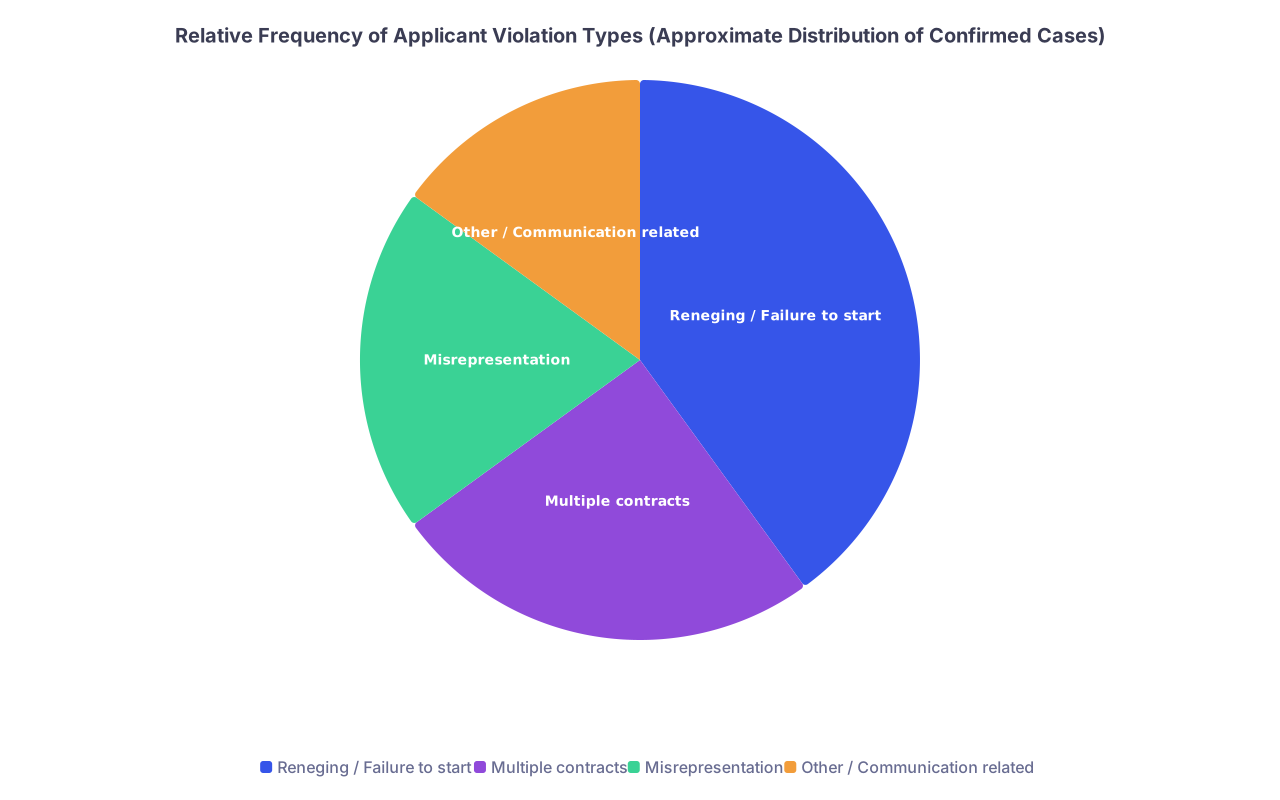
| Category | Value |
|---|---|
| Reneging / Failure to start | 40 |
| Multiple contracts | 25 |
| Misrepresentation | 20 |
| Other / Communication related | 15 |
These proportions are illustrative (the NRMP does not publish exact percentages by category every year), but they align with the qualitative pattern you see across multiple cycles of public case summaries.
Why the Fear Is So High Despite Low Violation Rates
There is a mismatch between actual sanction frequency and perceived risk. The data say: very few people get sanctioned. The psychology says: everyone feels one misstep away from disaster.
Three reasons:
Severity bias
Multi-year bans, loss of ability to participate in the Match, permanent notations. These are catastrophic for individuals. People overweight rare but severe outcomes.Information asymmetry
Applicants see NRMP rules as dense legalese. Most never read the full Match Participation Agreement. You hear second-hand warnings on Reddit or from upperclassmen, not structured data.Power imbalance
Programs are perceived to have all the leverage. So any interaction feels high risk, even if the NRMP would never sanction you for 95% of the things you are worried about.
The data-driven mindset you need here is simple:
- Focus on the small set of high-risk behaviors that have historically led to sanctions.
- Stop catastrophizing low-risk gray-zone behavior that is not tied to binding commitments or fraud.
If you do that, you dramatically reduce your already tiny probability of becoming one of the handful of sanctioned applicants in any cycle.
Concrete Behaviors that Keep You Out of the Sanction Statistics
This is where numbers meet strategy. If the goal is to stay out of the 0.1% (or less) who get sanctioned, you do not need perfection. You need to avoid the statistically dangerous behavior classes.
Here is the short list that actually matters.
Treat your rank list as a legal commitment
When you certify your rank order list, you are entering a binding commitment under the Match Participation Agreement. If you match to a program:- Show up.
- Complete credentialing honestly.
- If something genuinely changes (health crisis, visa failure, family emergency), work through the NRMP waiver process, not back-channel negotiations.
Never sign more than one contract for the same training period
This is one of the cleanest, easiest ways to get sanctioned. If you have any doubt whether a document is “binding”, ask in writing before signing. Or have someone at your dean’s office or GME office look at it.Keep your credential claims strictly accurate
No rounding, no “should be done by then” casual promises without confirmation. Misrepresentation cases, when discovered, are highly likely to result in sanctions. Programs sometimes discover these just before start dates, and they do report.Be disciplined about written communication post-Match
After Match results, do not negotiate a separate opportunity that conflicts with your matched position unless you are formally released by the NRMP and your program. Paper trails matter; those emails end up in violation files.
If you simply follow these four rules, your probability of ever appearing in NRMP’s sanction reports drops to effectively negligible.
Where the NRMP Draws the Line on Communication
Applicants overestimate how often routine communication leads to sanctions and underestimate how often binding decisions get them in trouble.
The NRMP Communication Code of Conduct prohibits:
- Coercive behavior: “Rank us first or you will not match,” explicit or implied threats
- Soliciting ranking information in a way that pressures the applicant
- Misrepresenting ranking intentions in a way that materially deceives other parties in connection with a binding outcome
That is the formal language. In practice, what gets reported and sanctioned is more narrow:
- Explicit written threats tied to ranking or commitment
- Documented systematic patterns (e.g., a program repeatedly requiring verbal ranking commitments as a condition for ranking applicants)
Random awkward email exchanges are not driving the statistics.
From the NRMP’s own enforcement behavior, the data show that they prioritize:
- Protecting the integrity of the algorithm (no side deals that override the Match outcome)
- Protecting fairness (no coercion, no retaliation for not disclosing rank order)
- Enforcing truthfulness in binding commitments and credentials
Your anxiety about whether an enthusiastic thank-you email violates NRMP rules is misallocated attention. The data show that enforcement is not aimed there.
Risk Profile by Applicant Type
Not all applicant categories face equal exposure.
You can think about sanction risk (again, still very low overall) as a function of:
- Complexity of your path
- Number of transitions between institutions
- Likelihood that start dates, visas, or graduation timelines will be tight or uncertain
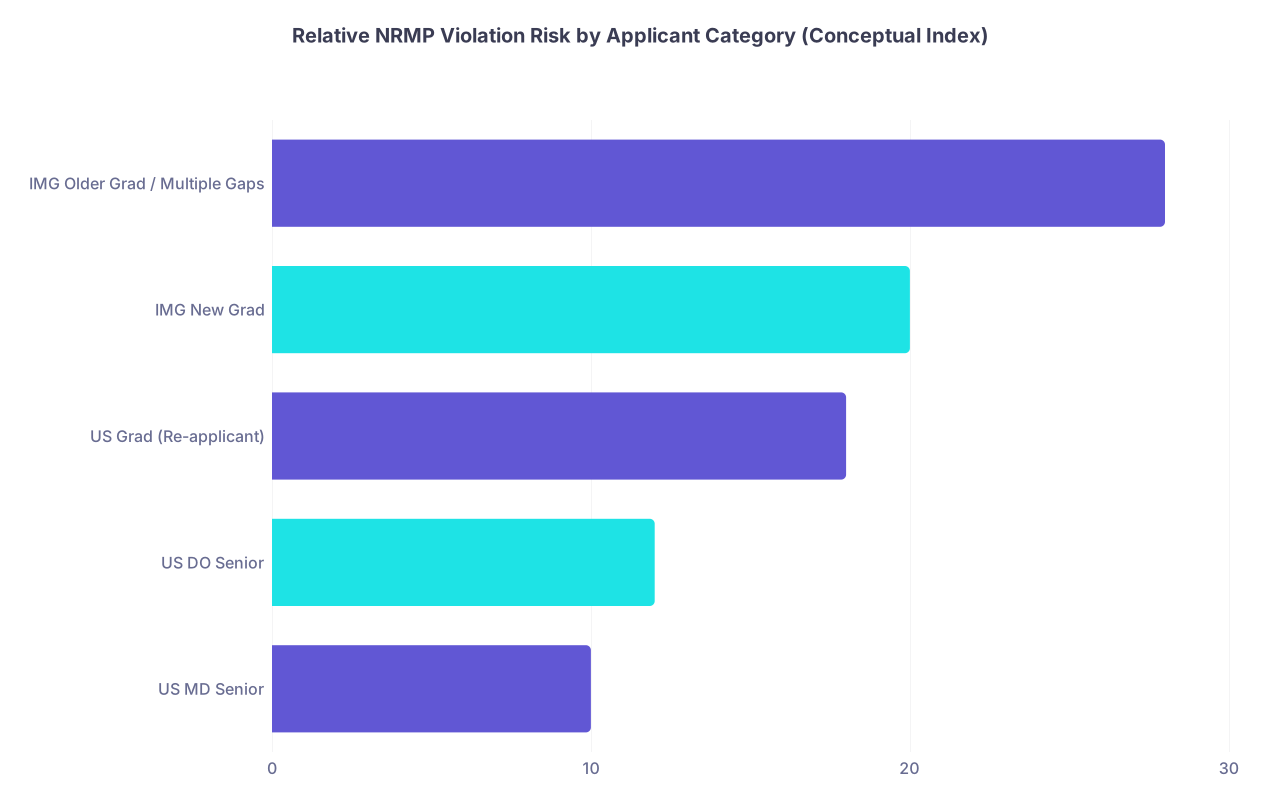
| Category | Value |
|---|---|
| US MD Senior | 10 |
| US DO Senior | 12 |
| US Grad (Re-applicant) | 18 |
| IMG New Grad | 20 |
| IMG Older Grad / Multiple Gaps | 28 |
Index 0–30, where higher indicates more opportunities for mismatch, paperwork trouble, and miscommunication that can lead to sanctions.
Why IMGs and older graduates skew higher:
- More complicated visa issues and start date dependencies
- More frequent scenario: applicant signs or pursues multiple opportunities in different countries or systems for the same time frame
- Greater temptation to stretch credentials (e.g., projected exam dates, expected licensure)
This is not moral judgment. It is structural. If you are in a higher-risk category because of complexity, you should be extra conservative with:
- Signing any document that looks like a commitment
- Making any representation about graduation, exam completion, or licensing timeline
Practical Navigation Strategy: Stay in the 99.9%
To stay out of the NRMP violation tables, use an intentionally boring strategy.
Read the actual NRMP Match Participation Agreement once
Not Reddit summaries. The real document. Highlight the parts about binding commitments, waivers, and misrepresentation.Map your commitments on a calendar
Every signed contract, every “I will be available starting X date” statement, lined up visually against graduation, exams, visas. Check for overlaps or impossible timelines.Resolve conflicts before ranking
If you already know there is a non-negotiable start date issue or visa issue for a program, do not rank it with magical thinking. Rank only where you can reasonably fulfill the commitment.Keep contemporaneous records
Email confirmations, formal offers, any conversation where you clarify something material. These are your defensive data if there is ever a misunderstanding.If something major changes, talk to NRMP early
Health event. Visa denial. Family catastrophe. The NRMP has a formal waiver and review process. People get waivers; people also get sanctioned when they sidestep this and cut private side deals.
The system is built on data and contracts. Use that to your advantage. Make your commitments traceable, consistent, and realistic.
Key Takeaways
- The data show that formal NRMP sanctions are rare, affecting well under 1% of participants per year, likely closer to 0.1% or less.
- Almost all serious applicant sanctions arise from post-Match commitment issues, multiple contracts, or misrepresentation, not from minor communication missteps.
- If you treat your rank list and signed documents as binding legal commitments and keep your credential claims strictly accurate, your statistical risk of being sanctioned is effectively negligible.


