

It is mid-January. Your interview season is tapering off, your email is quieter, but your anxiety is not. You are staring at your rank list draft and thinking:
“I liked Program A, but I only saw the VA. I never saw the main hospital. Can I go back?”
Then a co‑applicant says, “Our dean told us second looks are basically illegal now.” Someone else says, “No, they are allowed, you just have to be careful.” Another person forwards a screenshot from an anonymous Reddit thread quoting the NRMP—wrongly.
Let me clean this up.
You are not going to get in trouble with the NRMP for simply stepping inside a hospital or doing a second look. But there are very specific lines programs and applicants cannot cross—especially around pressure, promises, and quid‑pro‑quo behavior. Those are what get people reported.
I am going to walk you through what is actually allowed, what is prohibited, and how to handle second looks and onsite visits without stepping into an NRMP violation or shooting yourself in the foot.
1. What the NRMP Actually Regulates (And What It Does Not)
First, scope. The NRMP is not the travel police. They do not care if you physically visit a city, walk through a lobby, or grab coffee with a resident. They care about behaviors that threaten:
- The integrity of the match algorithm
- The voluntariness of rank order lists
- Fairness across applicants
The relevant framework is the NRMP Match Participation Agreement (MPA). Two sections matter most for second looks / onsite visits:
- Communication policies
- Prohibitions on coercion and commitments
Now, since people keep conflating “NRMP rules” with “program policies,” I will separate them clearly.
| Issue | NRMP Controls? | Individual Program Controls? |
|---|---|---|
| Whether you may visit in person | No | Yes |
| Whether they host formal second looks | No | Yes |
| Pressure to reveal rank order | Yes (prohibits) | No (must comply with NRMP) |
| Requiring commitments to rank high | Yes (prohibits) | No (must comply with NRMP) |
| Scheduling logistics, tour format | No | Yes |
So, “Are second looks banned by NRMP?”
No. That is simply false.
What is banned: using second looks (or any visit) as a way to extract commitments, pressure, or promises.
2. Core NRMP Rules You Need To Know
Let me strip NRMP language down to the parts that matter for you. You can always go read the full MPA, but here is the functional translation.
2.1 No Promises, No Guarantees, No Quid Pro Quo
Programs may not:
- Ask you to promise you will rank them #1
- Ask you to change your rank list
- Say or imply “If you rank us highly, we will rank you highly”
- Condition their rank list on your visit (e.g., “We will rank only those who attend the second look”)
You may not:
- Offer commitments in exchange for ranking
- Say “I will rank you #1 if you promise to rank me to match” and treat that as some contract
Those kinds of “understandings” are explicitly prohibited by the NRMP.
2.2 No Soliciting Rank Order Information
Programs are prohibited from requesting or pressuring you to disclose your rank order intentions.
Red‑flag program questions (these run close or over the line):
- “Where are we on your rank list?”
- “Are we your top choice?”
- “If we rank you to match, will you rank us to match?”
Your obligations:
- You are allowed to voluntarily express interest (“You’re my top choice” etc.).
- But you are never required to reveal your rank list.
- You are allowed to decline to answer or answer in a non‑committal but polite way.
2.3 No Conditional Second Looks or Conditional Benefits
A subtle but important point for second looks:
Programs cannot:
- Make attendance at a second look required to be ranked
- State or strongly imply that attending will meaningfully change your place on their list
- Offer special treatment that depends on how you say you will rank them
Sometimes they do this in coded language: “Attending will certainly help your application” or “We only rank people who demonstrate strong interest.” That kind of phrasing dances on the edge. I have seen NRMP compliance officers warn programs about this.
Your side: you can visit. You can show interest. But you want to avoid being drawn into any discussion that sounds like “You do X, we will rank you Y.”
3. Second Looks vs Other Onsite Visits: Clear Definitions
Part of the confusion comes from lumping all visits together. Let me separate them.
3.1 “Second Look” – The Classic Scenario
Definition in practice: a program‑organized post‑interview visit intended to give you another look at facilities, residents, or the city, often after interviews are complete.
Typical features:
- Scheduled group or individual in‑person day
- Optional (at least on paper)
- Sometimes resident‑led tours, shadowing in conference, dinner, etc.
- Usually no formal interview, but you may have conversations with leadership
NRMP stance:
Allowed. But communications during that day still fall under the MPA. No rank list coercion, no commitments.
3.2 Informal Onsite Visit
These are applicant‑initiated visits that are not part of a structured second look day.
Examples:
- You happen to be in town for another interview and ask to swing by for a quick tour
- You meet residents for coffee off‑site
- You walk through the hospital yourself and get a feel for the location
NRMP stance:
Also allowed. The same communication and coercion rules apply. The risk here is lower simply because there is no formal structure, but a careless program director can still say something dumb and cross a line.
3.3 Pre‑Interview vs Post‑Interview Visits
Pre‑interview visit (e.g., you are a visiting student, or you shadow before being offered an interview):
- NRMP rules still apply if both sides are participating in the Match
- But coercion and rank‑order talk are less relevant until an interview occurs
Post‑interview visit (most second looks):
- This is where NRMP is paying attention. Any impression that a program is using the visit to manipulate your rank list can be problematic.
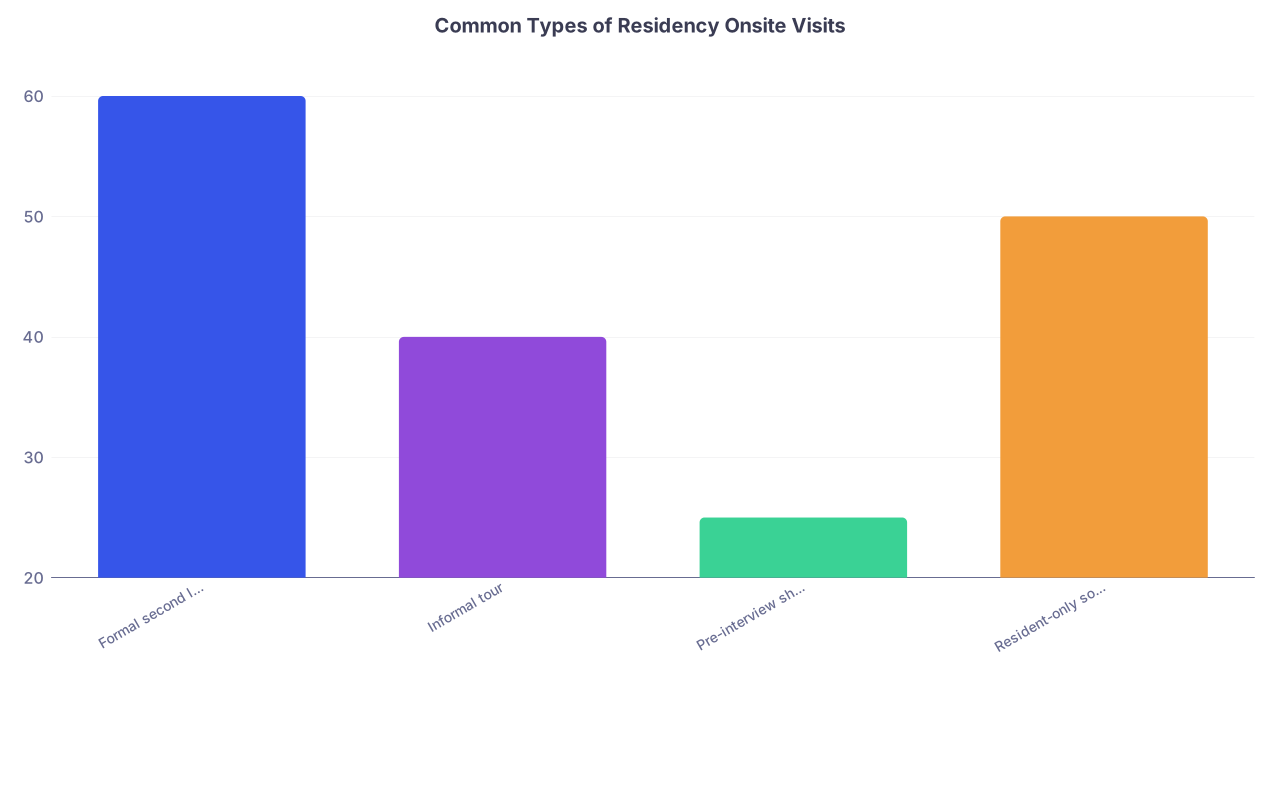
| Category | Value |
|---|---|
| Formal second look | 60 |
| Informal tour | 40 |
| Pre-interview shadow | 25 |
| Resident-only social | 50 |
(Values here are not exact statistics; they just illustrate relative commonness.)
4. What Programs Are Allowed To Do During Second Looks
Let me be specific, since people get paranoid and assume everything is illegal.
Programs may:
- Host optional, clearly voluntary second look days
- Offer tours of clinical sites they could not show on interview day
- Arrange resident‑only Q&A sessions
- Provide more detailed information about schedules, elective time, fellowships, etc.
- Explain how their program ranks applicants in general terms (“We value letters, clinical performance, fit, etc.”)
- Ask what questions you still have about the program or the city
- Accept your thank‑you emails, update letters, and “I will rank you highly” letters
They may even tell you:
- “You will be ranked on our list”
- “We were impressed with you”
- “We think you would fit well here”
Those are not violations by default. They veer into violation territory when the conversation tries to create a mutual ranking contract or extract your rank list.
5. What Programs Cannot Do – Applied Specifically to Second Looks
Let me phrase these as real‑world scenarios.
A PD says during your second look:
“If you come to the second look, it shows commitment. We only rank people who demonstrate commitment.”
Problem: Strong implication that attending second look is a condition for ranking. At minimum this is NRMP‑uncomfortable.During a one‑on‑one in the PD’s office:
PD: “We really like you. Where will you rank us?”
You: “I am still finalizing my list.”
PD: “If you rank us first, I will rank you high enough to match.”
This is classic NRMP no‑go. Conditional commitment tied to your rank order. If reported and documented, this is grounds for a program violation.Coordinator emails:
“Attendance at second look is highly recommended and may impact our ranking decisions.”
Again, that word “impact” is the problem. It explicitly links ranking decisions to visit attendance.
This is where NRMP sanctions hit: program citations, potential participation restrictions in future matches, and formal listing as a violator. Programs take that seriously when they are paying attention.
6. What You Are Allowed To Do (And How To Do It Smartly)
You have rights here. Use them.
6.1 You May Visit – With Some Basic Self‑Protection
You can:
- Request second looks or onsite visits
- Accept invitations for optional second looks
- Ask to see parts of the program you missed
- Meet residents, ask candid questions, compare cultures
Strategic tips:
- If you are visiting between January and February, assume anything you say might be interpreted as ranking‑related.
- Keep your language on interest honest but non‑binding unless you are very sure.
- Do not let FOMO force you into expensive travel that adds nothing to your decision‑making.
6.2 What You Can Say Safely
Safe phrases:
- “I am very interested in your program.”
- “You are among the programs I am strongly considering near the top of my list.”
- “I could see myself training here.”
- “I appreciate the second look; it helped me understand X and Y.”
If you truly know they are your #1 and you want to tell them:
- “After my interviews and visits, your program is my top choice. I plan to rank you first.”
This is allowed. Applicants can express these preferences. Just remember: NRMP considers all such statements non‑binding. And programs are not required to act on them.
6.3 How To Respond When Pushed About Your Rank List
You are in a PD office during a second look and they ask:
“Where are we on your list?”
Better responses:
- “I am still finalizing my list, but I am very interested in your program.”
- “I am trying to keep my rank list private, but I can say I would be very happy to match here.”
- “I prefer not to disclose the details of my list, but I really appreciate this visit and value your program highly.”
That is firm, polite, and NRMP‑aligned. If they push harder, that is their problem, not yours.
7. Are Second Looks Worth It? Strategic Considerations
Let me be blunt. Second looks are often oversold.
7.1 When Second Looks Actually Add Value
They can be useful when:
- You interviewed virtually and have never physically seen the hospital, call rooms, or city
- You are torn between 2–3 top programs and need a feel for culture and workflow
- You want to meet residents without the performance pressure of interview day
- You had a very short or odd interview and need more data
If your decision hinges on feel—how residents interact, how attendings talk to them, workflow in the ED or wards—a well‑structured second look can absolutely clarify things.
7.2 When Second Looks Are Mostly Noise
They are usually not worth it when:
- You are visiting a place that is clearly lower on your list and will not surpass your top tier
- You are traveling cross‑country at great expense for minimal additional information
- The program heavily choreographs the visit, and you only see a polished slice of reality
- You are hoping the second look itself will move you up on the rank list
(They may say they do not factor it in. Sometimes that is true, sometimes not. Either way, you cannot control it.)
You are not going to strong‑arm your way into a match by showing up again. Programs rank based on your file, interviews, and institutional fit. A second look can hurt you if you come off as pushy, awkward, or overly self‑promotional.
8. Financial and Equity Issues: NRMP’s Unstated but Real Concern
One reason there has been more negative chatter around second looks lately: equity.
Well‑funded applicants can afford multiple flights and hotels. Others cannot. If programs start:
- Relying heavily on second looks as a metric of "interest"
- Informally penalizing those who do not attend
…that skews the playing field. NRMP cares about fairness structurally, even if the MPA does not say “you may not host second looks.”
Some programs have responded by:
- Eliminating formal second looks altogether
- Switching to virtual “second look” open houses
- Explicitly saying: “We do not track or consider whether you attend.”
If you see such language, they are often trying to stay on the right side of both equity and compliance. Take them at their word unless you have a strong reason not to.
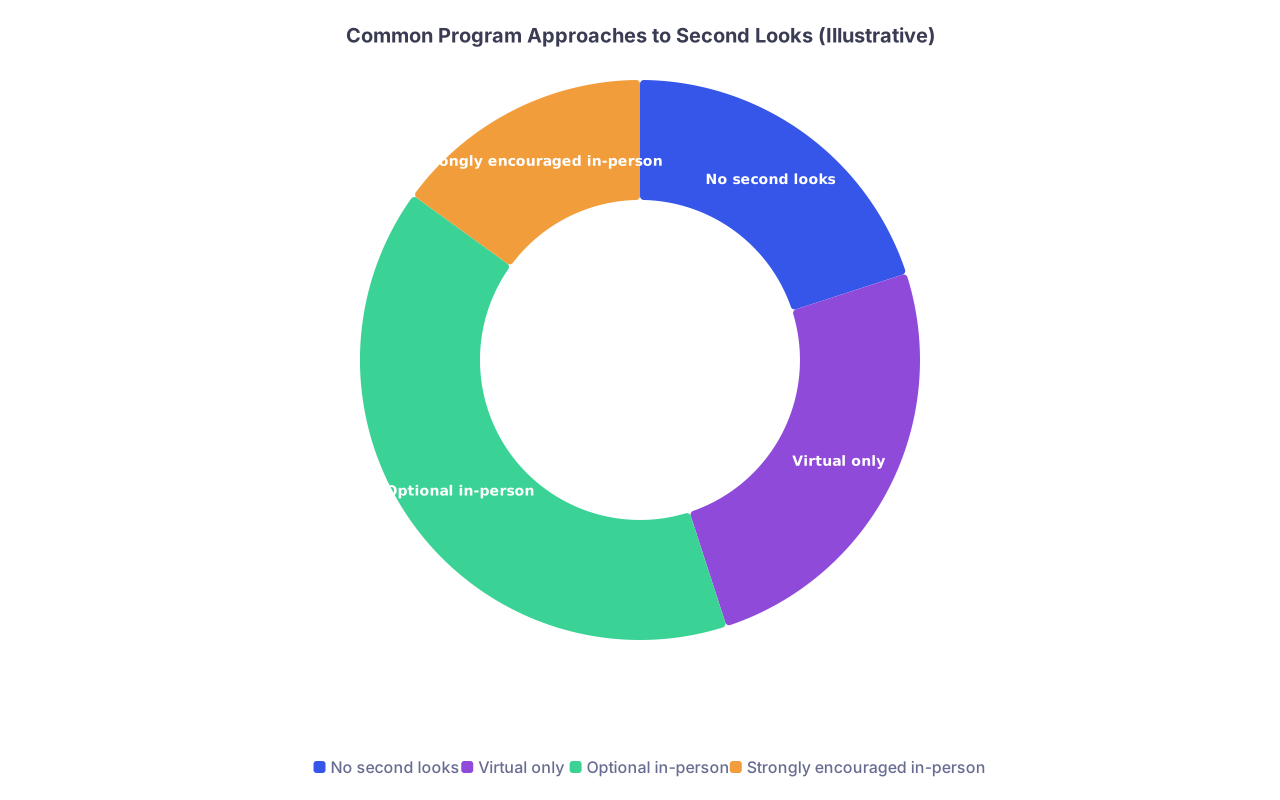
| Category | Value |
|---|---|
| No second looks | 20 |
| Virtual only | 25 |
| Optional in-person | 40 |
| Strongly encouraged in-person | 15 |
9. Practical Scripts and Email Templates
Let us get concrete. Here is how you actually handle this in your inbox and in person.
9.1 Email: Requesting an Optional Visit
Subject: Question Regarding Additional Visit Opportunity
Body (condensed):
Dear [Coordinator/Program Director],
I greatly appreciated the opportunity to interview with [Program Name] on [date]. I remain very interested in your program.
I will be in [City] on [date] for another commitment and wanted to ask whether there might be an opportunity for a brief visit to see [specific site / hospital] that I did not see on interview day. I understand if this is not possible and do not want to impose on your team’s time.
Thank you again for your consideration.
Sincerely,
[Name, AAMC ID]
Neutral, NRMP‑safe, and respectful of their time.
9.2 Email: Responding to a Formal Second Look Invitation
If you can attend:
Dear [Coordinator],
Thank you for the invitation to your second look day on [date]. I would be happy to attend and look forward to learning more about [Program Name].
Best regards,
[Name]
If you cannot attend (and you want to make clear this should not hurt you):
Dear [Coordinator],
Thank you for the invitation to your second look day. Unfortunately, due to [pre‑existing obligation / financial constraints / travel limitations], I will not be able to attend.
I remain very interested in [Program Name] and am grateful for the opportunity to have interviewed with you.
Sincerely,
[Name]
You do not need to grovel or overshare.
9.3 In‑Person: Handling Rank‑Fishing Questions
PD: “Are we your first choice?”
You:
“I am still finalizing my rank list, but your program is one of my top choices, and I would be very happy to train here.”
If they press:
“I prefer to keep the exact order of my list private, but I truly appreciate your consideration and would be excited to match here.”
Calm, firm, and NRMP‑aligned.
10. What Happens If Someone Violates NRMP Rules?
Worst‑case scenario questions always float around: “What if this PD clearly broke the rules, and I was in the room?”
10.1 Reporting Options
You can:
- Contact your dean’s office or student affairs; they often have direct NRMP contacts
- File a report directly with NRMP, usually requiring documentation (emails, written statements, etc.)
NRMP investigates when there is credible, documented evidence: emails, standardized patterns, multiple complainants.
10.2 Risk to You
NRMP is not in the business of punishing applicants who report violations. Your bigger practical worry is relational: if a single small program knows you reported them, they might be annoyed. But they do not control your entire career.
What I have seen more commonly:
Students document egregious behavior, talk to their dean, and sometimes the dean addresses it informally with the PD or GME office. NRMP gets involved when the pattern is systemic or affects many applicants.

| Step | Description |
|---|---|
| Step 1 | Witness concerning behavior |
| Step 2 | Document privately |
| Step 3 | Discuss with dean or advisor |
| Step 4 | Collect documentation |
| Step 5 | Consult dean / GME office |
| Step 6 | Consider NRMP report |
| Step 7 | Minor or serious? |
11. How To Use Second Looks Strategically (Without Losing Your Mind)
Let me consolidate this into a usable decision structure.
Ask yourself three questions:
Will this visit materially change my rank list?
If the honest answer is “no,” save your money and your time.Am I going primarily because I think it will move me up their list?
Bad reason. Occasionally it helps, but usually not in a predictable way, and never in a way you can verify.Am I financially and logistically stretched thin already?
If yes, be ruthless. Use virtual conversations, additional emails, and residents’ contacts instead.
Second looks should be a decision‑making tool, not a performance of devotion.
FAQs
1. Are second looks against NRMP rules now?
No. NRMP does not ban second looks or onsite visits. What they prohibit is using those visits to pressure applicants about rank lists, extract commitments, or condition ranking on attendance. Second looks are allowed as long as programs follow the Match Participation Agreement communication rules.
2. Will not attending a second look hurt my chances of matching at that program?
If a program tells you attendance is optional and not used in ranking, they are bound by the NRMP to avoid coercive behavior. Good programs do not penalize you for non‑attendance, especially recognizing financial and geographic inequities. In practice, most ranking decisions are driven by your interview performance and application, not whether you made an extra trip.
3. Can I tell more than one program that they are my “top choice”?
You can, but you should not. NRMP does not police your expressions of interest, but sending multiple “you are my #1” messages is ethically dubious and occasionally backfires when faculty know each other. Say “top choice” to exactly one program if you choose to use that phrase at all. To others, use “very interested” or “one of my top choices.”
4. What if a program director says, “If you rank us first, we will rank you to match”?
That is an NRMP violation on their side. You do not have to agree, and you should not treat it as a binding promise. You can respond non‑committally (“I am still finalizing my list, but I am very interested in your program”). If it feels egregious or part of a pattern, document the interaction and discuss it with your dean or advisor, and consider reporting it through appropriate NRMP channels.
Key takeaways:
- Second looks and onsite visits are allowed; coercive communication about rank lists is not.
- Use second looks only when they will genuinely clarify your ranking, not as a desperate way to “boost” your position.
- Protect yourself with clear, non‑committal language when programs push about ranking, and involve your dean or NRMP if you encounter serious violations.


