

The fastest way to get investigated by the NRMP is to “reassure” applicants about your rank list.
The NRMP Rules Most People Only Half‑Understand
Let me be blunt: most residents, many faculty, and more than a few PDs do not actually know what NRMP Communication Code says. They rely on tradition, hearsay, and what their chief told them in a 5‑minute “be careful” speech.
That is how people accidentally commit match violations.
Here is the core legal spine you must internalize:
- Programs and applicants may volunteer rank intentions.
- Programs and applicants may not:
- Request rank information from the other side.
- Make any commitment (or appear to make one) about ranking, matching, or offering a position outside the Match.
- Condition anything (interview offer, rank position, scholarships, couples considerations) on rank behavior.
The exact line that trips people up:
“Both applicants and programs may volunteer information about intentions, but may not solicit such information or make statements implying a commitment.”
That single sentence is the difference between “We will rank you highly” (permissible) and “We are ranking you to match” (prohibited).
Let me walk you through this in concrete, NRMP‑style case examples.
The Communication Code in Plain Language
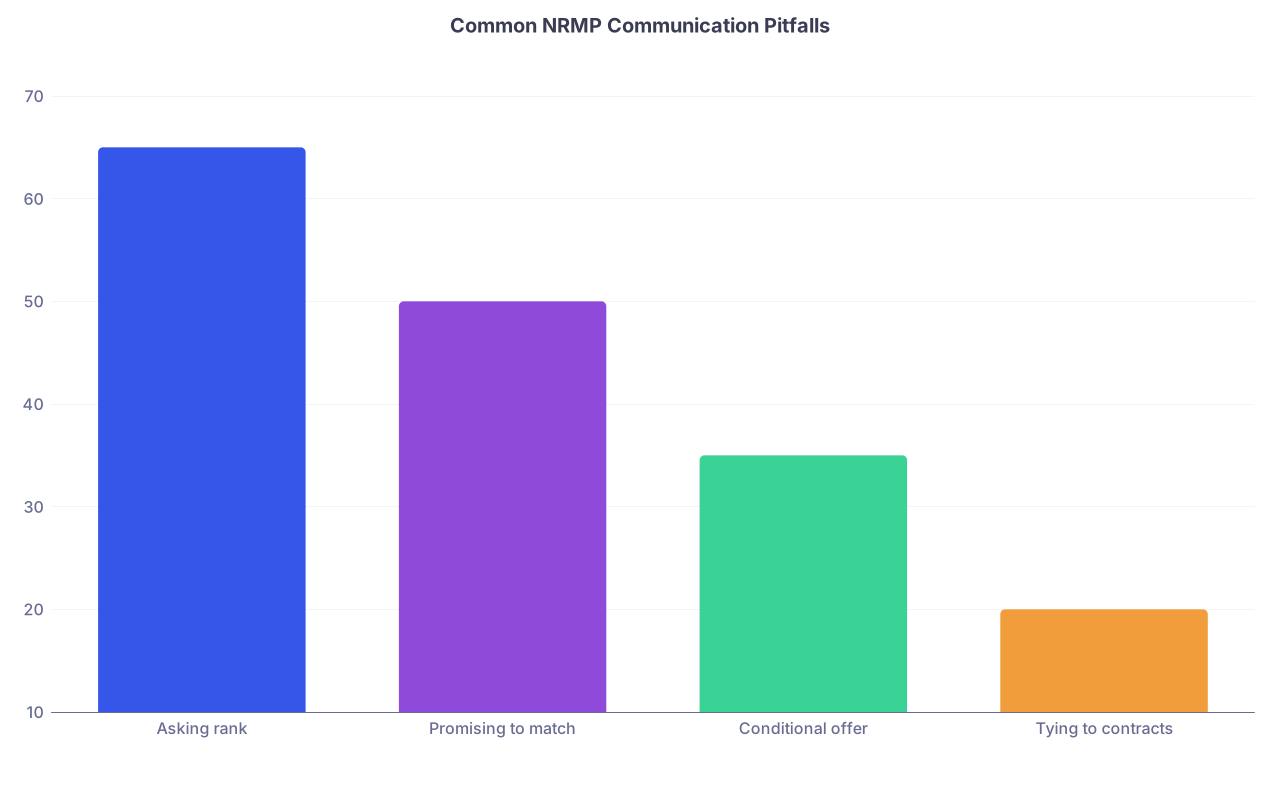
| Category | Value |
|---|---|
| Asking rank | 65 |
| Promising to match | 50 |
| Conditional offer | 35 |
| Tying to contracts | 20 |
Think of NRMP communication rules as three buckets:
- Clearly permissible – Safe, explicitly allowed.
- Clearly prohibited – Cited repeatedly in NRMP violation reports.
- Gray zone, but dangerous – Technically might not be a formal violation, but gets you uncomfortably close to “appearance of a commitment.”
What is allowed (and actually written as allowed)
You may:
- Tell a program “You are my number one choice.”
- Tell an applicant “We will rank you very highly.”
- Send thank‑you notes and post‑interview updates.
- Express strong interest, enthusiasm, or desire to match.
- Ask neutral questions about program factors, not rank behavior:
- “Do you anticipate filling all your positions through the Match?”
- “Is there any preliminary feedback about my fit with your program?”
You just cannot connect any of this to specific ranking or promises.
What is prohibited
You may not:
- Ask:
“Where will you rank us?”
“Are we your number one?”
“Will you rank us to match?” - Say anything that functions like a promise or guarantee:
- “We will rank you to match.”
- “If you rank us first, you will match here.”
- “We guarantee you a spot.”
- Offer anything conditional on rank behavior:
- “If you rank us first, we will make sure you get your preferred electives.”
- “Rank us top 3 and we can help your spouse with a job.”
- Discuss or request signed commitments before Match Day:
- Letters of intent that read like bilateral contracts.
- “Sign this to indicate you will rank us first.”
- Use rank behavior in any decision before ranking:
- Granting/withholding an interview based on an applicant saying they will or will not rank a program highly.
Now let us make this real with very specific dialogue‑level examples.
Applicant‑Side Rank List Talk: What You Can and Cannot Say

Applicant emails – side‑by‑side examples
These are scenarios I have actually seen or reviewed versions of.
Case A: Applicant telling a program they are #1
Scenario: February. Applicant loves Program X and wants to send a “you are my top choice” email.
Permissible version:
Subject: Continued strong interest in [Program X]
Dear Dr. Smith,
Thank you again for the opportunity to interview at [Program X]. After completing my interviews, I remain convinced that your program is the best fit for my training and long‑term goals. I plan to rank [Program X] as my top choice.
Sincerely,
[Name]
That is allowed. Applicant can voluntarily share rank intentions. No one requested it. No conditions. No ask for reciprocation.
Prohibited version:
“…I will rank [Program X] first if you can confirm that I will match there.”
The “if you can confirm” is the problem. You are effectively asking the program to give a commitment or guarantee. You are inviting them to violate rules. That is not allowed.
Semi‑dangerous (but technically still allowed) version:
“…I will rank [Program X] #1 and hope that you will rank me to match.”
Is this a violation by itself? Usually not. But it veers toward “pressure” and could be interpreted as seeking specific rank behavior. You do not need that line. Cut it.
Applicants answering direct questions – what to do
Case B: Program asks, “Where will you rank us?”
This is explicitly prohibited for the program to ask. You, as the applicant, are not obligated to answer.
Safe response:
“I have not finalized my rank list yet, but I am very interested in your program. I am trying to focus my decisions on program fit rather than sharing specific rankings.”
Or shorter in person:
“I’m still finalizing my list, but I’m very interested in your program.”
Do not let anyone push you into specifics. If they keep pressing, you can calmly repeat:
“I am not comfortable sharing my exact rank order, but I have a strong interest in your program.”
If you feel the questioning is clearly in violation, you can later contact NRMP for guidance. Document date, setting, exact wording, and who was present.
Program‑Side Rank List Talk: Exact Phrases That Get People In Trouble
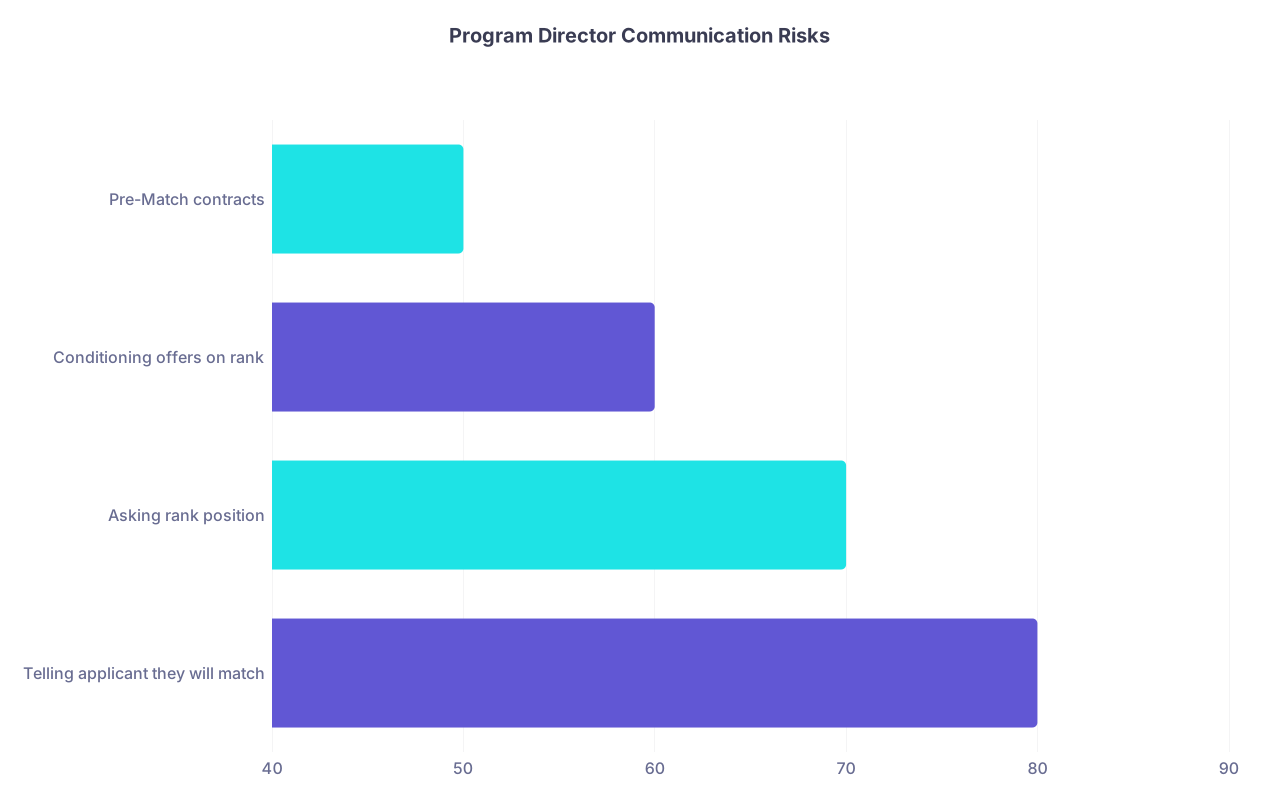
| Category | Value |
|---|---|
| Telling applicant they will match | 80 |
| Asking rank position | 70 |
| Conditioning offers on rank | 60 |
| Pre-Match contracts | 50 |
I have seen well‑meaning faculty walk straight into NRMP violations using phrases they thought were “just being nice.”
Here is the structure you should remember:
- Talking about interest and fit = safe.
- Talking about rank position in approximate terms = usually safe.
- Talking about match outcomes (“you will match here”) = not safe.
Case C: Classic PD email – “We will rank you very highly”
Scenario: Post‑interview, the PD emails an applicant:
Permissible:
“We were very impressed with you and believe you would be an excellent fit for our program. We expect to rank you very highly.”
This is expressly permissible under NRMP. Programs may voluntarily disclose interest or generic ranking intentions (“rank you very highly”).
Where people go wrong is when they shift from intention to commitment.
Prohibited:
“You are ranked to match.”
“You will match here.”
“We have ranked you to match our first position, and we fully expect that you will be joining us.”
Those statements cross the line into commitments about outcomes. NRMP has sanctioned programs for exactly this type of language.
Case D: The hallway comment – “You’re in”
Scenario: Interview day is winding down. A faculty member pulls an applicant aside:
“You’re in. You impressed everyone. I am sure we will see you in July.”
Faculty think they are being encouraging. NRMP sees potential violation. Why? It implies a guarantee of a training position, dependent on the Match algorithm.
Safer alternative faculty can use:
“You did very well today. I think you would be a great addition to our program and I hope you rank us highly.”
No promise. No outcome guarantee. Expression of enthusiasm only.
Case E: Asking applicants about their rank order
This is the most common outright violation.
Program director in a Zoom “exit interview”:
PD: “So, where are you planning to rank us?”
Applicant: (awkward pause) “I’m still deciding, but you’re near the top.”
PD: “Are we your number one?”
This is prohibited. NRMP is quite clear: programs may not solicit information about how applicants plan to rank programs.
I have seen NRMP’s violation documents where this exact exchange was cited almost verbatim.
If you are a PD or faculty:
- Do not ask “Are we your number one?”
- Do not ask “Will you rank us highly?”
- Do not ask “Are we your top three?”
You can reverse‑engineer your desire in a legal way:
“We really like you and think you would do well here. We hope you will consider ranking us highly.”
You are expressing hope, not requesting specific rank information.
Specific NRMP‑Style Case Examples (Modeled on Real Violations)
| Scenario | Permissible Statement | Prohibited Statement |
|---|---|---|
| Post-interview email | "We will rank you very highly." | "We will rank you to match." |
| Applicant interest | "You are my top choice." | "I will rank you #1 if you guarantee I will match." |
| During interview | "We hope you will consider us strongly." | "If you rank us first, you will match here." |
| Faculty hallway chat | "You would be a great fit here." | "You are in; we will see you in July." |
| Rank discussion | None (do not ask) | "Where will you rank our program?" |
Case 1: The “Rank us first and you’re guaranteed” disaster
Facts (composite of several violations NRMP has published):
- Specialty: Competitive surgical program.
- PD, during interview dinner, says to top applicant:
“If you rank us first, I can assure you that you will match here.”
- Applicant later matches somewhere else, feels misled, and files a complaint with NRMP.
Why this is a violation:
- It directly conditions a training position on an applicant’s rank behavior.
- It functions as a guarantee or commitment about the Match outcome.
- It undermines the independence of the rank list.
NRMP response in similar cases has included:
- Finding of a Match violation.
- Public posting of program name in NRMP’s violation report.
- Possible sanctions on the program’s future participation.
Case 2: Asking a couples match pair to send rank list
Scenario:
- Internal medicine program tells a couples‑matching pair:
“To help us support your couples match, please send us your full rank order list so we can optimize ours accordingly.”
On first glance, that sounds collaborative. In reality, you are requesting specific rank information. Programs can consider that the pair is couples matching; they cannot demand the contents of the rank list.
Permissible variant:
“We understand you are participating in the couples match. You are welcome to let us know if we are among your top choices, but you are not obligated to share your rank list with us.”
Or:
“We will review your applications with the couples match in mind, but we recognize that your rank list is confidential and we will not ask you to disclose it.”
The line is whether you are soliciting exact rankings or full lists.
Case 3: The “We’re ranking you #2” phone call
Scenario:
- PD calls an applicant in late February:
“I want to let you know you are our #2 choice. If our #1 goes elsewhere, you will be with us.”
Is that a violation? It is not as black‑and‑white as “we will rank you to match,” but it is still problematic.
Why it is dangerous:
- It gives the applicant the impression of a quasi‑guarantee.
- It implicitly manipulates the applicant’s rank behavior.
- It goes beyond generic “we will rank you highly” into specific list architecture.
If NRMP reviewed this, they would be looking at whether the communication created an apparent commitment. I would not advise any PD to do this.
Best practice: Do not disclose explicit rank positions (1, 2, 3). Stick to “very highly” if you feel compelled to say anything.
Hidden Traps: Pre‑Match Contracts, Institutional Bonuses, and Off‑Cycle Deals

| Step | Description |
|---|---|
| Step 1 | Applicant interviewed |
| Step 2 | Program expresses strong interest |
| Step 3 | NRMP solicitation violation risk |
| Step 4 | Safe interest communication |
| Step 5 | Clear NRMP violation |
| Step 6 | Still problematic |
| Step 7 | Program asks about rank? |
| Step 8 | Adds conditional offer? |
NRMP’s view is not limited to spoken words. They care about any agreement or arrangement that undermines the Match.
Pre‑match “letters of intent” that function like contracts
Applicants like to send “letters of intent.” Programs sometimes like to elicit them. The content decides whether they are harmless or toxic.
Permissible applicant letter:
“I plan to rank your program first.”
This is allowed if truly unilateral and voluntary.
Dangerous version (especially if requested by the program):
“I commit to ranking your program first, and in return you have committed to ranking me to match.”
Now we have a bilateral commitment outside the Match. If a program asks someone to sign this, it is playing with fire.
NRMP has treated signed agreements outside the Match as serious violations, particularly if they influence ranking behavior.
Signing contracts or GME paperwork before Match Day
General rule:
- You should not be signing an employment contract for a categorical residency spot before the Match.
- For fellowships and non‑NRMP matches, rules may differ; but for NRMP main residency, early binding contracts are a problem.
Example violation scenario:
- Program emails top applicant:
“We consider you our top candidate. Please sign this contract now, and we will withdraw our participation in the Match for this position.”
If this involves an NRMP‑participating position, it is very likely a violation. There are narrow, highly regulated exceptions (e.g., certain pre‑Match agreements in some specialties or institutional rules), but they are not the norm.
When in doubt: if it looks like a binding employment agreement for a position that is supposed to go through NRMP, press pause and ask your dean’s office or NRMP.
Social Media, Texts, and Off‑the‑Record Conversations

NRMP does not care that it happened on WhatsApp or Instagram DMs. A violation is a violation.
Case 4: Chief resident group chat
Scenario:
- Chief starts a group chat with interviewees:
“You all are our top tier, PD is planning to rank you to match. If you rank us first, there is basically no way you will not match here.”
Even though a chief is not the PD, they act on behalf of the program. NRMP will treat this as a program communication, not “just personal opinion.”
This crosses the line in two ways:
- Suggests a near‑guarantee of outcome.
- Links it explicitly to the applicant’s rank behavior (“if you rank us first”).
Safer text a chief can send:
“It was great meeting you all. We really enjoyed this group and hope you consider us strongly on your rank lists. Let us know if you have questions about the program.”
Enthusiastic, but neutral in terms of commitments.
Case 5: Applicant DM’ing a resident, “Where do you think I’ll fall on the list?”
Technically, the applicant asking is not the issue. The problem is what the resident says in reply.
Unsafe reply:
“You interviewed incredibly well. From what the PD said, I’m pretty sure they are ranking you to match.”
Better reply:
“I don’t know your exact rank position and could not speculate. I can say the program really liked you and you seemed like a great fit. The Match algorithm is designed so you should rank programs in your true order of preference.”
Notice the resident deflects speculating on the internal list.
How to Talk About Rank Lists Safely – Practical Phrasing Guide
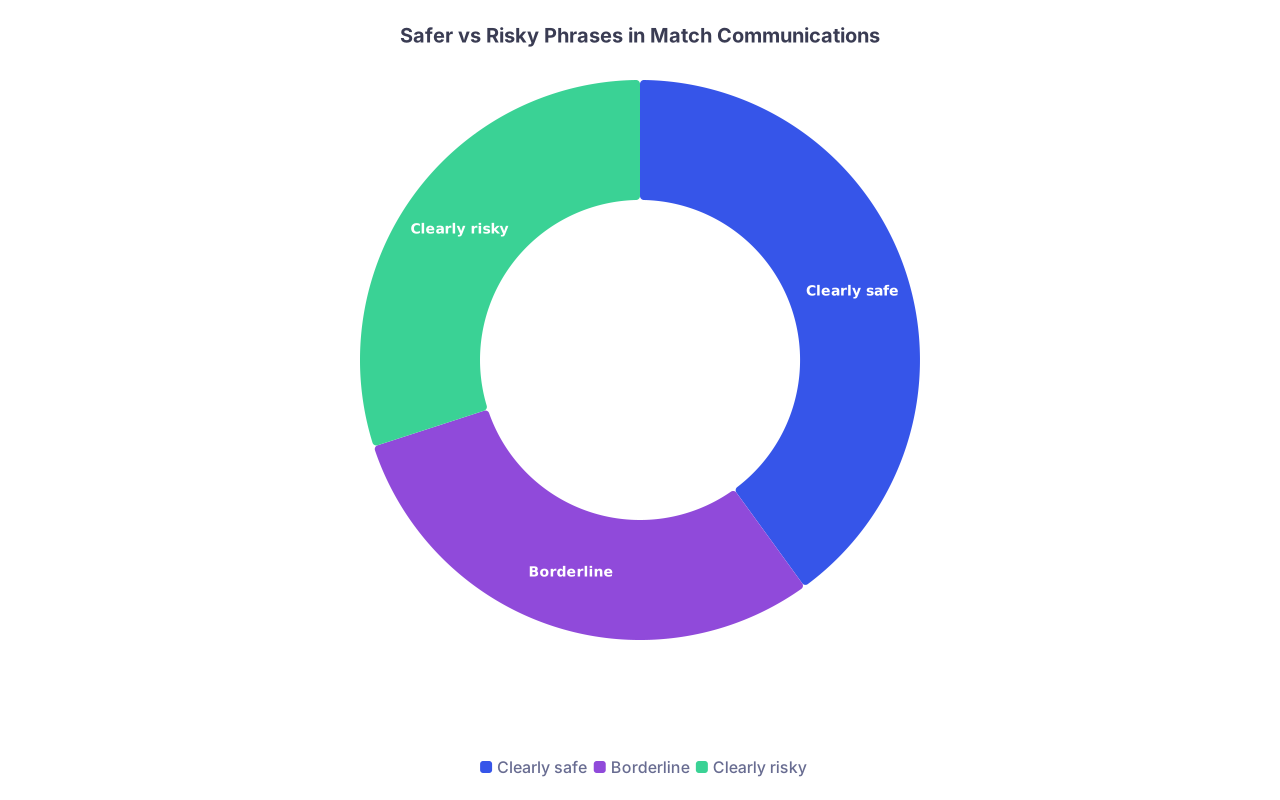
| Category | Value |
|---|---|
| Clearly safe | 40 |
| Borderline | 30 |
| Clearly risky | 30 |
Here is how I coach people (on both sides) to phrase things.
Safe phrases for programs
Use:
- “We were very impressed with you.”
- “You are a strong candidate and would fit well here.”
- “We hope you will consider us highly on your rank list.”
- “We expect to rank you very favorably.”
- “We cannot discuss specific rank positions, but we remain enthusiastic about you as a candidate.”
Avoid:
- “We will rank you to match.”
- “You will be our number one.”
- “If you rank us first, you will match here.”
- “We know you will be here in July.”
- “Tell me how you plan to rank us.”
Safe phrases for applicants
Use:
- “You are my top choice.”
- “I plan to rank your program highly.”
- “I feel your program is the best fit for my goals.”
- “Thank you again for the interview; my visit reinforced my strong interest.”
Avoid:
- “I will rank you first if you promise to rank me to match.”
- “Can you confirm I will match if I rank you first?”
- “I expect that since I’m ranking you #1, you will guarantee me a spot.”
- “If I sign this letter saying you are my #1, you will rank me first, right?”
What To Do If You Witness or Experience a Violation

| Step | Description |
|---|---|
| Step 1 | Notice concerning comment |
| Step 2 | Write down exact words |
| Step 3 | Identify who said it and when |
| Step 4 | Discuss with dean or trusted advisor |
| Step 5 | Contact NRMP for guidance |
| Step 6 | Document and monitor |
| Step 7 | Serious or repeated? |
I have seen students freeze when a PD asks, “Are we your number one?” They know it feels wrong, but they do not know what to do.
Here is the practical playbook.
During the encounter
Stay calm. You are not going to “fix” the PD in the moment. Protect yourself.Responses you can use:
- “I am still finalizing my rank list, but I am very interested in your program.”
- “I have been advised not to share specific rank positions, but I can say I am strongly considering your program.”
Immediately after
While it is fresh, write down:- Exact words used
- Date and time
- Names and roles of people present
- Setting (Zoom, clinic room, interview day social, etc.)
Talk to someone who knows NRMP
Your dean’s office, student affairs, or a trusted faculty adviser. Many schools have someone designated as the “Match liaison” who understands these issues.Decide on next steps
If the behavior was egregious or part of a pattern (e.g., conditional offers, explicit promises), you can:- Contact NRMP directly. They can advise anonymously.
- File a formal complaint if warranted.
I have seen NRMP quietly reach out to programs with reminders without blowing up an entire Match, when the issue was more “ignorance” than malice. They have tools other than the nuclear option.
Final Takeaways: How Not To Blow Up Your Match Over Loose Talk
Two things matter: the literal words, and the impression of a commitment those words create. NRMP cares about both.
If you strip this down to essentials:
- Voluntary, unilateral expressions of interest (“you are my top choice,” “we will rank you highly”) are allowed. Any hint of a mutual guarantee or conditional ranking is not.
- Never ask the other side about their specific rank list. Programs cannot solicit rank information. Applicants gain nothing by trying to extract guarantees.
- When in doubt, default to talking about fit and enthusiasm, not rank positions or match outcomes.
Get those three right, and you can communicate honestly without giving NRMP a reason to put your name in a violation report.


