

Most residents who get NRMP sanctions never thought they were doing anything that bad. They just did not understand the rules. That is the problem.
Let me be blunt: NRMP violations are not theoretical. They are not rare, and they are absolutely career-altering when they escalate beyond a simple reprimand. I have seen applicants go from “solid candidate” to “effectively unemployable for a cycle or longer” over an email they thought was harmless or an informal side deal with a program director.
You want to understand this before you are in trouble, not after you get the “Notice of Investigation” email.
This is a deep dive into:
- What actually triggers NRMP investigations
- The different tiers of sanctions (from slap on the wrist to nuclear)
- How each level affects your ability to apply, match, transfer, or do a fellowship
- What to do if you are under investigation or already sanctioned
- How to avoid ever getting near the NRMP violations list
1. The NRMP’s Enforcement Power: What You Are Really Signing Up For
The NRMP (National Resident Matching Program) is not just a website that runs an algorithm. It is a contract machine. When you register:
- You agree to the NRMP Match Participation Agreement.
- You agree that the Match is binding.
- You agree to their dispute resolution and sanction process.
You, your medical school, and residency/fellowship programs are all under the same rulebook. That matters, because sanctions affect your relationship not just with NRMP, but with:
- Future residency or fellowship programs
- State medical boards (indirectly, via professionalism reports)
- Your current institution’s GME office
And there is a crucial point people miss: NRMP sanctions are public. Your name, school, program, violation type, and sanction length go on their “Violations Report” for several years. Program directors read this. Fellowship PDs read this. GME offices read this.
So yes, “just this once” can follow you for a decade.
2. Common NRMP Violations: What Actually Gets People in Trouble
Let me break down the violation patterns I have repeatedly seen land people in hot water. These are not obscure.
Applicant-Side Violations
Accepting a position outside the Match while registered for that Match
Classic scenario:
- You are in the Main Residency Match, worried you will not match.
- A prelim or categorical program offers you a spot outside the Match if you withdraw or “promise not to rank them.”
- You verbally accept or email “I accept this position” while still in the Match.
That is a direct violation. Even if you later “fix it,” the damage is done.
Backing out of a matched position (“post-Match SOAP deals,” cold feet, or better offer)
Examples:
- You SOAP into a prelim medicine spot, then later a categorical IM program says they can take you off-cycle outside NRMP. You ditch the prelim.
- You match to Program A, then a home program or another institution offers you a PGY-1 if you walk away.
If you do not get a formal NRMP waiver granted before leaving, you are in violation. Programs report this. NRMP investigates.
Misrepresentation on the rank list or application (in the context of NRMP’s jurisdiction)
ERAS lies about exams, degrees, or prior training get you in trouble with programs, but they can bleed into NRMP territory if:
- They affect your eligibility for the position you matched into.
- The program claims they matched you based on false information and seeks a waiver.
Inappropriate coercive communication during ranking season
Things like:
- “If you rank us #1, we will rank you to match.”
- “You must tell us your rank order to remain on our list.”
- Or the reverse: you pushing a program for commitments in writing.
Most of the time, this results in admonitions or education. But repeat or blatant offenders can face formal findings.
Premature termination or unauthorized transfers without waiver
If you:
- Leave a program early to join a different program not through a sanctioned Match cycle
- Switch specialties or institutions without an NRMP waiver when your original match was via NRMP
You run straight into sanction territory.
Program-Side Violations (that pull you in)
Programs get sanctioned too, but you suffer the fallout. Examples:
- Promising unfilled positions outside of Match/SOAP when they are supposed to go through SOAP
- Pressuring applicants to reveal rank lists
- Not honoring a matched contract (trying to back out after Match Day)
- Offering positions contingent on the applicant withdrawing from an active Match
You cannot control programs. But you can absolutely refuse to participate in a side deal that will drag your name into a violation.
3. NRMP Sanctions Spectrum: From “Stop That” to “You Are Out”
NRMP does not treat all violations the same. There is a progression, and it matters where you land.
Think of it as four major levels:
- Admonition (private, lower-level corrective action)
- Reprimand (formal violation finding, public listing)
- Restriction (you can participate, but with limits)
- Bar (you are blocked from some or all Matches for a defined period)
Let’s walk through each.
| Sanction Level | Public Listing | Match Participation | Typical Duration |
|---|---|---|---|
| Admonition | Usually No | Unrestricted | 1–3 years record |
| Reprimand | Yes | Unrestricted | 3 years listed |
| Restriction | Yes | Limited/Conditional | 1–3 cycles |
| Bar | Yes | Prohibited | 1–3+ cycles |
3.1 Admonition: The Quiet Warning
Admonitions are on the lower end. NRMP finds a rules violation, but:
- They see mitigating circumstances
- There is minimal harm
- It looks fixable with education
You might see this with:
- An email from a program that technically crosses the line on ranking discussions
- Mildly coercive communication that does not affect the outcome
- A misunderstanding that did not lead to you accepting an outside position
Key points:
- Often not publicly listed in the NRMP Violations Report.
- Your name may still be known to NRMP internally.
- Repeated behavior after an admonition can escalate quickly.
You do not want even this, but it is not career-ending.
3.2 Reprimand: You Are Now on the Record
A reprimand is a formal violation finding. It is public and searchable.
Typical triggers:
- Failure to honor the Match commitment but eventually working things out
- Participating in prohibited communication that materially influenced rank lists
- Signing something conflicting, then backing out before starting
Consequences:
- Your name, med school, and violation summary go on the NRMP website for a defined period (often 3 years).
- Programs and GME offices see this when doing their due diligence.
- You remain eligible to register for and participate in Matches (unless combined with further restrictions).
This is the “permanent mark on your record” tier. It does not always stop you from matching later, but it absolutely raises eyebrows, especially for competitive specialties or fellowships.
3.3 Restrictions: You Can Match, But Only Under Certain Conditions
Restrictions are more intrusive. These can be tailored, but common versions look like:
- You may participate only with written acknowledgment from future programs that they know you were sanctioned.
- You may only accept positions in certain categories or settings.
- You cannot participate in certain NRMP services (e.g., you may be excluded from certain specialties or tracks).
Reasons for restrictions:
- Significant violation, but NRMP decides not to fully bar you.
- Patterns of behavior: repeated minor issues that add up.
- Early program departure without an approved waiver, but with some mitigating context.
This is where your Match logistics get messy:
- You will be explaining your NRMP history in every serious interview.
- Some programs will quietly screen you out.
- GME offices may decide you are “too high risk.”
3.4 Bar from Matching: The Nuclear Option
This is the one everyone fears: barred from NRMP participation for a defined period (often 1–3 years, sometimes longer).
This can apply to:
- Main Residency Match
- Specialty Matches (e.g., peds, psych, etc.)
- Fellowships (through NRMP’s Specialties Matching Service)
Typical triggers:
- Walking away from a matched position without an approved waiver and then taking another position
- Entering into a binding commitment outside the Match while still actively bound to NRMP rules (especially if a program “steals” you)
- Multiple or egregious violations, such as dishonesty combined with refusal to honor a contract
Practically, this means:
- You cannot register for the NRMP Match during the barred period.
- Programs cannot legally enter you into their rank lists through NRMP.
- Very few legitimate ACGME programs are willing to circumvent NRMP for someone currently under bar.
Yes, a few non-NRMP pathways exist (e.g., some off-cycle or non-standard GME arrangements), but this is not a stable or safe way to build a career. And it screams “problem trainee” to future employers.
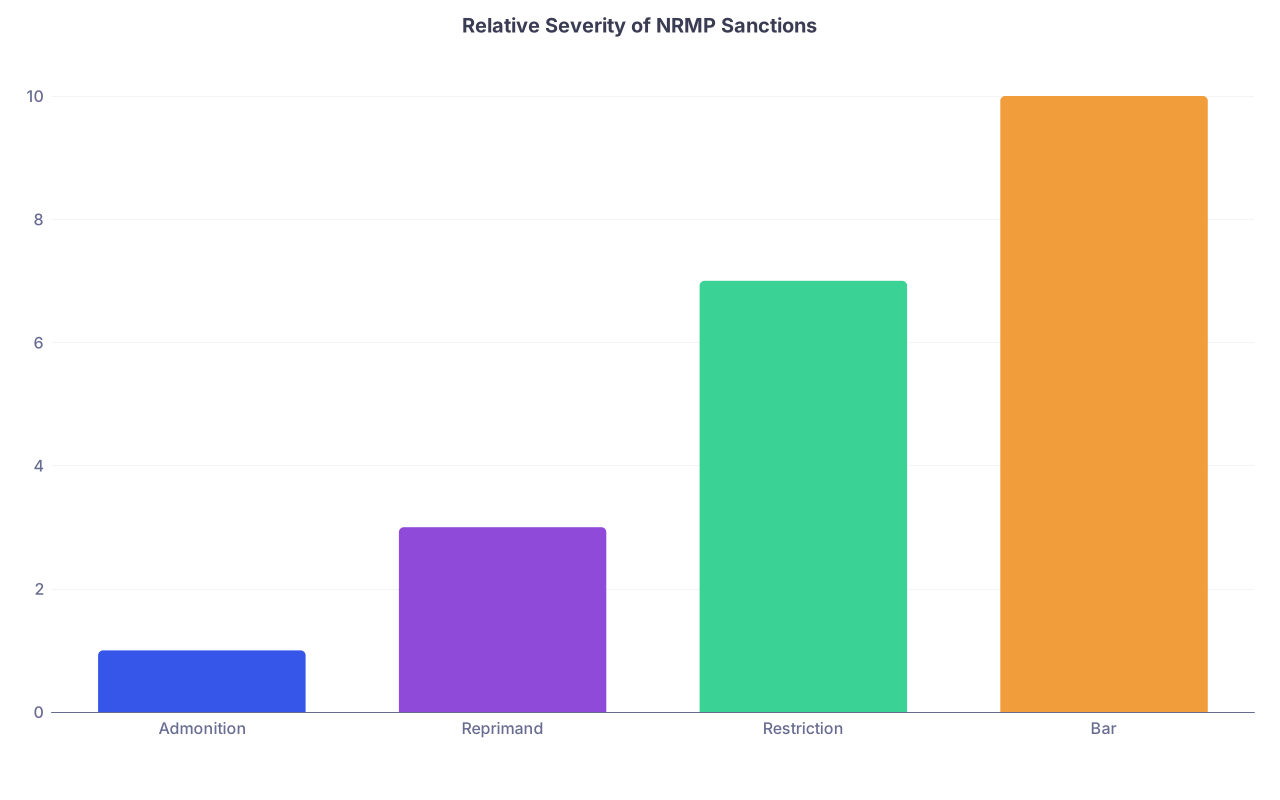
| Category | Value |
|---|---|
| Admonition | 1 |
| Reprimand | 3 |
| Restriction | 7 |
| Bar | 10 |
4. How Sanctions Affect Your Career at Each Stage
Here is where it gets real. The same sanction looks very different if you are a fourth-year medical student versus a PGY-3 looking at fellowship.
4.1 As a Medical Student (Pre-Residency)
Admonition:
Probably survivable, especially for less competitive specialties. Some PDs will be cautious; others will shrug if it looks minor.Reprimand:
You are explaining this constantly. Competitive specialties (derm, ortho, plastics, ENT) may be effectively off the table unless you are an exceptional applicant in every other way, and even then, some will not touch it.Restriction:
Your application logistics get complicated. You might be limited to certain tracks. GME offices may pre-emptively red-flag you.Bar:
You may be forced into a gap period, research, prelim work abroad, or non-clinical roles while waiting out the sanction. You will then apply as a re-entry, which is always an uphill climb.
4.2 As a Current Resident (Considering Transfer or Fellowship)
If you were initially matched via NRMP, your future moves are still under their umbrella.
- Leaving a program early without an NRMP-approved waiver → high risk of sanction.
- Transferring to a new program that knowingly accepts you in violation of NRMP rules → the program can be sanctioned, and you can be barred.
For fellowship:
- Most major fellowships (cards, GI, heme/onc, etc.) use NRMP’s Specialties Matching Service.
- A prior NRMP violation (even just a reprimand) will be visible.
- A bar means you simply cannot use the NRMP fellowship match until it expires.
I have seen strong IM residents shut out of competitive fellowships because PDs did not want to “inherit a contract problem.”
4.3 Long-Term Reputation
Even after your bar or restriction expires, the violation:
- Remains on public record for a defined time.
- May be accessible through archived NRMP reports or institutional records.
- Lives in the informal PD-to-PD whisper network.
Does it end your career automatically? No. But it narrows options, especially for competitive or leadership roles.
5. Inside an NRMP Investigation: What Actually Happens
People panic when they get the notice. Understand the process:
Complaint Filed
Usually by:
- A program director or DIO (e.g., “Our matched resident did not show up.”)
- An applicant (e.g., “I was pressured or coerced.”)
- Sometimes a third party with documentation.
Notice of Investigation
NRMP contacts you:
- Describes the alleged violation
- Requests your written response and supporting documents
- Gives deadlines
Fact-Finding
They may:
- Review emails, texts, contracts, ERAS documents
- Get statements from the program, GME office, your school
- Look at timing of Match registration, SOAP, and offers
Preliminary Determination
NRMP evaluates:
- Did a violation occur?
- How serious was it?
- Was there harm to the integrity of the Match?
Opportunity to Respond/Appeal
You can:
- Clarify facts
- Provide mitigating circumstances
- In certain cases, request a hearing
Final Decision and Sanction
They publish (if applicable):
- Your name
- Nature of violation
- Sanction type and duration
- Any participation bar or restrictions
This is not a casual back-and-forth. Treat it like legal/contractual litigation.

| Step | Description |
|---|---|
| Step 1 | Alleged Violation |
| Step 2 | Formal Complaint Filed |
| Step 3 | NRMP Opens Investigation |
| Step 4 | Notice Sent to Individual |
| Step 5 | Written Response Submitted |
| Step 6 | Evidence Review |
| Step 7 | Case Closed |
| Step 8 | Preliminary Decision |
| Step 9 | Opportunity to Appeal |
| Step 10 | Final Sanction Issued |
| Step 11 | Public Listing if Applicable |
| Step 12 | Violation Found |
6. Waivers, Early Releases, and Transfers: Where People Sabotage Themselves
A huge proportion of serious sanctions come from people not using the NRMP waiver process correctly.
6.1 The Waiver Concept
You matched. The Match is binding. However, NRMP can grant a waiver of:
- Your commitment to the program
- The program’s commitment to you
Valid reasons might include:
- Permanent change in your or your family’s health status
- Visa or licensing failure that truly prevents you from starting
- Major change in program structure (closure, merger, loss of accreditation)
- Serious documented personal hardship
Invalid reasons (that people try anyway):
- You got a better offer somewhere else
- You changed your mind about specialty
- You do not like the location
- You got into a research year and want to defer without agreement
If you walk away without an approved waiver, NRMP is almost certain to find a violation.
6.2 Transfer Between Programs
If you transfer:
- From one NRMP program to another
- Before or after completing a PGY year
You must check:
- Whether your initial commitment is still under NRMP rules
- Whether NRMP requires a waiver or notification
- Whether the new program is allowed to accept you under the current Match/contract status
Naive assumption: “If both PDs agree, it must be fine.”
Reality: If both PDs agree but ignore NRMP, all of you can get sanctioned.
7. How to Respond if You Are Under NRMP Investigation
If you are already in trouble, here is the unemotional, practical approach.
Stop improvising. No more informal promises or side deals.
Do not try to “fix it quietly” with the program. That often creates more evidence of rule-breaking.
Get institutional support early.
Contact:
- Your Dean of Students or Student Affairs (if you are a student)
- Your program director and DIO (if you are a resident)
Many institutions have dealt with NRMP before. They may connect you with legal counsel or GME experts.
Gather your documents. All of them.
- Emails with programs or NRMP
- Any written offers, contracts, or “letters of intent”
- Screenshots of texts or messages if relevant
- ERAS and NRMP registration confirmations
Submit a clear, factual, non-emotional response.
NRMP is looking for:
- A coherent timeline
- Evidence you did or did not know the rules at each step
- Whether you tried to correct the issue proactively
Do not lie. Do not “spin.” That is how minor violations become major ones.
Consider legal advice if the stakes are high.
If you are facing a likely bar or severe restriction, it is not excessive to talk to a lawyer familiar with contracts and GME. You are essentially in a dispute over a binding agreement.
8. How to Never See Your Name on the NRMP Violations List
Let me condense the most practical preventive rules. These avoid 90+ percent of disasters.
Never accept or verbally commit to a position outside the Match while:
- You are registered for that Match
- That position would normally be filled through NRMP
- You have not formally withdrawn with NRMP’s acknowledgement
If you matched, treat it as binding until NRMP releases you.
- Do not “shop around” after Match Day.
- Do not sign other contracts for same-year start dates.
- If something serious changes, initiate a waiver request first.
Assume every email is evidence.
If you would be uncomfortable seeing your message quoted in a violation report, do not write it.
If a program suggests something that feels off, bring in your school/GME immediately.
Example red flags:
- “We will save you a spot if you withdraw from the Match now.”
- “We are full in NRMP but can add an extra off-cycle resident if you quietly agree.”
- “We cannot put you on the rank list, but we can guarantee a position afterward.”
Loop in your Dean or DIO. Do not manage this alone.
Read the actual NRMP Match Participation Agreement once in your life. Fully.
It is not thrilling. But it makes the difference between “I did not know” and “I knew and stayed out of trouble.”
9. Realistic Examples: How Sanctions Emerge
Let me walk through a few composite scenarios that mirror real cases.
Example 1: The “Better Offer” PGY-1
- Student matches categorical IM at Hospital A.
- In June, before intern year, they get cold feet and receive an informal offer from Hospital B, closer to family, for a PGY-1 spot outside the Match.
- They tell Hospital A they are not coming, sign an offer with Hospital B, and never request a waiver.
Result:
- NRMP finds a violation for failure to honor the Match agreement.
- Applicant is sanctioned with a bar from consecutive Matches for 1–3 years.
- Hospital B may also be sanctioned for accepting a resident in violation.
Example 2: The SOAP Deal Gone Wrong
- Student did not match. During SOAP, Program X offers a prelim spot.
- The student accepts in SOAP.
- Two weeks later, Program Y offers a categorical position outside the Match starting the same July, if the student abandons the prelim.
If the student leaves Program X without an NRMP waiver and accepts Y, this can trigger:
- A violation for failing to honor an NRMP commitment
- Possible bar or restriction depending on context
Correct move: start at Program X, or request a formal waiver and wait for NRMP’s decision before any agreement with Y.
Example 3: Rank List Coercion That Goes on Record
- Program sends an email: “We will rank you highly if you rank us first. Please confirm by email that we are your #1.”
- Applicant feels pressured, complains to NRMP.
- NRMP investigates, confirms the emails.
Likely outcome:
- Program receives a reprimand or higher.
- Applicant might receive an admonition if they participated in reciprocal promises, but usually less severe.
10. Bottom Line: Where Sanctions Cross from Annoying to Catastrophic
NRMP is not out to punish honest mistakes. But they are absolutely out to protect the integrity of the Match. The line that changes your life:
- Minor communication or process slip → admonition or reprimand. Annoying, reputational, but usually survivable.
- Breaking the binding nature of the Match (walking away, side deals, accepting forbidden offers) → restriction or bar. Career-altering.
If you remember nothing else:
- Do not sign or verbally accept new GME positions without checking your NRMP status.
- Do not walk away from a Match commitment without an approved waiver.
- Do not try to game the system with side deals. NRMP has seen them all.
FAQ (Exactly 5 Questions)
1. If I match and then fail Step 2 or my visa is denied, is that an NRMP violation?
Usually not, as long as you are honest and transparent. NRMP can grant program or applicant waivers when you genuinely cannot start due to licensing, visa, or unforeseen barriers. The problem arises if you hide the issue, abandon the position without a waiver, or jump to a different program without NRMP involvement.
2. Can I ever take a position outside the Match while still registered for the Match?
Practically speaking, no, not if the position is the same training level and specialty that would normally be filled through NRMP. If you truly need to go outside the Match (for example, a one-off non-NRMP research position), you should withdraw from the Match first and confirm with your Dean or GME that it does not conflict with NRMP rules.
3. Do programs always check the NRMP Violations Report when they review my application?
Serious programs and GME offices often do. Many have a standard step in their screening workflow where they check OBGYN, ACGME, and NRMP histories for flagged applicants. Do not assume “no one will notice.” A reprimand or bar will usually be seen by someone at the institution before they rank you.
4. If I am barred from one NRMP Match (like the Main Residency Match), can I still participate in a fellowship Match later?
It depends on the specific terms of the sanction. Some bars are global (apply to all NRMP services), others may be limited by time or type of Match. The sanction letter and the NRMP Violations Report entry will specify what is restricted. Many bars affecting residency also extend to fellowship matching during the same time frame.
5. Can an NRMP sanction be removed or shortened once it is imposed?
Very rarely. NRMP has an appeal process during the investigation and early decision phases. Once a final sanction is issued and you have exhausted appeals, they expect you to serve it as written. They do sometimes consider mitigation during the decision-making process, but post hoc “please shorten this” requests almost never succeed.


