

It’s mid-November. You just walked out of your first residency interview. Your phone buzzes with a “Great to meet you!” email from the program coordinator. Another PGY-2 you met is now following you on Instagram. You’re staring at the screen thinking:
“What can I say back that won’t break NRMP rules… or make me look desperate… or hurt my Match chances?”
Here’s the answer: you need a structured, week-by-week communication plan that keeps you memorable, professional, and 100% NRMP-compliant. No hinting at commitments you cannot make. No fishing for promises they’re not allowed to give.
At each point in the season, there’s a right way and a wrong way to communicate.
Below is that timeline.
Ground Rules: What NRMP Actually Cares About (Read This Once)
Before we go week-by-week, you need the non-negotiables clear in your head. Otherwise you’ll improvise later and that’s when people say dumb things in emails.
The Core NRMP Communication Rules
You can:
- Express interest
- Send thank-you notes
- Tell a program you’re ranking them highly or #1
- Answer questions honestly
- Ask about program features, culture, logistics
You cannot:
- Ask for commitments:
“Will I match if I rank you #1?”
“Where am I on your rank list?” - Make binding commitments:
“If you rank me, I’ll definitely rank you #1.”
“I promise I’ll match here.” - Try to pressure:
“If you tell me where I stand, I’ll rank you higher.”
“I need to know if I’m in your top 5 before I submit my list.”
- Ask for commitments:
Programs cannot:
- Ask how you’re ranking other programs
- Ask for a commitment
- Tell you where you are on their rank list
- Condition their ranking of you on anything you say
You’re allowed to say:
“I plan to rank your program very highly.”
Or even: “I intend to rank your program #1.”
You are not allowed to treat that as a contract. And neither are they.
Hold that line in your head for everything that follows.
Overall Season Timeline: From First Interview to ROL Deadline
Here’s how the season usually breaks down.
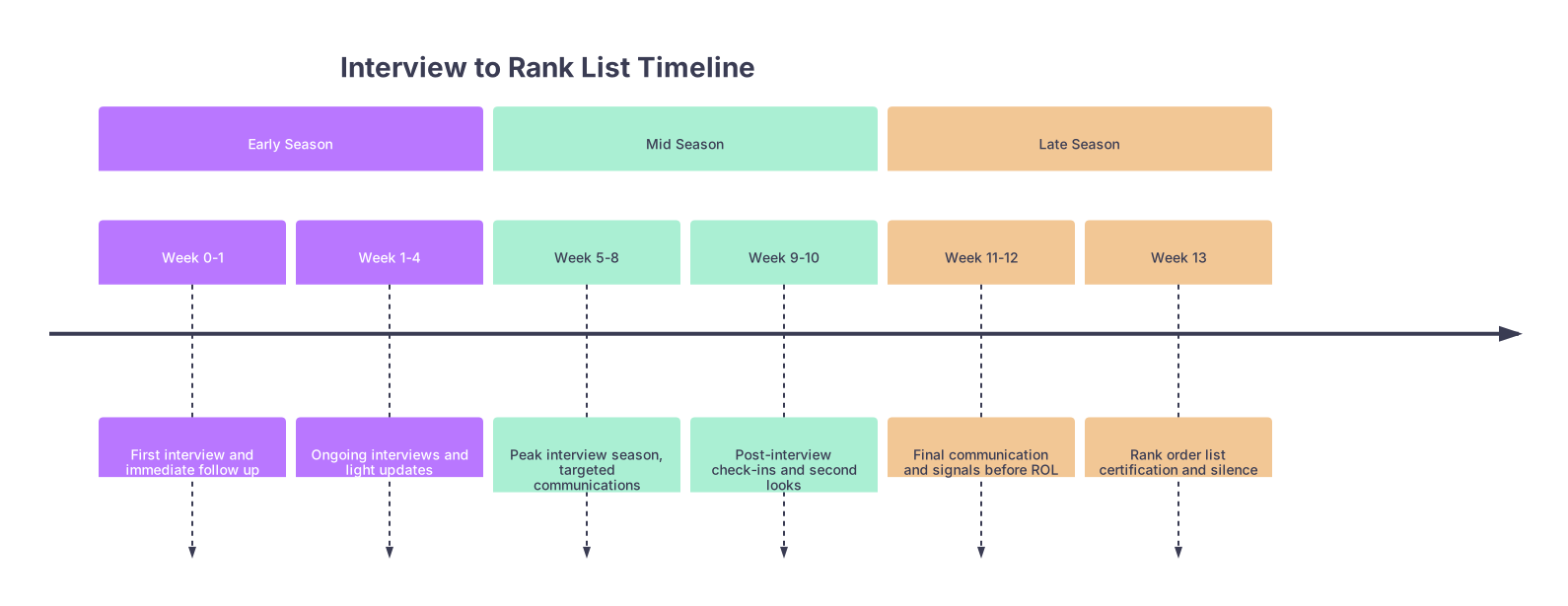
| Period | Event |
|---|---|
| Early Season - Week 0-1 | First interview and immediate follow up |
| Early Season - Week 1-4 | Ongoing interviews and light updates |
| Mid Season - Week 5-8 | Peak interview season, targeted communications |
| Mid Season - Week 9-10 | Post-interview check-ins and second looks |
| Late Season - Week 11-12 | Final communication and signals before ROL |
| Late Season - Week 13 | Rank order list certification and silence |
We’ll go phase by phase with concrete “at this point you should…” instructions, and then zoom into week-by-week.
Week 0–1: Right After Each Interview
You just finished an interview. This is the only time a “template” email is acceptable. But even then, you’re going to customize it.
Within 24–48 Hours: Thank-You Notes
At this point you should:
- Send brief, specific thank-you emails to:
- PD
- Any faculty who interviewed you
- Chief resident if you had a long interaction
- Keep it short. Three to five sentences. Max.
Structure that actually works:
- Thank them for their time.
- Reference 1–2 specific things you discussed.
- Reiterate one fit point.
- Close with a neutral sentence about looking forward.
Example (NRMP-safe, not cringe):
Dr. Smith,
Thank you for taking the time to speak with me yesterday about the Internal Medicine program. Our discussion about the X clinic and the resident autonomy on night float really resonated with what I’m looking for in training. The combination of strong clinical volume and clear resident support came through in every interaction I had.
I appreciate the chance to learn more about your program and hope to work with you in the future.
Best,
[Name]
Notice what’s missing:
- No “top choice”
- No “I’ll rank you highly”
- No pressure
That comes later, if at all.
At this point you should NOT:
- Ask about your rank position
- Ask for away rotations or research right away (looks transactional)
- Send gifts. Seriously, do not.
Weeks 1–4: Early Season While Interviews Are Still Rolling In
You’re now 3–4 interviews in, probably not close to a clear rank list yet. Programs are also still forming first impressions.
Your job in this phase: stay lightly on the radar, without overcommunicating.
At this point you should:
- Maintain a simple tracking sheet:
- Interview date
- Who you met
- 2–3 program strengths
- 1–2 concerns
- Whether you sent thank-you notes
- Respond promptly (same day if possible) to:
- Any follow-up questions from the program
- Requests for documents (USMLE transcript, updated CV, etc.)
Optional, NRMP-safe communication in this window:
- One short follow-up if you genuinely forgot something or have a real update, e.g.:
- New publication accepted
- AOA or Gold Humanism induction
- Step 2 CK score released (if good and they don’t have it)
Example update email (2–3 weeks after interview):
Dear Dr. Lee,
I wanted to briefly share an update since my interview on November 3rd. A manuscript on [topic] that I mentioned during our conversation was accepted for publication in [journal]. This project grew out of my interest in [relevant program feature].
I remain very enthusiastic about the possibility of training at [Program Name]. Thank you again for your time and consideration.
Sincerely,
[Name]
This is safe. No promises. No pressure. Just data + interest.
What you should avoid in Weeks 1–4:
- Telling multiple programs they’re your “top choice” (lying is dumb and spreads)
- Long, emotional emails about how the program is your “dream since childhood”
- Weekly check-ins. You are not their pen pal.
Weeks 5–8: Peak Interview Season – Targeted, Not Noisy
By now, you’ve probably finished >50% of your interviews. You have early favorites. Programs are starting to talk internally about who stood out.
At this point you should:
- Start stratifying programs into rough tiers:
- Tier 1: realistic programs you’d be thrilled to match at
- Tier 2: solid options
- Tier 3: backup / safety
- Decide which programs (not many) deserve a bit more communication effort.
Week-By-Week in This Mid-Season Window
Week 5–6: Mild Targeted Interest
For top-tier programs you’ve already interviewed at, and that continue to look strong as you compare:
- Send one short “continued interest” email if:
- It’s been 3–4+ weeks since your interview
- You have something new or specific to say
Example:
Dear Dr. Patel,
As interview season continues, I’ve had more opportunities to compare programs, and I wanted to let you know that [Program Name] remains one of the places I am most excited about. In particular, the combination of [specific feature] and [specific culture/structure] stands out.
I recently [brief relevant update – new leadership role, poster accepted, Step 2 score, etc.], which further aligns with my interest in [something the program values].
Thank you again for the opportunity to interview.
Best regards,
[Name]
That’s explicit interest, not a commitment.
Week 7–8: Clarifying Questions + Second Look Feelers
Now you’re starting to actually think about your rank list. You might have genuine gaps in your understanding of certain programs.
At this point you should:
- Identify 3–5 programs that are truly in the running for your top spots.
- For those, send focused emails if you need clarity on:
- Call schedule
- Fellowship match rates
- Research mentorship structure
- Support for specific career paths
Example safe question email:
Dear Dr. Nguyen,
As I reflect on my interview day at [Program Name], I had a question about your residents’ involvement in clinical research. Specifically, I’m interested in how residents who are aiming for [fellowship] typically find mentors and balance projects with their clinical duties.
I appreciated how several residents mentioned [specific detail from interview], and I wanted to better understand how that structure works in practice.
Thank you again for your time and any insight you can share.
Sincerely,
[Name]
If you’re considering a second look (for programs that allow them):
- Ask logistics only.
- Do not imply that a second look = higher rank.
- Do not ask if a second look will “help your chances.”
Weeks 9–10: After Most Interviews Are Done – Strategic Signaling
By now, interviews are winding down or over. This is when people start panicking and sending 20 “you’re my top choice” emails. That’s how you look unserious.
We’re not doing that.
At this point you should:
- Build a preliminary rank list for yourself.
- Decide:
- 1 program you genuinely intend to rank #1
- 3–6 programs you expect to rank highly (but not #1)
Now the communication gets more explicit, but still NRMP-safe.
Week 9: Your Intended #1 Program Email
Pick your actual #1. Not your fantasy #1. The real one.
To that single program, you may send a clear, honest “I intend to rank you #1” email. NRMP allows this. The problem is when people lie about it.
Example:
Dear Dr. [PD Last Name],
I wanted to thank you again for the opportunity to interview at [Program Name] and to learn more about your residents and training environment. After completing my interview season and careful consideration, I wanted to share that I intend to rank [Program Name] as my top choice.
The program’s strengths in [specific features] and the resident culture I observed on interview day align extremely well with the type of physician I hope to become. Regardless of the outcome, I am grateful for the chance to have interviewed with you.
Sincerely,
[Name]
This is allowed. What’s not allowed: pairing that with any expectation of their behavior.
Don’t add:
- “I hope this guarantees a match.”
- “Please let me know how I stand.”
- “If you rank me to match, I’ll definitely come.”
State your intent. Stop.
Week 9–10: Programs You’ll “Rank Highly”
For 3–6 other strong programs, you can send a carefully worded “rank highly” email. Do not say “top 3” to eight different places. They talk.
Example:
Dear Dr. Jones,
After completing my interview season and reflecting on my experiences, I wanted to let you know that I plan to rank [Program Name] very highly on my list. The emphasis on [specific] and the support for residents pursuing [your career goal] particularly stood out to me.
Thank you again for the opportunity to interview and for your consideration.
Best regards,
[Name]
NRMP-safe, honest, and restrained.
What you should NOT do here:
- Email every single program you interviewed at
- Promise “top choice” to multiple programs
- Ask, directly or indirectly, “Will you rank me to match?”
Weeks 11–12: Final Tweaks and Last-Call Updates
You’re now in the last 2–3 weeks before the rank list deadline. Your job here is cleanup, not chaos.
At this point you should:
- Have a near-final personal rank list
- Be done with “I’ll rank you #1” declarations
- Use communication only for:
- Legitimate major updates
- One-time clarification
- Polite closure
What Counts as a Legitimate Late Update?
- Major publication accepted in a strong journal
- New high-impact leadership position (chief, national committee)
- Big exam score that materially changes your application (e.g., excellent Step 2 when Step 1 was weak)
Minor updates (shadowing another attending, presenting at a local case conference, etc.) don’t deserve a last-minute email.
Safe late-update email:
Dear Dr. Rivera,
As rank lists approach, I wanted to share a brief update since my interview in December. A manuscript I mentioned during our conversation, focused on [topic], was accepted for publication in [reputable journal]. This project has continued to reinforce my interest in [relevant program focus].
I remain very enthusiastic about [Program Name] and appreciate your continued consideration.
Sincerely,
[Name]
Again: interest, update, gratitude. No pressure. No bargaining.
What About If a Program Emails You?
Common late-season things they might send:
- “You remain a strong candidate for our program.”
- “We were impressed by your application.”
- “We hope you will strongly consider ranking us.”
NRMP reality: these are usually mass emails or soft signals. You’re not obligated to respond more than politely.
Safe responses:
- “Thank you for the update; I continue to be very interested in your program.”
- “I appreciate the message and enjoyed meeting the residents and faculty.”
If they cross the line and say something like “We will rank you to match”:
- Do not mirror the language.
- Do not answer with “Then I will rank you #1” unless that’s already true and you were planning to say that anyway.
- Just respond with:
“Thank you for your confidence and for the opportunity to interview at your program. I was very impressed by [specific observation] and will be giving [Program Name] strong consideration when finalizing my rank list.”
Week 13: Rank List Certification and Radio Silence
ROLS due. Time to stop talking.
At this point you should:
- Certify your list before the last day if you’re smart.
- Once your ROL is certified:
- No more updates
- No last-minute “I changed my mind, you’re actually my top choice”
- No fishing emails
After lists are in, communication can’t change anything and starts to look unprofessional. Or desperate.
If a program reaches out after the ROL deadline with a generic “thank you for your interest”:
- You can reply politely.
- Keep it generic:
“Thank you, I appreciated the opportunity to interview and learn more about your program.”
But again: nothing about rankings, nothing about commitments, nothing that implies back-channel negotiation.
Quick Reference: What to Send and When
| Timeframe | Main Goal | Safe Email Types |
|---|---|---|
| 0–2 days post-int | Acknowledge, be polite | Thank-you emails |
| Weeks 1–4 | Light presence | Single update, if real news |
| Weeks 5–8 | Clarify + refine | Continued interest, specific Qs |
| Weeks 9–10 | Strategic signaling | 1 clear #1 email, a few “rank highly” |
| Weeks 11–12 | Cleanup only | Major updates, rare clarifications |
| Week 13 | Done | No communication about ranking |
Visual Snapshot: How Often You Should Email
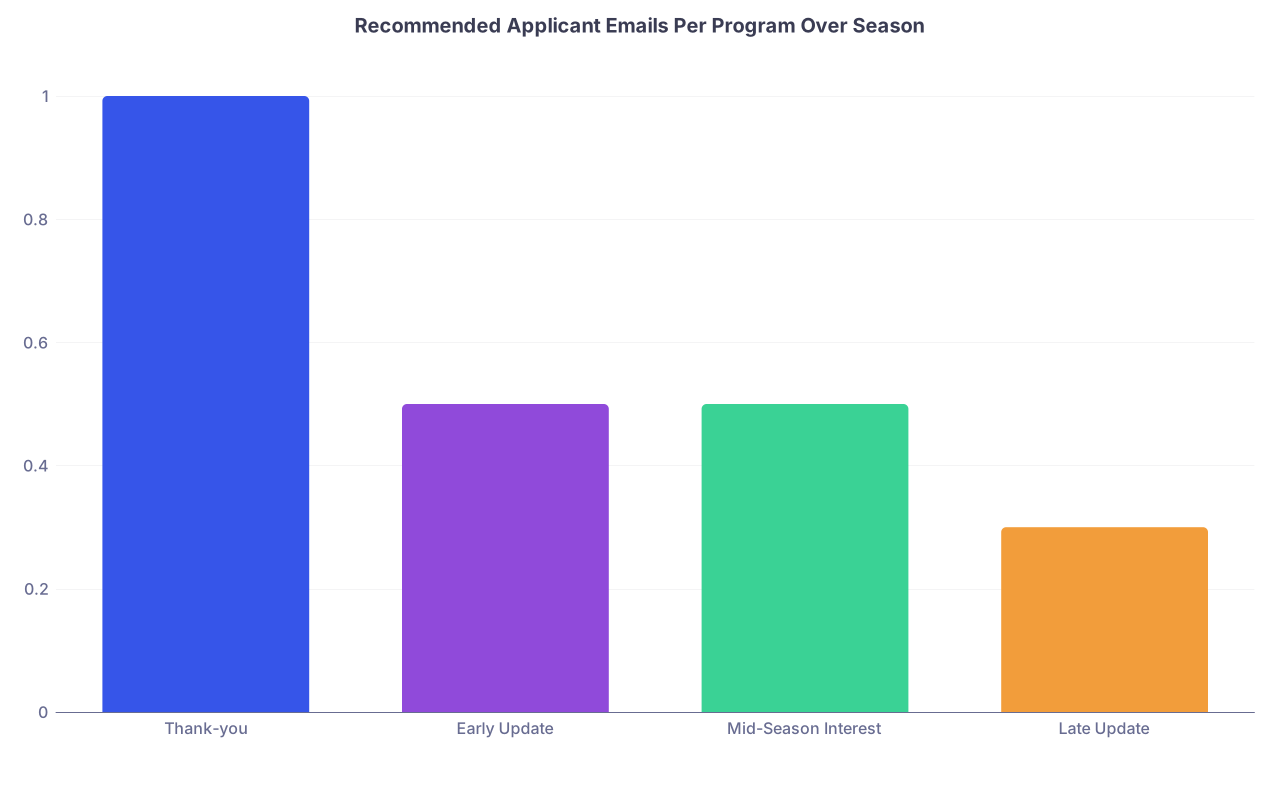
| Category | Value |
|---|---|
| Thank-you | 1 |
| Early Update | 0.5 |
| Mid-Season Interest | 0.5 |
| Late Update | 0.3 |
Interpret this like a ceiling, not a target. For most programs, 1–2 total emails is enough.
Final Short Timeline – Week-by-Week Script
Assume a November–February season. Adjust dates to your year.
Week 0–1 (Immediately after interview)
- Send thank-you emails within 48 hours.
- Log notes about each program.
Week 2–4
- Optional: 1 brief update if you have real new information.
- Otherwise, silence is fine.
Week 5–6
- Identify your emerging top 5–8 programs.
- For top programs, 1 short “continued interest” email is reasonable.
Week 7–8
- Ask targeted questions where you need clarity (clinical structure, fellowships, mentorship).
- Decide on second looks only if truly necessary and welcomed by the program.
Week 9
- Pick your real #1 program.
- Send honest “I intend to rank you #1” email (once, to one place).
- No bargaining. No promises from them expected.
Week 9–10
- To a few other strong programs, send “I plan to rank you highly” emails.
- Avoid specific numeric promises (“top 3”) unless you mean it and limit it.
Week 11–12
- Only email if you have a major update or pressing question.
- Confirm your own internal rank list.
Week 13 (ROL deadline week)
- Certify your rank list.
- Stop talking about rank with programs. You’re done.
Bottom Line: What Actually Matters
Keep these in your head:
- Your communication should be sparse, specific, and honest. One good email beats five needy ones.
- NRMP cares about promises and pressure, not politeness. Thank-yous, interest, and honest #1 declarations are fine. Trying to extract or offer guarantees is not.
- Your rank list should reflect where you want to train, not who emailed you the sweetest message. Programs play their own game. You protect your own future.
Follow the timeline, keep your emails tight, and let the algorithm do its job.


