

The NRMP Match Participation Agreement is the most expensive contract many applicants sign without reading.
You are not “accepting terms and conditions.” You are entering a legally enforceable agreement that can make or break your career for years. And most applicants scroll, click, and move on.
Let me walk you through the clauses people ignore until they are in trouble.
The Match Is a Binding Contract, Not a Shopping Cart
Start with the core mistake: applicants think the Match is a “preference tool.” Rank programs, see what you get, decide how you feel. That is wrong.
The Match is a binding contract system. Once you certify your rank order list and the algorithm runs, you are committed to the result if you match.
There are three intertwined pieces people underestimate:
- The legal force of the Match Participation Agreement
- The professional consequences of breaching it
- How little sympathy you get if you claim you “did not understand”
Let me be specific.
The Binding Nature of a Matched Position
When you certify your rank list, you agree that:
- If you match to a program, you will start training there on time.
- You will not seek or accept any other concurrent residency position starting the same year in the Main Residency Match (or related matches under NRMP jurisdiction).
- You will not attempt to renegotiate, delay, or “shop around” after Match Day.
If after Match Day you decide:
- “I changed my mind, I want a research year.”
- “I got into a different country’s program; I’ll skip this one.”
- “I’ll just tell them I am not coming and try SOAP or reapply next year.”
You are not just “withdrawing.” You are potentially breaching a contract with both NRMP and the matched program.
Consequences:
- NRMP can investigate.
- You can be found in violation.
- You can be barred from future Matches for a set period.
- You can be publicly identified in NRMP’s violation reports.
- Your school dean will be notified.
No, “mental health,” “family reasons,” or “better opportunity” do not automatically excuse a breach. There is a waiver process for that, which almost nobody reads before they need it. I will get to that.
Clauses That Quietly Control Your Options
The Match Participation Agreement is not just a formality. It quietly dictates what you can and cannot do before, during, and after the Match.
There are five categories where applicants commonly trip:
- Misrepresentations in applications
- Post-interview communication and coercion
- Prematch contracts and outside offers
- Withdrawing and waivers
- SOAP and off-cycle positions
Let me break each down.
1. Misrepresentation: What “Lying” Actually Means Under NRMP Rules
You already know you should not lie on ERAS. That is not the interesting part. The subtle part is how NRMP treats misrepresentation as an independent violation, even when ERAS or a state board has not caught up yet.
Misrepresentation Is Broad, Not Just Fabricated Publications
Under the Match Participation Agreement, you are prohibited from providing false, misleading, or incomplete information to:
- NRMP
- Programs
- Medical schools or deans
- Other applicants
- Or any entity involved in the match process
This covers:
- Invented research, publications, or presentations
- Inflated roles (“co-first author” when you are not, “PI” as a medical student)
- Misrepresented USMLE/COMLEX scores or attempts
- Omitting attempts or failures in communications with programs
- Misstating visa status or citizenship
- Claiming “ongoing” experiences that have already ended or never really started
I have seen an applicant sanctioned because a “submitted manuscript” listed on ERAS was allegedly never actually submitted, and the program flagged it when they checked with the attending. It did not matter that ERAS itself did not penalize them first. NRMP treated it as a contractual misrepresentation.
Consequences of Misrepresentation
The NRMP can:
- Initiate an investigation based on a program report
- Request documents from your school, programs, and you
- Hold a hearing
- Impose sanctions including:
- Being barred from one or more future Match cycles
- Being identified by name in violation reports
- Notification to your dean and programs
And this can happen even if you match successfully and are already an intern. It is not limited to pre-Match behavior.
If you are thinking, “Nobody checks,” understand this: programs have become more aggressive about reporting concerns to NRMP when they feel misled. Especially after a bad experience.
2. Post-Interview Communication and Coercion: Both Sides Cross the Line
The Match Participation Agreement has a whole philosophy: keep the process free of pressure and side deals. Almost everyone ignores it.
What Applicants Are Not Allowed to Do
You are not allowed to:
- Ask programs where they will rank you.
- Assert that you will rank a program first if that is not your real intention.
- Attempt to obtain a guarantee of a position outside the Match while participating in it (for most NRMP-participating specialties).
- Harass or pressure programs after interviews for “feedback” on your rank status.
NRMP is explicit: neither applicants nor programs may solicit or reveal ranking information or try to influence each other’s rank order lists via coercive behavior.
Are follow-up thank-you emails allowed? Yes. Are “I will rank you highly” types of messages allowed? Usually, yes, though pointless. Are “I will rank you #1” statements allowed? Technically, yes, but if they are knowingly false and part of a broader pattern of deception, they can feed into misrepresentation arguments.
Where people go wrong: spamming programs with “I will rank you first” emails, then doing the same thing to ten programs, and one of them later feels misled and annoyed. If things go south, that can be ammunition.
What Programs Are Not Allowed to Do (That You Should Recognize)
Programs are prohibited from:
- Asking you to state where you will rank them.
- Requiring or pressuring you to reveal other applications or interview invites.
- Asking you to commit to ranking them first.
- Conditioning ranking on verbal promises.
- Requiring you to sign any commitment letter that freezes your rank.
If a program director or faculty member says:
- “If you tell us we’re your first choice, we’ll rank you high.”
- “We need you to promise you will not rank other programs above us.”
- “We only rank people who commit to us.”
They are violating NRMP rules. And you should know that you are not bound by that conversation, even if you felt cornered and agreed in the moment.
You can report programs to NRMP for this behavior. Many applicants do not, because they fear retaliation. That is reality. But the clause exists, and it means something when disputes later arise.
3. Prematch Contracts, Outside Offers, and Why “Double-Dipping” Is Dangerous
Here is where people really get burned: trying to be clever with outside offers or prematch arrangements.
NRMP vs Non-NRMP Positions
Most U.S. ACGME-accredited categorical and advanced residency programs in the main specialties must use the Match. A few do not. Some preliminary or off-cycle positions live outside NRMP.
The Participation Agreement states you cannot:
- Simultaneously accept a residency position that starts in the same appointment year through a different matching plan (or outside the Match) in a specialty/program that is supposed to participate in NRMP, while also entering the NRMP Match for that same type of position.
Said differently:
You cannot hold a binding offer for a July 1 residency position in an NRMP-participating specialty and still enter the Match for a similar slot, pretending you are “just seeing what happens.”
If you accept an outside position (for example, a non-NRMP FM program or off-cycle spot) that overlaps with the Match year, you must understand what kind of position it is and whether you are now obligating yourself in a way that conflicts with NRMP rules.
| Scenario | NRMP Issue Risk |
|---|---|
| Match-participating IM program offers off-cycle PGY-1 contract while you enter Match for IM PGY-1 | High |
| Non-ACGME research fellowship while entering Match | Low |
| Preliminary surgery spot outside NRMP while ranking NRMP prelim surgery | Moderate–High |
| Non-NRMP FM program in a state system while entering Match for FM | High |
Prematch Agreements and Categorical Positions
For specialties that are still technically allowed prematch contracts (mainly outside the U.S. or in a few specific non-NRMP systems), if you enter into a binding agreement and then also join the NRMP Match for the same training year/position type, you can be found in violation.
The part applicants ignore: telling yourself “It is just a verbal understanding, nothing is signed” does not automatically protect you. Programs can claim there was a commitment. NRMP can review emails, letters, even text messages if they are part of evidence.
When in doubt, you do not enter the Match for a position you have already committed to elsewhere for the same year. Or you avoid accepting binding offers until you are out of the Match.
4. Withdrawing from the Match and the Waiver Process: The Clauses Nobody Reads
People only discover this section after Match Day when they suddenly want out. By then, they are already behind.
Withdrawing Before Rank Lists Are Due
You are allowed to withdraw from the Match before the rank order list certification deadline. There is a formal process through your NRMP account. If you withdraw in time:
- You will not be matched to any program that year.
- You will not be bound to any potential position.
- You retain eligibility to participate in future Matches (barring other issues).
Two common errors:
- Assuming “not submitting a rank list” is equivalent to withdrawing. It is not. That can leave you in a weird limbo and look unprofessional to programs that ranked you.
- Forgetting that if your school or sponsoring institution controls your participation, they may need to certify or approve your withdrawal.
After the Match: The Waiver Myth
Once you match, withdrawal is not a thing. There is only a waiver request.
Here is what applicants imagine:
“Life changed, I will ask NRMP for a waiver and they will understand.”
Here is what actually happens most of the time:
NRMP views waivers as exceptions granted only in compelling circumstances, not a casual opt-out.
Legitimate grounds usually involve:
- Serious, documented personal or family health issues
- Substantial change in visa or immigration status beyond your control
- Major life events that make relocation or training literally impossible, not just unpleasant
- Program closure or major program failure (ACGME accreditation loss, etc.)
What NRMP does not consider valid reasons on their own:
- “I got a better offer elsewhere.”
- “I realized I do not like that city.”
- “I want a different specialty.”
- “My partner matched somewhere else and I want to follow them.”
Can those play into a broader petition? Maybe. But on their own, they usually fail.
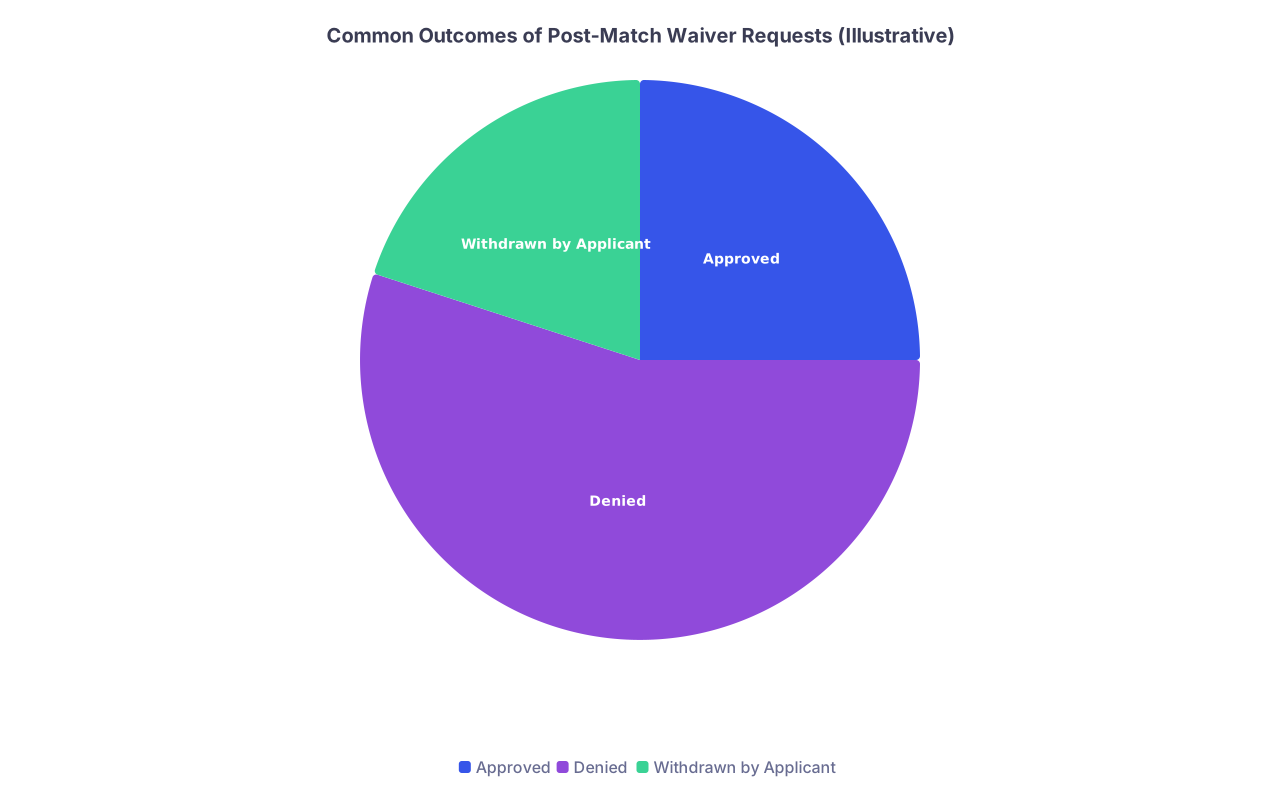
| Category | Value |
|---|---|
| Approved | 25 |
| Denied | 55 |
| Withdrawn by Applicant | 20 |
If you start a waiver request:
- You must stop negotiating with other programs until NRMP rules on it.
- If the waiver is denied and you still refuse to start, you can be sanctioned.
- If the waiver is granted, there can still be restrictions on your future Match participation, depending on the circumstances.
So the fantasy of “I’ll match and then just see how I feel later” is dangerous. By the time you “see,” your leverage is basically gone.
5. SOAP and the Silent Rules Nobody Talks About
During SOAP, applicants are usually panicked and sleep-deprived. Not a great state to make contractual decisions. But the NRMP rules still apply, and there are extra constraints.
Binding Nature of SOAP Acceptances
If you receive and accept a SOAP offer:
- That is a binding commitment just like a Main Match position.
- You cannot later say, “Actually I got a better SOAP offer, let me switch.”
- Once you accept, your SOAP participation ends.
Some people treat SOAP offers like job interviews. They are not. Once you hit accept, you are done for that cycle. If you back out, you are exposing yourself to NRMP violation proceedings.
Programs Cannot Pressure You During SOAP (In Theory)
Programs are not allowed to:
- Demand that you rank them or accept an offer as a condition to be “considered” in SOAP.
- Misrepresent the type or duration of the position.
- Try to coerce you into decisions outside the SOAP platform.
In practice, some programs still play games. “If we send you an offer, you must accept immediately.” Or, “we need your verbal agreement first.” The system is supposed to prevent that, but real life is messy.
You should know that the legally binding step is the accept click in the NRMP SOAP system. Not your panicked “yes” on the phone.
6. Behavior, Professionalism, and How You Can Be Reported
Another ignored clause: NRMP expects not just honest paperwork, but professional conduct. Programs can and do report applicants for:
- Grossly unprofessional behavior on interview day
- Threats, harassment, or abusive communication
- Retaliatory or defamatory online posts that cross from “opinion” into targeted harassment
This is not about you posting “I did not like Program X” on a forum. But if you:
- Launch a sustained campaign against a program director by name
- Publish confidential interview content
- Make discriminatory or threatening statements tied to your identity as an applicant
You are giving programs ammunition. Some will use it.
NRMP has discretionary power. They can treat severe unprofessional conduct as violation of the spirit of the Match rules, especially if it undermines the integrity of the process.
Is that common? No. But when it happens, the accused applicant is usually shocked that “this could even be a thing.” The clause is right there in the agreement.
7. The Overlooked Role of Your Medical School
Applicants tend to think it is just them and NRMP. Wrong. Your school (or sponsoring institution for IMGs) is wired into this contract.
Your school agrees to:
- Certify your eligibility for the Match.
- Verify your expected graduation and credentials.
- Report material changes in status (delays, professionalism concerns, dismissals).
- Cooperate with NRMP investigations.
If your school pulls your certification before rank lists are due, or even after, that can sabotage your Match. Programs may have ranked you, but if your school flags you as ineligible, NRMP will not place you.
Two underappreciated implications:
- If you are having professionalism problems or facing possible disciplinary action, your dean’s office has enormous influence over your Match fate.
- If you consider doing anything borderline with programs (back-channel offers, threatening behavior, etc.), keep in mind: NRMP will almost always loop your dean’s office into the investigation.
I have seen cases where the NRMP sanction was actually more survivable than the fallout at the home institution. The school’s letter will follow you for years across credentialing committees.
8. How Violations Follow You
The NRMP tends to take a long view. Their violation letters and public reports do not vanish after a year. And programs talk.
Consequences can include:
- Being barred from one or more future Match cycles.
- Being ineligible for certain matches while a sanction is active.
- Having your name published in the NRMP’s “Match Violation” reports, accessible to programs.
- Permanent notations that can be requested later by hospitals or licensing boards.
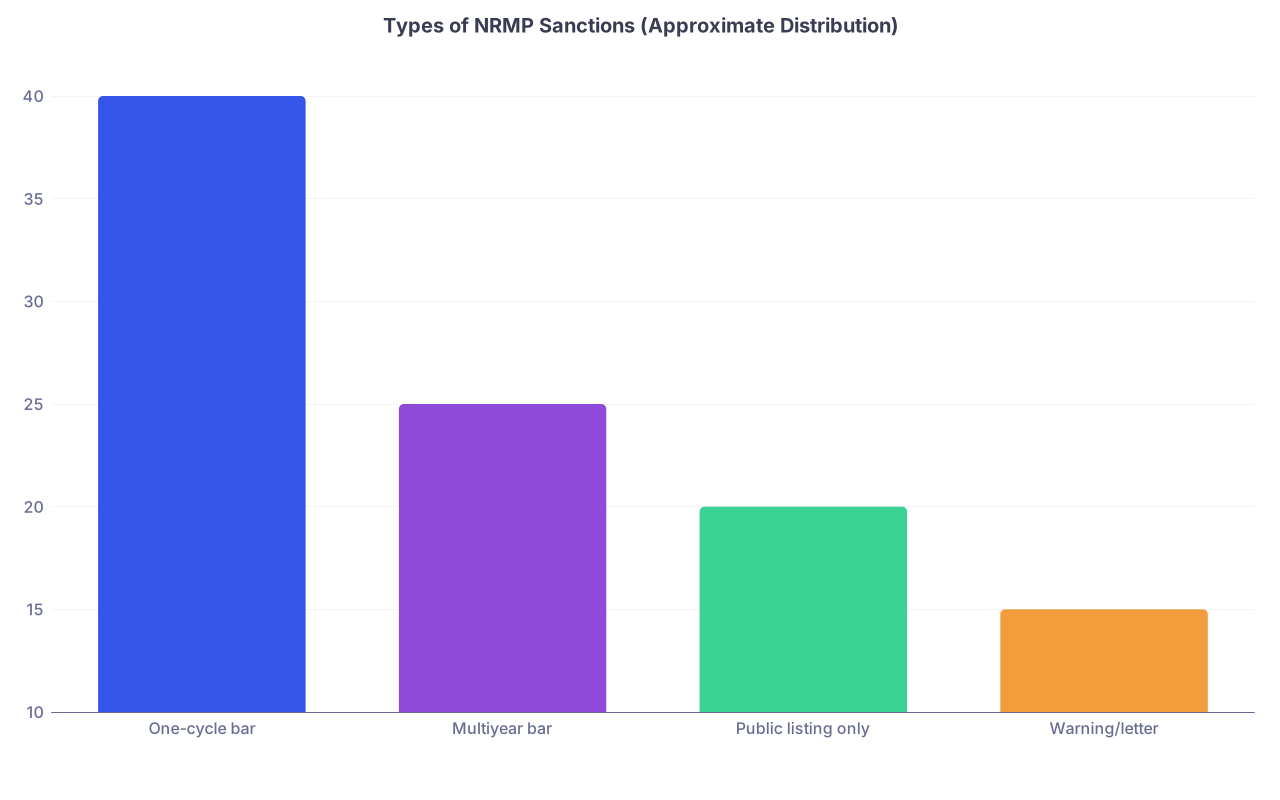
| Category | Value |
|---|---|
| One-cycle bar | 40 |
| Multiyear bar | 25 |
| Public listing only | 20 |
| Warning/letter | 15 |
This is why treating the Match Participation Agreement like Apple’s terms of service is reckless. A single impulsive decision—backing out of a matched position without a waiver, double-booking positions, blatantly lying to a program—can echo every time a credentialing office does a background check.
9. A Practical Way to Read the Agreement Without Losing Your Mind
The full agreement is long and written in committee-legal language. You do not need to memorize every sentence. But you should explicitly look for and understand five sections:
- “Binding commitment” or “obligations of matched applicants”
- “Prohibition of coercion and solicitation of ranking information”
- “Waivers of the match commitment”
- “Violations policy and sanctions”
- “SOAP rules and binding offers”
Here is a simple reading strategy I recommend to my own advisees:

| Step | Description |
|---|---|
| Step 1 | Open NRMP Agreement PDF |
| Step 2 | Search for binding |
| Step 3 | Read full section on commitment |
| Step 4 | Search waiver |
| Step 5 | Read waiver criteria and process |
| Step 6 | Search coercion and communication |
| Step 7 | Review post interview rules |
| Step 8 | Search violation and sanctions |
| Step 9 | Review consequences |
| Step 10 | Search SOAP |
| Step 11 | Review SOAP obligations |
Do this once. It takes 30–40 minutes if you are focused. That is less time than you spend tweaking a single ERAS paragraph. But it prevents the “I did not know” disaster later.
10. Concrete Scenarios: What the Rules Actually Mean For You
Let me walk through a few common real-world scenarios and how the Agreement actually applies.
Scenario 1: Backing Out After Matching for a “Dream Program” Elsewhere
You match to Program A in Internal Medicine. Two weeks later, a different program (Program B) tells you they have an off-cycle or out-of-match IM PGY-1 spot starting the same year and “we’d love to have you.”
If you:
- Quietly sign with Program B and email Program A that you are not coming
- Do not seek a formal NRMP waiver
- Plan to show up at B on July 1
You have put yourself at high risk of an NRMP violation. If Program A reports you, the NRMP can:
- Investigate
- Bar you from future matches
- Identify you publicly as having violated the match agreement
Program B can also get pulled into this if they knowingly induced you to breach your prior commitment.
The correct, albeit painful, path:
- If you truly cannot or will not go to A, request an NRMP waiver first.
- Wait for a decision. Do not sign anything binding with B until then.
- Understand that the waiver may be denied, and you may have to decide between honoring the commitment or accepting sanctions.
Scenario 2: Program Asking You to Promise to Rank Them First
You interview at Program C. Afterwards, the PD says on a Zoom call:
“If you tell us we are your number 1 and confirm by email, we will rank you to match.”
That is NRMP coercion territory on the program side.
What you can do:
- Nod politely in the moment. You are not contractually bound to follow through.
- Later, rank programs in your true order of preference.
- If they push further or threaten not to rank you if you do not commit, you can document the exchanges and, if needed, contact NRMP.
Your Match Participation Agreement protects your right to make an independent ranking decision without being forced into pre-commitments. Use that protection.
Scenario 3: You Want to Delay Residency for a Year After Matching
You match to Program D, but then a major life issue arises—severe parental illness, your own medical diagnosis, major visa disruption.
The Participation Agreement does not say “you must show up no matter what.” Instead, it gives a structured path:
- You and/or Program D can jointly or separately request a waiver or deferral from NRMP.
- NRMP reviews the situation.
- Sometimes they grant a release from the contract; sometimes they allow deferral; sometimes they expect you to start as scheduled.
Key detail people ignore: a purely personal preference delay (“I want to do a startup,” “I want to travel”) rarely qualifies. If you are going to ask for relief, you need serious, well-documented reasons.
11. The Mindset Shift: Treat the Match Like the Contract It Is
The healthiest way to approach the NRMP Match Participation Agreement is simple:
- Before ranking: Decide as if your #1 choice will definitely become your reality. Because if you match there, you are stuck with it absent unusual circumstances and a successful waiver.
- During SOAP: Treat each accept click as the last decision you will make this cycle. Because it is.
- When tempted to “game” the system: Ask, “If the other party reported this to NRMP, how would it look on paper?”
None of that requires paranoia. Just honesty and a basic understanding that the Match is a legal framework, not a choose-your-own-adventure.
Key Takeaways
- The NRMP Match Participation Agreement is a legally binding contract, and a matched position (Main Match or SOAP) is a real commitment with real consequences if you walk away.
- Misrepresentation, coercive communication, double-booking positions, and casual post-Match “backing out” are all explicitly covered and sanctionable, often much more harshly than applicants expect.
- You protect yourself by reading the specific sections on binding commitment, waivers, post-interview communication, violations, and SOAP rules—and then acting like what you agreed to actually matters.


