

The biggest myth about NRMP violations is that it’s all about what applicants do. It’s not. Behind the scenes, programs are quietly archiving every questionable email you send—partly to protect themselves, and partly to have leverage if things go sideways.
Let me walk you through what really happens on the program side when that “innocent” email from you hits their inbox.
The Unspoken Reality: Programs Are Just as Scared of NRMP as You Are
Most applicants think they’re the only ones anxious about breaking NRMP rules. Wrong. Program directors, coordinators, and GME offices are terrified of NRMP violations. They get the annual warning emails. The compliance talks. The “remember that program that got sanctioned for three years” horror stories.
Because of that, programs document way more than you think.
Any time there’s even a whiff of impropriety—an email that sounds like a commitment, an awkward response to a post-interview question, a screenshot of a text—somebody is quietly dropping it into a folder labeled something like:
- “NRMP – 2026 Match Communications”
- “Recruitment Compliance”
- “Applicant Communications (Archive)”
And if you think your name isn’t getting attached to that? It is.
How Your Email Enters the System – And Why It Stays There
Let’s trace the life cycle of one potentially problematic email from you.
You send:
“Dr. Smith, I loved your program. I will rank your program #1 if I receive an assurance that I’ll match here.”
On your end, it’s a single email. On theirs, it starts a chain of documentation.
Step 1: The First Person Who Sees It
Usually it lands in one of three places:
- Program director inbox
- Program coordinator inbox
- Shared program email (e.g., “[email protected]”)
In most well-run programs, at least two of these people have eyes on recruitment emails. The coordinator is often the first filter. If they see something NRMP-sensitive, they don’t shrug and ignore it. They flag it.
I’ve seen coordinators do exactly this: forward the email to the PD and GME office with a subject line like, “FYI – NRMP-related language from applicant.” No commentary. Just getting it into the paper trail.
Step 2: Forwarded to GME / Legal
In larger institutions, any whiff of an NRMP issue gets bumped upstairs. Some PDs are trained to never respond directly to questionable emails until GME or legal reviews. So your message may get forwarded to:
- The DIO (Designated Institutional Official)
- GME office staff
- Hospital legal/compliance
And the second that happens, your email has entered a formal system. It’s no longer “just an email.” It’s a potential compliance artifact.
Step 3: Saved, Categorized, and Filed
Here’s what many programs actually do, whether they admit it publicly or not:
- Create a centralized folder for that Match cycle: “2025 NRMP Communications”
- Save your email as a PDF or EML file with a clear name: “Lastname_Firstname_Applicant_Email_01.pdf”
- If it’s really spicy, attach it to some sort of “Issue Log” or running documentation file
Sometimes they just rely on Outlook archive and search. But the more burned or paranoid a program has been in past cycles, the more formal the process gets.

| Step | Description |
|---|---|
| Step 1 | Applicant sends email |
| Step 2 | Coordinator reads email |
| Step 3 | Routine response or ignore |
| Step 4 | Forward to PD and GME |
| Step 5 | Save email to NRMP folder |
| Step 6 | Draft compliant response |
| Step 7 | PD or coordinator replies |
| Step 8 | Retain for Match cycle |
| Step 9 | NRMP concern? |
What Exactly Programs Save: It’s More Than Just the Email
Programs don’t just keep your words. They keep context.
I’ve watched PDs and coordinators build full communication dossiers on certain applicants without ever calling it that out loud. Not because they’re obsessed with you, but because they’re protecting themselves.
Here’s what often ends up documented:
- The raw email itself – your exact words, timestamp, subject line
- Program’s reply – especially if they had to phrase things carefully
- Notes on any phone or Zoom conversations related to NRMP topics
- Copies/screenshots of messages sent through ERAS/Thalamus/VidCruiter/VSLO
- Any internal discussion that mentions your name plus “NRMP” or “commitment”
Sometimes it’s as simple as a Word file or Excel sheet where they jot down:
- “1/15 – Applicant emailed asking for assurance of match. Responded with standard NRMP-compliant message. No promises made.”
Do you ever see this documentation? No. Does NRMP see it automatically? Also no. But if someone files a complaint—even months later—that log suddenly becomes gold.
The NRMP Landmines in Your Emails (That Programs Watch For)
Programs are not hunting for tiny technical violations in your messages. They’re watching for anything that can be twisted into:
- You claiming they promised you something
- You claiming they pressured you to rank them higher
- You claiming you were misled about how the Match works
So certain phrases trigger their documentation reflex immediately.
| Applicant Phrase Type | Program Reaction |
|---|---|
| “Thank you, I enjoyed the day” | Ignored / generic response |
| “You’re my top choice” | Mentally noted, not archived |
| “I will rank you #1” | Often saved, maybe logged |
| “If you rank me highly…” | Almost always documented |
| “You assured me I’d match” | Documented + escalated |
No one cares if you say “I loved your program.” That’s harmless.
They care when you start tying your rank list to expectations, assurances, or deals.
How Programs Craft Their Responses – And Log Them
Here’s a secret: a lot of programs have canned NRMP-safe responses saved somewhere—usually in the coordinator’s drafts or in a shared file.
When you send something risky, they do not freestyle.
They pull something like this:
“Thank you for your email and your interest in our program.
In accordance with NRMP rules, we cannot make any statements about ranking commitments or your position on our rank list. We encourage you to create your rank list based on your true preferences.”
Then they send it. And then they save what they sent. Sometimes they even BCC the program’s shared mailbox or forward a copy to GME as proof: “Here’s how we responded.”
Why? Because if later you claim, “They told me I’d match here,” the program wants to be able to show:
“No. Here’s the actual email we sent.”
They’re not just protecting themselves from NRMP. They’re protecting themselves from you misremembering or misrepresenting.
When Things Get Serious: NRMP Complaints and How Your Emails Get Used
The whole reason programs log this stuff is not day-to-day paranoia. It’s risk management for if—and when—a complaint lands.
Let’s say:
- You don’t match at a program you thought “promised” you something
- You’re angry, exhausted, and your advisor says, “You should report that”
- You file a complaint with the NRMP, citing your recollection of an email or conversation
Here’s what happens on the program’s side, quietly and quickly:
- The NRMP notifies the institution or program that a complaint has been filed.
- The PD and DIO go into “find everything” mode.
- Those archived emails, notes, and logs suddenly become evidence.
They’ll assemble a packet:
- Your original email(s)
- Their responses
- Any internal discussion at the time
- Any phone/Zoom notes written then (even in shorthand)
Then GME or legal will help write the official response to NRMP, using those records to show:
- “We explicitly did not promise a match.”
- “We referred them to NRMP rules.”
- “We did not request or require any ranking information.”
If they win that narrative, you look like the unreliable historian.
If they have nothing documented, it becomes your word vs. theirs. And that’s when programs start sweating.
, Complaints about other programs](https://cdn.residencyadvisor.com/images/articles_svg/chart-common-triggers-for-nrmp-documentation-2449.svg "Common Triggers for NRMP Documentation")
| Category | Value |
|---|---|
| Match promises | 90 |
| Rank discussions | 80 |
| Guarantee language | 75 |
| [Post-interview pressure](https://residencyadvisor.com/resources/nrmp-match-rules/how-overeager-updates-to-programs-can-cross-nrmp-boundaries) | 60 |
| Complaints about other programs | 40 |
(Values represent rough percentage of programs I’ve seen document each category at least once over several cycles.)
The Gray Zone: How Programs Talk About “Interest” Without Violating NRMP
Here’s another reality you won’t hear on official webinars: some PDs do walk right up to the line in communication. Especially in smaller or more competitive programs where they want to lock in high-yield applicants.
But the savvy ones do two things:
- They pick their words very, very carefully.
- They document those words like a legal deposition.
You might see emails like:
- “You remain a highly ranked applicant in our pool.”
- “We were very impressed with you and believe you’d be an excellent fit here.”
- “We sincerely hope you will consider us favorably on your rank list.”
What they will not write (if they have any sense):
- “We will rank you to match.”
- “You are guaranteed a spot if you rank us #1.”
- “We can promise you that you’ll be here in July.”
And if some overeager assistant PD or faculty member crosses the line and sends something borderline? The PD or coordinator will quietly screenshot it, drop it in the NRMP folder, and sometimes even have that person undergo “remedial education.” It’s not about throwing them under the bus immediately; it’s about having the receipts in case the bus ever arrives.
Internal Logs: How Your Name Shows Up on Their Spreadsheets
A lot of programs maintain what they call a “recruitment log” or “communication log” each season. Officially it’s to track interview offers, thank-you notes, LOIs, etc. Unofficially, it’s also where they flag NRMP-sensitive stuff.
That file might have columns like:
- Applicant name / AAMC ID
- Interview date
- Thank-you email received (Y/N)
- “Interest” email or LOI (Y/N)
- NRMP-related content? (Y/N)
- Comments
The comments column, for a handful of applicants, will have things like:
- “Requested assurance of matching – responded with standard NRMP reply.”
- “Claimed other program promised them a spot – did not engage.”
- “Multiple emails asking about rank list position – documented, no info provided.”
If NRMP ever audits, or if a complaint comes through, that spreadsheet plus the email archive becomes their defense package.
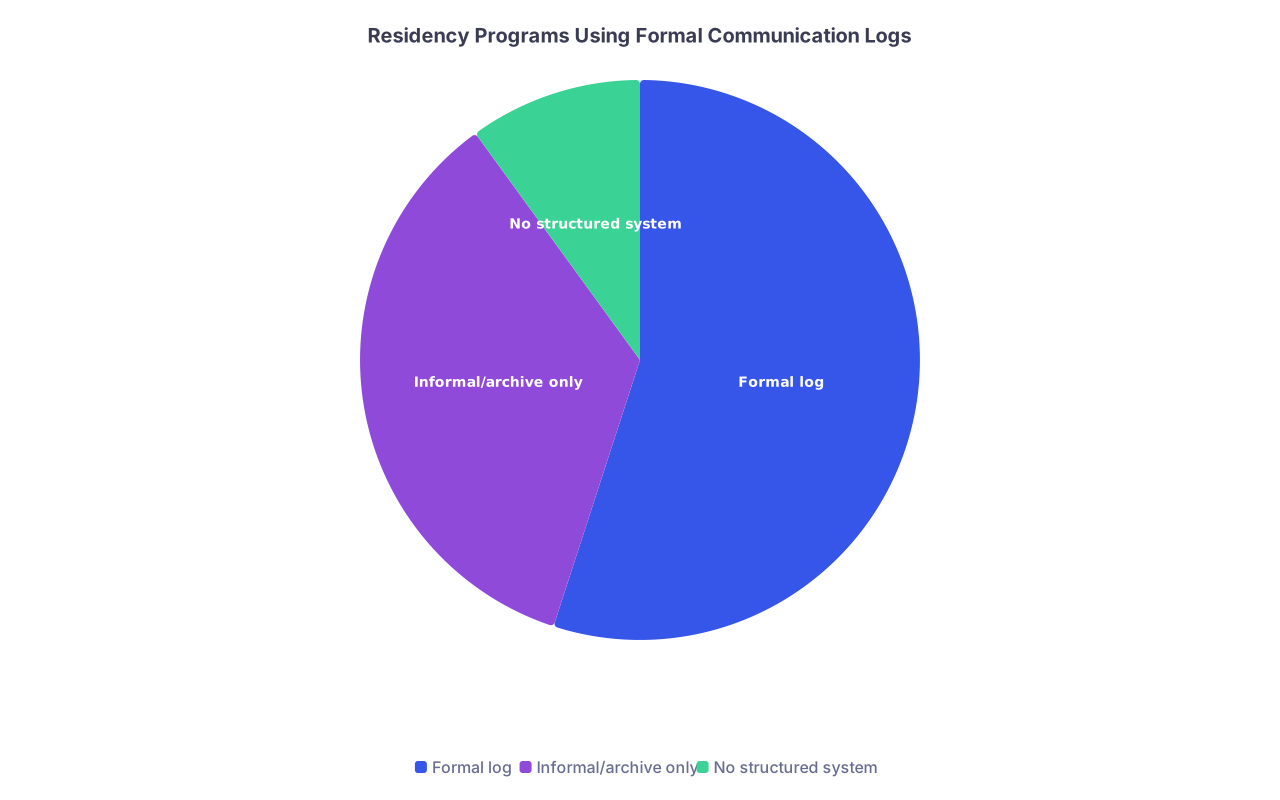
| Category | Value |
|---|---|
| Formal log | 55 |
| Informal/archive only | 35 |
| No structured system | 10 |
Numbers are approximate based on what I’ve seen and heard across IM, psych, EM, and peds programs.
Where Applicants Get Burned Without Realizing It
Let me be blunt: most applicants who get themselves “documented” weren’t trying to be shady. They were anxious, confused about rules, or following terrible advice.
Common patterns I’ve watched play out:
1. The Quasi-Ultimatum Email
“Dr. X, if I rank your program #1, can you guarantee I won’t go unmatched?”
You’ve just written the kind of line that will be screenshotted, archived, and discussed in GME. Even if they respond perfectly, your name is now tagged in the “NRMP stuff” bucket.
2. Claiming Other Programs Broke Rules (In Writing)
“I wanted to let you know Program Y told me I’d match there if I ranked them first.”
Now they have to document your email plus their response, because you just implicated another program. Some will even quietly send that up to the DIO as a “heads-up” in case this turns into a bigger issue.
3. Repeated Pressure for Rank Information
One email asking politely how the process works? Fine.
Three emails over two weeks trying different ways to get them to reveal where they’ll rank you? You’ve become “that applicant.” And your messages are absolutely being saved.
How to Communicate Strong Interest Without Ending Up in the NRMP Folder
You don’t need to be paranoid about every sentence. You just need to avoid the landmines that make people hit “Forward to GME.”
Safe, strong interest looks like this:
- “Your program is my top choice based on X, Y, Z reasons.”
- “I plan to rank your program very highly and would be thrilled to train there.”
- “I left the interview day feeling this would be an excellent fit for my goals.”
All of that is fine. Programs expect it. Many track it. Some even like seeing it.
What crosses into documentation territory is when you tie your ranking to deals, conditions, or expectations about what they’ll do with their rank list.
Here’s the line:
You talking about your rank list = usually fine.
You asking about or negotiating their rank list = documentation magnet.
What Programs Actually Think When They Archive Your Email
Here’s the part no one says out loud: just because your email gets documented doesn’t mean they hate you. Or that you’re blacklisted. Or that they’re calling NRMP on you.
Most of the time, the reaction is closer to:
- “Ugh, another NRMP-adjacent message. Save it.”
- “Make sure we respond with the template.”
- “Okay, documented. Move on.”
They’re not out to destroy your career. They’re out to avoid getting sanctioned.
Where it can hurt you is at the margins: if there’s any sense that you’re either:
- Not understanding NRMP rules despite them being explained
- Trying to corner them into a promise
- Likely to file a complaint if things don’t go your way
Then yes, some programs will quietly move you down a bit on the rank list, or at least strip away any “bonus” bump you might have had from a great interview. No one wants the applicant who will become a three-email drama with GME.
The Bottom Line: What You Should Actually Do
You don’t need to read NRMP policy like a lawyer. But you do need to understand the basic power dynamic:
- Programs are documenting to protect themselves, not to trap you.
- Your written words last way longer than your memory of what you “meant.”
- Anything that smells like a deal, a promise, or leverage gets saved.
So your playbook is simple:
- Express genuine interest.
- Don’t ask for promises.
- Don’t claim anyone promised you anything in writing.
- Don’t pressure them about where you are on their list.
You’ll stay out of their NRMP folder, and they’ll remember you for your interview—not your email trail.
Because years from now, you won’t be thinking about what you wrote to that program coordinator at 1:17 a.m. You’ll be thinking about the kind of colleague you became—and whether you handled all this early professional nonsense with clarity and integrity.


