

The biggest NRMP disaster stories almost never start with malicious intent. They start with a vague comment, an unclear email, or a resident too afraid to push back. Then it escalates.
You stop that escalation by dealing with concerns early, directly, and in a way that is aligned with NRMP rules. Not by being passive. And not by firing off angry emails.
Below is a concrete, step‑by‑step playbook for resolving NRMP‑related concerns with a program before anyone ends up filing a violation report or getting sanctioned.
1. Know What Is Actually an NRMP Problem vs Just “Annoying”
You cannot resolve a problem if you mislabel it. Programs do plenty of irritating, unfair, or unprofessional things that are not NRMP violations. And some seemingly small things are violations.
Here is the core distinction:
- NRMP issue = anything that touches Match commitments, ranking decisions, contract enforcement, or attempts to influence how you (or the program) rank.
- Non‑NRMP issue = most day‑to‑day conflict, bad communication, scheduling, or generic unprofessional behavior.
Common true NRMP‐related concerns you might face:
- Pressure about rank lists:
- “If you rank us #1, we’ll rank you highly.”
- “You should tell us we’re your top choice if you want a spot.”
- Premature contract or commitment:
- Being asked to sign something that feels like a binding commitment before Match results.
- “If you verbally commit right now, we can guarantee a position.”
- Conditional promises:
- “We will rank you to match if you withdraw your application from other programs.”
- Post‑Match games:
- A program saying they might not honor your matched position.
- Being told to do extra work or accept a changed role to “keep” the Match spot.
- Pressure not to report concerns:
- Subtle threats about “ruining your chances” if you complain.
Typical non‑NRMP concerns (still important, but different category):
- Poor interview day organization.
- A rude interviewer.
- Late emails or confusing communication.
- Vague responses about schedule, call, or pay.
Why this matters:
If the worry is NRMP‑related, the stakes are higher. You need documentation, clear language, and a structured approach. If it is not, the strategy shifts more toward feedback and deciding whether you still want to rank that program.
2. First Move: Slow Down and Capture Evidence
Your first instinct may be to confront someone immediately or vent in a group chat. That is how people lose control of the narrative.
Do this instead.
Step 1: Write down exactly what happened
Right after the incident:
- Open a note on your phone or laptop.
- Capture:
- Date and time.
- Who was present (names, roles).
- Exact phrases used, as closely as you can remember.
- Context (Zoom interview, phone call, hallway conversation, formal email, etc.).
- How you responded.
Do not edit for drama. Keep it factual. Think: “If I had to hand this to NRMP tomorrow, would it be clear?”
Step 2: Preserve all written communication
- Save emails. Do not delete anything, even if it makes you look uncertain or awkward.
- Take screenshots of:
- Text messages.
- Direct messages on ERAS, Interview Broker, Thalamus, etc.
- If it was a phone call or in‑person comment:
- Immediately send yourself a summary email:
“At 2:15 pm today, Dr. X said the following during my interview…”
That timestamped email is evidence of your contemporaneous recollection.
- Immediately send yourself a summary email:
You are not doing this because you “plan to report.” You are doing it because you might need to prove a pattern later if the conversation does not resolve.
3. Diagnose the Level of Risk Before You Speak
Not all concerns deserve the same level of escalation. Classify your situation quickly.
| Risk Level | Example Situation | Suggested First Step |
|---|---|---|
| Low | Vague “we like you a lot” email | Clarify politely in writing |
| Medium | “Tell us we are #1 if you want to match here” | Document and seek quiet advice |
| High | “We will only honor your match if…” | Pause, get counsel, consider NRMP contact |
Low risk:
Ambiguous language, awkward compliments, overly friendly communication. These often resolve with a one‑line clarifying email and are rarely malicious.
Medium risk:
Comments clearly related to ranking, but no explicit quid pro quo. These are where early, careful communication can prevent a formal violation.
High risk:
Any hint of conditional ranking, demands for pre‑Match commitments, or threats about not honoring the Match. These situations require you to be strategic. You do not “wing it” on the phone.
4. How to Approach the Program Directly (Without Backfiring)
Talking directly to the program is usually the best first move—if you do it the right way. You are not accusing them of an NRMP violation. You are seeking clarification and giving them a chance to correct course.
Principles for contacting the program
- Use email, not phone, for your first clarification.
- Written record.
- Time to think before you reply.
- Be neutral in tone.
- No “This is unethical.”
- No “I talked to NRMP and they said…”
- Ask for clarification, do not assign intent.
- Your goal is to give them an off‑ramp.
Who to contact
- Best first target: Program Coordinator or Program Director.
- If the issue involves the PD directly and you feel unsafe writing them:
- Consider the Designated Institutional Official (DIO) or GME office after you talk with a trusted advisor.
Sample email templates (you can adapt)
Template A – Ambiguous rank language
Subject: Clarification regarding interview conversation
Dear Dr. [Last Name],
Thank you again for the opportunity to interview with [Program Name]. I appreciated our conversation on [date].
I wanted to clarify one point from our discussion. I understood your comment about “candidates who tell us we are their top choice” as related to the ranking process. I want to be sure I am following NRMP guidelines correctly, which ask both applicants and programs not to solicit or make commitments about rank order lists.
Can you please confirm that there is no expectation that I disclose how I plan to rank programs, and that my candidacy will not be affected by whether I share this information?
Thank you for your time and clarification.
Sincerely,
[Your Name], [AAMC ID if applicable]
Template B – Conditional commitment concern
Subject: Question regarding Match process discussion
Dear Dr. [Last Name],
I appreciated speaking with you on [date] regarding [Program Name]. During our conversation, I understood your comment to mean that ranking me to match could be contingent on my withdrawing applications from other programs.
I may have misunderstood, but I want to be careful to follow NRMP policy, which prohibits statements or agreements that create commitments outside the Match process. I would appreciate clarification that there is no expectation that I withdraw from other programs, and that any ranking decisions are made independently according to NRMP rules.
Thank you again for your time.
Sincerely,
[Your Name]
Do not threaten. Do not copy NRMP. Your goal here is simple: give them a chance to say, “You misunderstood, that is not our expectation,” and correct their behavior going forward.
Often, that is enough.
5. What to Look For in the Program’s Response
Their reply tells you almost everything you need to know about what to do next.
A good, low‑risk response looks like:
- Clear reassurance your rank list is your own.
- Explicit acknowledgment of NRMP rules.
- Sometimes even an apology for unclear wording.
Example of a “good” response:
“Thank you for reaching out. To clarify, there is absolutely no expectation that you disclose or change your rank list. We follow all NRMP Match rules and your candidacy will not be affected by whether you share this information.”
If you get this, save it. You can now move forward, still aware of the earlier red flag, but confident the program corrected course.
Red‑flag responses that increase the risk:
- Minimizing your concern:
- “You are overthinking this.”
- “Everyone understands how the game is played.”
- Doubling down:
- “Candidates who tell us we are #1 always have an advantage.”
- “We want to know you are committed before we commit to you.”
- No response at all after a week.
- Anger, defensiveness, or subtle threats:
- “Comments like this could harm how you are perceived.”
If you see any of that, you are now beyond “simple misunderstanding territory.” You need a more defensive strategy.
6. Quietly Get Advice Before You Escalate
This is the point where people either do nothing (and regret it later) or overreact publicly (and lose leverage). You want a third way: quiet, expert advice.
People worth talking to:
- A trusted faculty advisor at your school.
- Your home residency PD (if you have a good relationship).
- An experienced dean of student affairs.
- A recent graduate who has actually gone through this.
- In some higher‑risk situations: the NRMP Policy staff directly.
You are not asking them to “handle it” for you. You are asking three questions:
- Based on the exact wording, does this sound like an NRMP concern?
- Would you:
- Do nothing?
- Send one more clarification?
- Talk to the GME/DIO?
- Contact NRMP for guidance?
- How might this affect my chances if the program finds out I raised the concern?
If you contact NRMP for advice:
- You can ask hypothetically and without using names initially.
- Their job is not to blow up your application. Their job is to protect the Match.
- They can tell you:
- Whether the behavior you describe matches known violations.
- What options you have if the program escalates the problem.
7. Deciding Whether and How to Raise It Internally (GME or DIO)
Sometimes the best resolution is internal: handled by the hospital’s own GME structure, never reaching NRMP.
You consider this step if:
- The program’s response was poor or non‑existent.
- The behavior seems systemic (e.g., multiple interviewers doing the same thing).
- You believe the program may jeopardize Match integrity.
Who is the DIO and why they matter
The Designated Institutional Official (DIO) oversees all residency programs at an institution. Their job includes ensuring compliance with ACGME and NRMP standards.
Typical step sequence:
- Gather your documentation in a clean order:
- Timeline of events.
- Exact quotes.
- Screenshots/emails.
- Your initial clarification email.
- The program’s response (or lack thereof).
- Request a confidential conversation:
- Usually via email: “I am an applicant to [program]. I have a concern regarding adherence to NRMP policies and would appreciate a confidential discussion.”
- Stay factual in the meeting:
- No speculation about motives.
- No global statements (“This program is toxic.”).
- Stick to: “On [date], Dr. X said [quote]. On [date], I emailed [text]. On [date], they replied [text].”
What you want from this conversation:
- Confirmation that you are not at risk for raising a concern.
- Assurance that GME will address or monitor the situation internally.
- Clarity on whether you should still rank this program.
You are not responsible for fixing their compliance problem. You are responsible for protecting your own Match outcome and maintaining integrity.
8. Adjusting Your Rank List Based on How They Handle It
The way a program responds to an NRMP‑related concern tells you more about them than any glossy slide deck on interview day.
Here is a blunt framework for adjusting your rank list.
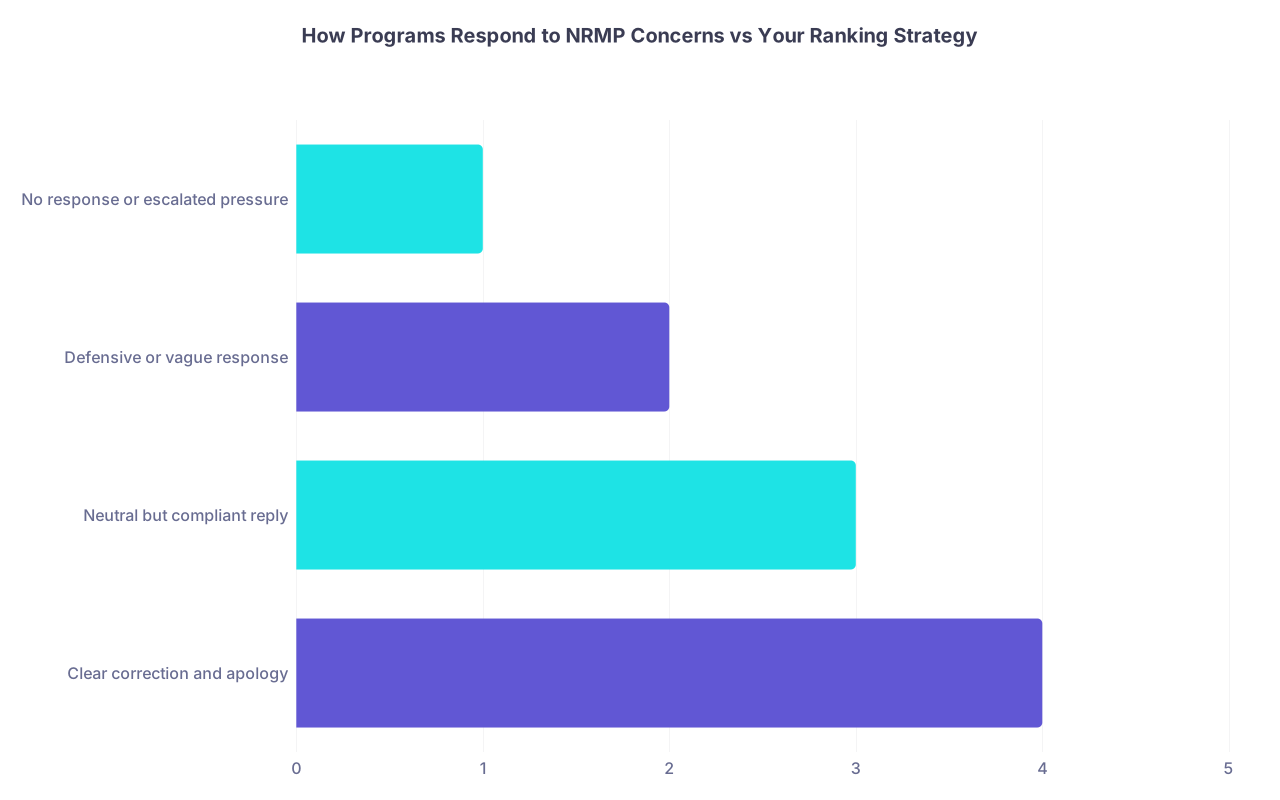
| Category | Value |
|---|---|
| Clear correction and apology | 4 |
| Neutral but compliant reply | 3 |
| Defensive or vague response | 2 |
| No response or escalated pressure | 1 |
Interpretation (1–4 where 4 = safest to rank highly):
- 4 – Clear correction and apology
- They made a mistake, owned it, and fixed it.
- I would still rank them according to genuine preference.
- 3 – Neutral but compliant reply
- No apology, but they confirm compliance.
- Mild concern, but not disqualifying.
- 2 – Defensive or vague response
- I would strongly consider moving them down.
- Ask yourself: Do I want to train under people who react this way to a sincere, policy‑based question?
- 1 – No response or escalated pressure
- This is a serious signal. I have seen people regret ranking these programs highly.
- Often safest to move them way down or off your list completely.
Rank lists are about where you want to work all day for years, not just who looked shiny on interview day. You just got a more realistic data point than most applicants ever see.
9. When and How to Involve NRMP Formally
Sometimes, despite every attempt to resolve things locally, a line is clearly crossed. That is when formal NRMP involvement becomes justified.
Common triggers for considering a report:
- A program explicitly conditions ranking you highly on:
- You ranking them #1.
- You withdrawing from other programs.
- A program suggests it may not honor a Match commitment.
- You learn of a pattern affecting multiple applicants in the same cycle.
- You have evidence of post‑Match retaliation or coercion connected to your rank list.
Before filing anything:
- Re‑review the NRMP Match Participation Agreement and Violations Policy (NRMP website).
- Reconstruct a clear, chronological narrative with supporting documents.
- If possible, get a final sanity check from a trusted dean or mentor.
If you proceed:
- Expect it to take time. This is not a 48‑hour turnaround.
- You may be asked to provide copies of your documentation and possibly testify if it reaches a formal hearing.
- NRMP does not punish applicants for reporting good‑faith concerns. They do punish retaliation.
One more point:
You do not file a report just because a program was annoying. You file a report because their behavior threatens the fairness of the Match.
10. Playbook Summary: Step‑by‑Step Protocol
Here is the practical protocol I recommend you follow when you sense something is off:

| Step | Description |
|---|---|
| Step 1 | Notice concerning comment or request |
| Step 2 | Write detailed notes and save messages |
| Step 3 | Classify risk - Low, Medium, High |
| Step 4 | Send neutral clarification email |
| Step 5 | Get quiet advice before responding |
| Step 6 | Evaluate program response |
| Step 7 | Document and adjust rank list if needed |
| Step 8 | Consult advisor or DIO |
| Step 9 | Protect yourself and rank accordingly |
| Step 10 | Consider NRMP guidance or report |
| Step 11 | High risk? |
| Step 12 | Response reassuring and compliant? |
| Step 13 | Pattern or serious violation? |
And for how you split your time and energy on this during application season:
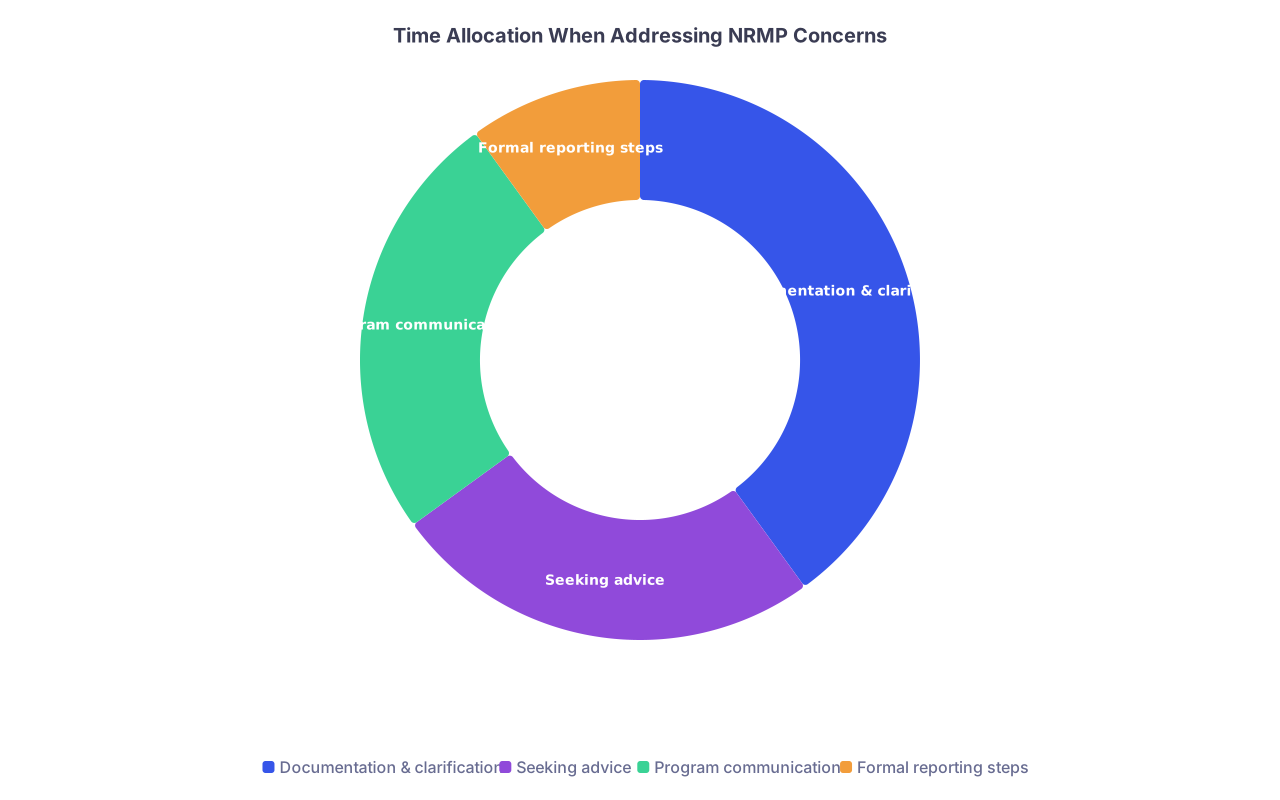
| Category | Value |
|---|---|
| Documentation & clarification | 40 |
| Seeking advice | 25 |
| Program communication | 25 |
| Formal reporting steps | 10 |
If you are spending 90% of your time on formal complaints, something is off. Most concerns will and should resolve at the documentation + clarification + informal advice level.
11. How to Protect Yourself Going Forward
A few habits dramatically reduce the odds that an NRMP concern spirals.
Stay boringly professional in writing.
Your emails will be read by more people than you think if this escalates. Make sure they age well.Avoid volunteering rank information.
Programs love fishing: “Where do we stand?”
Easiest safe answers:- “I am very interested in your program and will be ranking based on overall fit.”
- “I am still finalizing my list but I had a very positive impression.”
If pressed, stick to policy.
You can literally say:- “NRMP guidance is that we should not commit to or request commitments about rank lists, so I prefer to follow that.”
Use “I may have misunderstood” as a de‑escalation tool.
Even when you know you did not misunderstand. It lets the other party back away from a bad statement without losing face.Do not crowd‑source legal decisions in group chats.
Your classmates mean well. They are not NRMP, GME, or legal counsel.
FAQ (Exactly 3 Questions)
1. Will raising an NRMP‑related concern with a program hurt my chances of matching there?
It might, in the sense that you are dealing with humans and some will react poorly to being questioned. But that is precisely the point: if a program punishes you for politely clarifying compliance with basic Match rules, that is strong evidence you do not want to train there. Programs that are serious about ethics and compliance usually appreciate the opportunity to clarify or correct a misunderstanding. You are not obligated to ignore red flags just to keep every option open.
2. What if a program calls me on the phone and pressures me about rank lists—should I confront them in real time?
On the call, do not argue. Keep it neutral: “I appreciate your interest. I plan to follow NRMP guidelines regarding rank lists.” End the call as soon as it is natural. Then immediately document the conversation: time, who called, exact phrases. After that, you can choose to send a clarification email, talk with an advisor, or, if the pressure was explicit and conditional, consider involving GME or NRMP. Real‑time confrontation on the phone rarely helps and often leaves you with less clear evidence.
3. How do I know when an issue is serious enough to consider an NRMP violation report?
Ask three questions:
- Was there a clear attempt to influence ranking decisions with promises, threats, or conditions?
- Was there an attempt to create a commitment outside the Match (like requiring a pre‑Match promise or hinting they might not honor the Match)?
- Is there a pattern involving multiple applicants or repeated behavior after you sought clarification?
If the answer to any of those is “yes,” and you have documented evidence, you are in the zone where a violation report is reasonable to consider—ideally after at least one conversation with an advisor or dean who understands NRMP policy.
Key takeaways:
- Document first, react second. Written records and calm clarification protect you.
- Give the program a clean chance to correct itself before escalating. Their response tells you a lot about whether to rank them.
- Use advisors, GME, and NRMP strategically. You are not alone, and you do not need to let a small concern grow into a full‑blown Match crisis.


