

You just finished a residency interview. You’re back at the hotel or your apartment, badge still on the table, your email open. You type: “Thank you so much for the opportunity to interview today…”
Then you freeze.
You’ve heard horror stories: “NRMP violations,” “no communication after interviews,” “you can’t say anything about ranking,” “programs aren’t allowed to ask, and applicants shouldn’t tell.” Now you’re wondering if a simple thank-you note could somehow break NRMP rules or hurt you in the Match.
Let me be direct:
A normal, polite, non-ranking, non-pressuring thank-you note is not risky and does not violate NRMP rules. The danger isn’t the thank-you itself. It’s what you put in it—and what some programs try to get you to say.
This article walks you through exactly what is and is not allowed, and gives you specific language you can safely use.
The Core Question: Are Thank-You Notes Risky Under NRMP Rules?
Short answer:
No, standard post-interview thank-you notes are not risky under NRMP rules, as long as you avoid:
- Promising how you will rank a program
- Asking how the program will rank you
- Any hint of pressure, quid pro quo, or “if you do X, I’ll do Y”
- Misrepresentation or misleading statements
The NRMP Match Communication Code of Conduct is not anti-thank-you. It’s anti-coercion and anti-gamesmanship.
Key NRMP principles here:
- Programs and applicants may communicate after interviews.
- Neither side may solicit or require information about ranking intentions.
- Neither side may make offers or commitments outside the Match.
- Statements of genuine interest are allowed, as long as they aren’t coercive or conditional.
So the simple “thank you for your time, I enjoyed meeting you” is absolutely fine.
Where people get in trouble is when an innocent thank-you morphs into:
“I will rank you #1 if you rank me highly.”
That’s where the NRMP starts caring.
What NRMP Actually Says About Post-Interview Communication
Let’s break this into practical language.
The NRMP’s Match Participation Agreement and Code of Conduct say (summarized in plain English):
- You and programs can send messages after interviews.
- You cannot be required to send thank-you notes or post-interview communications.
- Programs cannot ask you: “Where will you rank us?” or “Will we be your #1?”
- You should not feel pressured to reveal your rank list.
- Both sides must not make promises or threats tied to ranking or positions.
That means:
- A thank-you note = okay
- A thank-you note that says “I will rank you #1” = still technically allowed, but dumb and unnecessary
- A program saying “We’ll rank you highly if you commit to ranking us #1” = not okay
- You saying “If you guarantee me a spot, I will rank you #1” = not okay
NRMP is most concerned about coercion, pressure, and secret side deals. They’re not out here monitoring your polite emails.
When Thank-You Notes Become Problematic
The thank-you note itself isn’t the problem. The content can be.
Here’s where you can drift into risky or just plain bad territory:
Explicit ranking promises
- “I am ranking your program #1.”
- “I will definitely rank you above all other programs.”
These are not illegal, but they’re pointless and can backfire. People change their minds. Program directors know that.
Conditional or transactional language
- “If you’re able to rank me highly, I’ll rank you #1.”
- “If I match at your program, I expect to be able to do X fellowship.”
Now you’re hinting at deals or expectations beyond what’s appropriate.
Fishing for their rank intentions
- “Where will I fall on your list?”
- “Am I in the top group?”
Programs cannot answer this in a meaningful way under NRMP rules, and you put them in an awkward position.
Anything that feels like pressure
- “You’re my top choice, I’d appreciate confirmation you feel the same.”
- “I’ll only rank you highly if I hear back from you.”
That starts to sound like leverage, not gratitude.
The line is simple:
Thank-you + specific things you liked + polite closing = fine.
Rank talk, deals, pressure, or fishing for info = don’t do it.
Safe vs Risky: Concrete Email Examples
Here’s the part you actually want: what you can safely send.
Safe, NRMP-Friendly Thank-You Templates
Use these as a base. Customize lightly.
Basic, totally safe version:
Subject: Thank you for the interview
Dear Dr. Smith,
Thank you for the opportunity to interview with the Internal Medicine Residency at City Hospital yesterday. I appreciated learning more about your program’s focus on resident autonomy and the strong ICU experience.
I especially enjoyed speaking with the residents about their continuity clinic and the support they described from faculty. Our conversations reinforced my interest in your program.
Thank you again for your time and consideration.
Best regards,
[Your Name], MS4, [School]
This is 100% safe. No rank talk. No pressure. Shows interest and professionalism.
“Strong interest” but still safe:
Dear Dr. Jones,
Thank you again for the chance to interview at Lakeside Family Medicine. The emphasis on community engagement and longitudinal behavioral health exposure really stood out to me.
I left the day with a very strong interest in your program and can clearly see myself thriving in your resident culture.
Thank you for your time and consideration.
Sincerely,
[Your Name]
You’re allowed to say “very strong interest.” You’re allowed to say you can see yourself there. That’s not an NRMP problem.
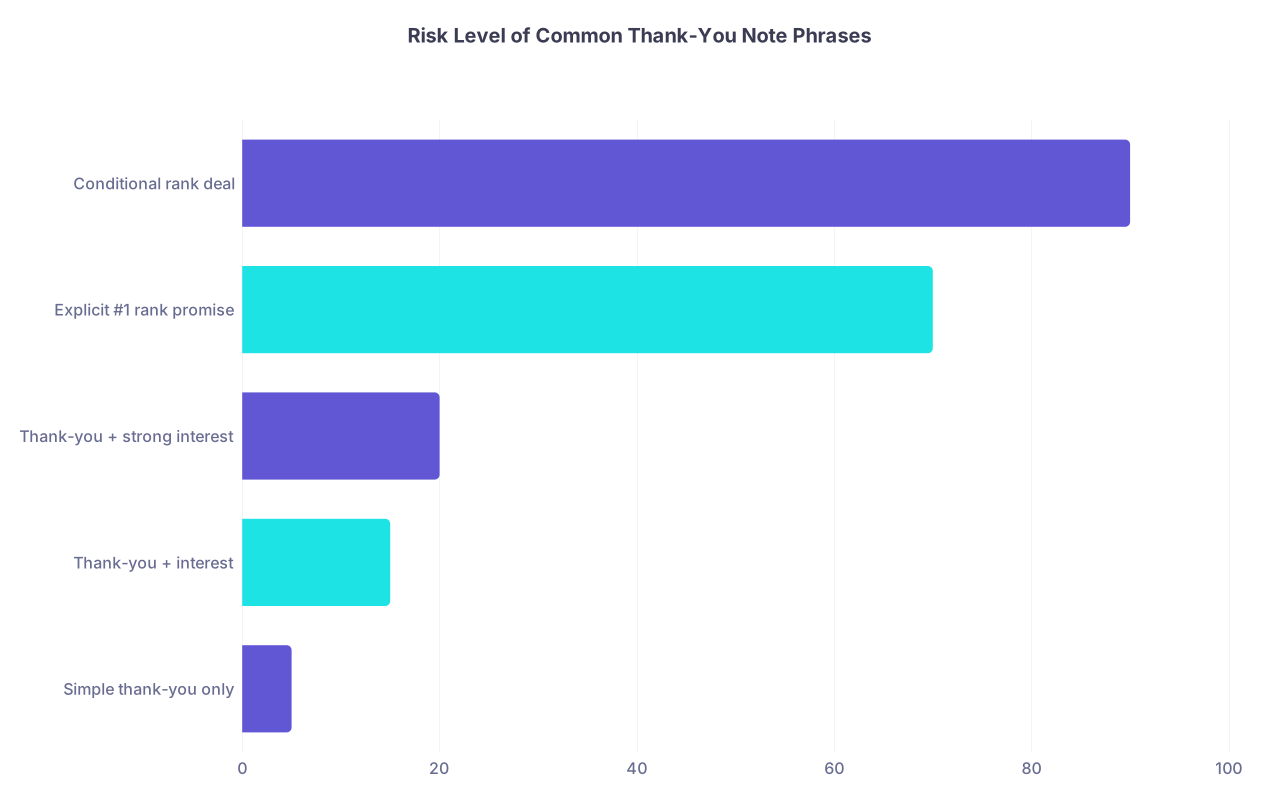
| Category | Value |
|---|---|
| Simple thank-you only | 5 |
| Thank-you + interest | 15 |
| Thank-you + strong interest | 20 |
| Explicit #1 rank promise | 70 |
| Conditional rank deal | 90 |
Risky or Just Plain Unwise Phrases
Do not write these:
- “You are my #1 choice and I will rank you first.”
- “If you rank me highly, I’ll rank you #1 as well.”
- “I will withdraw my other applications if I hear I’m ranked to match.”
- “Please let me know where I fall on your rank list.”
These aren’t always direct NRMP violations, but they’re red flags. They put everyone in a bad position and make you look inexperienced at best.
Program Communication: What If They Say Something Weird?
Sometimes programs are the problem, not you.
I’ve seen emails like:
- “If you rank us first, you’ll have a very good chance of matching here.”
- “We intend to rank you to match.”
- “You’re in our top group of candidates.”
Let’s unpack this.
Under NRMP rules, programs may express interest, but they may not:
- Ask where you’ll rank them
- Promise that you will match if you do X
- Attempt to pressure you to rank them a certain way
If a program sends you a borderline or questionable message, your priorities are:
Do not mirror their mistake.
You don’t need to say “I’ll rank you #1 too.” You can reply with a polite, noncommittal thank-you like:
“Thank you for the update and for your continued interest. I appreciate the opportunity to have interviewed with your program.”Rank according to your true preferences.
The Match algorithm is designed to favor your ranking, not theirs. Chasing “signals” or emails is a rookie error.If a message feels coercive or explicitly asks for rank info and you’re worried, you can quietly discuss it with your dean’s office or student affairs. They’ve seen this before.
Strategy: Should You Even Send Thank-You Notes?
Now to the practical side.
Are you required? No.
Will some programs notice? Yes.
Will it make or break your match? Almost never.
Here’s a realistic framework:
- If a program explicitly says “do not send thank-you notes” in their materials → don’t send them. Respect that.
- If a program says they don’t expect them → you can skip them or send just one to the PD or coordinator if you genuinely want to.
- If a program seems traditional, smaller, or very community-focused → a brief thank-you is often appreciated and culturally expected.
Where thank-you notes might actually help:
- You had a memorable, specific interaction with a PD, APD, or faculty member.
- You’re genuinely very interested and want to reinforce that without talking about rank.
- You have a short, meaningful follow-up (e.g., “You mentioned X resource, I read about it and it aligns well with my interest in Y.”).
Where they won’t matter:
- Big-name, high-volume programs interviewing hundreds of people.
- Programs that literally say “we do not consider post-interview communication in our ranking.”
| Program Type | Impact of Thank-You Note |
|---|---|
| Small community programs | Moderate |
| Mid-size academic programs | Low–moderate |
| Large university programs | Low |
| Programs banning thank-yous | None (do not send) |
| Highly competitive specialties | Low (but fine to send) |
How to Stay 100% Safe: A Simple Personal Rule Set
If you want a no-headache rule set, use this:
Limit content to:
- Thanking them for their time
- Mentioning 1–2 specific things you liked or learned
- Briefly restating your interest (without rank language)
Never:
- Mention your rank list at all
- Ask about their rank list
- Make any conditional or transactional statements
Keep it short.
5–10 sentences max. This is not a second personal statement.Don’t send multiple waves of “just checking in” emails.
One thank-you is plenty. Over-communication looks needy, not professional.Default to honesty.
If you’re not genuinely very interested, don’t fake “top choice” language. A neutral, polite thank-you is always fine.

| Step | Description |
|---|---|
| Step 1 | Finished Interview |
| Step 2 | Do not send anything |
| Step 3 | Skip thank you |
| Step 4 | Write short email |
| Step 5 | Delete rank language |
| Step 6 | Send safe thank you |
| Step 7 | Program bans thank you notes |
| Step 8 | Want to genuinely thank them |
| Step 9 | Include rank talk |
Frequently Asked Questions (Exactly 6)
1. Can I tell one program they are my #1 choice without breaking NRMP rules?
You can, but I don’t recommend it. NRMP doesn’t ban you from saying “you’re my first choice,” but it’s unnecessary, creates expectations you might not honor later, and offers you no real advantage. Programs know applicants say this to multiple places. If you absolutely feel compelled, keep it honest, non-conditional, and understand it doesn’t guarantee anything.
2. Is it an NRMP violation if a program emails, “We will rank you to match”?
This kind of statement is questionable but not uncommon. It brushes up against the spirit of NRMP rules, because it implies a level of certainty they cannot guarantee. It’s not your violation, though. Do not engage in rank talk in return. Reply with a neutral “Thank you for the update and the opportunity to interview” if you feel you must respond, and then ignore it in your ranking decisions.
3. Do I have to send a thank-you note to every interviewer?
No. You’re not required to send any. If you do send them, a common middle-ground approach is: one note to the program director (and optionally the coordinator), and maybe one or two to individual faculty where you had particularly meaningful conversations. Sending 8 emails to every person you met is overkill and buys you nothing.
4. Can programs penalize me for not sending a thank-you note?
Most do not, and many explicitly state that post-interview communication is not used in ranking. Some smaller or more traditional programs might notice, but even there, it’s rarely a major factor. If you’re worried, sending a single short, professional thank-you to the PD is a safe, low-effort move.
5. What if a program asks directly, “Where will you rank us?”
That’s inappropriate under the NRMP communication guidelines. You don’t have to answer. A safe response: “I’m still finalizing my rank list, but I really enjoyed learning more about your program and appreciate the opportunity to have interviewed.” If they keep pushing, that’s a red flag about their culture, honestly.
6. Is it okay to send an update or letter of interest later, not just a thank-you?
Yes, as long as you follow the same rules: no deals, no pressure, no “if you rank me, I’ll rank you.” An update like “I’ve accepted a new leadership role” or “I presented a poster” is fine. A letter of interest that says you remain very interested is also fine. Just keep rank-list language out of it and never imply any commitment outside the Match.
Key takeaways:
- Normal, polite thank-you notes that avoid rank talk are not risky under NRMP rules.
- The danger isn’t the email; it’s turning it into rank negotiation, pressure, or side deals.
- Keep your messages simple: thank them, mention specifics you liked, express genuine interest—and let your official rank list do the real talking.


