
You’re three weeks from your rank list deadline. You’ve got a draft list in your head, a half-baked one in NRMP, and that one annoying program director email sitting in your inbox: “We enjoyed meeting you and you’ll be ranked highly.”
And now you’re wondering:
Can I actually talk about my rank list with my home program faculty? With residents I know at places I interviewed? With that PD who keeps “checking in”?
Let’s answer that cleanly.
Short Answer: Yes, You Can Talk – But With Clear Limits
You’re allowed to:
- Ask faculty/residents for advice about your rank list.
- Talk about what you value (location, fellowship, culture, etc.).
- Share general preferences (“I’m leaning toward mid-sized academic IM programs in the Northeast”).
- Tell people where you interviewed and what you liked or didn’t like.
You should be very cautious or avoid:
- Telling a program “I’m ranking you #1” (or asking them the same).
- Letting anyone pressure you about how to rank.
- Giving programs “promises” about your exact rank order.
- Having any conversation that feels like a deal: “If you rank me highly, I’ll rank you highly.”
The NRMP’s Match Participation Agreement is clear about the core rule:
Your rank list must be your choice, free from pressure, and you’re not obligated to tell anyone how you ranked them.
So the question isn’t “Am I allowed to talk at all?” It’s: How do I talk smart so I don’t get manipulated or violate rules?
What the NRMP Actually Cares About
Let’s cut through the folklore and “my PD said” noise.
The big NRMP concerns are:
Coercion or pressure
Anything that pushes you to rank a program a certain way.Misleading or binding statements
Programs or applicants suggesting commitments outside the algorithm.Quid pro quo
“If you tell me where you’ll rank us, we’ll tell you where we’ll rank you.” That’s the kind of thing that gets people investigated.
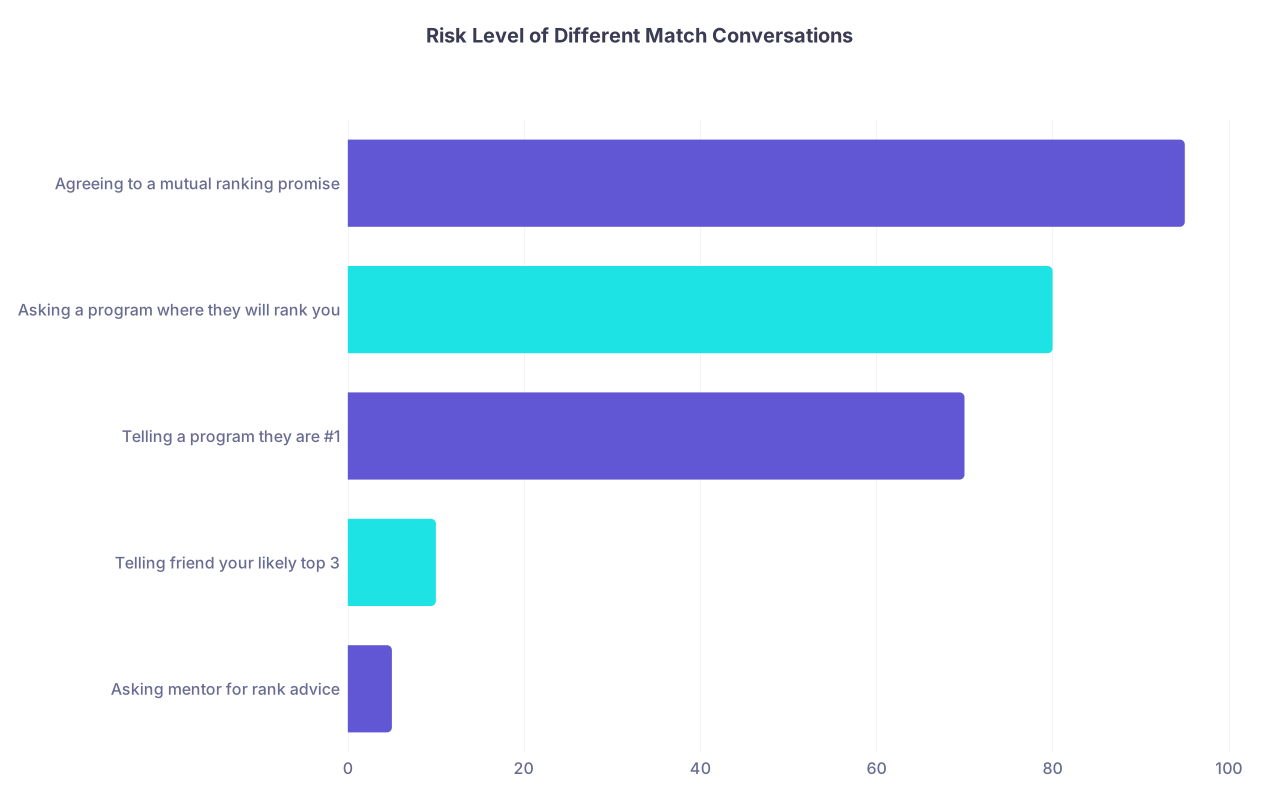
| Category | Value |
|---|---|
| Asking mentor for rank advice | 5 |
| Telling friend your likely top 3 | 10 |
| Telling a program they are #1 | 70 |
| Asking a program where they will rank you | 80 |
| Agreeing to a mutual ranking promise | 95 |
Low risk: honest, non-binding, advisory conversations.
High risk: “promises,” pressure, or implied agreements between applicant and program.
Talking With Home Faculty: What’s Safe vs Problematic
You should use your faculty. That’s part of their job. But you need to keep the power where it belongs: with you.
Completely Appropriate Conversations
These are fine and common:
- “Here’s my current rank list — what do you think?”
- “Can you help me compare Program A vs Program B?”
- “Do you know anything about the fellowship opportunities at X?”
- “How realistic is it to go into [competitive fellowship] from Y program?”
- “Can we talk through how this rank list aligns with my long-term goals?”
Faculty giving perspective isn’t a violation. It’s mentoring.
Where It Starts To Smell Bad
- “You need to rank our home program first.”
- “If you don’t rank us high, that will be remembered.”
- “We expect you to stay here after all we did for you.”
- “Switch your list so you match here; it’s better for us.”
That kind of pressure violates the spirit of NRMP rules, even if no one says “NRMP” out loud.
Your response can be calm and boring:
“I really appreciate everything this program has done for me. I’m planning to certify my list based on overall fit for my goals, and I’m still thinking that through.”
You don’t have to argue. Just restate that the list is your decision.
Should You Show Faculty Your Exact Rank List?
You can, but I’d be selective.
Good times to share specifics:
- With a mentor you trust who knows your specialty and priorities.
- When deciding among a few programs you’re truly torn about.
- When you want targeted career advice: “If I want cards, is it dumb to rank X over Y?”
Bad times to share specifics:
- With anyone who has a clear interest in where you match (e.g., your home PD in a small program who wants to keep you).
- With people who’ve already shown they’re pushy.
- With folks who gossip (and every hospital has at least one of these).
If you want advice but not pressure, you can keep it at the “bucket” level:
“Top tier for me: A, B, C. Mid tier: D, E, F. Bottom: everything else. Any strong opinions?”
Talking With Residents: Easier, But Still Some Boundaries
Residents are usually safer. They’re not in charge of your contract. They’re just slogging through 28-hour calls and trying to help you not regret your choices.
Totally fine with residents:
- “I’m thinking of ranking you guys in my top 3.”
- “I’m torn between your program and X; here’s why.”
- “How often do people actually get the fellowships they want?”
- “What would you do if you were me?”
Things to avoid telling residents who might relay info back:
- “You’re my #1 no matter what.”
- “I’ll rank you #1 if you tell your PD I’m committed.”
- “I just need to know I’m safe to match here.”
Residents talk. A lot. Especially on night float at 3 am. Assume anything you tell them about exact rank positioning might end up back at the PD level.
Better phrasing:
“You’re very high on my list.”
“You’re in my top group, for sure.”
That gives positive feedback without creating spoken “promises.”
Talking Directly With Programs: Where You Can Get Burned
Here’s where NRMP rules and real-world gamesmanship clash the hardest.
Are You Allowed To Tell a Program They’re #1?
Technically: yes. The NRMP doesn’t forbid you from saying “you’re my top choice.”
They do forbid anyone from:
- Making statements that are misleading or intended to influence rank lists in a way that undermines the Match.
- Requiring or soliciting ranking information as a condition of acceptance or evaluation.
The harder question is: Should you say it?
My answer:
Only if all 3 are true:
- You are absolutely certain they are your #1 and will remain #1.
- You’d be genuinely happy and not regret it if you match there.
- You’re okay with the possibility they don’t rank you highly anyway.
But understand this:
Telling multiple programs “You’re my #1” is unethical. It also sometimes gets reported. I’ve seen that go badly.
What You Shouldn't Ask Programs
Don’t ask:
- “Where will you rank me?”
- “Can you tell me if I’m in your top group?”
- “If I rank you #1, will that guarantee I match there?”
Those questions put them at risk of violating rules. The good ones will dodge. The bad ones will say too much. Either way, it doesn’t help you.
Better questions to ask instead:
- “Where do most of your grads match for fellowship?”
- “Can you talk about how this program supports residents with kids/partners?”
- “How often do residents get their first-choice rotations/electives?”
Information that matters. Not pseudo-commitments that don’t.
How To Get Real Advice Without Breaking Rules
You want clarity without drama. Here’s a simple model that works.

| Step | Description |
|---|---|
| Step 1 | Need rank list advice |
| Step 2 | Share goals and options |
| Step 3 | Ask about day to day reality |
| Step 4 | Ask only info questions |
| Step 5 | Ask for comparison not directives |
| Step 6 | Avoid rank promises |
| Step 7 | Update personal rank list |
| Step 8 | Who am I asking |
When you talk to:
Faculty mentors
You say: “Here are my top 5. Here’s what I care about long-term. What am I missing?”
You get: feedback, pattern recognition, warnings about hidden issues.
Residents
You say: “What sucks here that doesn’t show on interview day?”
You get: reality check, culture insight, how people actually live.
Programs (PDs, APDs, coordinators)
You say: “Can you clarify X about training/fellowships/backup support?”
You get: structured information, not rank games.
Sample Phrases You Can Steal
Use these when someone walks close to the line or you feel cornered.
When a PD fishing for your rank asks: “So…where do we stand?”
You can say:
- “I really enjoyed your program; you’re definitely among my top choices.”
- “I’m still finalizing my list, but you’re in a very strong position for me.”
- “Out of respect for the Match rules, I’m keeping my final list private, but I left very impressed.”
All of those are honest and non-committal.
When your home PD says: “We expect you to rank us first.”
You can say:
- “I’m very grateful for everything I’ve gotten here, and I’m still weighing what’s best for my long-term goals.”
- “I’m going to submit a list that reflects fit for me and my family; I hope you can understand that.”
- “I’m still thinking carefully, and I’ll be certifying my list based on overall fit.”
Repeat the “fit and goals” line as many times as needed.
When a resident you like asks: “Are we your #1?”
You can say:
- “You’re in my top group, for sure.”
- “Very high. I had a great experience on interview day.”
- “I’m still juggling a few that I loved, and you’re absolutely in that mix.”
You’re being honest without pinning yourself down.
Strategy: How Much Should You Share At All?
Let’s be blunt: most of the hyper-specific rank talk doesn’t meaningfully change outcomes. It mostly raises stress.
Here’s a practical way to approach it:
- With faculty mentors you trust – Be reasonably open. Use them to sharpen your thinking.
- With residents – Ask tons of questions about real life there. Share general enthusiasm, not detailed rank math.
- With program leadership – Ask for information, express interest, don’t play rank games.
- With classmates – Share broad strategies (“I ranked fit over prestige”), not exact lists. Comparing 1–2–3 orders with friends mostly just makes everyone more anxious.
| Person Type | Level of Detail to Share | Main Goal of Conversation |
|---|---|---|
| Trusted Faculty | Moderate–High | Career fit, strategy, insight |
| Residents | Low–Moderate | Culture, lifestyle, reality |
| Program Directors | Low | Clarify info, express interest |
| Classmates/Friends | Variable, but cautious | Emotional support, perspective |
Common Myths You Can Ignore
Let me kill a few pieces of bad advice you’ll hear in hallways:
“You have to tell a program they’re #1 if you want to match there.”
False. The algorithm already favors your preferences. Telling them might make you feel better, that’s it.“If you don’t rank your home program highly, they’ll blacklist you forever.”
Dramatic and usually wrong. People match elsewhere all the time and come back for fellowship or jobs.“Programs know your rank list anyway.”
Completely false. No one sees your list except the NRMP system.“It’s against the rules to talk about your rank list at all.”
Wrong. What’s restricted is pressure and deals, not normal advice-seeking.“If a PD says you’ll be ranked to match, it’s a guarantee.”
Absolutely not. I’ve watched people with “ranked to match” emails end up unmatched. Don’t base your list on promises.
Bottom Line: Yes, Talk. But Protect Your Autonomy.
You’re allowed to discuss your rank list with faculty, residents, and even programs, as long as:
- You keep your autonomy.
- You don’t enter into explicit or implied ranking “deals.”
- You avoid promising things you’re not absolutely sure about.
- You remember: the algorithm protects your preferences, not their emails.
Today, do this:
Open your current rank list draft. Then text or email one mentor and one resident at a program you like. Ask each of them one specific, concrete question that will actually help you decide on your top 3. Nothing about “#1.” Just: “Help me see what I’m missing.”
That’s how you use conversations to make your list smarter, not more stressful.
FAQ (Exactly 5 Questions)
1. Is it an NRMP violation if I tell a program they’re my #1?
No, not automatically. The NRMP doesn’t forbid you from voluntarily sharing your preferences. The risk is ethical and practical, not strictly legal: if you tell multiple programs they’re #1, that’s dishonest and can damage your reputation. And even if you’re honest, it doesn’t guarantee anything, so it’s usually not worth the emotional weight it creates.
2. Can a program ask me where I’ll rank them?
They do, but they’re not supposed to pressure you. Directly asking “Where will you rank us?” or implying your evaluation depends on your answer moves toward a gray zone with NRMP rules. The safest move is to pivot: “I really liked your program and you’re among my top choices, but I’m keeping my final list private per Match guidelines.”
3. Can I get in trouble for showing my entire rank list to my mentor?
No. You’re allowed to share your list with whomever you trust. NRMP doesn’t police private advice conversations. The only real risk is social: if you share widely, you invite pressure and second-guessing. I’d keep exact lists to a very small circle of trusted advisors.
4. Do programs ever change how they rank me based on what I say about my list?
Sometimes, yes. If you tell them they’re your clear top choice, some programs might move you up because they think you’re more likely to match there. But others ignore that kind of info entirely. It’s unpredictable. That’s exactly why you should build your rank list assuming they’re all ranking you honestly based on your application, not your flattery.
5. What should I do if I feel pressured or threatened about how to rank?
First, document it: save emails, write down what was said, by whom, and when. Second, talk to someone you trust outside that power structure—another faculty mentor, your dean of students, or your school’s Match advisor. If it’s serious (e.g., threats about your future, explicit demands), you can contact the NRMP for guidance. But practically, your first move is to quietly reaffirm: “I’m going to submit my rank list based on overall fit for my goals,” and then do exactly that.


