

The NRMP Match has rules everyone reads—and red lines programs quietly assume you will never cross.
Those unspoken red lines are where people get burned. Not because they’re evil or reckless, but because no one told them how programs actually react when you dance near the NRMP boundaries.
I’ve sat in meetings where faculty literally said, “I don’t care what the NRMP guide says, if an applicant does that, they’re dead to me.” That’s the part you never see published.
Let’s walk through the real, behind-the-scenes “do-not-cross” lines programs enforce socially—even when the formal rules sound softer on paper.
1. The “Gamesmanship” Line: When Normal Strategy Becomes Toxic
Programs expect you to strategize. They do not expect you to look like you’re trying to game them.
Here’s the distinction faculty quietly make in their heads:
- Smart: Apply broadly if you’re mid-tier.
- Normal: Send a short, targeted interest email.
- Red line: Behave like you’re running your own mini-match and using them as leverage.
The classic example: the “you’re my #1” game.
On paper, NRMP says you can tell programs how you plan to rank them, as long as nobody pressures anyone. In reality, program directors have been burned too many times by applicants promising the moon.
So here’s how this lands in real committee rooms:
- Applicant tells Program A: “You’re my #1. 100%.”
- Applicant tells Program B: same line.
- PD of Program B mentions this to PD of Program A at a conference or on a text thread.
- Both PDs roll their eyes and move you from “probably rank” to “we don’t trust this person.”
Yes—PDs talk off the record. Constantly. Within specialties, they know who’s honest and who sounds like a politician.
Insider line: You get exactly one true “You’re my #1” email that’s believable. Maybe two if you phrase it very carefully. Once your name starts popping up as the candidate promising true love to everyone, it’s over.
Where you cross the line:
- You use absolute language: “I will rank you #1, guaranteed” to multiple programs.
- You email half your interview list with the same “you’re my top choice” template.
- You start sounding transactional: “If you rank me highly, I’ll rank you highly.”
What faculty hear under that: “This person doesn’t understand professionalism or honesty. Pass.”
2. The Communication Line: Pressure, Probing, and Overcontact
, Post-interview lobbying](https://cdn.residencyadvisor.com/images/articles_svg/chart-program-director-red-flags-from-applicant-communic-1239.svg "Program Director Red Flags from Applicant Communication")
| Category | Value |
|---|---|
| Excessive emails | 40 |
| Pressure about rank | 70 |
| [Inappropriate questions](https://residencyadvisor.com/resources/nrmp-match-rules/step-by-step-script-for-responding-to-improper-nrmp-questions) | 55 |
| Post-interview lobbying | 65 |
NRMP is obsessed with one concept: no one should pressure anyone about rank lists. That’s the formal rule.
Programs also have their own informal code: do not make us uncomfortable.
You cross that line faster than you think.
What crosses into “nope, we’re done” territory for most programs:
- Fishing for rank information
Things like:
- “Where do I stand on your list?”
- “Can you tell me if I’m in your top tier?”
- “I’m trying to decide where to rank you; could you share roughly how likely I am to match there?”
This is a huge red line. Not just NRMP-wise—culturally. PDs hate this. Faculty hate it. Coordinators hate it. It puts them in a bind and makes you look naïve at best, manipulative at worst.
I’ve heard PDs say, “If they’re asking me this now, imagine them negotiating call schedules as a resident.”
You get quietly moved down. Or off.
- Repeated follow-up emails that turn into pressure
You’re allowed to send a single thoughtful post-interview email. A short, sincere “Thank you, I really appreciated X, I’m very interested.”
Where applicants cross the line:
- Emailing weekly “check-ins” asking if there’s anything else the program needs.
- Sending a follow-up to your follow-up because they didn’t respond.
- Copy-pasting the same long “interest letter” to multiple faculty at the same site.
Programs see this as desperation and poor boundaries. They’re busy ranking. They’re not going to reassure you.
Red line moment: When your name starts showing up in coordinator inbox threads with comments like, “This is the 4th email from this applicant…”
- Inappropriate familiarity or tone
No, you are not “fam.” And you are not “besties” with the PD because you had a good interview.
Things that absolutely get forwarded and mocked in workrooms:
- Overly casual emails: “Hey doc, just checking where we’re at with the rank list.”
- Over-flattery: “You are my role model and dream mentor; I felt a deep personal connection.”
- Guilt-trippy lines: “I hope I’m not forgotten as just another applicant.”
Once your email gets screenshotted into a group chat of assistant PDs, you’re done.
3. The Honesty Line: Misrepresentation and Half-Truths
This is the line programs assume you will never cross—and some of you still do.
I’ve watched PDs absolutely explode over this one. Not annoyed. Furious.
Here’s where people get in trouble:
Inflating rank intentions
There’s a difference between:
- “Your program is one of my top choices.”
- “I’m ranking you very highly.”
and
- “I will be ranking your program #1.” (when you won’t)
- “I’ve already finalized my list with you at the top.” (when you haven’t)
NRMP doesn’t police your language. Programs do.
What happens behind the scenes when they realize you lied?
You become a “never again” name. Attendings remember. PDs talk year to year. You’re not just burning one program—you’re burning that PD’s circle.
Misrepresenting other interviews or offers
Overstating how many interviews you have, or name-dropping “I’ve also interviewed at [prestige places] but you’re my favorite” is a classic insecurity tell.
Faculty who’ve done this for years can smell it immediately. And they’ll check.
I’ve literally watched a PD text a colleague at another institution: “Did you interview [Applicant Name]? They claimed we’re both in their top three.”
Reply: “Never heard of them.”
Guess what happened to that application.
4. The “You’re Using Us as a Backup” Line
Programs tolerate being a backup. They do not tolerate being obviously treated as one.
You may not realize how clearly you signal this.
Red line behavior they absolutely notice:
- Telling a mid-tier community program: “I’m really hoping for [top academic name] but I really like you too.”
- On interview day, emphasizing how “I’ve always wanted to be in this other city but would settle here.”
- Saying, “If I don’t match at my dream specialty, I’d be happy here,” to a categorical program.
Programs want to feel chosen. Or at least plausibly chosen.
They know they’re not everyone’s first love. But they expect you to show basic respect. When you make them feel like a safety school, you get knocked down.
Insider reality: On rank committee days, specific phrases get quoted. Verbatim. The enthusiastic applicants win ties. The “this is my backup” people lose them.
5. The “Flaking on Commitments” Line: Second Looks and Signals
Now let’s talk about something students chronically misunderstand: optional program events and how they can backfire.
Second looks
Optional second looks are exactly that—optional. You’re not required to go.
But here’s the unspoken red line:
- Signing up, making them plan for you, involving residents
- Then no-showing or canceling last minute without a real reason
That’s how you become “the flaky applicant” in their Slack. You wasted staff time. You wasted resident time. You signaled unreliability before Day 1.
Better to never schedule a second look than to treat it casually.
Signaling and then acting the opposite
With preference signaling (in some specialties), there’s another line:
- You signal a program, email them, tell them they’re a priority
- Then later let slip you’re “definitely going elsewhere if I can”
Programs interpret that as tactical dishonesty. Legally allowed? Sure. Socially acceptable? No.
Remember: match rules are legal boundaries. PDs enforce cultural boundaries on top of those.
6. The Post-Match Line: How You Behave When Things Go Wrong
Here’s where the true character assessments happen: SOAP and after.
I have seen careers salvaged and careers poisoned in this window.
During SOAP
Red lines that absolutely kill you with programs:
- Harassing coordinators with repeated calls and emails during SOAP, demanding updates.
- Acting angry or entitled when a program doesn’t pick you.
- Trying to negotiate or pressure: “If you rank me first in SOAP, I promise I’ll stay all 3 years.”
SOAP is brutal for everyone. Programs are drowning. If you come across as high-maintenance or unstable under pressure, you get screened out in minutes.
After you match somewhere else
Programs talk about this. Quietly.
You matched at Program X. But you:
- Email Program Y (where you didn’t match) expressing disappointment and second-guessing the system.
- Trash-talk your matched program on social media or among residents (yes, this gets back to PDs).
- Ask Program Y how to transfer before you’ve even started residency.
It makes you look ungrateful, unreliable, and potentially disruptive.
PDs remember your name. Other PDs hear the story later when you apply for fellowships. You don’t want to be the story they tell: “This is the one who was mad they didn’t match here and then tried to bail on their actual program.”
7. What Programs Actually Track Behind Closed Doors
| Behavior | Typical Program Reaction |
|---|---|
| Single sincere thank-you email | Slight positive bump |
| Multiple “you are my #1” emails to different faculty | Trust drops, rank drops |
| Asking about rank position | Often moved down or off list |
| No-showing second look | Reliability questioned |
| Honest, measured interest | Seen as mature and professional |
You think your application is just your scores, letters, and interview.
Programs see a pattern of behavior. They keep an informal ledger in their heads.
Things that tilt you up:
- You send one concise, specific thank-you that references something real from the day.
- You don’t over-promise.
- You never ask for rank details or reassurance.
- You treat everyone—coordinator, residents, faculty—with clear respect and basic courtesy.
Things that tilt you down hard:
- You come off as calculating.
- You push them for information they cannot ethically give.
- You appear to be working multiple programs against each other.
I once watched a borderline applicant get bumped up because the residents said, “They were just…normal. Comfortable to talk to. No drama.” That’s the bar. Not genius. Not perfection. Just not trouble.
8. A Simple Mental Model: NRMP Legal Rules vs Program Social Rules

| Step | Description |
|---|---|
| Step 1 | NRMP Rules |
| Step 2 | No rank pressure |
| Step 3 | No conditional offers |
| Step 4 | No coercion |
| Step 5 | Program Social Code |
| Step 6 | No obvious games |
| Step 7 | No rank fishing |
| Step 8 | No flaking or dishonesty |
| Step 9 | Applicant stays professional |
This is how to keep yourself out of trouble.
Think of two overlapping circles:
- The NRMP legal circle – what’s formally prohibited or allowed.
- The program culture circle – what gets you quietly downgraded or blacklisted.
Never skate on the edge of the legal circle and assume that’s safe. You need to stay comfortably inside the social circle.
So:
You can say you’re ranking a program highly.
But you shouldn’t typecast everyone as “my #1” like you’re copy-pasting a breakup text.
You can email a PD once after an interview.
But you shouldn’t treat them like your personal therapist as you process your anxiety about the Match.
You can manage your own strategy privately.
But you shouldn’t make your strategic thinking their problem or their discomfort.
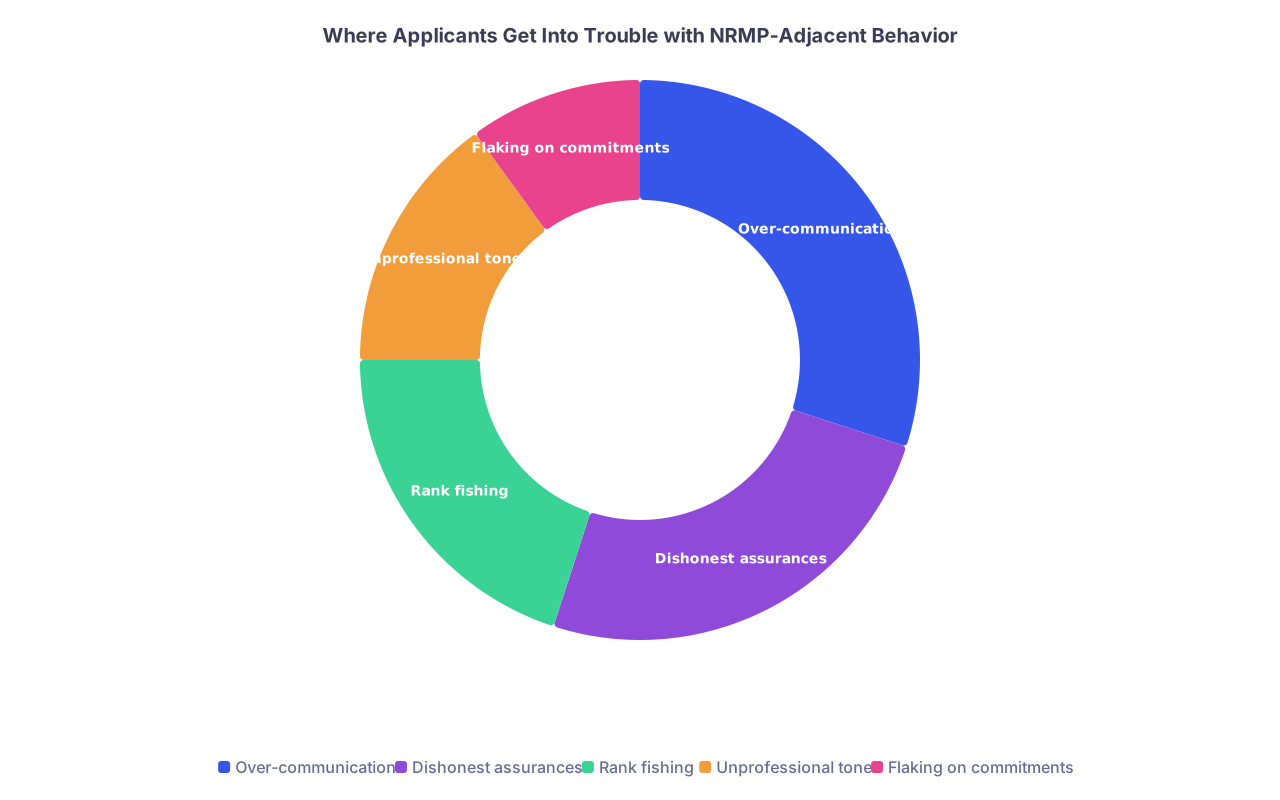
| Category | Value |
|---|---|
| Over-communication | 30 |
| Dishonest assurances | 25 |
| Rank fishing | 20 |
| Unprofessional tone | 15 |
| Flaking on commitments | 10 |
9. How to Push to the Edge Without Crossing the Line
You’re not a monk. You’re allowed to advocate for yourself. There is a way to do that that doesn’t make PDs nervous.
What’s safe and seen as mature
- “Your program is one of my top choices. I felt the best fit there.”
- “I really appreciated the culture and the residents. I could absolutely see myself training there.”
- “I intend to rank your program highly and would be thrilled to match there.”
All of that signals strong interest without making a concrete promise you might break.
If they like you, that helps you. If they don’t, it won’t matter anyway.
What’s clever but not toxic
- Telling exactly one program, honestly, “I plan to rank you first.”
- Sending one well-timed update if something truly significant changes (new Step 2 score, major publication, award).
- Having a mentor who’s known in the field quietly email a PD and vouch for you if that mentor genuinely believes you’d thrive there.
Programs respect that. It’s how the game is played, and it doesn’t trip any legal or social alarms.
10. If You Already Crossed a Line
Let me be blunt: most of the time, the best fix is to stop digging.
If you:
- Sent a slightly over-eager email? Fine. Move on.
- Maybe overstated your interest? Fine. Don’t double down.
What you should not do is:
- Send a follow-up apologizing for your previous email in dramatic fashion.
- Try to “clarify” a promise you made by over-explaining.
If you committed a serious misstep—like blatantly lying about ranking or interrogating them about your position—talk to your dean or advisor. Very occasionally, a carefully crafted, brief clarification from you or a mentor helps. But often the damage is mostly about perception, and perception rarely gets reversed by more words.
Final Thought
The Match is sold to you as an algorithm. Fair. Orderly. Neutral.
That’s the half-truth.
Behind that algorithm are humans who absolutely judge how you behave in the gray zones—where the NRMP guide goes silent and professionalism takes over. Programs assume you won’t cross certain red lines because to them, those lines are obvious.
They’re not obvious to you. You only go through this once.
Years from now, you won’t remember the wording of the NRMP rules. You’ll remember whether you acted like the kind of colleague people trust, or the kind they warn each other about. Act like you’re already the resident you want to be, and you’ll stay far away from the red lines that never make it into the handbook.


