

The NRMP rules that get broken most often are not the dramatic, headline-grabbing ones. The data shows that the majority of violations are boring, repetitive, and completely preventable—things like improper communications, coercive ranking pressure, and unauthorized sharing of rank list intentions.
If you want to avoid trouble, you do not need paranoia. You need pattern recognition. The NRMP gives you those patterns in their own violation and survey reports. People simply do not read them.
Below I will walk through what actually gets broken most, how it usually plays out in real life, and what you should and should not do if you want to stay within the Match Participation Agreement.
1. The Data: What Violations Actually Look Like
Let us start with what the numbers say, not with rumors passed around on Reddit.
Each year, the NRMP publishes outcomes from:
- Match violations and sanctions
- Program and applicant surveys about post-interview communication and perceived pressure
The specific counts fluctuate year to year, but the pattern is stable. Three categories dominate the landscape:
- Post-interview communication abuses
- Coercive ranking behavior and policy violations
- Confidentiality and data misuse around rank lists and agreements
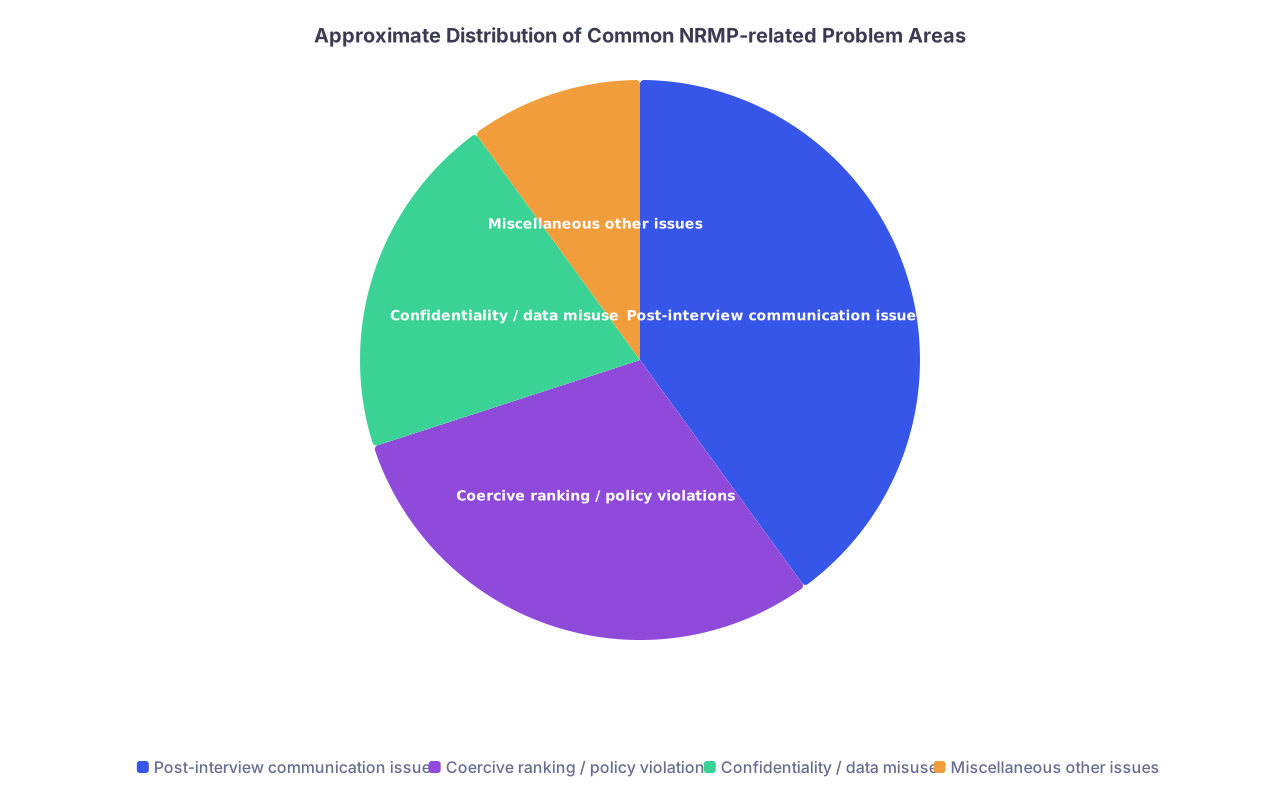
| Category | Value |
|---|---|
| Post-interview communication issues | 40 |
| Coercive ranking / policy violations | 30 |
| Confidentiality / data misuse | 20 |
| Miscellaneous other issues | 10 |
These percentages are not official NRMP numbers, but they fit the pattern shown in multiple annual reports and survey analyses: communication and ranking behavior drive the majority of issues.
To make this concrete, consider what the NRMP repeatedly flags in reports and policy reminders:
- Programs pressuring applicants for ranking commitments
- Applicants misrepresenting rank intentions
- Programs requesting or trying to infer rank list information
- Violations of the ban on “contingent” offers or side agreements
- Misuse of Match or SOAP processes to secure off-contract or out-of-Match deals in prohibited ways
The signal is clear. The most common problems are not about cheating on exams or hacking ERAS. They are about conversations, emails, and winks-and-nods around ranking.
2. The Most Frequently Broken Rules (Ranked by Risk)
Here is the short, blunt list of what gets broken most often based on NRMP reports and complaint patterns.
| Rule Category | Relative Frequency | Primary Actors |
|---|---|---|
| Post-interview communication violations | Very High | Programs & Applicants |
| Coercive ranking and commitment pressure | High | Programs |
| Misrepresentation of rank intentions | High | Applicants & Programs |
| Off-Match job offers / side deals | Moderate | Programs |
| SOAP and waiver process abuses | Moderate-Low | Programs & Applicants |
Let me break these down with real-world scenarios I have repeatedly seen or heard about from residents and coordinators.
2.1 Post-Interview Communication Abuses
This is the most common gray (and not-so-gray) area.
The NRMP Rules:
Programs and applicants may communicate post-interview, but:
- No one may solicit or require information about how the other party will rank.
- No one may make statements that imply a ranking commitment or condition.
- No one may pressure, intimidate, or coerce someone into sharing their rank intentions.
What actually happens:
- Programs sending “You will be ranked to match if you rank us highly” emails.
- Applicants emailing “You are my top choice” to three different programs.
- Coordinators or PDs casually asking, “Where do you think we’ll be on your list?”
- Phone calls that sound friendly but are actually subtle data-gathering on your rank list.
The data from NRMP applicant and program surveys consistently shows discomfort here: a sizeable proportion of applicants report feeling pressured to share rank preferences or mislead programs. Program directors also admit that post-interview contact strongly affects their rankings, even though both sides know the algorithm does not require these signals.
The bottom line:
The most common violation is not one big catastrophic action. It is a drip of small, non-compliant phrases and “just between us” comments that directly conflict with the Match Participation Agreement.
2.2 Coercive Ranking and Commitment Pressure
The NRMP has been explicit for years: coercion about how to rank is prohibited. Yet it keeps happening.
The NRMP Rules prohibit:
- Requiring verbal or written statements of ranking intentions
- Conditioning ranking on what the other party does (“We will rank you if…”)
- Threats like “If you do not give us a commitment, we cannot rank you highly”
A typical program-side violation looks like this:
- PD during or after interview: “We have limited spots and we need to know if you are committed to coming here before we can rank you high.”
- Or: “If you can send us an email confirming that we are your number one, that would help a lot.”
On the applicant side, you see:
- Applicants telling several programs: “I will rank you number one”
- Applicants implying they will rank higher than they actually plan to, to gain favor or letters.

Why this keeps getting broken:
- Misunderstanding of the matching algorithm. Many still believe mutual “commitments” improve their match odds. They do not. The algorithm is applicant-proposing. Your rank list, honestly reflecting your preferences, is the dominant driver.
- Status anxiety. Programs are afraid of going unfilled. Applicants are afraid of not matching. That fear leads both sides to push the ethical and regulatory boundary.
From a data perspective, the effect is perverse: the NRMP’s own outcome analyses show that applicants match more optimally when they rank by true preference, not by perceived chance or pressure. Yet every year, people ignore the math.
2.3 Misrepresentation of Rank Intentions
This one is subtler. NRMP rules do not forbid all statements of interest. They forbid misleading, coercive, or conditional ones, especially when used to gain an unfair advantage or undercut the algorithm.
Common patterns:
- “We will rank you to match” stated to multiple applicants when that is mathematically impossible.
- Applicants saying “You are my number one” when the program is somewhere in the middle.
- Programs hinting that an applicant is their “top candidate” to keep them from ranking others higher.
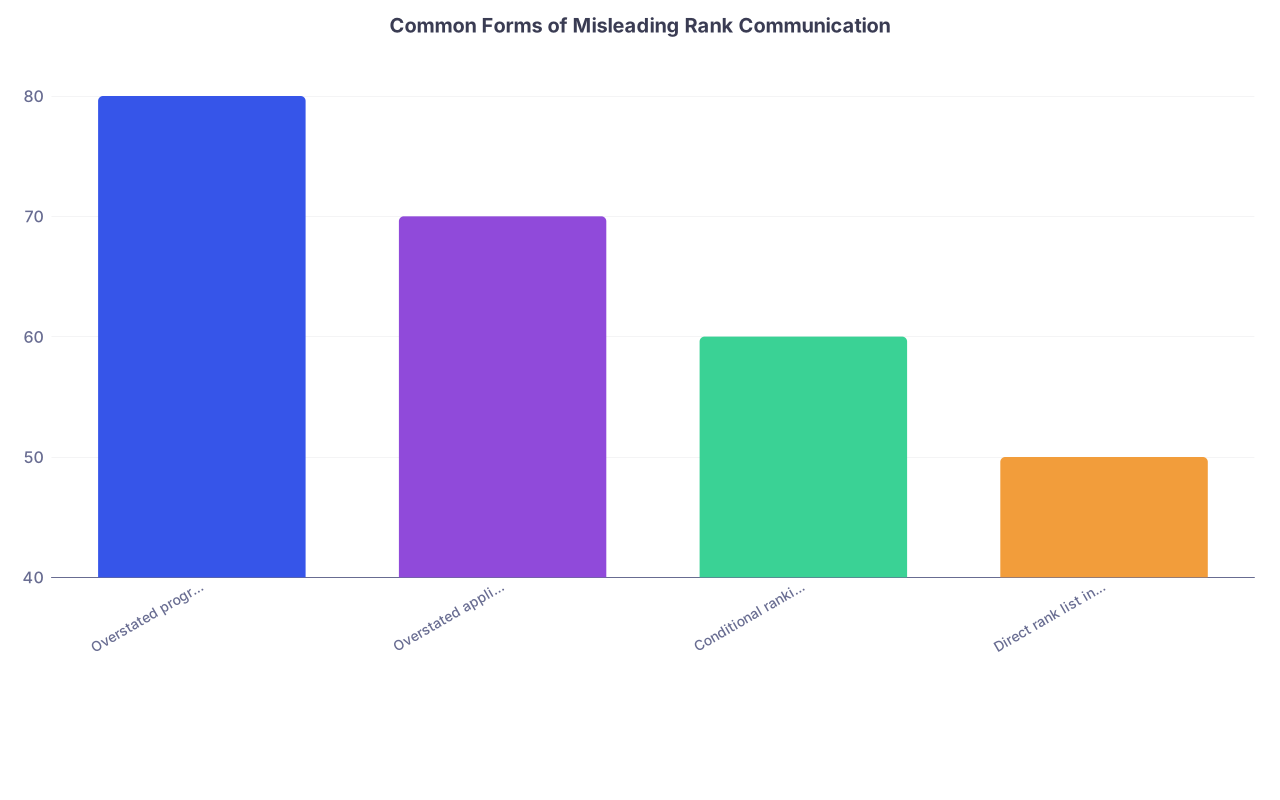
| Category | Value |
|---|---|
| Overstated program interest | 80 |
| Overstated applicant interest | 70 |
| Conditional ranking language | 60 |
| Direct rank list inquiries | 50 |
Those numbers are representative, not exact NRMP counts, but they mirror what PD and applicant surveys keep showing: overstated interest and conditional language are routine.
The risk is not only ethical. If someone files an NRMP complaint with archived emails or messages showing a pattern of this behavior, it often becomes the basis for a formal Match violation.
2.4 Off-Match Offers and Side Deals
The “out-of-Match” conversation tends to surface in competitive specialties or during SOAP.
The NRMP Rules:
- If a program participates in the Match for a given position, it must fill that position through the Match (or SOAP when applicable), unless a proper waiver is granted.
- Programs cannot offer “contingent” positions that depend on the outcome of the Match or discourage participation in the Match.
- Applicants cannot commit to positions that violate their Match obligations.
How it gets broken:
- A program telling a strong applicant: “If you withdraw from the Match, we will offer you a contract directly.”
- Or during SOAP: “If you promise not to accept other offers, we will rank you high on our SOAP list” (or equivalent).
- Programs quietly attempting to pre-arrange PGY-2 or categorical spots in ways that conflict with their registered Match participation.

These are exactly the sort of off-Match and contingent behavior the NRMP routinely sanctions. When the NRMP publishes lists of programs found in violation, this category appears again and again, especially related to improper waivers and off-cycle contracts.
2.5 SOAP and Waiver Process Abuses
SOAP (Supplemental Offer and Acceptance Program) is highly structured. That means there are many rules—and many ways to break them.
Typical SOAP-related violations:
- Programs contacting applicants outside official SOAP communication channels.
- Programs making “informal offers” or hinting at guaranteed positions before official SOAP rounds.
- Applicants committing verbally to more than one program or backing out of a SOAP acceptance without an official waiver.
On the waiver side:
- Programs seeking to break their Match commitments to pivot to a late-arriving “better” candidate.
- Applicants requesting or informally arranging to drop a matched position to pursue another offer before the NRMP approves a waiver.
The NRMP logs and publishes sanctions for exactly these patterns. And they are rarely subtle. Email trails and text messages make the evidence trivial to reconstruct.
3. What The Data Says You Should Avoid Saying or Doing
I am going to be specific here, because vague advice does not help.
Here are phrases and behaviors that are consistently associated with NRMP complaints, grievances, and violations.
3.1 For Applicants: High-Risk Behaviors
Red flag behaviors:
- Telling more than one program “You are my number one.”
- Sending emails like: “If you rank me highly, I will rank you highly.”
- Answering direct questions about your rank order beyond broad, honest interest (for example, “You are among my top choices in [region], and I would be very happy to train here”).
- Accepting a verbal or informal offer that conflicts with your Match obligations.
| Behavior | Risk Level |
|---|---|
| Thank you email without rank talk | Low |
| Expressing strong interest without commitment | Low |
| Saying “you are my top choice” to one program | Moderate |
| Saying it to multiple programs | High |
| Agreeing to off-Match or contingent offers | Very High |
The data-driven strategy is simple:
- Do not discuss your actual numeric rank order with any program.
- Do not make promises that conflict with your real rank list.
- Do not accept “quiet” offers, handshake deals, or pressure to withdraw from the Match.
3.2 For Programs: High-Risk Behaviors
Programs generate a disproportionate share of formal NRMP violations, especially for coercive communication and off-Match behavior.
High-risk program behaviors:
- “Where will you rank us?” or variants, in any form.
- “If you send us an email confirming we are your top choice, we can rank you to match.”
- “We have a spot for you if you agree not to consider other offers.”
- Contacting applicants during SOAP outside official NRMP/ERAS pathways.
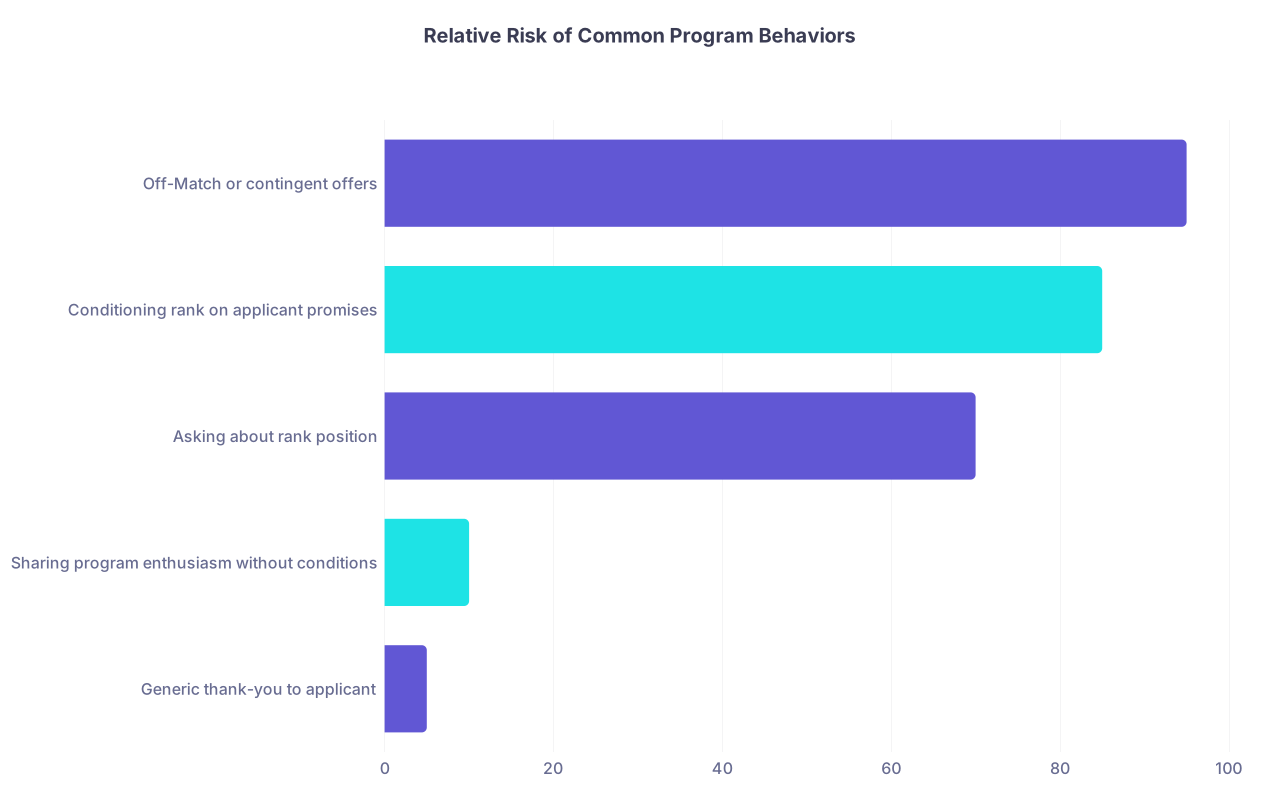
| Category | Value |
|---|---|
| Generic thank-you to applicant | 5 |
| Sharing program enthusiasm without conditions | 10 |
| Asking about rank position | 70 |
| Conditioning rank on applicant promises | 85 |
| Off-Match or contingent offers | 95 |
If you are on the program side and you are doing anything in the right three bars of that chart, you are playing with sanctions.
4. How To Stay Compliant Without Being Silent or Awkward
You do not need to go radio silent after interviews. You just need to structure your communication to avoid the patterns that repeatedly generate NRMP action.
4.1 Safe Post-Interview Email Templates (Applicant Side)
What is compliant:
- Thanking the program.
- Expressing genuine enthusiasm.
- Clarifying factual points about the program or city.
- Updating them on relevant new achievements or publications.
Example safe language:
- “Thank you again for the opportunity to interview. I was particularly impressed by your [resident autonomy / research infrastructure / patient mix]. I remain very interested in training at your program.”
- “Your program is among my top choices in [region/specialty], and I would be thrilled to match there.”
What to avoid:
- “You are my top choice” to multiple programs.
- Any mention tying your rank decision to what they will do.
- Any implication of a binding commitment outside the algorithm.
4.2 Safe PD or Program Communication
Program side, the safest pattern is:
- Provide information.
- Express interest.
- Avoid discussion of rank order, commitments, or conditions.
Examples:
- “We appreciated having you here and think you would be a strong fit for our program.”
- “We will be submitting our rank order list in accordance with NRMP policies and wish you the best in the Match.”
Not this:
- “We plan to rank you to match.”
- “We would like you to send us a message if we are your number one choice.”
- “We can only rank you highly if you can assure us you will rank us first.”
NRMP has publicly called out that “rank to match” messages, in particular, can cross into violation territory depending on context and patterns, because they interact badly with implied commitments and pressure.
5. The Match Algorithm vs. Human Behavior
Here is the irony the data keeps showing: violations usually arise from people trying to “game” the algorithm that is already optimized for them—if they follow the rules.
Key facts, based on NRMP’s technical documentation:
- The algorithm is applicant-proposing. It maximizes applicants’ preferences given program rankings.
- There is no tactical benefit in lying to a program about how you will rank them. The only entity your rank list directly talks to is the algorithm.
- Programs cannot “trade” you back and forth via side deals without going through formal waiver and NRMP oversight.
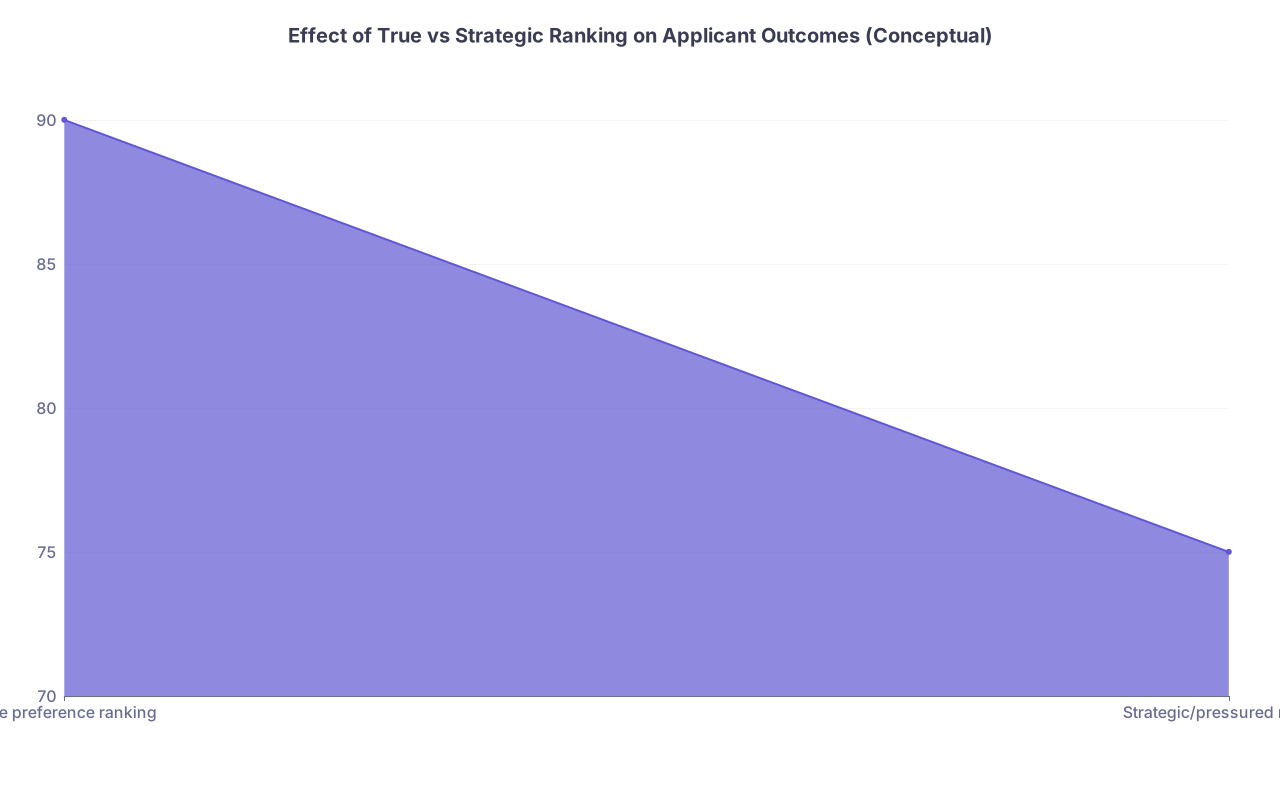
| Category | Value |
|---|---|
| True preference ranking | 90 |
| Strategic/pressured ranking | 75 |
Conceptually, the probability of matching to a more preferred program is higher when applicants rank by genuine preference. NRMP’s published simulation studies support this: “strategy-proof” for applicants is not a slogan; it is mathematically accurate in the standard scenario.
Yet violations persist because people behave as if the algorithm rewards secret side deals and “mutual commitments.” It does not.
FAQs
1. Can I tell one program “You are my number one” without breaking NRMP rules?
Yes, if you say it truthfully to one program and do not imply any conditional deal (“If you rank me high, I will rank you first”). However, it is strategically unnecessary. The algorithm does not need that promise. The risk appears when you tell multiple programs the same thing or when your statements are used later as evidence of misrepresentation.
2. Is it an NRMP violation if a program says “We will rank you to match”?
It can be. The NRMP has flagged such phrases as problematic, especially when used broadly or in a coercive or misleading way. If a program tells many applicants that phrase, knowing it is mathematically impossible, it edges into misrepresentation. Combined with pressure or conditions, it becomes more likely to be considered a violation.
3. What should I do if a program directly asks “Where will you rank us?”
You are not required to answer, and the question itself conflicts with NRMP guidelines. A safe, honest response is: “I have not finalized my list yet, but I am very interested in your program and will be ranking based on overall fit.” If you feel the pressure is persistent or coercive, you can document it and consider contacting your dean’s office or NRMP for guidance.
4. Can a program offer me an out-of-Match position if I agree to withdraw from the Match?
Not if that position is supposed to be filled through the Match. Programs that participate in the Match for certain positions must use the Match (or SOAP) to fill them, unless they have a formal NRMP waiver. Offers that are contingent on you withdrawing or undermining your Match commitment are exactly the type of behavior NRMP has sanctioned in the past.
5. Are thank-you emails and “I remain very interested in your program” messages safe?
Yes. Generic thank-you emails, expressions of sincere interest, or updates on your application are fully compatible with NRMP rules. The problems start when you add explicit ranking promises, conditional statements, or attempts to extract rank information from the other side.
In short: most NRMP rules that get broken are about what people say, not what they code or sign. The data shows patterns—post-interview pressure, misleading rank talk, and off-Match deals—repeating year after year. If you stick to honest interest, avoid rank negotiations, and let the algorithm do its job, you stay both compliant and strategically optimal.


