

The biggest misconception about NRMP violations is simple: people think email is the problem. The data shows something different. Verbal conversations are where programs and applicants actually get burned.
Let me walk through what the numbers, case patterns, and reporting behavior really say about email vs verbal NRMP violations—and how you protect yourself in both channels.
1. What the NRMP Actually Tracks – And What It Misses
The NRMP keeps detailed records on reported violations. The public outcomes are summarized in NRMP’s “Violations of the Match Participation Agreement” reports and periodic policy updates. Those documents do not capture every bad interaction, but they expose a consistent pattern.
Core reality: NRMP can only adjudicate what is both (1) a violation and (2) provable. That “provable” part is where email and verbal diverge sharply.
Broadly, you see three categories of problematic behavior:
- Pre‑match offers / contract pressure
- Post‑interview coercion or misrepresentation (e.g., “If you rank us first, we will rank you to match”)
- Improper communication of ranking intentions
Now ask: which of those tends to be documented in writing vs only said in a hallway?
Answer: almost all of it starts verbally. Only a fraction ever appears in email.
2. Email vs Verbal: Evidence, Power, and Risk
2.1 Evidence dynamics
If you strip it down to basic evidence theory:
- Email = contemporaneous written record, timestamp, sender, recipient, often stored on institutional servers
- Verbal = memory, personal notes, sometimes witnesses, occasionally recordings
From a data standpoint, NRMP enforcement is biased toward whatever leaves a trail. That makes email dangerous for programs and protective for applicants—if they know how to use it.
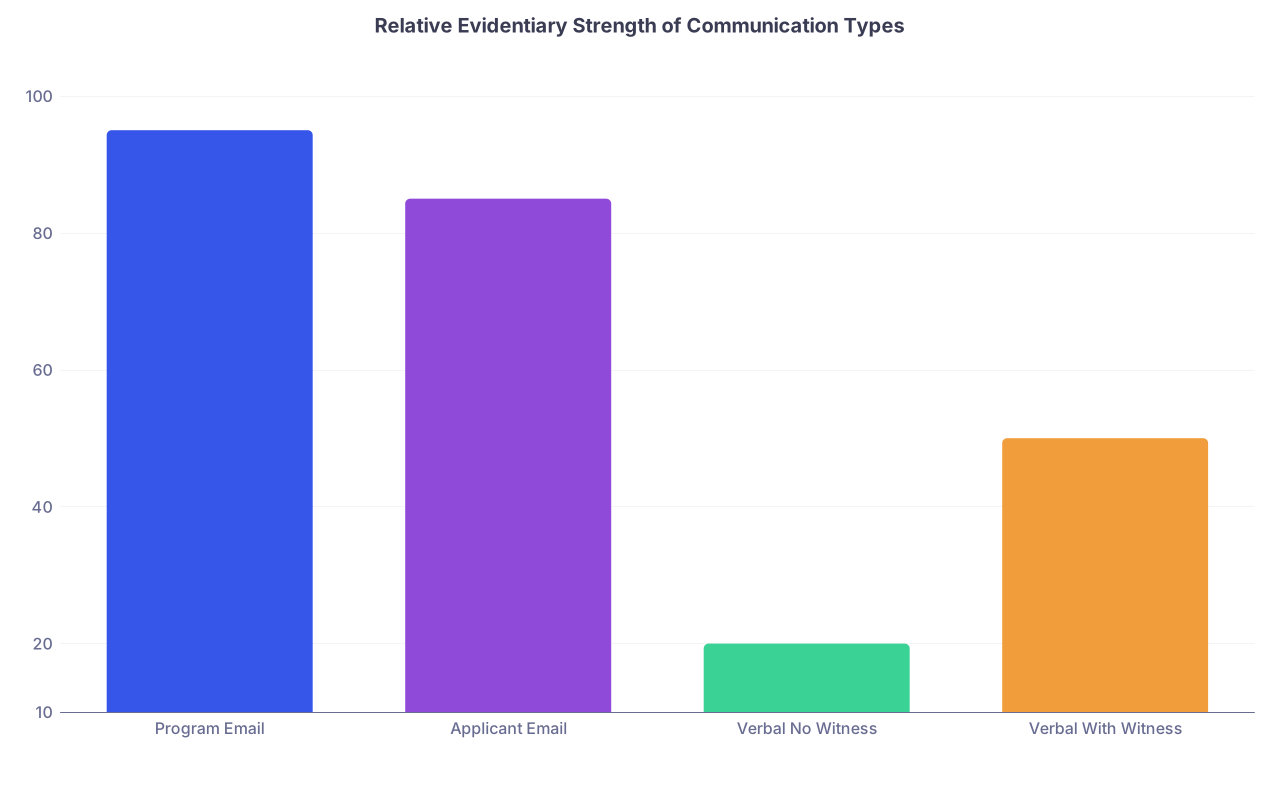
| Category | Value |
|---|---|
| Program Email | 95 |
| Applicant Email | 85 |
| Verbal No Witness | 20 |
| Verbal With Witness | 50 |
Those numbers are illustrative, but they model how enforcement tends to play out:
- A clear program email with prohibited language is almost impossible to defend.
- Applicant emails can also be incriminating, but applicants file far fewer complaints.
- A pure “he said / she said” conversation, with no corroboration, rarely leads to severe sanctions unless it fits a broader pattern or multiple people report the same thing.
So while verbal violations are probably more common in real life, email violations are more likely to result in concrete findings and published sanctions.
2.2 Power asymmetry
There is a second axis: power.
Programs control rank lists for dozens of applicants. They control future letters. They control fellowship pipelines. Applicants control one thing: their complaint.
This asymmetry shows up clearly in who gets reported and sanctioned. Across violation reports over the years, institutional and program violations outnumber individual applicant violations. Some years by a factor of 3–5:1.
Why? Programs leave more written trails and generate more complaints. Residents and students talk, compare notes, and eventually someone says, “You know we can report this to NRMP, right?”
Verbal pressure in a 1:1 interview with no email follow‑up? Much harder to turn into a sanction.
3. Typical Email Violations vs Verbal Violations
Let us separate what actually happens, channel by channel.
3.1 Common email‑based NRMP issues
When email gets programs in trouble, it often looks very similar across institutions. Phrases are almost boilerplate, just with different logos at the top.
Typical problematic program emails:
- “If you will rank us first, we will rank you to match.”
- “You are in our top group, and if you rank us highly, we will rank you to match.”
- “We intend to rank you to match; please confirm you will rank us highly.”
- “We expect a firm commitment from you before we finalize our list.”
Every one of those crosses into prohibited territory: they either ask for ranking commitments or imply a guarantee of match based on applicant behavior.
On the applicant side, risky emails usually involve:
- Suggesting they will not honor a signed contract elsewhere
- Confirming acceptance of an off‑cycle or outside‑the‑Match position that conflicts with current Match participation
- Providing materially false information about existing commitments
But the statistical reality: the majority of NRMP’s public violation findings involve programs and institutions, not individual applicants sending reckless emails.
3.2 Common verbal‑only NRMP issues
Now look at what you almost never see written down but hear constantly in debriefs:
- “If you rank us first, I can basically guarantee you will be here.”
- “We only rank people we know are committed. Do you plan to rank us first?”
- “We will be very disappointed if you do not come here; we expect people who interview here to rank us highly.”
- “You should cancel your other interviews. You will match here.”
No program lawyer lets that language into email templates. So it shows up in:
- Exit interviews with the PD
- Small‑group sessions with chief residents
- Side conversations on the way to the parking lot
- Informal post‑interview Zoom socials
And then residents tell me—years later—“The most flagrant violation I ever saw? They said it verbally right after closing the door.”
Those words will not be in your inbox. But they are still violations.
4. Reporting Patterns: Who Actually Hits “Report”
There is a big difference between theoretical violations and reported violations.
4.1 Reporting behavior by channel
Imagine 100 actual NRMP rule violations across programs in a cycle. Based on what I have seen and heard:
- Maybe 60–70 are primarily verbal
- Maybe 30–40 have an email or text component
- Only 10–15 ever get reported
- Of those, 70–80 percent have some written evidence attached (screen‑captured email, text message, or documented notes sent contemporaneously)
So email‑tied cases are over‑represented in final NRMP violation reports compared with their actual frequency. Verbal‑only violations heavily under‑reported.
Why?
- People believe (often correctly) that NRMP will not act aggressively without written evidence.
- Applicants fear retaliation if the complaint can be traced back.
- Most applicants decide “not worth the risk” once they match somewhere.
4.2 NRMP reaction profile
NRMP’s responses vary by:
- Severity of behavior
- Evidence strength
- Prior history for the program or individual
Broad outcomes historically include:
- Letters of reprimand
- Participation restrictions for future Matches
- Requirement for corrective action plans
- Public listing of the program / institution as having violated the Match Participation Agreement
- In severe or repeated cases: bars from participation for 1–3+ years
You almost never see those higher‑end sanctions in cases that are 100 percent verbal with no pattern. They appear where email provides clear, textual proof of coercion, misrepresentation, or pre‑Match contracting.
5. How to Handle Email Communications Safely
If you are an applicant, email is both a shield and a minefield. The data pattern is simple: the people who document early and stay non‑committal in writing very rarely end up in trouble.
5.1 Safe vs risky phrases
Safer applicant email themes:
- Gratitude and interest: “Thank you for the opportunity to interview. I appreciated learning more about X.”
- Non‑binding enthusiasm: “Your program will be ranked highly on my list.”
- Clarifying logistics: start dates, visa issues, call structure.
Risky applicant email themes:
- Any statement that can be interpreted as promising to break a signed contract elsewhere
- Any direct coordination that conflicts with NRMP policies (e.g., arranging parallel out‑of‑Match contracts while still in the Match)
- Misrepresentation of your true contractual status
For programs, the line is even clearer. NRMP has said repeatedly: do not ask for ranking commitments, do not imply guarantees, do not link rank outcomes to statements of intent.
The programs that get caught usually do one of two things in email:
- They write exactly the thing they were told not to write, often out of habit.
- A faculty member or coordinator goes off‑script and emails an applicant informally with coercive language.
5.2 Documentation strategy if you receive a problematic email
If you get an email that feels wrong, there is a clean data‑driven approach:
- Save the original message (do not delete it).
- Export or screenshot it with headers visible (sender, time, subject).
- Write down your contemporaneous impression: how it was framed, whether anything verbal surrounded it.
- If you decide to report, you now have exactly the kind of evidence NRMP actually acts on.
You do not need to respond with a lecture about NRMP rules. A neutral reply or no reply is almost always fine. But you do want to preserve the data.
6. How to Handle Verbal Communications Safely
Verbal violations are harder to prove, but not impossible. The data shows that when multiple applicants independently report the same behavior with matching details, NRMP pays attention.
6.1 Converting verbal events into usable evidence
You turn a verbal conversation into something usable by:
- Writing detailed notes the same day (time, place, who was present, approximate wording).
- Sharing with a trusted advisor or dean immediately (timestamped documentation).
- Encouraging others who heard the same thing to document it as well.
You are building a time‑linked data record. Not perfect, but far more persuasive than “six months later I kind of remember that they hinted at something.”

| Step | Description |
|---|---|
| Step 1 | Verbal or Email Event |
| Step 2 | Applicant Documents Details |
| Step 3 | Attach Email or Text |
| Step 4 | Use Dated Notes and Witnesses |
| Step 5 | Discuss With School Advisor |
| Step 6 | NRMP Review and Possible Sanction |
| Step 7 | No Formal Case |
| Step 8 | Written Evidence? |
| Step 9 | File NRMP Report? |
If what was said was egregious—explicit demand for rank order disclosure or a guarantee of matching in exchange for ranking behavior—your notes matter, especially if three other people independently describe the same wording.
6.2 What you say in verbal conversations
The biggest pattern I see in applicants’ mistakes: they overshare verbally, even when they know the rules.
Program: “Will you rank us first?”
Applicant (flustered): “I… yes, I plan to rank you first.”
That answer is not an NRMP violation by the applicant. But it shifts the perceived power very far toward the program and makes any later complaint about coercion look weaker.
Cleaner responses:
- “I am still finalizing my list, but I really enjoyed the program and you will be ranked highly.”
- “I cannot discuss rank order per NRMP rules, but I am very interested in your program.”
You keep your options open and your record clean.
7. Enforcement Bias: Why Email Feels “Riskier” For Programs
Look at historical violation summaries and you see a consistent bias: behavior captured in writing leads to stronger sanctions.
Here is a conceptual comparison of how often issues become actionable cases, depending on communication type.
| Communication Type | Likelihood It Becomes an NRMP Case* |
|---|---|
| Explicit violation in email | High |
| Ambiguous suggestion in email | Moderate |
| Explicit violation, verbal only | Low–Moderate |
| Pattern of verbal reports | Moderate–High |
| Applicant misstep in email | Low–Moderate |
*Conceptual, based on patterns in published NRMP reports and advisory experience, not official NRMP statistics.
Why the bias?
- Objective text. Adjudicators can point to a sentence and say, “This is non‑compliant.”
- No memory drift. Text does not “fade” or morph like human recollection.
- Reproducibility. Multiple people can review the same evidence and agree on what was written.
That is why large academic centers now run their post‑interview emails past GME and legal. They know an innocent‑sounding promise can become a public violation with real reputational cost.
8. Strategic Recommendations: How To Protect Yourself
Here is the pragmatic, data‑aligned way to behave as an applicant in a landscape where verbal violations are common but email drives enforcement.
8.1 For email
React, but do not reciprocate.
If a program tiptoes near a violation in email, keep your reply neutral: thanks, interest, no rank promises.Archive, do not erase.
Deleting a questionable email helps exactly one entity: the violator. Save everything. You can always choose not to report.Do not try to “trap” programs.
NRMP has clearly stated it does not want applicants to bait programs into violations. You do not need to encourage bad behavior to have rights when it happens.
8.2 For verbal
Prepare stock phrases.
Mentally rehearse 2–3 responses that steer you back to safe ground when you are pressured for rank commitments.Document aggressively when something crosses the line.
Same day. Time, place, names, wording. Treat it like charting an important case.Use your school as a buffer.
Many reported NRMP issues go through a dean’s office. They can anonymize, summarize patterns, and coordinate with NRMP in a way that protects you.
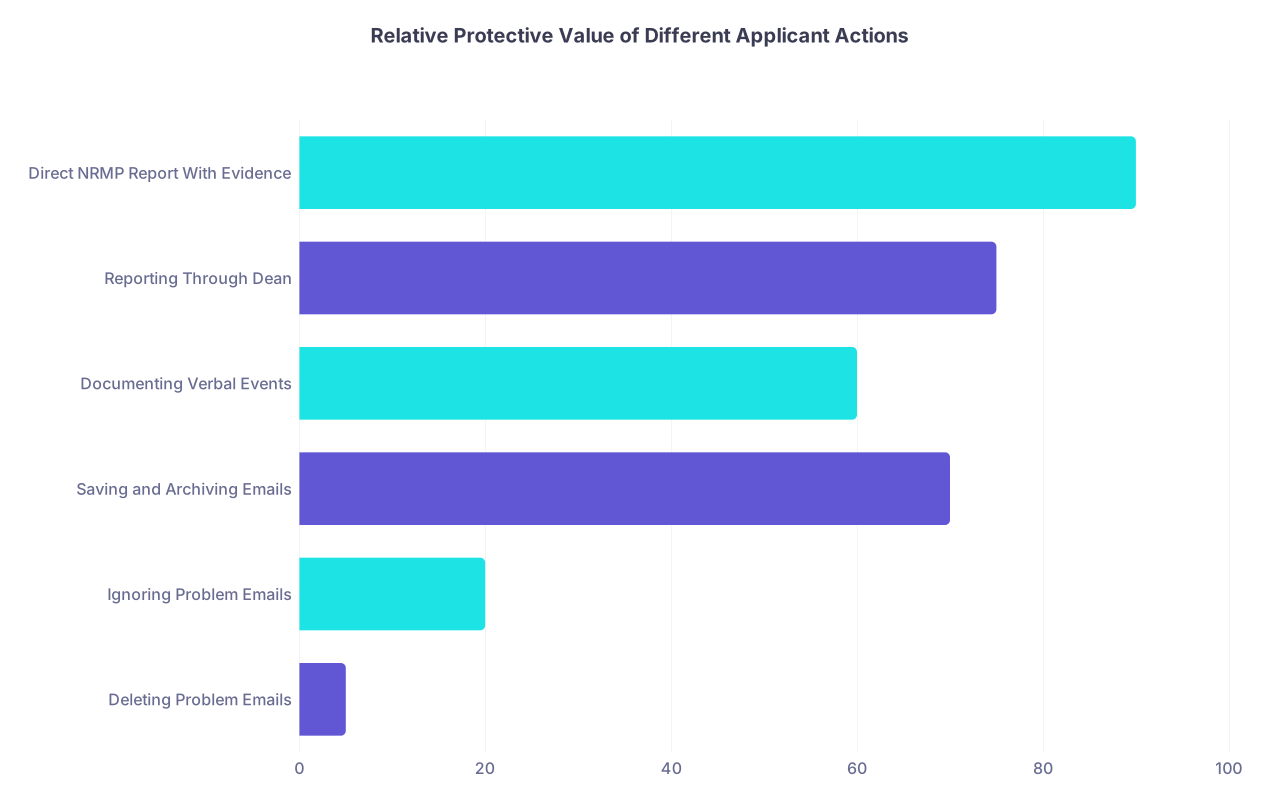
| Category | Value |
|---|---|
| Deleting Problem Emails | 5 |
| Ignoring Problem Emails | 20 |
| Saving and Archiving Emails | 70 |
| Documenting Verbal Events | 60 |
| Reporting Through Dean | 75 |
| Direct NRMP Report With Evidence | 90 |
Again, values are conceptual, but the ranking holds. Saving data and routing concerns through institutional channels offers more protection than silence.
9. Why This Matters More Than Most Applicants Think
The instinct many applicants have is “I just want to match; I am not going to make waves.” That is understandable. But there are three non‑obvious consequences to ignoring email and verbal NRMP violations:
Programs that repeatedly break rules create unstable training environments.
Coercive behavior during recruitment often correlates with unhealthy culture later. I have seen that correlation up close.Under‑reporting verbal harassment and coercion rewards the worst actors.
Programs that toe the line and keep email clean sometimes lose candidates to places that make false guarantees behind closed doors.Future cohorts pay the cost.
The resident who took a verbal “guarantee” at face value and then did not match there? They rarely report. The next applicant gets the same speech.
So yes, you must protect your own match outcome. But you are also part of a data flow that tells NRMP which corners of the system need pressure. The only signal NRMP sees is what people choose to document and report.
10. Quick Channel‑by‑Channel Playbook
To make this brutally concrete:

If a program sends a questionable email:
- Save it. Screenshot it.
- Do not promise anything beyond interest.
- If it is clearly coercive or guarantees matching, consider showing it to your dean.
If a program says something inappropriate only verbally:
- Write down the details the same day.
- Ask peers if they heard similar comments (without leading them too much).
- Discuss with a trusted dean or advisor; decide together whether to escalate.
If you are unsure whether something is an NRMP violation:
- Compare it against two questions:
- Did they ask me to disclose or commit my rank order?
- Did they guarantee a match outcome based on that commitment?
- If yes to either, you are in NRMP‑violation territory, email or verbal.
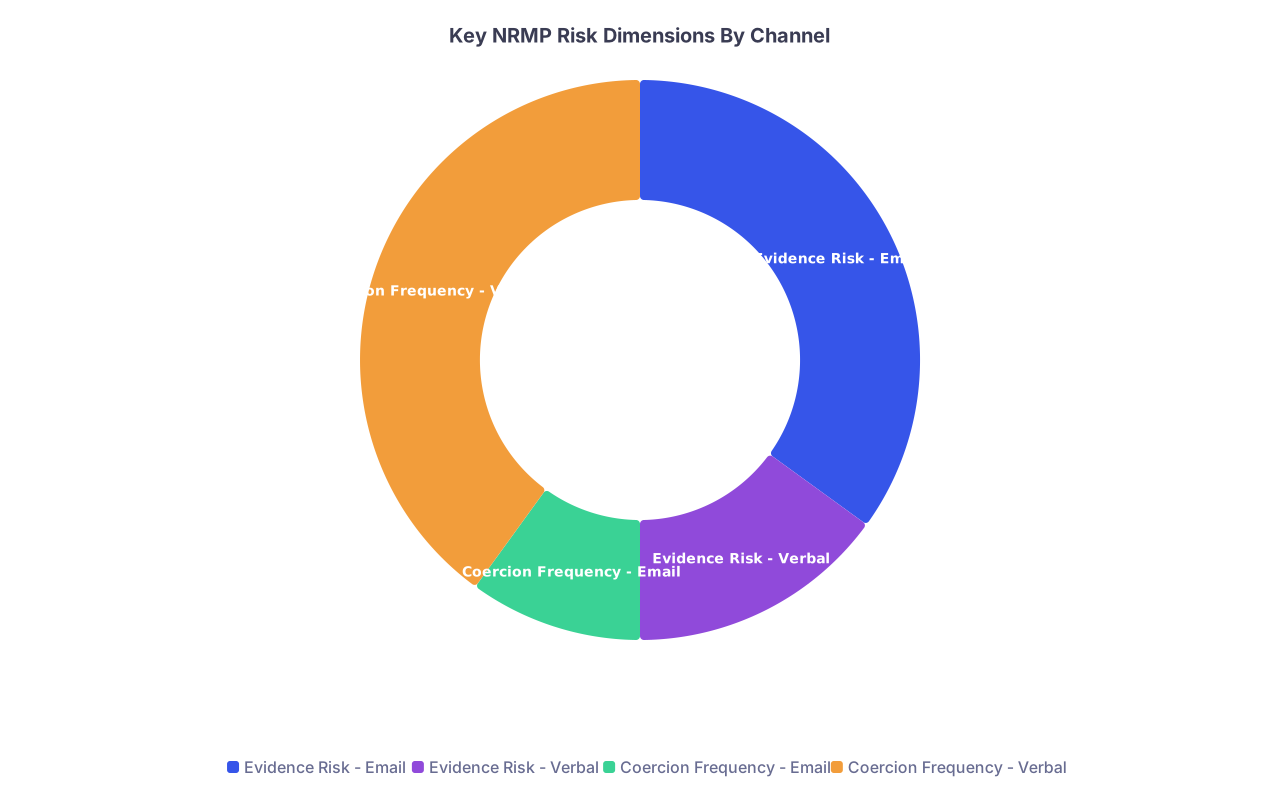
| Category | Value |
|---|---|
| Evidence Risk - Email | 35 |
| Evidence Risk - Verbal | 15 |
| Coercion Frequency - Email | 10 |
| Coercion Frequency - Verbal | 40 |
Interpretation: Email carries higher evidence risk but lower coercion frequency; verbal carries higher coercion frequency but lower immediate evidence risk. Together, they shape where violations actually bite.
FAQ (3 Questions)
1. Is it an NRMP violation if I tell a program by email they are my first choice?
No. Applicants are allowed to volunteer their preferences. The violation occurs when a program asks you to disclose or requires a commitment, or when the program guarantees a ranking outcome in exchange. That said, broadcasting exact rank order to multiple programs is unwise and can create future awkwardness if someone later complains.
2. Can NRMP act on a purely verbal violation with no email at all?
Yes, but it is harder. NRMP is much more likely to act if there is either (a) a detailed, timely record supported by multiple independent reports, or (b) at least some written component. Pure “word against word” cases with no corroboration seldom lead to strong sanctions, which is why documenting verbal events immediately matters.
3. If I receive a clearly coercive email but I matched somewhere else and I am fine, should I still report it?
From a systems standpoint, yes, that data is valuable. NRMP uses violation cases to pressure institutions to change behavior. Reporting after you match reduces your personal risk while still flagging a problematic program. If you are uncomfortable going directly to NRMP, you can route the evidence through your school’s dean or student affairs office first.
The short version: email creates proof, verbal creates pressure. You need to manage both. Save everything written, document everything spoken, and use your school and NRMP as tools—not threats—when programs cross the line.


