

The biggest myths about NRMP sanctions are dangerously wrong. The data shows that for many applicants, the sanction length you accept today quietly shapes your match probabilities for years.
1. What NRMP sanctions actually mean numerically
The NRMP is not vague about consequences. A sanction is fundamentally a time‑bounded ban from some or all NRMP services. In practical terms: the number of Match cycles you lose access to is the number that really matters.
Most applicants confuse “months” with “cycles.” Bad idea. The residency Match is annual. So a 12‑month vs 24‑month sanction is not just “twice as long.” It is often the difference between missing one Match cycle vs two.
Strip away the legal language and you get three core variables that drive outcomes:
- Length of sanction (in months/years)
- Scope of sanction (Main Residency Match only vs all NRMP programs/services)
- Timing of violation in relation to the Match calendar (before rank lists, after match, in fellowship years, etc.)
Those three variables largely determine:
- How many opportunities you miss to match
- How “old” your application looks when you return
- How much suspicion PDs will have when they see the “NRMP violation” disclosure
To see why this matters, you need to think in cycles and probabilities, not feelings and intentions.
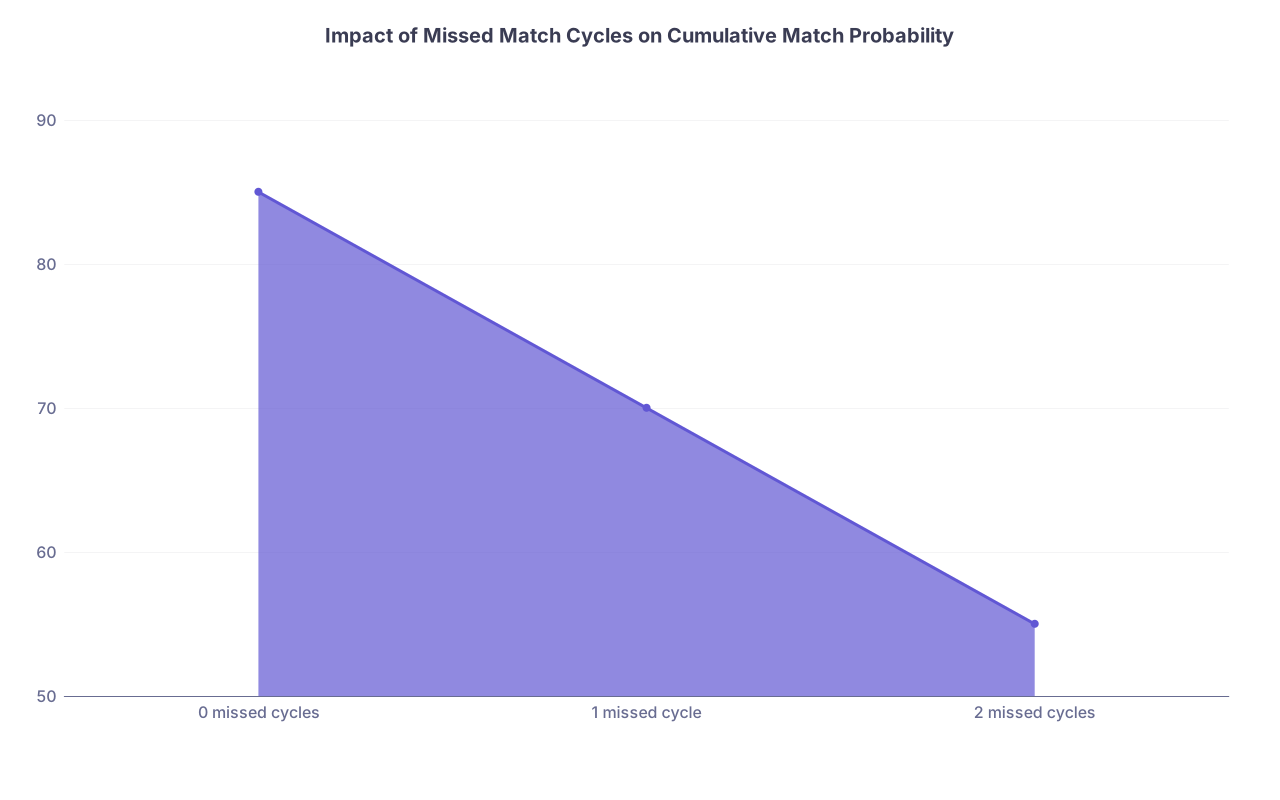
| Category | Value |
|---|---|
| 0 missed cycles | 85 |
| 1 missed cycle | 70 |
| 2 missed cycles | 55 |
You can argue about the exact numbers, but the general shape is reality: each missed cycle drops your cumulative chance of eventually matching, especially in competitive specialties.
2. NRMP violation types and likely sanction ranges
The NRMP’s “Violations Policy” describes a range of sanctions, but in practice, violations cluster into a few common patterns. I will not list every clause; I will translate them into situational buckets I have actually seen on rank committees and with applicants.
Common violation patterns:
- Attempting to back out of a binding match (no‑show, refusal to start, or trying to renegotiate terms)
- Premature contracts or offers outside Match rules
- False statements in the Match process (certifications, waivers, eligibility, etc.)
- Contact violations (illegal solicitations for ranking information, coercive communication)
Here is a simplified mapping between violation severity and typical sanction lengths that aligns with published policy examples and what program directors quietly expect:
| Violation Pattern | Typical Sanction Range | Cycles Impacted* |
|---|---|---|
| Minor contact / communication violation | 0–12 months | 0–1 |
| Misrepresentation / false attestation | 12–24 months | 1–2 |
| Accepting incompatible positions (dual binding) | 12–24 months | 1–2 |
| Failure to honor match (no‑show, early exit) | 24–36 months | 2–3 |
| Egregious / repeated violations | 36+ months / permanent | 3+ |
*Cycles impacted depends heavily on when the sanction clock starts (more on that later).
These numbers are not hypothetical. The NRMP regularly publishes case summaries with sanctions ranging from public reprimands up to multi‑year participation bans.
Here is the key point: once you cross the line from “contact violation” into “failure to honor a binding match,” you are in the domain where 2+ cycles can be lost. That moves you from “annoying setback” territory into “structural career risk.”
3. How sanction length converts to missed Match cycles
The raw sanction length (e.g., 24 months) is less informative than how that length overlaps with application cycles. Think about it like this: if the sanction blocks you from certifying a rank list or enrolling in the Match system at the critical time, that entire year is gone.
The NRMP calendar is your denominator. The Match is effectively a once‑per‑year discrete opportunity. If you are barred from participating on February 1, it does not matter if your sanction technically ends in July — you still lost the entire cycle.
So the key variables:
- When the violation is adjudicated
- When the sanction clock begins
- Whether the sanction explicitly includes “ineligible to participate in the Main Residency Match” during given cycles
Let’s quantify this in more concrete terms.
Assume:
- Match cycle runs roughly from September (ERAS opening) to March (Match Day)
- A sanction that covers January–March in a given year effectively wipes out that cycle
- Each missed cycle forces you to re‑enter later with a larger time gap from graduation
Now look at three simple cases.
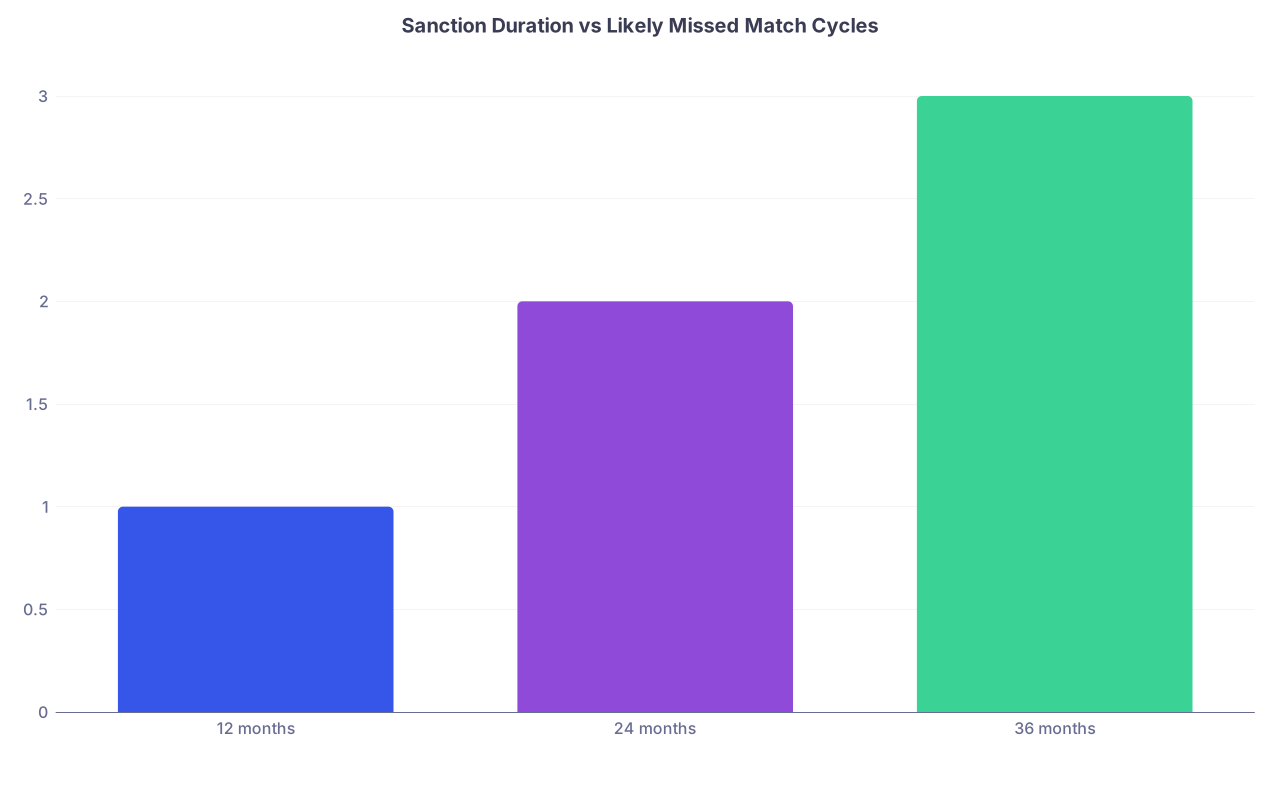
| Category | Value |
|---|---|
| 12 months | 1 |
| 24 months | 2 |
| 36 months | 3 |
This mapping is crude but directionally accurate:
- A 12‑month sanction implemented mid‑year usually costs you 1 cycle
- A 24‑month sanction often costs you 2 cycles
- A 36‑month sanction can easily touch 3 cycles depending on start date
I have seen applicants focus on shaving six months off a sanction, thinking that is meaningful, when in fact both options still wipe out two full Matches. You are not negotiating months. You are negotiating cycles.
If you ever face a settlement or appeal decision, the data‑driven question is simple: “Does this proposal let me participate in the next Match or the one after?” That binary is far more important than whether your final end date is 18 vs 24 months.
4. The longer you are out, the colder your application gets
Now to the uncomfortable but measurable part: outcome data.
The NRMP and specialty organizations have published multiple analyses showing that time since graduation is a negative predictor of matching, independent of scores. For example, IMGs more than 3 years out face steep drops in match rates across Internal Medicine, Pediatrics, and Family Medicine. The same pattern exists, though more muted, for U.S. grads who step away.
You can think of “time since graduation” as a discount factor applied to your application’s attractiveness.
A simplified model (numbers approximate, not official, but consistent with published trends):
- 0–1 years since graduation: full baseline probability (100% of your “true” competitiveness)
- 2–3 years out: multiply that by ~0.8
- 4–5 years out: multiply by ~0.6
- 6+ years out: often <0.4 of original competitiveness, unless you have strong compensating factors (active clinical practice, research, additional degrees)
For someone who would have had, say, an 80% baseline probability of matching in Internal Medicine straight from graduation, a 2‑cycle delay can easily move them into the 50–60% band.
To make this more concrete, compare three hypothetical applicants, all with similar initial competitiveness.
| Applicant Scenario | Years Since Grad at Re‑entry | Adjusted Match Probability* |
|---|---|---|
| No sanction, on‑time first cycle | 0–1 | ~80% |
| One missed cycle (12–18 months out) | 1–2 | ~65–70% |
| Two missed cycles (24–30 months out) | 2–3 | ~50–60% |
*Approximate for relatively non‑competitive specialties given similar scores, assuming no major red flags other than time.
And this is before you layer on the separate red flag: “NRMP violation” which must be disclosed.
So the damage is not linear. Each extra missed Match cycle hits you twice:
- It pushes you further from graduation, dropping your baseline attractiveness.
- It prolongs the period where you have to maintain explanation‑worthy “gaps” in clinical activity.
By the time you are explaining both a two‑year gap and a documented NRMP sanction, your odds in competitive fields can drop close to the single digits.
5. How programs interpret different sanction lengths
From the program director side, the data point that matters is not just “NRMP violation: yes/no” but also:
- What exactly happened
- How long the NRMP sanctioned you
- How far in the past the event is at the time of application
This is where length starts to act as a quasi‑severity score.
Short sanctions (≤12 months):
- Often interpreted as lower‑level or technical violations
- Many PDs will still consider the application, especially in shortage specialties (FM, IM, Psych in some regions)
- You may need to explain the event but can frame it as a single misstep with proportionate consequences
Medium sanctions (18–24 months):
- Interpreted as more serious or involving dishonesty / binding commitments
- Some programs will have an unofficial “no” policy for any NRMP sanction regardless of length
- Others will want extensive evidence of remediation, mentorship letters, and a strongly coherent narrative
Long sanctions (30–36+ months):
- Usually reserved for high‑severity or repeated violations
- Flagged not just as a red flag, but as a “risk to institutional compliance culture”
- Many PDs will not spend time reading the rest of the file
From what I have seen reviewing applications, PDs mentally combine three elements:
- Violation type (honesty vs process vs communication)
- Sanction length (short vs medium vs long)
- Time since violation (recent vs 3+ years old)
Short sanction + 4 years ago + strong performance since? Some will take a chance.
Long sanction + 1–2 years ago? Very few will.
So any negotiation that reduces a sanction from 36 to 24 months is not just about earlier entry. It lowers the perceived severity and gives you more calendar time to build a positive track record before you reapply.
6. Strategic moves if you are facing or serving a sanction
If you are already in sanction territory, the goal is not to “win” against the NRMP. The probability that you beat the system completely is extremely low. The goal is to optimize three things:
- Number of lost Match cycles
- Time‑since‑graduation at reentry
- Strength of your “rehabilitation data” (what the record shows you did during the gap)
I will frame this numerically.
6.1. Prioritize preserving at least one early reentry window
On a decision tree:
- Path A: 24‑month sanction, starts immediately, you miss 2 cycles, reenter at t = 2.0 years
- Path B: 18‑month sanction, but structured so that you can enter the second cycle (sanction ends just before rank deadline), reenter at t = 1.5 years
Even if Path A looks “more lenient” in language, Path B is mathematically superior. It maintains a higher probability for the earlier reentry because:
- You are closer to graduation
- You have one fewer year of explaining “what I did while not in training”
When your lawyer or advisor talks about appealing, ask them to map each option to “cycles I can enter” not just “months of restriction.”
6.2. Convert the gap into positive signal, not dead time
Programs will ask, explicitly: “What did you do during the period you were not in training?”
If the answer is “traveled and thought about things,” your probabilities shrink. If the answer is “full‑time research with 2 publications, ongoing supervised clinical involvement where legally allowed, structured remediation,” you retain more leverage.
Think in terms of quantifiable inputs:
- Number of hours/week of clinically relevant work
- Number of months in continuous structured activity
- Number of supervisors who can vouch for professionalism since the violation
PDs are pattern‑recognizers. When they see a 24‑month sanction followed by 18–24 months of:
- Consistent work
- No further complaints
- Strong evaluations
their posterior probability that “this was a one‑time lapse” goes up.
6.3. Adjust specialty and geographic strategy to your new baseline
A sanctioned applicant who previously targeted Dermatology or Ortho must look at the numbers again. Those specialties were already high‑risk even with a clean record. Add a multi‑year gap and an NRMP violation, and we enter statistical fantasy.
You likely need to:
- Shift to less competitive fields (FM, IM, Psych, Neuro, Path, depending on region)
- Over‑apply by a large multiple (3–4x the number of programs you would have applied to before)
- Prioritize community and mid‑tier academic programs in regions with chronic workforce shortages
This is not pessimism; it is Bayesian updating. You are no longer in the same reference class of applicant.
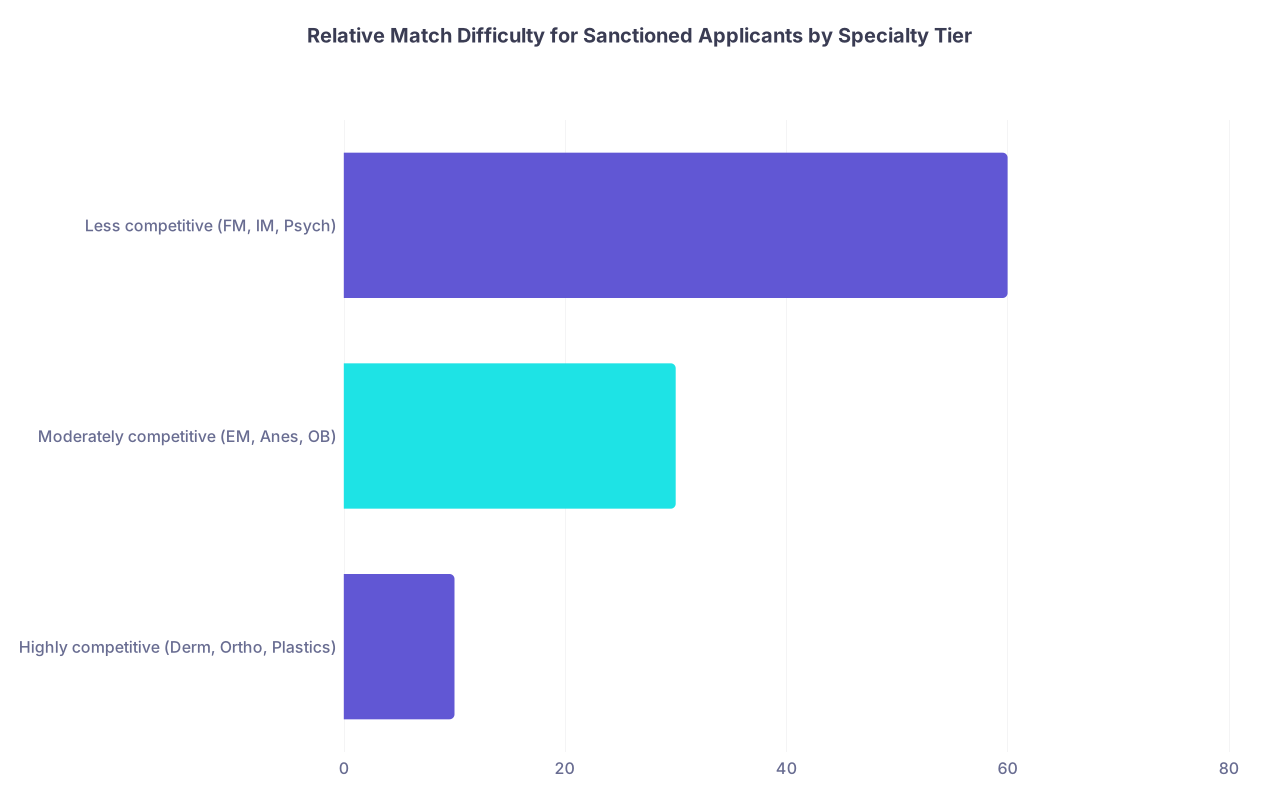
| Category | Value |
|---|---|
| Highly competitive (Derm, Ortho, Plastics) | 10 |
| Moderately competitive (EM, Anes, OB) | 30 |
| Less competitive (FM, IM, Psych) | 60 |
Interpretation: approximate percentage of sanctioned applicants with strong profiles who may realistically match into each tier, based on PD sentiment and past cases I have seen. The exact percent will vary, but the ordering is consistent.
7. How to think about risk before you ever get sanctioned
The most valuable takeaway here is preventative: a single reckless decision can convert a near‑certain match into a multi‑year probability drain.
The high‑risk situations, based on pattern data:
- Trying to “trade up” after the Match
- Backing out of a contracted position because of geography or perceived prestige
- Signing simultaneous commitments (e.g., a contract and a Match ranking) that cannot both be honored
- Casual, undocumented conversations with PDs about “if you rank us first, we will rank you highly” that drift into prohibited territory
The expected value calculation is brutally straightforward.
You are often trading:
- A certain but less ideal position this year
for:
- A low‑probability chance at a “better” position
- With a non‑trivial chance of 1–3 year sanction and permanent red flag
On expected earnings, even ignoring the psychological cost, this is usually irrational.
Assume:
- Primary care attending salary begins at ~$220k/year
- Postponing residency by 2 years = 2 years of lost attending income, even if you do eventually match
- Direct financial hit = 2 × $220k = $440k (before discounting, ignoring cost of extra pre‑residency work)
Now add:
- Increased probability of never matching, which may force an entirely different lower‑paid career path
The risk‑adjusted expected cost of a serious NRMP sanction can easily be in the mid six figures. For the “gain” of slightly altering where you do residency. The math is not in your favor.
FAQ (exactly 4 questions)
1. If I receive an NRMP sanction, am I permanently barred from all residency programs?
No. Most sanctions are time‑limited restrictions on participation in NRMP‑sponsored matches, not a permanent bar from all residency training. However, programs will see or learn about the violation, and many will treat it as a major red flag. Your effective odds depend on sanction length, specialty choice, time since graduation, and how strong your post‑violation record is. Permanent or very long sanctions are rare but usually career‑ending for U.S. residency.
2. Is a 12‑month vs 24‑month sanction really that different for my match chances?
Yes, if the difference changes the number of Match cycles you miss. If both lengths still block you from two cycles, the practical impact is similar. If the shorter sanction allows you to enter the next Match instead of the one after, your odds improve significantly because you reenter closer to graduation and with less unexplained gap time. You must think in cycles, not calendar months.
3. How much does “time since graduation” matter once I also have an NRMP violation?
It compounds the problem. Time since graduation is already negatively correlated with match success, especially beyond 3 years. When you add an NRMP violation, programs often require stronger evidence that you are safe to train. A 2‑year delay can shift an otherwise competitive applicant into a borderline or low‑probability category, particularly in competitive specialties. That is why minimizing missed cycles and building a strong track record during the gap is critical.
4. Can switching to a less competitive specialty offset the impact of a sanction?
It can partially offset it, but does not erase the risk. Shifting from extremely competitive fields (Derm, Ortho, Plastics) to less competitive ones (FM, IM, Psych, Pathology in some regions) increases your base probability of matching. For sanctioned applicants, that shift is often the only path that moves their match odds from near zero into a realistic range. Coupled with broad applications and strong performance during the sanction period, it can turn a catastrophic setback into a recoverable detour.
Two points to keep in your head: first, sanction length is best understood as “how many Match cycles and how much time from graduation do I lose?” Second, the combination of missed cycles plus a documented NRMP violation cuts your match probabilities more than most applicants realize — especially in competitive specialties.


