

Programs test your NRMP rule knowledge on purpose—and they do it in ways you will not see in any official guide.
I’m going to walk you through how it really works behind closed doors: the wording they use, the games they play, what’s actually discussed in ranking meetings, and what happens when applicants “cooperate” a little too much.
You’re not just being evaluated on your CV. You’re being evaluated on whether you understand—and respect—the Match contract you signed.
The Quiet Reality: PDs Know Exactly Where the Line Is
Let me start with the part nobody says out loud.
Program directors, coordinators, and GME offices get NRMP training every year. They know the rules. They know the phrases they cannot say. They also know how to get right up to the edge of a violation and still get the information they want from you.
Do all PDs play games? No. Some are scrupulous and borderline paranoid about NRMP issues. But enough of them test the limits that you need to assume, going into interview season, that you will be probed at least once.
Here’s what they’re balancing in the background:
- They want to know how likely you are to rank them highly.
- They want “commitment signals” without saying “you must commit.”
- They want to avoid a formal NRMP violation but still extract intel.
So they resort to backchannel pressure. Not through formal, traceable communications. Through hallway comments, “off the record” conversations, and plausibly-deniable wording.
And you—if you’re not prepared—will walk right into it.
The Core NRMP Rules PDs Tiptoe Around
Let’s be concrete. The NRMP rules that matter most for this game are pretty simple:
- They can’t ask you how you’ll rank them or other programs.
- They can’t demand any verbal or written commitment.
- They can’t offer you a position outside the Match.
- They can’t suggest that your ranking them lower (or not at all) will result in retaliation.
Flip that around and you get the temptations:
- “So where are we on your list?” → illegal to ask directly.
- “If you rank us highly, you’ll match here” → illegal quid pro quo.
- “We expect our top candidates to tell us we’re first.” → illegal pressure.
The NRMP language is dry. PDs interpret it into real-world tactics. Here’s the secret: most of the questionable behavior doesn’t happen over email. It happens in rooms with closed doors and no recording, or on the phone.
Which means your only real defense is: you need to know the rules better than they assume you do, and you need a few rehearsed lines to hold your ground without acting confrontational.
How PDs Actually Apply Backchannel Pressure
Let me show you how this looks in practice. Because it’s not, “Tell me your rank list.” It’s subtler.
1. The “Help Me Advocate for You” Trap
Classic PD move. You’re at the end of the interview day, 1:1 with the PD or APD. They’re warm, maybe even a bit paternal.
They say something like:
“I’d really like to advocate for you at our rank meeting. It would help me if I knew how interested you are in us compared to your other programs.”
Or:
“I know you’re seeing a lot of places. Just between us, are we in your top tier or more of a backup?”
They frame it as advocacy. They’re “helping” you. They want information they’re not supposed to ask for. They’re testing whether you know that.
A lot of students cave here. They overshare: “You’re my number one” or “Top three for sure.”
Behind the scenes? That goes in your file. I’ve literally seen applications with a line added by faculty: “Told PD we’re #1.” That comment gets referenced in the ranking discussion. It’s not theoretical.
Do PDs get in trouble for this? Almost never. Because nobody reports it. And the wording is vague enough that NRMP would have to reconstruct tone and intent.
2. The “We Love You, Do You Love Us?” Email
This one usually hits late January or early February.
Subject line: “Continued Interest in Our Program”
Body is full of flattery:
“You remain one of our top candidates this year. We hope to see you training here in July. If you continue to have strong interest in our program, we encourage you to let us know.”
Notice the game: they don’t order you to say they’re first. They just strongly invite you to “let us know” you’re interested.
You reply with: “You’re my first choice.” They now have what they wanted. You volunteered it. No direct question. NRMP can’t touch it.
I’ve seen programs keep literal spreadsheets:
- Column A: applicant name
- Column B: “Love letter received” Y/N
- Column C: “Stated we are #1” Y/N
Does this always move people up the list? No. But it absolutely becomes a tiebreaker in a lot of rooms.
3. The “Informal” Phone Call After Interviews
This is more aggressive and more common in smaller, mid-tier, or nervous programs that worry about not filling.
Timeline: late January to mid-February.
You get a call from the PD, chair, or sometimes a chief:
“We just wanted to check in. We were really impressed with you.”
Then, somewhere in the conversation:
“We want to make sure we’re on your radar. Are we a place you could see yourself ranking highly?”
That question is already over the line. They’re fishing directly about your rank intentions. But it’s verbal, no witnesses, and most students interpret it as friendly interest.
If you say, “Yes, I’m ranking you first,” they’ll remember that. You have now given verbal commitment, even though the rules say it’s not binding. You’ve also taught them you don’t fully understand NRMP protections.
A savvy PD watches that very carefully.
4. Post-Interview Second Looks as Pressure Tools
Second looks are not always dirty. Sometimes they’re just a chance to see the city or hospital again. But the way they’re framed can be manipulative.
Red-flag phrases from coordinators or residents during second looks:
“We usually tell people not to come back unless they’re very serious about us.”
or
“Most people who do a second look here end up ranking us first.”
or from a PD:
“I’m glad you came back—it tells me you’re serious.” Long pause. “So where do you think we’ll land on your list?”
That pause is intentional. They’re waiting to see if you’ll fill it with something incriminating like “You’re top three” or “Probably first.”
They’re testing your knowledge and your boundaries in real-time.
What PDs Actually Talk About After You Leave
Here’s the part you never see: the rank meeting.
Picture a conference room. Spreadsheet projected. Names down the left. Columns with Step scores, grades, interview scores, “fit” notes, red flags. And then a few soft columns: “interest,” “ties to region,” “couples match,” and occasionally “expressed strong interest.”
I’ve watched this play out:
- Applicant A and B have similar files.
- Both interviewed well.
- Someone says, “A told me we’re their top choice.”
- Another says, “B was noncommittal, said they were very interested but gave no rank info.”
Then you hear the line I’ve heard more than once:
“If A is committing to us, we should commit to them. Put A above B.”
Is that the official rationale? No. Is it written down? Also no. But that’s what actually happens.
Do some PDs hate this kind of conversation? Yes. I’ve seen PDs stop a discussion cold: “We are not ranking based on who told us we’re number one. That’s NRMP bait.” But not every PD is that rigid, especially in highly competitive or anxious programs.
How to Respond Without Burning Bridges (Or Breaking Rules)
You need scripts. If you try to wing it, you’ll overshare or get flustered. Here’s how savvy applicants handle pressure without sounding robotic or rude.
When They Ask Where They Are on Your List
Example PD question:
“So, where do you think we’ll be on your rank list?”
A good answer:
“I’m not allowed to disclose my rank list per NRMP rules, but I can say I’m very interested in your program and could absolutely see myself training here.”
You just did three important things:
- You referenced NRMP rules explicitly. That signals you know the contract.
- You declined to share rank info without being combative.
- You still gave them positive affect (“very interested,” “could see myself here”).
If they push:
“I just mean generally—top, middle, bottom?”
You stay firm:
“The NRMP’s pretty clear we shouldn’t be discussing specific ranking, so I don’t want to cross that line. But you’re definitely a program I would be happy to match at.”
You’ll be surprised: most PDs back down immediately when you name NRMP directly. They don’t want that in writing, in email, or quoted later.
When They Fish Through “Advocacy” Language
PD:
“I want to advocate for you. It really helps me argue your case if I know how strong your interest is.”
Your answer:
“I really appreciate that. I’m taking the NRMP rules seriously, so I’m not sharing my rank list with any programs. But in terms of interest, this is one of the places I felt I fit well, and it will absolutely be on my list.”
You separated “interest” from “rank.” Smart move.
When You Get a Flattering “You’re at the Top” Email
Program email:
“You are one of our top candidates this year and we hope to see you here in July. Please let us know if we remain one of your top choices.”
What they want: “You’re my #1.”
What you send instead:
“Thank you so much for the kind note. I really enjoyed meeting your residents and faculty and I’m very interested in your program. In keeping with NRMP guidelines I won’t be disclosing my rank list, but I can say that your program will be ranked highly.”
That signals interest. It doesn’t give them usable leverage.
What Actually Counts as an NRMP Violation (And What To Do)
Students wildly overestimate and underestimate different things here.
Clear Violations You Might See
- Direct question: “Where are you ranking us?”
- Conditional statements: “If you rank us first, you’ll match here.”
- Threats: “If you tell me we’re not in your top three, we’re not going to rank you.”
- Off-Match offers: “We can guarantee you a spot if you commit now and don’t go through the Match.”
Those are textbook violations.
The gray zone is more common: “We hope you rank us highly,” “You’re in our top group,” “Let us know if we’re your first choice.” Those skirt the border.
Should You Ever Report a Program?
Here’s the ugly, honest answer: most students do not. They’re afraid it’ll backfire. They don’t want to be “that person” who got a program in trouble.
I’ve seen exactly two situations where students reported programs. In both, the PD had clearly and repeatedly crossed the line (including explicit off-Match talk). NRMP investigated; the programs got reprimanded. It did not hurt the students’ Match outcomes, but they were understandably anxious through the process.
If you do consider reporting, there are ways to anonymize and delay it. But that’s a longer discussion with your dean’s office or an advisor you trust.
For most students, the practical move is this:
- Know your rights.
- Don’t give prohibited information.
- Document anything blatantly out of bounds (screenshots, saved emails).
- Use those receipts only if the program massively crosses the line or threatens you.
Where Applicants Mess This Up (And What PDs Think)
Let me be blunt about the common mistakes.
1. Telling Multiple Programs “You’re My #1”
Yes, PDs talk. Especially within the same region or specialty. I’ve seen it happen between two IM programs, two EM programs, even across coasts at national meetings.
The exact exchange:
PD1: “Did you get a love letter from [Applicant]?”
PD2: “Yeah, they told us we’re first.”
PD1: “Funny, they told us the same.”
What happens then? They both downgrade you on “trust” and “professionalism.” Does it tank your rank? Not always. But it can hurt when they’re deciding between otherwise-equal candidates.
2. Panicking and Oversharing on the Phone
You get a surprise PD call. You feel flattered. You overcompensate, trying to “secure” your spot.
You ramble: “You’re absolutely my top choice, I withdrew from other interviews because of you, I’ll definitely rank you first.”
Then, later, you realize you prefer another program.
Behind the scenes, your name in their notes: “Told us we’re #1.” You didn’t break any NRMP rules, but you did create a situation where if you match somewhere else, that PD will remember your name—for the wrong reason.
3. Being So Vague You Sound Disinterested
Other extreme: you’re so terrified of breaking a rule that you answer every interest question like a hostage reading off a cue card.
“Your program is one of many I’m considering. I cannot comment on my rank list.”
It sounds cold. PDs interpret that as “they’re not into us.”
You need warmth without specifics. “I’d be very happy to match here” is safe and signals genuine interest.
How to Signal Interest Without Getting Played
Let’s talk strategy. Because pretending you don’t care about any program is stupid. Interest matters.
Here’s how PDs read “interest” without you ever saying “you’re #1”:
- Prompt, thoughtful thank-you email after interview day.
- A follow-up question about something specific from your visit (curriculum, research, mentorship).
- Clear explanation on interview day of why their specific program fits you.
- Reasonable, not over-the-top, communication in January/February that says “I’m very interested” without giving them your exact rank position.
If you really do have a true number one and you want to tell them, you can, as long as they didn’t solicit it directly. NRMP allows that.
Just don’t play that card with more than one place. PDs remember the applicants who were honest and consistent far longer than they remember your Step score.
A Quick Reality Check: Do Programs Actually Follow the NRMP Algorithm?
Yes. The algorithm is real. You can’t “cut side deals” that overrule it. A PD can’t just plug you into a slot off to the side.
But.
They can absolutely move you up and down their rank list based on the impressions you leave—including how you handled backchannel pressure.
Some PDs genuinely respect applicants who say, “I’m following NRMP guidelines and not disclosing my list.” They see it as professionalism.
Others quietly favor the ones who “commit.”
The only variable you control is whether you maintain your integrity and protect yourself. The rules are designed to protect you more than them. Use that.
| Scenario Type | PD Statement | Strong Applicant Response |
|---|---|---|
| Direct rank probing | "Where will we be on your list?" | "I’m not sharing my rank list per NRMP rules, but I’m very interested in your program." |
| Advocacy framing | "I want to advocate—how high are we?" | "I can’t discuss rankings, but I’d be very happy to match here and I’ll rank you fairly." |
| Flattering email | "You are one of our top candidates..." | "Thank you, I’m very interested and will rank you highly, but I won’t disclose specifics." |
| Phone pressure | "Are we in your top group at least?" | "I value your program a lot; out of respect for NRMP I’m not labeling programs by rank." |
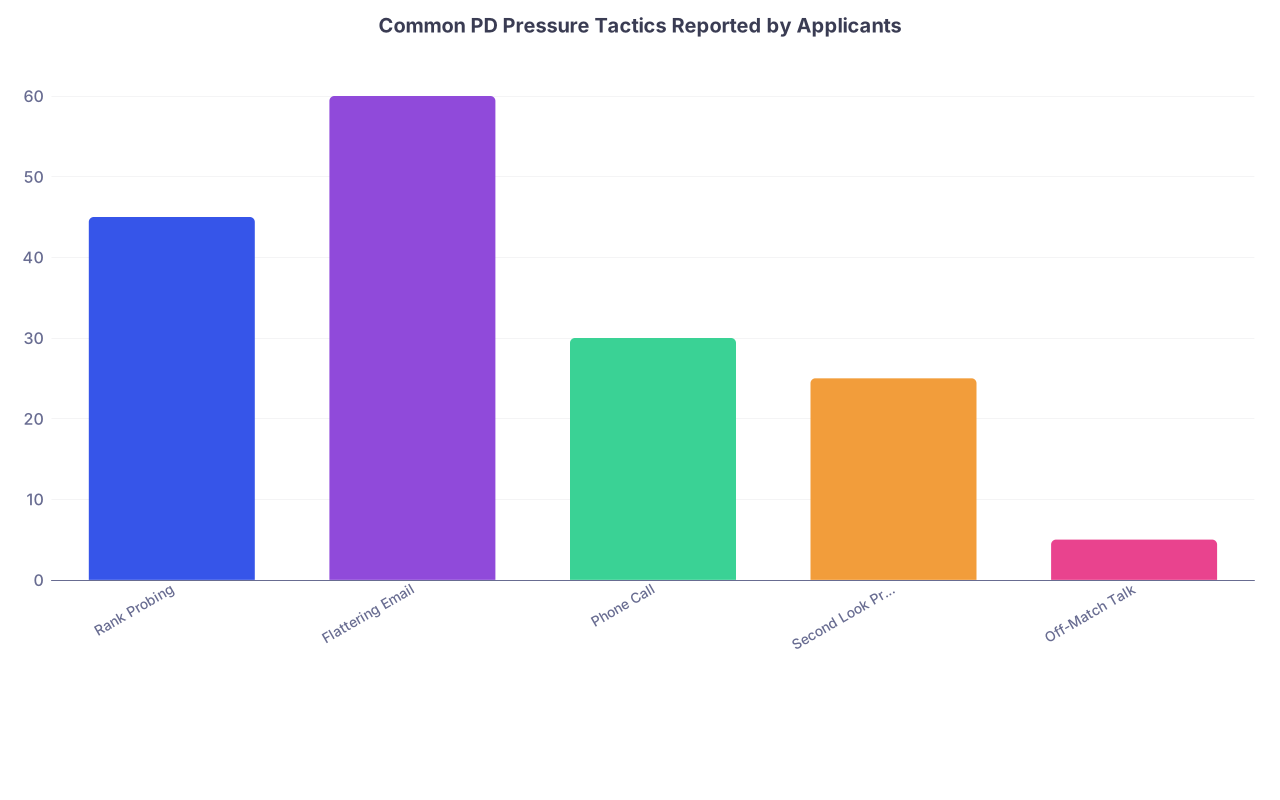
| Category | Value |
|---|---|
| Rank Probing | 45 |
| Flattering Email | 60 |
| Phone Call | 30 |
| Second Look Pressure | 25 |
| Off-Match Talk | 5 |

| Step | Description |
|---|---|
| Step 1 | PD applies pressure |
| Step 2 | Direct rank question |
| Step 3 | Implied interest question |
| Step 4 | Flattering email or call |
| Step 5 | Reference NRMP rules and decline |
| Step 6 | Express strong interest without ranks |
| Step 7 | Warm reply, no specific ranking |
| Step 8 | Document if egregious |
| Step 9 | Type of pressure |



Key Takeaways You Actually Need
- Programs will test your NRMP rule knowledge, usually through vague “interest” questions and flattering emails or calls. Expect it.
- Your safest move is consistent: explicitly reference NRMP rules, refuse to disclose your rank list, but clearly express that you’d be happy to match there if it’s true.
- Do not tell multiple programs they’re your #1. PDs talk. Your reputation for honesty is worth more than a brief hit of reassurance.


