

The dirtiest secret about the Match is this: the rules are clear, but a lot of people quietly test the fence to see how far they can lean over it without getting caught.
Let me walk you through what really happens with handshake deals, “you’re my top choice” promises, and all the off-the-record nudges that live in the gray zone of NRMP rules.
What The Rules Actually Say… And How People Dance Around Them
You’ve seen the NRMP boilerplate: no coercion, no asking applicants how they’ll rank, no guarantees of ranking, no deals contingent on how someone ranks the other. Clean. Idealistic. Theoretically enforced.
Reality is more nuanced.
Here’s the key: NRMP rules focus on coercion and explicit commitments. Most program directors (PDs) don’t want to lose their job or get their program sanctioned. So they learn the language that lets them signal intent without “technically” violating the rules.
Things PDs cannot do (on paper):
- Ask you how you will rank them
- Ask you to commit to rank them first
- Tell you how they will rank you in a way that constitutes a “guarantee” or quid pro quo
- Make any condition: “If you rank us first, we’ll rank you to match”
Now the part no one tells you: what they actually say.
I have literally heard, word for word, in a closed-door debrief:
- “I told her, ‘You will be very competitive on our rank list.’ She’ll hear what she wants to hear.”
- “We never say ‘we’ll rank you to match.’ We say, ‘We’re ranking you very aggressively.’ Same message, less liability.”
- “He kept asking if he’d match here, so I told him, ‘If you end up here, we will be thrilled.’ That’s as far as I go.”
You’re not imagining the game. It’s real. It’s deliberate. And it’s designed to make you feel chosen without crossing the explicit line.
Handshake Deals: Myth, Half-Truth, and Career Suicide
There are two different things people call “handshake deals”:
The mythical version:
PD literally tells an applicant, “We will rank you high enough to match if you rank us first.” Applicant agrees they’ll rank the program #1. Everyone “shakes hands” on it.The realistic version:
Strong mutual interest, heavy signaling, but nothing so explicit that NRMP could nail them for it.
The mythical version does happen, but a lot less than students think. And when it does, one of three things follows:
- PD keeps the promise, they match, everyone is happy.
- PD intends to keep the promise, then the chair, match committee, or dean changes the list anyway. Applicant doesn’t match and feels betrayed.
- PD never meant it and used it as leverage. That’s rare but not unheard of at toxic places.
Let me be blunt: a “deal” that depends on a rank list no one has seen yet, which multiple people can edit, and which gets uploaded at the last minute by a coordinator under time pressure, is not a deal. It’s faith. Or delusion.
On the program side, here’s what I’ve watched happen behind closed doors the week before lists are certified:
- The chair walks in, drops the phrase, “We need more categorical positions filled; last year’s scramble was brutal. Push known quantities up. I don’t want to see any unknown away rotators above our home students unless they are absolutely outstanding.”
- The PD says, “Remember that rockstar from Hopkins I told you I promised?”
The associate PD shrugs: “Yeah, but the dean wants us to make sure our own seniors don’t go unmatched. Move her down three spots.”
Handshake deal evaporated in 30 seconds.
If you’re banking your future on a back-channel promise, you’re ignoring how chaotic and political that final week really is.
“We’ll Rank You Highly”: Decoding The PD Language
Programs have evolved a vocabulary that feels flattering but legally safe. Once you know the code, you’ll stop reading tea leaves like they’re sacred scripture.
Here’s how it translates in most contexts:
| PD Phrase | What It Usually Means |
|---|---|
| "We’ll rank you highly." | You’re on the list, not guaranteed. |
| "You would do very well here." | We like you; not a ranking promise. |
| "We see you as a great fit." | Cultural fit; may or may not rank high. |
| "If you end up here, we’ll be thrilled." | We like you; zero info on list position. |
| "You’re exactly what we’re looking for." | Strong signal, but still not a contract. |
PDs talk to each other. They share strategies. After NRMP sanctions hit a few programs in public fashion, everyone started getting meticulous about language.
What they won’t say if they’re careful:
- “We’re ranking you to match.”
- “If you rank us first, you’ll be here in July.”
- “You have a spot here.”
The reckless PDs still say versions of those. Or they do it off the record—on personal email, on WhatsApp, or on the phone. They’ll say something like:
“This is off the record, but if you rank us first, I’m confident we’ll be working together next year.”
Now you’re in the gray zone where they’ve basically violated the spirit of NRMP rules, but there’s no proof unless you screenshot or record them—and almost nobody does.
What Happens In Those Rank Meeting Rooms
You need to understand what you’re competing with, even if a PD “promised” you something.
Inside those rooms (and yes, I’ve sat in them), rank lists are:
- Multi-variable arguments, not love letters to individual applicants.
- Influenced by the chair, senior faculty, sometimes even GME and hospital leadership.
- At the mercy of last-minute data—new Step 2 scores, professionalism flags, Dean’s letters.
Typical scenario in internal medicine, surgery, anesthesia—pick your poison:
- PD walks in with a preliminary list: 60 names for 12 spots.
- Education chief or APD pulls out a spreadsheet: “We’ve got three home students who might not match otherwise. We can’t hang them out to dry.”
- Chair says, “I want at least two people interested in academics and research, and I don’t care about their Step scores if they can publish.”
- Someone else says, “The last away rotator we took flamed out. Be cautious with anyone we only saw for one month.”
You, with your handshake deal, are just one of many variables. If you’re not a perfect fit across the politics, you can get bumped. Even when someone genuinely tried to help you.
That’s why NRMP’s line—“a verbal commitment is not binding”—isn’t just legal cover. It’s operational reality.
How Often Do Programs Actually Break Their “Promises”?
You’ll never get this from an official report, so let me give you what PDs share with each other when applicants are not in the room.
On a typical cycle in a moderately competitive specialty, here’s what I’ve seen or heard:
- PDs “heavily signal” strong interest to 2–3× more people than they have spots.
- Of those “we love you” candidates, they will not match with 30–50%, depending on how the applicant ranks.
Do some PDs email 15–20 people saying “you are in our top group”? Yes. Those emails go out like candy in January.
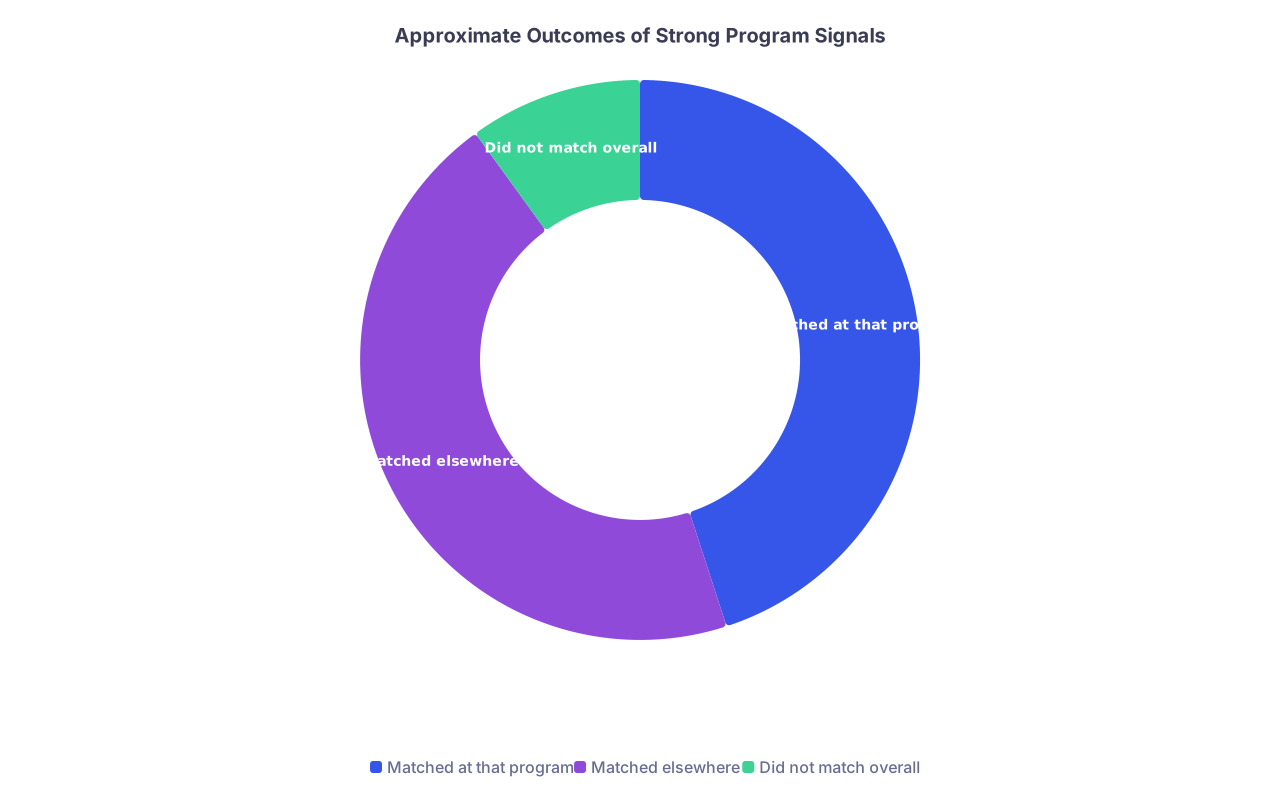
| Category | Value |
|---|---|
| Matched at that program | 45 |
| Matched elsewhere | 45 |
| Did not match overall | 10 |
Those numbers aren’t precise, but they’re representative of what PDs complain about over drinks: “We told them we really liked them, and they still ranked us third and went somewhere ‘better’.”
Here’s the irony: while applicants are afraid of being lied to, PDs are just as wary of being “used” as a backup. That paranoia is exactly what fuels vague, manipulative communication.
What You Can Say Without Burning Yourself
Students overestimate the risk of running afoul of NRMP rules. Most of you are too cautious, honestly.
NRMP’s main concern is coercion from the program side. Applicants are allowed to express preferences. You can tell a program they’re your top choice. You can say, “I will rank you first.” That’s allowed.
Where you get into trouble ethically (and strategically) is when you lie or shotgun the same message to six places. PDs talk. Coordinators talk even more.
Concrete reality:
- It’s fine to send one program: “You will be ranked #1 on my list.”
- It’s fine to send others: “I will rank you very highly.”
- It’s not fine to tell five different programs, “You are my #1,” and assume no one will compare notes at a regional PD meeting.
Will NRMP sanction you for lying? Almost never. But some PDs will remember. I know one PD who literally keeps a mental blacklist:
“She told us we were first, then we saw the data after Match and realized we weren’t. I’ll never take one of their students at face value again.”
You’re not just managing this Match. You’re building a reputation pipeline for your school.
How To Respond When A PD “Promises” You Something
Let me give you the practical script, because this is where students freeze.
Scenario: end of interview, PD says, “We’ll rank you highly. You’d fit in really well here. If you end up here, we’ll be delighted.”
Your move:
- Smile.
- Say: “Thank you, I really appreciate that. I’ve loved what I’ve seen here.”
- Go home and pretend you never heard it when building your rank list.
You can note it as a sign of genuine interest, sure. But you do not move a program from 4th to 1st based on that alone. That’s how people end up miserable in places that sounded flattering in January and toxic by October.
Now, if a PD crosses the line:
“If you rank us first, I can basically guarantee you’ll be here next year.”
You have three options, and they’re all valid depending on your risk tolerance and the vibes:
- Nod, do not commit on the phone, and later rank where you want.
- Send a very neutral follow-up: “Thank you for your time and support. I continue to be very interested in your program.” No rank talk.
- If it feels egregious or coercive, document it privately. You can later decide whether to report it to NRMP. Some do.
What you do not need to do: argue, correct, or “remind” them of the rules in real time. You won’t win that confrontation, and it’s not your job.
How To Build Your Rank List When Everyone Is Making Promises
This is where the real test of judgment comes in. You’ll be swimming in mixed signals, half-truths, and your own anxiety.
Here’s the insider framework PDs wish applicants understood:
| Factor | Reality Check |
|---|---|
| PD email saying "top of our list" | Nice ego boost; not binding. |
| Resident vibes on interview day | Very predictive of day-to-day life. |
| Location and support system | Huge for long-term well-being. |
| Program reputation | Matters, but less than you think for many careers. |
| Research output if you want academics | Critical if fellowship/academia focused. |
| Call schedule and culture | Massive for burnout risk. |
Rank by where you would want to work if nobody promised you anything.
That’s how PDs think too. Ask them off record: “Would you want your kid to match at the place that flattered them or the place that will train them and not destroy them?” They’ll all say the same thing.
The Quiet Patterns PDs Use To Signal Interest
There are signals that mean more than fancy words. Let me show you the ones that come up again and again when faculty gossip.
Stronger signals (still not guarantees, but they carry weight):
- Multiple touch points: PD + APD + chief resident all email you or have side conversations. Effort = genuine interest.
- Post-interview contact from the PD personally (not a mass “thank you”): short, specific notes referencing your conversation. That took real time.
- Programs that invite you back for a second look and actually roll out residents to spend time with you. That’s operational cost.
Weaker or meaningless signals:
- Mass emails saying, “We hope to see you here in July!”
- A generic “ranking reminder” from a coordinator.
- Interviewers saying, “You’d be a great fit” to basically everyone.
, Generic PD email, Personal PD note, PD+APD follow-up, Second-look with residents](https://cdn.residencyadvisor.com/images/articles_svg/chart-relative-strength-of-common-program-interest-signa-4362.svg "Relative Strength of Common Program Interest Signals")
| Category | Value |
|---|---|
| [Mass thank-you email](https://residencyadvisor.com/resources/nrmp-match-rules/the-post-interview-thank-you-mistakes-that-trigger-nrmp-problems) | 10 |
| Generic PD email | 25 |
| Personal PD note | 60 |
| PD+APD follow-up | 75 |
| Second-look with residents | 85 |
Again, none of these override your own priorities. But if you’re torn between two roughly equal programs, those stronger signals can help break a tie.
NRMP Enforcement: What Actually Gets People In Trouble
You’ve probably seen NRMP warnings and thought, “They must be enforcing this aggressively.” They’re not the Match police lurking behind every email.
Here’s what typically triggers an investigation:
- A pattern of coercive behavior reported by multiple applicants or faculty.
- Extremely explicit quid pro quo (“rank us first and we guarantee you a spot”) that someone documents.
- Programs retaliating or threatening applicants over rank choices.
The smokier gray zone—vague promises, “we love you” language, heavy signaling—almost never leads to real consequences. NRMP doesn’t have the bandwidth or the legal teeth to chase every slippery sentence.
For you, that means two things:
- Do not assume “they wouldn’t dare say this if it wasn’t true.” They dare. All the time.
- You’re unlikely to be punished for expressing interest honestly, even explicitly, as long as you’re not colluding or scheming with a program to game the algorithm.

| Step | Description |
|---|---|
| Step 1 | Safe - Basic Thank You |
| Step 2 | Moderate - Expressing Interest |
| Step 3 | Edgy - You are my #1 |
| Step 4 | Risky - Program Guarantees |
| Step 5 | Reportable - Explicit Quid Pro Quo |
The Rule That Actually Protects You
The NRMP Match Algorithm protects one party more than the other: the applicant.
It’s applicant-proposing. That means the algorithm tries to give you the highest-ranked program on your list that also ranks you high enough. Not the other way around.
So the smartest move—even with handshake deals, sweet talk, and glowing emails—is brutally simple:
Rank in YOUR true order of preference.
Every PD I know who actually respects the process says the same thing behind closed doors:
“The students who listen to the algorithm do fine. The students who try to game the system based on vague promises get burned.”
Handshakes don’t change the algorithm. Promises don’t change the algorithm. Your rank list does.
How To Keep Your Head Clear In The Noise
There’s one more layer to this whole mess: your own insecurity. Programs know you’re anxious. Some exploit it more than others.
Protect yourself with a few internal rules:
- Any statement that isn’t in the NRMP system doesn’t exist. It can be a data point, not a contract.
- If your gut says a PD is slimy or too pushy about rank commitments, believe it. That behavior doesn’t magically disappear July 1.
- If residents hint, “Yeah, they told a bunch of us we’d match here too,” that’s gold. Listen to the people already inside.
And here’s something students never think to do: during dinner or social events, casually ask senior residents:
“Did any of you get strong signals or promises? How did that play out for your class?”
When I’ve heard residents answer honestly, the stories are almost always some variation of:
- “They told me I’d be ranked highly. I had no idea what that meant. I matched here, but so did a lot of people who never heard a word afterward.”
- “I ranked them first because I loved the residents. Whatever they said to me didn’t really matter as much as seeing how they treated interns.”
That second answer is the only rational one.
The Perspective You’ll Only Get From The Other Side
A few years after residency starts, most people stop obsessing over the calculus they did for their rank lists. They remember the human pieces: who taught them, who had their back on nights, whether they felt disposable or valued.
Nobody says, “I’m glad I trusted that one vague PD email instead of my own instincts about where I’d be happy.”
Handshake deals and match promises feel huge right now because they play directly on your fear of not matching and your desire to be chosen. They are emotional leverage, not structural guarantees.
Years from now, you will not remember the exact wording of that “we’ll rank you highly” email. You will remember whether you chose a place for its simulation center and flattery, or for the people who handed you a warm cup of coffee at 3 a.m. and said, “Go lie down, I’ve got this one.”
When you’re staring at that rank list, shut out the noise. Ignore the handshakes. Let the promises fade. Ask yourself one question:
“If nobody had said a word about how they’d rank me, where would I actually want to show up on July 1?”
Answer that honestly, and the rest—algorithm, politics, sweet talk—will sort itself out in ways you can’t fully control anyway.


