
It is 10:47 p.m. The interview went great, you are exhausted, and then your stomach drops.
You re-read the email you just sent to a program director:
“Your program is my top choice. If you rank me highly, I will rank you highly as well.”
Or you recall what you said on Zoom earlier:
“If you rank me to match, I’ll rank you first.”
Or the reverse: a PD just wrote, “If you rank us first, we will rank you to match.” You replied “Deal!” without thinking.
Now you are sitting there wondering:
Did I just break an NRMP rule?
Can I get kicked out of the Match?
Do I need to report this?
You have 24 hours to stop this from turning into an actual problem.
Let me walk you through exactly what to do, step by step.
Step 1: Calm Yourself and Identify What Actually Happened
Before you start firing off apology emails, you need to know whether:
- You violated an NRMP rule
- The program may have violated a rule
- Neither of you violated a rule, and you are just scared
A quick, reality-based NRMP rule refresher
Here is the core of what the NRMP really cares about in this context:
No one can ask you how you will rank them.
Programs cannot require statements or ask questions that demand you reveal your rank order list.No one can pressure you to rank a certain way in exchange for a benefit.
No “If you rank us first, we will rank you to match” deals. That is coercive and not allowed.You cannot sign any agreement that binds your rank order list.
Rank lists are confidential and non-binding until Match day.You can express interest.
Saying “You are my top choice” or “I plan to rank you highly” is allowed, as long as you are not promising anything in exchange for something.Programs can express interest.
“We will rank you highly,” “We liked you a lot,” or even “We plan to rank you to match” is allowed. It cannot be a condition.
So the line usually gets crossed when:
- An explicit quid pro quo is made (“If you do X on your rank list, we will do Y”), or
- Someone demands to know or control your ranking in a way that feels like a requirement.
Categorize what happened (do this now)
Write it down, word for word, while it is fresh. Then drop it into one of these buckets:
| Scenario Code | Description |
|---|---|
| A | You expressed interest only (“top choice,” “rank you highly”) |
| B | Program expressed interest only (“rank you highly,” “rank to match”) |
| C | You made a conditional statement involving ranks (“If you rank me… I will rank you…”) |
| D | Program requested or demanded your intended ranking (“Will you rank us first?” as a condition) |
| E | You or program referenced any “agreement” about ranking |
- A or B – Almost always allowed under NRMP rules.
- C, D, or E – This is where it can cross into potential violation territory.
If you are in C, D, or E, keep reading like this is urgent. Because it is.
Step 2: Do a Quick Rule Check (20 Minutes Max)
You do not need to become an NRMP lawyer tonight. But you need to check whether what happened is plausibly a violation.
Here is the fast-track way to do it:
1. Compare your situation to the core prohibition
Ask yourself:
- Did I or the program link ranking behavior to a benefit?
Example: “If you rank us first, we will rank you to match.” - Did I or the program try to bind someone’s rank list by promise or “agreement”?
Example: “I promise I will rank you first if you rank me first.” - Did the program make me feel like I had to reveal or commit to a ranking to be considered seriously?
If the answer is “yes” to any of these, you are flirting with an NRMP rule issue.
2. Recognize what is not an NRMP violation (even though it feels gross)
These are generally not violations by themselves:
- Program sends: “We really liked you and will rank you highly.”
- You send: “You are my first choice” (even if it is emotional, maybe unwise, but not illegal).
- Generic “love letters” without conditions: “I intend to rank you highly; I felt a strong fit.”
These can be ethically questionable or misleading if you say it to 10 places, but NRMP is not going to chase you down for that alone.
3. If you are still unsure, assume “possible violation” and move forward
If you are stuck debating whether what you said is technically coercive, err on the side of:
“This might be problematic; I should clean it up now.”
You are not solving a legal brief; you are doing damage control.
Step 3: Preserve Evidence Before You Touch Anything
Do not delete. Do not edit. Do not try to make it disappear.
I have seen people panic-delete emails and then regret it badly when NRMP asks what happened and they have nothing to show.
Within the next 15 minutes:
Screenshot the relevant emails, messages, or notes of what was said verbally.
Save them as PDFs or images with simple file names:
ProgramX_Email_2026-01-06.pngZoom_Conversation_Notes_ProgramY.docx
If this was a phone or Zoom comment:
- Write down exact phrases you remember
- Note the date, approximate time, and who was present
Why this matters:
- If a complaint is ever filed (by you or the program), NRMP will want copies.
- If you clean it up proactively, having documentation shows you acted in good faith and quickly.
Do not skip this step. It takes 10–20 minutes and can save you later.
Step 4: Decide If You Need to Send a Clarifying Follow-Up (Next 2–4 Hours)
Now to the main question: what do you do now?
Case 1: You wrote something that sounds like a binding or conditional agreement
Example phrases you sent:
- “If you rank me highly, I will rank you first.”
- “If you rank me to match, I will rank you highly as well.”
- “I promise I will rank you first if you rank me to match.”
- “You’ll get my top spot if you rank me highly.”
These are the ones that worry you.
Your goal now:
Disentangle your communication from any impression that rankings are conditional or that there is an “agreement.”
You are not confessing a crime. You are clarifying your intent.
Use a concise clarification email
Send this within 24 hours if possible. Keep it short, factual, and boring.
Template you can adapt:
Subject: Clarification of Prior Communication
Dear Dr. [Last Name],
I wanted to briefly clarify my previous message. In my enthusiasm after our interview, my wording may have implied some form of agreement or condition regarding rank lists. That was not my intent.
I understand that rank order lists are confidential and that both programs and applicants must make independent ranking decisions in accordance with NRMP policies.
I remain very interested in [Program Name] and appreciate the opportunity to have interviewed with you and your team.
Sincerely,
[Your Full Name]
AAMC ID: [#########]
Why this works:
- It neutralizes any “deal” implication.
- It demonstrates you understand NRMP rules.
- It does not accuse the program or escalate unnecessarily.
- It creates a written record that you corrected course promptly.
Case 2: The program offered a conditional statement; you passively agreed
Example:
- PD: “If you rank us first, we will rank you to match.”
- You: “That sounds good,” “Deal,” or worse, “Yes, I’ll rank you first if you do that.”
In this scenario, both sides may be in a gray or red zone.
You still use the same basic approach: clarify and remove the appearance of a binding agreement.
Possible follow-up email:
Subject: Clarification of Prior Conversation
Dear Dr. [Last Name],
Following our recent [call/Zoom/email exchange], I wanted to briefly clarify and ensure that I am adhering to NRMP policies. During our conversation I expressed agreement in a way that could be interpreted as an understanding about how we might rank one another.
To be clear, I recognize that both applicants and programs are required to formulate their rank lists independently, without any obligations or agreements. I will be submitting my rank list based on my own assessment of program fit, consistent with NRMP rules.
I am grateful for the opportunity to have interviewed at [Program Name] and remain very interested in your program.
Sincerely,
[Your Full Name]
AAMC ID: [#########]
This does three things:
- It pulls you out of any “agreement” implication.
- It politely reminds the program of NRMP expectations.
- It documents that you tried to correct the situation quickly.
Case 3: You only expressed interest (no conditions, no deals)
Example:
- “You are my top choice.”
- “I intend to rank you highly.”
- “I would be thrilled to train at your program.”
You probably do not need to send anything.
If you are still uneasy, you can “cool” the language in a neutral way:
Dear Dr. [Last Name],
Thank you again for the opportunity to interview at [Program Name]. I remain very interested in your program and appreciate the time and effort your team invests in applicants.
Sincerely,
[Name]
But if your original email was just classic post-interview enthusiasm without explicit conditions, NRMP is not going to consider that a violation.
Step 5: If the Program Clearly Violated a Rule – Protect Yourself Strategically
Sometimes the thing that happened is not subtle.
Example:
- “We require that you tell us whether you will rank us first.”
- “If you do not indicate we are your first choice, we will not rank you.”
- “We only rank applicants who commit to ranking us first.”
That is textbook program-side NRMP trouble.
You have three parallel goals now:
- Protect yourself from any implication of complicity.
- Stop participating in the violation.
- Decide whether to report, and if so, how and when.
1. Stop engaging in the violation immediately
If they are pushing you on your rank list, you do not need to answer their question.
You can reply with something like:
Dear Dr. [Last Name],
Thank you for your message and for your interest in my application. I want to be sure I adhere to NRMP policies, which require both programs and applicants to create their rank lists independently and without any commitments or agreements about ranking.
I remain grateful for the opportunity to interview at [Program Name].
Sincerely,
[Your Name]
You did not answer their demand. You set a boundary and documented that you know the rules.
2. Decide whether to file a complaint – and when
You do not have to decide this in the middle of the night. NRMP has a formal violations process and timeline after the Match.
But here is how I would think about it:
- If the program’s conduct was egregious, repeated, or clearly systemic (same comment to multiple applicants) – that is stronger justification for reporting.
- If it was one awkward, out-of-line comment from a single faculty interviewer, and they backed off when you pushed back, you might decide to let it go.
If you ultimately choose to report:
- Preserve all documentation (already done above).
- You can submit a concern directly to NRMP after the Match if needed.
- You can talk to your dean’s office / student affairs first to strategize. They have seen this movie before.
Do not threaten the program with NRMP. Do not bait them. Just quietly protect your own position and leave enforcement to NRMP if you go that route.
Step 6: Talk to Someone Who Actually Knows This Stuff
Within the next 24 hours, you should loop in one knowledgeable human:
- Your Dean of Students or Student Affairs Dean
- Your home program director (if you trust them and it is appropriate)
- An experienced faculty advisor
- If available, your school’s “NRMP compliance” or career advising person
Why involve them?
- They can confirm whether what you did is actually problematic or not.
- They can review any email you are about to send before you send it.
- They can advise if and when involving NRMP is smart.
Bring:
- Screenshots or PDFs of the emails.
- Written notes of verbal conversations (dates, times, names).
- A short, honest timeline: “Interview on X, email sent at Y, my reply at Z.”
Do not crowdsource this in a group chat or Reddit thread. That is how rumors and bad advice spread.
Step 7: Fix Your Future Communications So You Do Not End Up Here Again
You still have more interviews, more “thank you” notes, more chances to step in it. So put some guardrails in now.
Safe Templates You Can Use Repeatedly
You can copy-paste and tweak any of these.
Post-interview thank you note (safe, neutral):
Dear Dr. [Last Name],
Thank you again for the opportunity to interview at [Program Name]. I appreciated learning more about your approach to [specific feature: education, mentorship, patient population, etc.].
I remain very interested in [Program Name] and would be excited about the opportunity to train with your team.
Sincerely,
[Your Name]
If you genuinely want to indicate strong interest, without deals:
Dear Dr. [Last Name],
I wanted to thank you again for my interview at [Program Name]. After having time to reflect, I feel your program would be an excellent fit for my goals in [subspecialty/setting], and I am very enthusiastic about the possibility of training there.
Best regards,
[Your Name]
No mention of rank order. No “first.” No “promise.” Still clear you care.
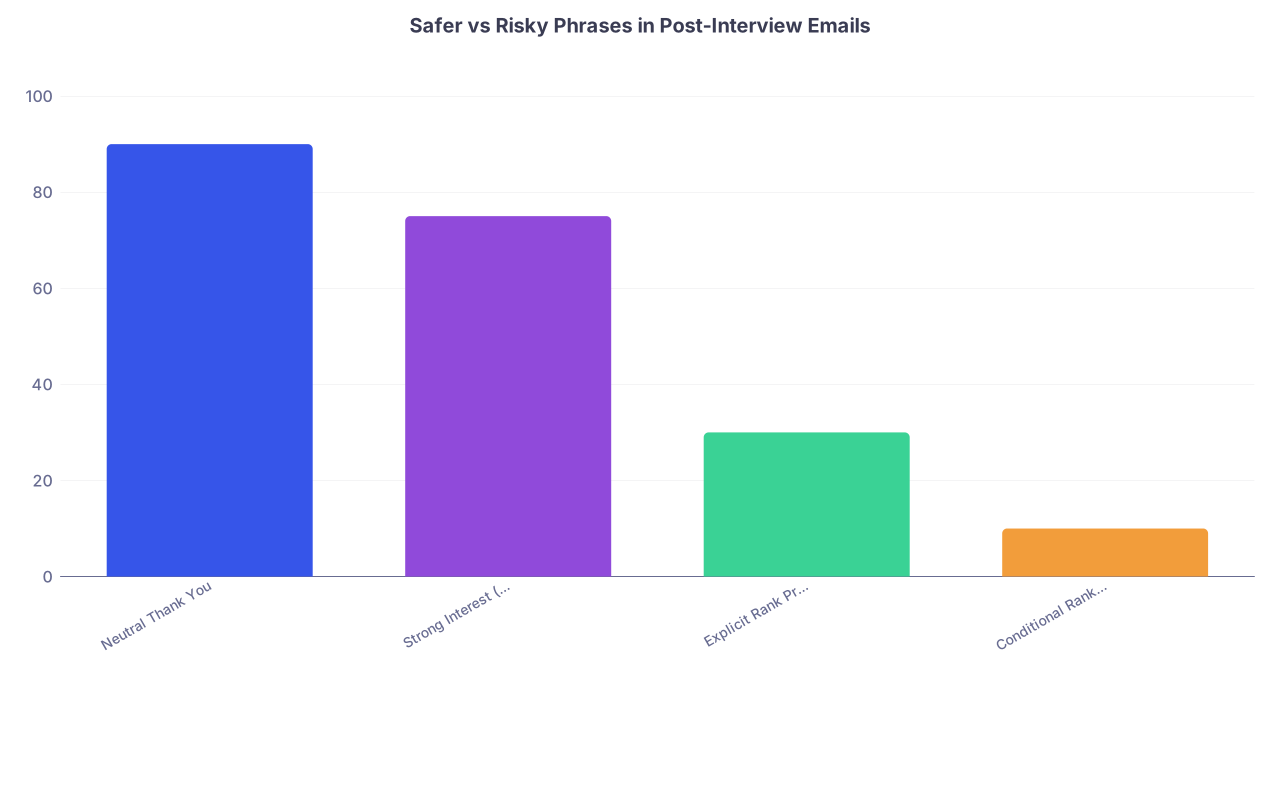
| Category | Value |
|---|---|
| Neutral Thank You | 90 |
| Strong Interest (No Rank Language) | 75 |
| Explicit Rank Promise | 30 |
| Conditional Rank Deal | 10 |
(Think of those numbers as “safety scores,” not real data. Use the top two.)
What you should stop writing entirely
Do not ever put the following in writing (or say them, if you can help it):
- “You are my guaranteed #1.”
- “I will rank you first if you rank me first.”
- “I promise to rank you to match.”
- “We have an understanding about how we will rank each other.”
The less precise you are about your exact rank list, the safer you are, both ethically and under NRMP rules.
Step 8: Mental Reset – Do Not Let One Dumb Line Derail Your Match
You are going to obsess about this tonight. That is fine. But after you do the following, you stop:
- Document what happened.
- Send any needed clarification email.
- Talk to one knowledgeable advisor.
- Lock in safer templates for future communications.
Then you move on.
Why?
Because:
- NRMP is not hunting people for one poorly worded email that was quickly corrected.
- The system is more focused on serious, repeat, or coercive behavior, and especially on program-side misconduct.
- You are far more likely to damage your application by panicking and over-communicating than by fixing it once and then letting it go.
Use this as a boundary lesson:
- You do not owe your rank list to anyone.
- You do not have to play weird “promise” games to match well.
- Programs that pressure you are showing you a red flag. Believe them.
Quick 24-Hour Action Checklist
Here is your situation boiled into a single, usable checklist. Follow it in order.

| Step | Description |
|---|---|
| Step 1 | Realize possible NRMP issue |
| Step 2 | Write down exact words and context |
| Step 3 | Categorize scenario A-E |
| Step 4 | Preserve evidence - screenshots, notes |
| Step 5 | No action or mild cooling email |
| Step 6 | Draft clarification email |
| Step 7 | Send clarification within 24 hours |
| Step 8 | Consult dean or advisor |
| Step 9 | Adjust future emails to safe templates |
| Step 10 | Possible violation? C/D/E |
You can literally check these off:
- Write down exactly what was said / sent
- Preserve screenshots and notes
- Decide if scenario is likely A/B vs C/D/E
- If C/D/E: send a short clarification email
- Contact dean / advisor with documentation
- Switch to safe communication templates for the rest of the season
One More Thing: Reality Check About Consequences
You are probably imagining worst-case scenarios: being banned from the Match, losing your career, NRMP knocking on your door.
Here is the more realistic view from someone who has seen too many cycles:
- The most common NRMP-related problems are program violations, not students.
- When students get into trouble, it is usually for serious, deliberate behavior: misrepresentation, contract breaches, or retaliation.
- A single, enthusiastic, but clumsy email that you promptly correct? That is not what NRMP is hunting.
The key is that you are responding proactively:
- You identify it.
- You correct it in writing.
- You stop the behavior.
- You seek guidance.
That pattern looks responsible, not shady.
Final 2–3 Key Takeaways
- Do not panic-delete; document and clarify. Save everything, then send a short, boring clarification email if there was any hint of a “deal” or binding rank agreement.
- You never owe anyone your rank list. Express interest, sure. But avoid explicit rank promises or conditional statements. Those are where real NRMP trouble starts.
- Get a real human advisor to sanity-check you. Bring them your screenshots, fix this once, adopt safe templates, then move on and focus your energy where it actually improves your Match outcome.


