

The fastest way to tank your career before it starts is to play games with NRMP rules because a program “asked you to.”
You are the one whose name is on the Match contract. You are the one who gets sanctioned if things go sideways. Programs know this. Some push anyway.
Let me walk you through exactly how to handle it—what to say, what to write, when to shut up, and when to report.
1. Ground Rules: What You Actually Signed Up For
You cannot respond intelligently until you know the rules you are being asked to break.
The NRMP Match Participation Agreement (for applicants) boils down to a few practical, non-negotiable points:
You must:
- Provide truthful information to programs and NRMP
- Not solicit or accept promises of ranking or placement
- Not make or sign any commitment outside the Match that conflicts with it
- Not pressure programs for ranking info or commitments
Programs must:
- Not ask you for ranking info or commitments
- Not ask you to “sign,” “promise,” or “agree” to match with them
- Not condition ranking or ranking position on your statements about other programs or couples match behavior
- Not offer you a position outside the Match once you are a registered Match applicant (with narrow exceptions like SOAP, post-Match openings, etc.)
The NRMP phrases are a little stiff. In reality, rule-breaking conversations often sound like this:
- “If we rank you highly, will you definitely rank us first?”
- “We expect our top applicants to commit verbally to us.”
- “Can you send us an email confirming we’re your number one?”
- “We need to know whether you’ll withdraw from the Match and sign this pre-Match contract.”
- “We will rank you to match if you tell us you’ll rank us to match.”
All of those are inappropriate at best and may be NRMP violations.
You are not paranoid. If your gut says “This feels off,” it probably is.
2. Recognize the Red Flags: Common Ways Programs Push You
Here is the practical translation of “program asks you to break rules.”
| Scenario Type | Example Phrase |
|---|---|
| Rank commitment | "If we rank you to match, will you rank us to match?" |
| Written pledge | "Email us stating that we are your first choice." |
| Pressure about other programs | "Tell us where else you interviewed and how you will rank them." |
| Prematch contract | "Withdraw from NRMP and sign with us now." |
| Couples match leverage | "Break your couples agreement; we want you alone." |
If you hear or read anything like:
- “We require a commitment.”
- “You must…” “You’re expected to…” “We need you to say…”
- “Do not tell NRMP about this, but…”
Stop. That is your signal you are entering “document and deflect” mode.
3. Your Default Response Strategy: Deflect, Don’t Debate
Your job is not to educate programs on NRMP rules. Your job is to protect yourself while not torching opportunities unnecessarily.
So you need a tight script toolkit.
A. Live Conversation (Phone or In-Person)
When someone says something sketchy on a call or on interview day, use a three-step approach:
- Acknowledge (lightly, neutral)
- Reaffirm your intent to follow the Match
- Change topic or end gracefully
Example 1 – Rank commitment request:
Program: “If we rank you to match, will you rank us to match?”
You: “I really appreciate your interest in me. I am fully committed to following NRMP rules, so I cannot make specific ranking commitments. I can say I had a very strong impression of this program and it will be near the top of my list.”
Then stop. Silence is your ally.
Example 2 – “We expect top applicants to send an email promising to rank us #1”:
You: “I understand you want to know my level of interest. I am following NRMP guidelines, so I cannot make or send that kind of commitment. I can tell you I am seriously considering your program and will rank based on overall fit.”
You are not arguing. You are calmly refusing to break rules. That is the key.
B. Email or Written Requests
Written is actually easier. You have time.
Keep it short:
Dear Dr. Smith,
Thank you for your message and for your continued interest in my application. I am excited about [Program Name] and I anticipate ranking your program highly.
In accordance with NRMP Match policies, I am not able to make specific ranking commitments or provide written assurances about my rank list. I will finalize my list based on overall fit and training opportunities.
Thank you again for the opportunity to interview and learn more about your program.
Sincerely,
[Your Name]
That is polite, clear, and keeps you clean.
If they push again anyway, that becomes potential evidence.
4. Categorize the Situation: Annoying vs. Dangerous
Not every awkward conversation needs an NRMP complaint. But some absolutely should be reported.
Think in three levels.
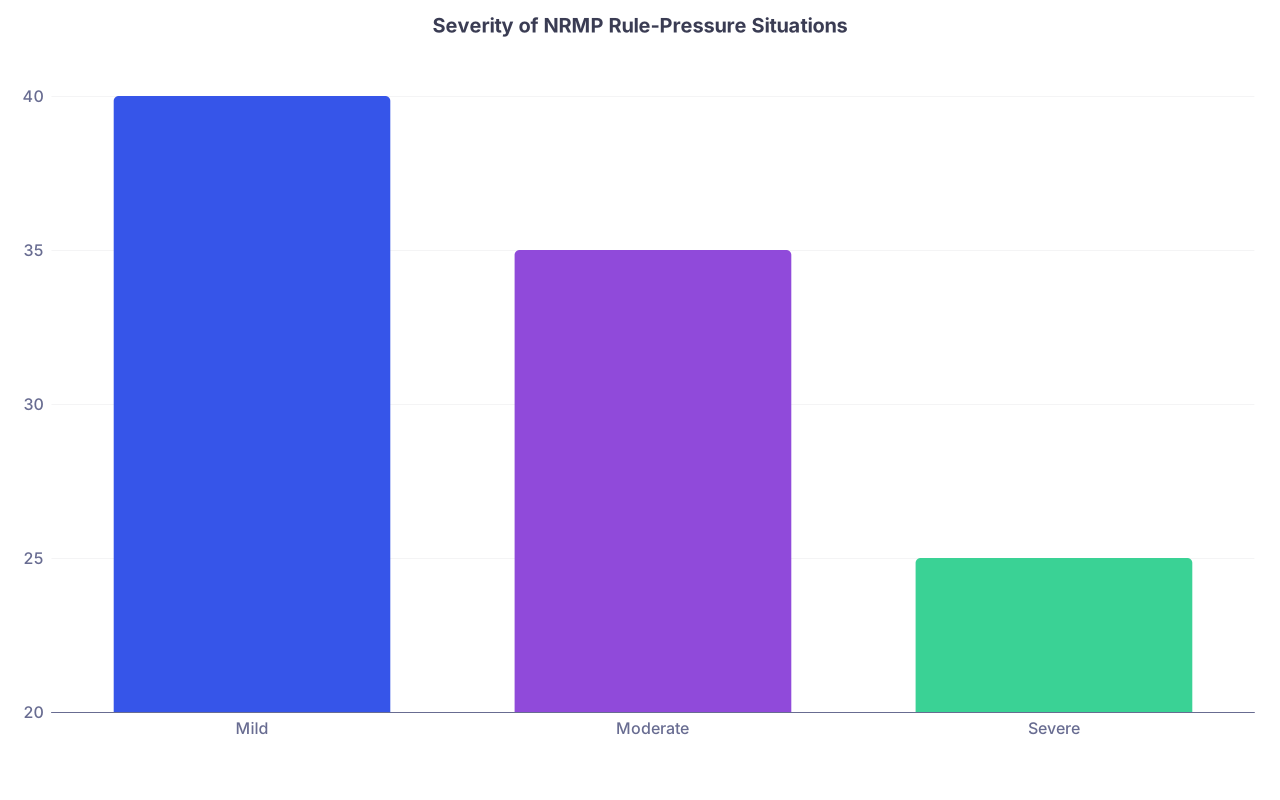
| Category | Value |
|---|---|
| Mild | 40 |
| Moderate | 35 |
| Severe | 25 |
Level 1: Mild – Clumsy, But Not Malicious
Examples:
- “We hope you will rank us highly”
- “We are very interested in you and hope you will consider us strongly”
- “We think you would be an excellent fit here”
Annoying? Maybe. Violation? Usually no.
Response:
Smile (or type) something generic and move on.
“Thank you, I enjoyed meeting the team and will be considering your program very carefully.”
No need to escalate.
Level 2: Moderate – Inappropriate Pressure
Examples:
- “We expect our top candidates to send a letter saying we are their first choice.”
- “We would like you to confirm by email that we are your top choice before we finalize our list.”
- “If you tell us you will rank us first, we can rank you more favorably.”
Here you have two tasks:
- Protect yourself (refuse the request).
- Document it (save the email, write down details from calls).
You may or may not decide to report. If you are unsure, talk to:
- Your home institution’s Student Affairs / GME office
- A trusted faculty advisor
- Your dean’s office or ombudsperson
I have seen students quietly let these go if they felt it was a one-off dumb comment. I have also seen students report when it was clearly systemic language from multiple people at that program.
Level 3: Severe – Potential NRMP Violation
Clear red lines:
Any request for:
- A written or verbal promise to rank first / to match
- Withdrawing from the Match to sign a prematch offer (for a Match-participating program)
- Hiding or changing information related to couples match to benefit the program
- Lying about your rank list or other programs
Any promise from them that:
- “We guarantee you will match here if you do X”
- “We are ranking you to match contingent on you saying Y”
These are not just “icky.” These are serious.
This is when you strongly consider engaging NRMP directly.
5. How to Document Without Turning Paranoid
You do not need a surveillance operation. Just be systematic.
A. Keep a Match Interaction Log
Very simple:
- One document or spreadsheet
- Columns:
- Program
- Date
- Person (name + role)
- Type (email / call / in-person)
- Summary of what was said, especially anything questionable
- Your response
If something bothers you, write it down the same day. That way you are not reconstructing from fuzzy memory in March.
B. Save Emails and Messages
Obviously:
- Keep all program emails
- Do not delete anything weird “to stay on their good side”
- If a call or in-person conversation is sketchy:
- Immediately after, write yourself an email with:
- “Conversation with Dr. Smith from [Program] on [date] at [time], said: ‘…’ I responded: ‘…’”
- Immediately after, write yourself an email with:
You are building contemporaneous notes. Those matter.
6. When and How to Report to NRMP
You do not report every awkward moment. But you should not be scared to report truly bad behavior. Programs that habitually pressure applicants rely on your silence.
A. What NRMP Actually Does (Reality Check)
NRMP has a violation reporting process. They review, investigate, contact both sides, and can issue sanctions. I have seen:
- Programs publicly named for violations
- Programs losing slots or being barred from future Matches
- Applicants sanctioned for accepting or soliciting illegal commitments
NRMP is not out to punish applicants who refuse to break rules. They are out to maintain the integrity of the Match.
B. How to Decide Whether to Report
Look at three factors:
Severity
- Direct ask for illegal commitment or prematch = high severity
Pattern
- Multiple people from the same program say similar things
- Other applicants report the same behavior
Impact
- Did you feel coerced?
- Were you threatened with being ranked low or off the list if you refused?
When these line up, reporting is reasonable and frankly protective for future applicants.
C. Practical Steps to Report
- Gather your evidence
- Emails, screenshots, notes, your interaction log
- Check your school resources
- Talk to Student Affairs / GME
- They may:
- Encourage you
- Offer to submit an institutional report
- Help you anonymize details if possible
- File with NRMP
- Use NRMP’s “Policy Violations” or “Report a Violation” process on their website
- Be factual, neutral, and specific:
- Dates, times, names
- Exact phrases used, if possible
- Copies of written communication
Do not dramatize. Do not speculate on motives. Let the behavior speak.
7. How to Protect Yourself If You Feel You Already Crossed a Line
This happens. In the moment, with an attending applying pressure, many students say more than they should.
Maybe you already:
- Sent an email saying, “You are my #1 and I will rank you to match”
- Verbally promised to rank them first
- Signed something that looked like a “letter of intent” or “commitment”
You are not the first, and you are not doomed.
A. Understand the Good News
The Match algorithm does not care what you said to programs. It only uses:
- Your certified rank list
- The program’s certified rank list
Your verbal or email “promise” is non-binding with respect to NRMP. The problem is the act of making such commitments, under NRMP rules, not the algorithm.
B. Immediate Damage Control
Stop repeating the mistake
- Do not send more promises
- Do not try to “even it out” by promising multiple programs
-
- Rank programs in your true preference order
- Do not contort your list to “honor” a promise
Consult a trusted advisor
- Explain exactly what you said/signed
- Ask if they think you need:
- To clarify with the program
- To consider self-reporting to NRMP (rare, but sometimes best)
C. Optional: Clarify with the Program
In some cases, a short clarification email can defuse things:
Dear Dr. Smith,
I wanted to clarify my earlier message to ensure I remain consistent with NRMP policies. I am very enthusiastic about your program and you remain one of my top choices. In alignment with Match guidelines, I will submit my rank list based on overall fit and cannot make binding commitments outside of the NRMP system.
Thank you again for your consideration.
Sincerely,
[Your Name]
You are retreating from an over-strong promise without picking a fight.
Do not write a confession or a long explanation. Just reset to compliant language.
8. Specific Scripts for Common Messy Situations
Let us make this painfully concrete. Here is what to say in a range of ugly but common scenarios.
Scenario 1: “Email Us Saying We’re Your #1”
Program email:
We strongly encourage our top applicants to send a letter confirming that our program is their first choice and that they will rank us to match.
Your reply:
Dear Dr. [Name],
Thank you for your email and for your interest in my application. I truly enjoyed my interview day and feel that [Program Name] would be an excellent place to train.
To remain consistent with NRMP policies, I am not able to provide specific ranking commitments. I look forward to submitting my rank list and appreciate the opportunity to be considered by your program.
Sincerely,
[Your Name]
Done.
Scenario 2: Phone Call With Direct Pressure
Program:
We need to know that if we rank you to match, you will rank us to match. Can you confirm that?
You:
I really appreciate your interest. I am committed to following NRMP Match policies, so I cannot commit to a specific rank order. I can say I am very interested in your program and it will be high on my list.
Then stop. If they push again:
I understand this is important to you. I have to be clear that I will follow NRMP guidelines in how I handle my rank list and communications.
If they keep going after that, you are in “document and maybe report” territory.
Scenario 3: Prematch Offer From a Match-Participating Program
Program:
We would like to offer you a position outside the Match, but we need you to withdraw from NRMP and sign with us by Friday.
Understand:
- If this is a standard NRMP-participating residency slot, this is likely not allowed. There are nuances (some specialties/regions historically used prematch, but NRMP rules have tightened heavily).
Your reply:
Thank you for your confidence in me and for the offer. I am currently registered for the NRMP Match, and I intend to complete the Match process according to NRMP policies, so I will not be able to withdraw and accept a position outside the Match.
If they argue, you can add:
My understanding is that as a Match applicant, I am required to let the Match process proceed. I need to adhere to that.
This is a “likely report” situation. Write it down.
9. Emotional Reality: You Will Feel Pressured. Do Not Let That Drive Your Decisions.
I have watched very strong students crumble when an influential PD says something like:
- “We thought you were serious about us.”
- “Our residents are disappointed if applicants do not commit.”
- “Other candidates are not having a problem saying we are number one.”
This is manipulation. Sometimes conscious, sometimes just bad culture. Either way, you do not owe them your integrity.
A few grounding points:
- The algorithm favors honesty. You gain nothing by gaming the system.
- Programs rank you based on their evaluation, not your flattery. The “I will rank you #1” emails are mostly security blankets for insecure faculty.
- You are not the only one they are saying this to. Ever.
When you feel your anxiety spiking, go back to a simple mantra:
“I will follow NRMP rules. I will rank in my true order of preference. That is my job.”
Everything else is noise.
10. Quick Reference: What You Can and Cannot Say
| Situation | Safe to Say | Risky / Do Not Say |
|---|---|---|
| Expressing interest | "Your program is one of my top choices." | "I will rank you first." |
| Thanking after interview | "I am very interested in your program." | "I promise I will come if I match." |
| Asked about other programs | "I am interviewing widely and will rank based on fit." | "I am ranking you above [Other Program]." |
| Responses to pressure | "I must follow NRMP policies about rankings." | "Okay, I will email my commitment." |
Print this out if you have to. Seriously.
11. A Simple Decision Flow You Can Follow
Use this like a mental checklist.

| Step | Description |
|---|---|
| Step 1 | Program says something about ranking or commitment |
| Step 2 | Generic interest only - respond politely and move on |
| Step 3 | Deflect with NRMP language and express general interest |
| Step 4 | Refuse politely citing NRMP rules |
| Step 5 | Document what happened |
| Step 6 | Keep records, consider informing advisor |
| Step 7 | Discuss with advisor and consider NRMP report |
| Step 8 | Is it a clear request for rank info or a promise? |
| Step 9 | Is it asking for a commitment or guarantee? |
| Step 10 | Severe or repeated behavior? |
You are not guessing. You are following a protocol.
FAQs
1. Can I tell a single program they are my “number one” without breaking NRMP rules?
You can express strong interest. You can say “Your program is one of my top choices” or “I could see myself very happy training here.”
The line you should avoid is making explicit promises or guarantees about rank order, especially in writing, at the program’s request. The more specific and contractual it sounds (“I will rank you first,” “I guarantee to rank you to match”), the closer you are to potential trouble. There is zero strategic advantage to crossing that line.
2. What if a program says, “We will rank you to match” – is that a violation?
Programs are not supposed to make explicit guarantees either. Telling an applicant, “We will rank you to match” is problematic, especially if tied to you doing something in return.
Does that mean you must report it every time? Not necessarily. But you should:
- Write down exactly who said it and when
- Not change your true preference order based on that “promise”
- Discuss with an advisor whether this looks like part of a broader pattern that should be reported
Never let a program’s “guarantee” steer your rank list.
3. Will reporting a program to NRMP hurt my chances of matching there or elsewhere?
NRMP has processes to protect whistleblowers, and they do not broadcast who reported what to every program director in the country. Could there be rare situations where a program guesses who reported? Possibly. But you have to weigh that against allowing systemic bad behavior to continue unchallenged.
If you are worried, route your concerns through your Student Affairs or GME office first. They can sometimes report at the institutional level, which creates an extra layer between you and the program. Your priority is your long-term reputation as an honest professional, not appeasing a program that is comfortable skating on the edge of policy.
Open your email drafts and your notes from interviews right now. Find any message where you even came close to promising rank order. Replace those with NRMP-compliant language today, and make yourself a one-page script sheet so the next time a program pushes, you already know exactly what you are going to say.


