

The couples match does not ruin relationships. Poor communication during the couples match does.
If you get the communication piece wrong, everything else—program lists, geography, “fit,” even strong applications—starts to wobble. I have watched couples blow up over a single rank order list meeting that went sideways. I have also watched very average applicants match into excellent combined situations because they treated communication like a protocol, not a vibe.
You want a survival playbook? Here it is.
1. The Non‑Negotiable Ground Rules (Before You Touch ERAS)
Before you even open the NRMP couples match page, lock in these rules. They are your operating system. Skip this and you will keep having the same fight in different costumes from September through March.
Rule 1: Default to Over‑Communication
Assume your partner is not reading your mind. They are not “obviously” understanding:
- How badly you want that big‑name academic program
- How miserable you would be in a small town
- How much you care about being near family vs near a major airport vs near nothing
Fix:
- Each of you writes a one‑page “Residency Priorities Brief”
- Top 3 professional priorities
- Top 3 personal/geographic priorities
- Top 3 “would be great but I can live without” items
- Swap, then discuss line by line. Not “do you agree?” but “what would you sacrifice first?”
Do this before interviews, not when you are exhausted in January.
Rule 2: No Silent Resentment About Geography
Silent geography resentment is the couples match cancer. One partner pretends they are “open to anywhere” while quietly panicking about moving 2000 miles from their support system.
Fix:
- Each partner names:
- 3 “Green Zones” – happily live here
- 3 “Yellow Zones” – can live here with tradeoffs
- 3 “Red Zones” – absolutely not, even for a top program
Write them down. If a red zone becomes necessary, you have a serious, explicit conversation—not a quiet capitulation.
Rule 3: No Surprise Applications or Hidden Programs
Nothing creates distrust faster than:
- “Oh, I also applied to this program in Alaska I never mentioned”
- “I got an interview at X but I did not think you would want to go so I did not tell you”
Fix:
- Shared master spreadsheet of all programs, both partners, always visible
- Column for: “Applied?”, “Interview invite?”, “Status discussed as couple?”
If you would be embarrassed to put a program on that sheet, you probably should not be applying there as a couple.
2. NRMP Couples Match Rules You Cannot Afford to Misunderstand
Misunderstanding the actual NRMP mechanics is how couples accidentally sabotage themselves. Let’s clear the landmines.
| Concept | Reality | Common Wrong Assumption |
|---|---|---|
| Coupling | You submit linked rank lists | NRMP finds you housing together |
| Pairings | Each line is Program A + Program B | “We rank programs separately then NRMP links them later” |
| Unmatched option | You can rank 'Program + No Match' | “If I do not match, my partner will not either” |
| Rank order impact | You can rank hundreds of combinations | “We should keep lists short so it is simpler” |
| Independence | You can decouple before deadline | “Once we couple, we are stuck no matter what” |
How the Couples Rank List Actually Works
You and your partner do not submit two independent lists that NRMP “tries to keep together.” You submit paired choices.
Think of each rank line as:
(My program, Partner’s program)
Example:
- Line 1: (Mass Gen IM, Brigham OB-GYN)
- Line 2: (Mass Gen IM, Beth Israel OB-GYN)
- Line 3: (Tufts IM, Brigham OB-GYN)
- Line 4: (Tufts IM, Beth Israel OB-GYN)
- Line 5: (Tufts IM, No match) – yes, that is a real option
The algorithm tries to find the highest line where both partners can match simultaneously.
The “No Match” Option: Use It Intentionally, Not Emotionally
You can rank combinations like:
- (Program A, No match)
- (No match, Program B)
- (No match, No match)
These exist to let you say:
- “I would rather go unmatched than match here without my partner.”
- “I would rather my partner go unmatched than separate to this city.”
This is not romantic symbolism. This is contract language with a probabilistic algorithm.
So you need an explicit decision:
- Under what conditions is “No match” better than matching separately?
If you have not said that sentence out loud together, you are not ready to submit your list.
3. Build a Communication Protocol, Not “We’ll Just Talk About It”
Couples that wing this process have the same three arguments on rotation:
- “Why did you apply there without telling me?”
- “Why did you not tell me you hated that city?”
- “I did not know this program meant that much to you.”
You avoid that by treating communication like a standing meeting, not a panic button.
Weekly Match Meeting: Non‑Negotiable Standing Appointment
Set up a weekly 30–60 minute “Match Meeting” from September through rank list submission.
Agenda:
- Quick status update
- New interviews
- New rejections
- Programs added / removed
- Emotional check
- 5 minutes each: what is stressing you the most this week?
- Decisions needed
- Travel plans
- Which interviews to decline
- Early thoughts on program tiers
- Action items
- Who updates spreadsheet
- Who emails program coordinators
- Plan for any couples‑specific emails
No phones. No multitasking. This is your residency life you are negotiating.
Use A Shared System, Not Random Texts
Use something you both can see and edit in real time:
- Google Sheets
- Notion board
- Airtable if you want to be fancy
Key columns (for each partner):
- Program name
- City / region
- Specialty
- Tier (1, 2, 3) – we will define shortly
- Interview offered? (Y/N)
- Interview scheduled date
- Personal impression (1–10)
- Partner impression (1–10)
- Geographic category (Green/Yellow/Red zone)
- Notes
This is your single source of truth. If it is not in there, it does not exist for decision-making.
4. Tiering and Tradeoffs: How to Avoid 300‑Line Rank List Chaos
Most couples crash here. They try to build the rank list from raw, unsorted programs and end up drowning.
You do two separate triage passes before you ever start pairing programs.
Step 1: Individual Tiering (Done Separately First)
Each partner takes their own programs and does a three‑tier system:
- Tier 1 – Dream/Ideal
- You would be genuinely excited to train here.
- Strong training, good support, strong fit.
- Tier 2 – Solid / Good
- You can imagine being content.
- Some tradeoffs, but still acceptable.
- Tier 3 – Only If Necessary
- You would take it over going unmatched, but with reluctance.
Rule:
- No more than ~20% of your list can be Tier 1.
- At least 30–40% must be Tier 2. You are not that special. Neither are most applicants.
- Anything you would resent for 4 years straight does not belong on the list. Even Tier 3.
Then you compare Tiering with your partner.
Step 2: Joint Tiering by Combination, Not Individual Programs
This is where couples often get it wrong. They treat:
- “My Tier 1 + your Tier 3” as automatically OK. It is probably not.
You need to define joint tiers for combinations:
- Joint A: Strong for both
- (My Tier 1, Your Tier 1/2)
- (My Tier 2, Your Tier 1)
- Joint B: Strong for one, acceptable for the other
- (My Tier 1, Your Tier 3 – but you are truly OK with it)
- (My Tier 3, Your Tier 1 – but I can stomach it)
- Joint C: Borderline / last resort
- (My Tier 2/3, Your Tier 2/3) in less‑desirable locations
- Anything where you already feel dread while discussing it
If a combination feels like “I will probably resent you for this in 18 months,” that is Joint D: do not rank.
5. How To Actually Build The Couples Rank List Without Fighting
Now the mechanics. This is the part people overdramatize. There is a clean way to do it.

| Step | Description |
|---|---|
| Step 1 | Start - Individual Lists Ready |
| Step 2 | Each partner tiers programs |
| Step 3 | Define Joint A B C categories |
| Step 4 | Group by City or Region |
| Step 5 | Create best Joint A combinations first |
| Step 6 | Add Joint B combinations |
| Step 7 | Decide on any No match lines |
| Step 8 | Review top 20 lines together |
| Step 9 | Expand to final list |
Step 1: Group Programs by City/Region
You want to live together. Start where that is actually possible.
Within your spreadsheet or a second tab, group programs by:
- Same city (ideal)
- Reasonable commuting distance (suburbs, adjacent small cities)
- Same large region if you are willing to live apart but close (some couples do ~1–2 hours apart if necessary)
You will get clusters like:
- Boston cluster: MGH, Brigham, BI, Tufts
- Philly cluster: Penn, Jefferson, Temple, Drexel
- “Random city with only one program” cluster: that becomes its own problem.
Within each cluster, map:
- My programs in that city
- Your programs in that city
Then you can list possible combinations within each cluster.
Step 2: Prioritize Joint A Combinations First
Within each cluster:
- List all (My Tier 1, Your Tier 1/2) and (My Tier 2, Your Tier 1) combinations.
- These form the top portion of your entire rank list, interspersed across cities.
You are not ranking yet. Just identifying which combinations might live near the top.
Step 3: Then Layer in Joint B Combinations
Only after mapping Joint A do you:
- Add combinations where:
- One partner gets a Tier 1; other gets Tier 3 but is genuinely OK with it.
- Both get Tier 2 in good cities.
You have to say out loud:
“I am willing to take this weaker program so you can get your top choice.”
And the other person has to believe you.
If you cannot say that without clenching your jaw, that combination goes lower or off the list.
Step 4: Decide How Much Long‑Distance You Will Accept
Some couples refuse any long‑distance during residency. Others accept 1–2 hours apart. A few accept different states.
You must define your rule explicitly:
- No commuting longer than X minutes.
- No more than Y miles apart.
- Absolutely no separate states.
Then your combinations either:
- Meet that rule
- Or are classified as “distance combos” and live after all same‑city options, unless one is a life‑changing opportunity.
Step 5: Intentionally Place “No Match” Combinations (If Any)
If you decide to use options like:
- (Program X, No match)
- (No match, Program Y)
- (No match, No match)
Then define:
- Exactly why they exist
- Exactly how high they should be
Example:
- “We will place (No match, Partner’s Dream Program) after all combinations where we are within 2 hours of each other, but before any combination where we are in different regions.”
This is not emotional theater. These lines change your probabilities. Place them like you are drafting a legal contract.
6. Conflict Scripts: What To Say When You Disagree
You will disagree. That is not failure. Bad communication about the disagreement is failure.
Here are scripts that work. Same patterns I have coached couples through.
Scenario 1: One Partner Loves a Program, the Other Hates the City
You: “I know X Program is top tier for you. For me, living in that city is almost a Red Zone. I will be isolated and miserable there.”
Better response than “Well, it’s only four years”:
- “Let us name this combination honestly: Joint B leaning C. We can keep it on the list, but I want it below any option where we are both at least moderately happy, even if the programs are less prestigious.”
Translation: You acknowledge their program value but protect your own baseline quality of life.
Scenario 2: Disagreement on Using “No Match”
Partner: “If you match at Program A, I do not want to match anywhere else. I would rather go unmatched and reapply near you next year.”
You: “I hear that, but we need to walk through what that actually means: no guaranteed SOAP success, a full reapplication year, and probably applying VERY broadly. Are you still willing if you do not match there next year either?”
Then you decide. Rationally, not romantically.
Scenario 3: One Partner Wants To De‑Couple Late
This happens more than people admit. Usually when one partner starts getting many more interviews.
The honest script:
- “If we de‑couple, you are prioritizing your training flexibility over our guarantee to be together. That might be the right decision. But we need to say it for what it is, not pretend it changes nothing.”
Then:
- Sit down with your PD/advisor separately.
- Run a probability calculation: do your chances really improve that much by de‑coupling?
- Decide with both eyes open.
7. Logistics Communication: Travel, Money, and Emails
People forget: the couples match is not just rank lists. It is also a logistical mess. Communication here saves money and sanity.
Interview Travel: You Need a Joint Strategy
Problems I have seen:
- Both partners book different interview dates in the same city and fly twice.
- One person constantly rearranges flights last minute and bleeds money.
Fix:
- When one of you gets an invite in a city where the other applied, pause.
- Before scheduling:
- Check if the other has an outstanding invite or pending review there.
- Email the program coordinator as a couple if needed: “My partner has an interview on X date; is there any chance of pairing dates?”
Coordinators often try to help couples if you ask early and politely.
Money Communication
You are about to spend real money:
- Flights
- Hotels
- Ubers
- Food
Set:
- A joint interview travel budget.
- A rule for when to skip far‑away, low‑yield interviews. For example:
- “We do not fly cross‑country for a single community program if neither of us has strong interest and we already have 8+ interviews in that specialty.”
Speak about it openly. Debt stress quietly poisons relationships during this period.
8. When One Partner Is Much More Competitive Than The Other
This is the most painful scenario. Classic pattern:
- Partner A: AOA, 260+, strong letters, competitive specialty.
- Partner B: average scores, non‑AOA, less competitive specialty or red flags.
If you do not communicate clearly, both people end up resentful:
- A feels “dragged down”
- B feels “like dead weight”
You fix it by designing tiers around this asymmetry.
Step 1: Agree On a Principle
Explicitly choose:
- Are we prioritizing:
- Getting A into the best possible program they can reach?
- Getting B into a program at all, even if A takes a weaker option?
- Staying physically together above all else?
Rank those three in order. That is your compass.
Step 2: Build Gradients, Not All‑or‑Nothing
Example structure:
- Lines 1–10: A’s top programs + B’s mid/low programs in same cities (Principle: give A some shots at top tier)
- Lines 11–40: Both in solid programs where B is competitive (Principle: together and both matched)
- Lines 41+: B’s safety programs, A’s solid but non‑elite programs (Principle: avoid B going unmatched)
That way:
- A still gets a chance at high‑end options.
- B is protected.
- You are not pretending you are equally competitive.
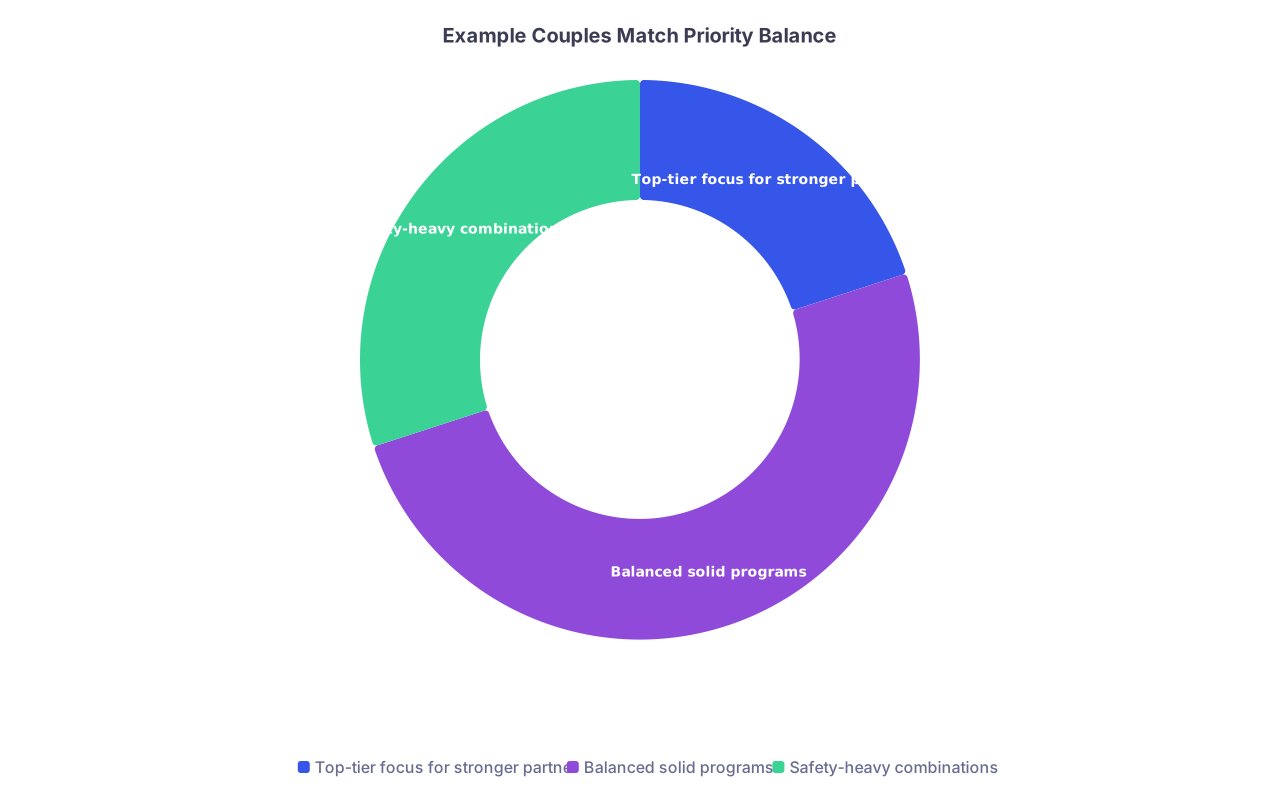
| Category | Value |
|---|---|
| Top-tier focus for stronger partner | 20 |
| Balanced solid programs | 50 |
| Safety-heavy combinations | 30 |
9. Your Pre‑Submission Checklist: Talk Through These Before You Click “Certify”
Do not certify your rank list until you have had one serious sit‑down and answered this entire set out loud.
A. Values and Tradeoffs
- Do we each know the other’s:
- Top 3 career priorities?
- Top 3 life/practical priorities?
- Do we agree which of these three wins if they conflict:
- Prestige
- Togetherness
- Geographic preference
B. Geography and Distance
- Are our Red Zone cities truly off the list?
- Have we explicitly agreed on:
- Max acceptable commute
- Whether 1–2 hours apart is acceptable
- Whether different states are ever acceptable
C. List Structure
- Do we both understand:
- Our Joint A, B, C categories?
- Why the top 10 lines are in that exact order?
- Can each of us articulate:
- “I understand why line 1 is ahead of line 2, even if it is not my personal ideal.”
If one of you shrugs and says, “I don’t really get our top lines, I’m just trusting you,” that is a red flag. Stop and review.
D. Worst‑Case Scenarios
- If one of us goes unmatched:
- What is our plan? SOAP? Reapply? Research year?
- If we both match but to a lower‑tier combination:
- Are we going to make peace with that, or talk about transferring later?
You are not predicting disaster. You are refusing to be blindsided by it.
10. The Emotional Side: How To Not Turn This Into A Relationship Stress Test
The couples match will stress‑test you. But it can also be one of those seasons that, weirdly, makes you more aligned if you treat it like joint problem‑solving instead of a referendum on your relationship.
Here is what works.
Use “We” Language When Discussing Programs
Compare:
- “You are making me rank down my dream program.”
- “We are choosing to prioritize staying together over that program.”
Language shapes blame.
Do Not Weaponize Sacrifices
If you choose to sacrifice for your partner (and you probably will), you do it cleanly:
- “I am choosing this, and I will not hold it against you later.”
If you know you will absolutely throw this back in their face in PGY2, do not agree to it now. Better to have a harder conversation up front.
Protect Non‑Match Time
During interview season and rank list season:
- Protect at least one time block per week where medicine and match talk are off‑limits.
- Go out. Cook. Watch something dumb. Be humans, not applicants.

11. Quick Communication Templates You Can Literally Copy‑Paste
These are short, practical phrases that keep conversations from spiraling.
When You Need To Revisit Priorities
“Can we pause rank list talk and go back to what we are each optimizing for? I feel like we are making tactical decisions that do not match what we said was important.”
When You Feel Steamrolled
“I am feeling like a passenger in this process right now. I need us to slow down and make sure I am actually OK with these top 5 lines, not just nodding along.”
When You Need To Say “No” To a Sacrifice
“I know this combination is amazing for you. For me, it crosses from ‘sacrifice’ into ‘misery.’ I love you, but I am not willing to put it above X on our list.”
When You Are Grateful For a Compromise
“I see that you are ranking down something important to you so we can stay together. I do not take that lightly. I am going to remember this when we are choosing fellowships or jobs.”
These matter. Tiny sentences that keep trust intact while you make high‑stakes tradeoffs.
12. A Sanity‑Preserving Timeline For Couples Communication
Wrap this with a simple, realistic timeline so you are not trying to do everything in one exhausted February weekend.
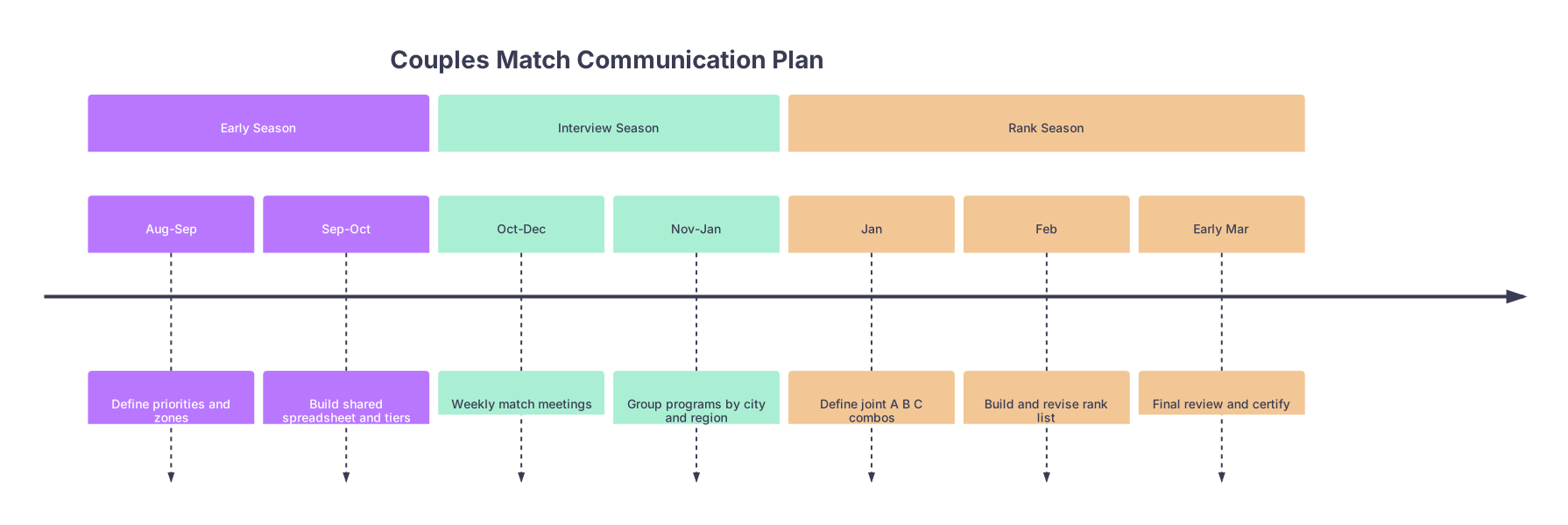
| Period | Event |
|---|---|
| Early Season - Aug-Sep | Define priorities and zones |
| Early Season - Sep-Oct | Build shared spreadsheet and tiers |
| Interview Season - Oct-Dec | Weekly match meetings |
| Interview Season - Nov-Jan | Group programs by city and region |
| Rank Season - Jan | Define joint A B C combos |
| Rank Season - Feb | Build and revise rank list |
| Rank Season - Early Mar | Final review and certify |

Final Takeaways
- Treat communication like a protocol, not a personality trait. Weekly meetings, shared documents, explicit rules about geography and priorities.
- Build your rank list from joint tiers and city clusters, not from individual fantasies. Every line is a contract of what both of you are saying yes to.
- Say the hard things early—about “No match,” distance, and asymmetric competitiveness—so you are not negotiating with resentment in February.
You will not make a perfect list. Nobody does. But if you follow these rules, you will make a list you both understand, own, and can live with. And that is the real goal.


