

You Are Here
It’s late January. Your interview season is mostly done. Your inbox is a mess of “Thank you for interviewing with us,” a few oddly personal follow‑ups from PDs, and a couple of… let’s call them “aggressive” emails from mid‑tier programs hinting you should rank them highly.
Your friends are all saying different things.
“PD told me I’m ranked to match.”
“My advisor says never tell a program they’re number one.”
“Is it illegal if I ask where I am on their list?”
You know there are NRMP communication rules. You’ve clicked that attestation box. But you do not actually know what is allowed, what is just “frowned upon,” and what will get you truly screwed if someone files a violation report.
Let me tell you what program directors expect you to know—but most of you don’t. Because there’s what’s written in the NRMP handbook. And then there’s how PDs, coordinators, and faculty actually operate under those rules.
We’ll talk about both.
The Core NRMP Communication Rule PDs Assume You Understand
Here’s the real anchor point: once you’re in the Match, nobody is allowed to demand or require you to reveal your rank list, and nobody is allowed to make you feel like your ranking depends on revealing it.
We all sign that agreement. PDs, chairs, faculty, you, your school.
The NRMP language is dry. The reality is not.
What PDs expect you to already know:
- You are allowed to volunteer information about your preferences.
- Programs are allowed to volunteer information about their impressions of you and their interest.
- Nobody is allowed to extract a promise, bargain, or quid pro quo about rank order.
- Nobody is allowed to guarantee you’ll match.
That’s the spine of the whole thing. Everything else is a riff on that.
Here’s the translation in plain language:
- You can say: “You are my top choice.”
- They can say: “We will rank you highly.”
- You cannot be forced to say: “You are #1 on my list or I will not be ranked.”
- They cannot say: “We will rank you to match if you tell us we’re your #1.”
PDs expect you to walk into interviews understanding that line without needing them to explain it. If you don’t, you’re an easy mark for the more manipulative players.
What PDs Can Say, What They Won’t Say (But Think), And What Crosses The Line
Every year, at least one faculty member wants to “reassure” an applicant in ways that make coordinators and PDs cringe. I’ve watched PDs literally walk down the hall after interviews to clean up over‑promises.
So let’s split this out.

Things PDs Are Allowed To Say (And Commonly Do)
You’ll hear:
- “We really enjoyed meeting you.”
- “We think you’d be an excellent fit here.”
- “We intend to rank you highly.”
- “You’ll be very competitive on our list.”
- “You’d be welcome here.”
These are all allowed. They are deliberately vague. On purpose.
What they mean inside the room afterward:
- “Rank you highly” might mean top 5. Or top 30. Or somewhere between “probably match” and “nice but not essential.”
- “Excellent fit” could mean you’re solid but not special. It’s still technically true.
Here’s the trick: PDs know applicants read enormous meaning into tiny differences in phrasing. They expect that. Many will choose their language carefully, almost like code:
- “Top of our list” / “Near the top of our list” – usually reserved for the few people actually near the top.
- “We intend to rank you to match” – these days, most PDs avoid this phrase because it can be misinterpreted as a promise. The NRMP frowns hard if it looks like a guarantee.
If you’re expecting crystal clarity, you’re going to be disappointed. Vague is a protective strategy—legally and politically.
Things PDs Won’t Say But Might be Thinking
What they often think but don’t verbalize:
- “You’re fine, but you’ll probably end up somewhere with stronger research.”
- “We like you for our middle of the list; you’re safe but not a priority.”
- “You’re our backup in case our top tier over‑reaches and doesn’t get us.”
You will not hear: “You’re our backup plan.” But that thought is there. And it’s not a violation.
Programs are not obligated to tell you anything about where you stand. NRMP doesn’t require transparency. Silence is the default.
What Crosses the NRMP Line
Here’s where PDs know they’re flirting with a violation:
- “If you rank us first, we will rank you to match.”
- “We expect our top candidates to tell us we are ranked #1.”
- “We cannot rank you highly if you’re not fully committed to us.”
- “Tell us where we are on your list so we can decide where to put you.”
That’s coercive. It’s asking you to reveal your rank order or conditioning your rank on your disclosure. That’s explicitly prohibited.
I’ve seen programs get reported for softer versions like, “We like to have a sense of where applicants will rank us.” NRMP takes patterns seriously. One off random sloppy phrase? Probably nothing. Consistent pattern, multiple complaints? Now you’re on their radar.
PDs know this. The smart ones train their faculty before interview season: “Don’t ask about rank. Don’t promise match. Don’t say ‘number one’ anything.”
When a PD “messes up” and says something borderline in an email, there’s usually a coordinator quietly panicking behind the scenes.
What You Can Say Without Getting Yourself (Or Them) in Trouble
This is where most applicants overthink things.
You are not going to get NRMP‑disciplined for sending a genuine, simple, non‑conditional expression of interest. The rules were not written to punish you for saying you like a program.
You are at risk of burning trust if you spray “You’re my #1” emails to three different programs, and they find out later. That’s not an NRMP sanction issue. That’s a reputation issue.
| Applicant Phrase | How PD Usually Interprets It |
|---|---|
| "You are my top choice." | Might rank us high, maybe #1 |
| "I will rank you to match." | Strong interest, likely top 1–3 |
| "I plan to rank you highly." | Likes us; could be top 5–10 or vague |
| Generic thank‑you note only | Neutral, no useful signal |
| No post‑interview contact at all | Not necessarily negative, just quiet |
Programs expect some signaling. They just also know applicants lie.
Safe, Honest, Allowed
These are fully allowed under NRMP rules:
- “I will rank your program to match.” (Assuming it’s true.)
- “Your program is my first choice.” (Again—don’t lie.)
- “I plan to rank your program very highly.”
- “I left the interview even more excited about the possibility of training with you.”
All of those are voluntary disclosures of your preference. You are not being coerced. They did not demand it. That’s fine.
Where you get yourself into ethical—and practical—trouble is lying. Not an NRMP problem (usually), but a “people talk, PDs remember, faculty move programs” problem.
I’ve watched PDs compare notes at national meetings.
“Oh, that applicant told you that you were their first choice? Funny, I have the same email.”
You don’t want to be the name in that story.
What You Should Avoid Asking
There’s one question PDs wish you’d stop asking, because it forces them into weird territory:
They won’t tell you. Not the smart ones. Some will dodge. Some will give a mushy answer like, “We’re very interested in you.”
You can technically ask. It’s not a violation for you to ask. The violation is on them if they condition your rank on answering. But from their point of view, a student who asks that often looks naïve or poorly advised.
It broadcasts: “I don’t understand the rules, and I think this is like applying to college.” It’s not.
The Backchannel Reality: What PDs Do With Your Emails
You send that long, heartfelt email: “Dear Dr. X, thank you again…” You sweat every comma. Let me tell you what happens ninety percent of the time.
The PD reads the first two lines. Maybe the line that says “You are my top choice.” Then:
- Either prints it to PDF and drops it in your application file.
- Or just mentally notes: strong interest.
That’s it.
If you told them they’re number one and they trust your school, your advisor, or your general vibe, they may nudge you upward a few spots on their list.
More honest version: PDs weigh three things more than your love letter:
- Interview performance.
- File strength (scores, grades, letters).
- How you compared to other applicants in the committee meeting.
Your “you’re my #1” email influences the fine tuning step. Not the ranking skeleton.
I’ve seen PDs move someone from 18 to 12 after a strong, believable “you’re my first choice” note. Have I seen someone go from 50 to 5 based on an email? No. That’s fantasy.
And the more competitive the program, the less weight your “signal” carries. At a community IM program that really worries about filling? Different story. Interest matters more.
The Ugly Side: When Programs Push the Limits
Let’s talk about what actually happens behind closed doors. Because not every program plays it clean.

I’ve seen:
- Faculty casually asking, “So where else are you interviewing?” then, “Where do you think you’ll rank us?”
- PDs sending emails that strongly imply ranking guarantees without stating them outright.
- Chairs calling advisors at med schools fishing for, “Is this student really going to rank us high?”
NRMP’s stance: information exchange is allowed, coercion is not.
In practice, the line blurs because applicants feel pressure even when nothing explicit is said. A PD hinting, “We really focus on candidates who we feel are truly committed” is skirting that edge.
Would NRMP sanction for that? Probably not, unless there’s a written pattern or recorded evidence and multiple complaints.
What PDs expect of you in this environment:
- Recognize when you’re being nudged versus required.
- Know that you can always say: “I’m still finalizing my rank list, but I really enjoyed your program and will consider it strongly.”
- Understand that not giving them a clear “you’re #1” will not blacklist you. The algorithm protects you more than you think.
Programs that truly threaten applicants—“Tell us or we won’t rank you”—do get reported occasionally. And they remember the applicants who reported them, yes. But NRMP tends to treat those reports carefully, and it’s usually not traced back in a way that destroys you. There’s too much risk for them if that reprisal is obvious.
The Match Algorithm Truth PDs Wish You Understood
Most applicants say they know the algorithm is “applicant favorable,” but then they act like they’re bargaining for positions.
You’re not bargaining. You’re submitting your truth. They’re submitting theirs. The computer does the rest.
PDs are counting on you misunderstanding this so they can extract more certainty from you than is justified.
Here’s the behind-the-scenes conversation in rank meetings:
- “They love us, said we’re their first choice.” → Good. Slight boost.
- “They didn’t say anything about rank.” → Neutral.
- “They clearly want to be in City X and we’re their only option there.” → Probably rank them; they’re more likely to match here.
But none of those override: “How good are they really compared to the others?”
Programs are not supposed to and generally do not say: “We will only rank people who told us we’re #1.” That’s shooting themselves in the foot. They need a full list to protect their outcome.
A lot of your anxiety is built on the false idea that you can “game” this by trading information. PDs expect you to know that you can’t.
You rank:
- Your real order of preference.
They rank:
- Their real order of preference (heavily influenced by interview and file).
Trying to pump your position with flattery and vague promises helps only at the margins.
Follow-Up Communication: What PDs Actually Want (And What Annoys Them)
PDs talk about this every season. Over coffee, at national meetings, at 7 pm sitting in their office with 120 unread emails.
There are three types of post‑interview communication from applicants:
- Thoughtful, concise thank‑you with a clear signal.
- Generic, copy‑paste fluff.
- Neurotic spam: multiple emails, updates, “just checking in,” “have you made your rank list yet?”
Guess which bucket they respect.
What PDs Consider Reasonable
- One thank‑you email per program, maybe including “You are my top choice” if it’s true.
- A significant update that genuinely changes your profile (new first‑author paper accepted, major award, passing Step 2 if it was previously missing).
- A short check‑in if you had a unique situation (couples match, visa issues) to clarify logistics.
They expect you to know that “I shadowed again this week” is not an update.
They also expect you to realize they may not reply. That silence is not a secret code. They’re swamped, and some PDs have a firm “no reply to post‑interview communications” policy to avoid any hint of impropriety.
What Annoys Them (and Hurts You Subtly)
- Multiple “just following up” emails.
- Long emotional essays about how you’ve “always dreamed of living in [city]” with zero new substance.
- Variations of, “My advisor told me to confirm that I’m still in consideration.” That reads as insecurity and lack of awareness.
Does annoyance translate into dropping you on the list? Sometimes. At least at the margins.
I’ve seen PDs literally say in committee: “She’s fine on paper, but the three follow‑up emails felt off. Let’s move her down a few slots.” They won’t tank you solely for it, but when picking between similar candidates, vibe matters.
What PDs Expect You To Know About NRMP Violations—and Why Most Programs Play It Safer Than You Think
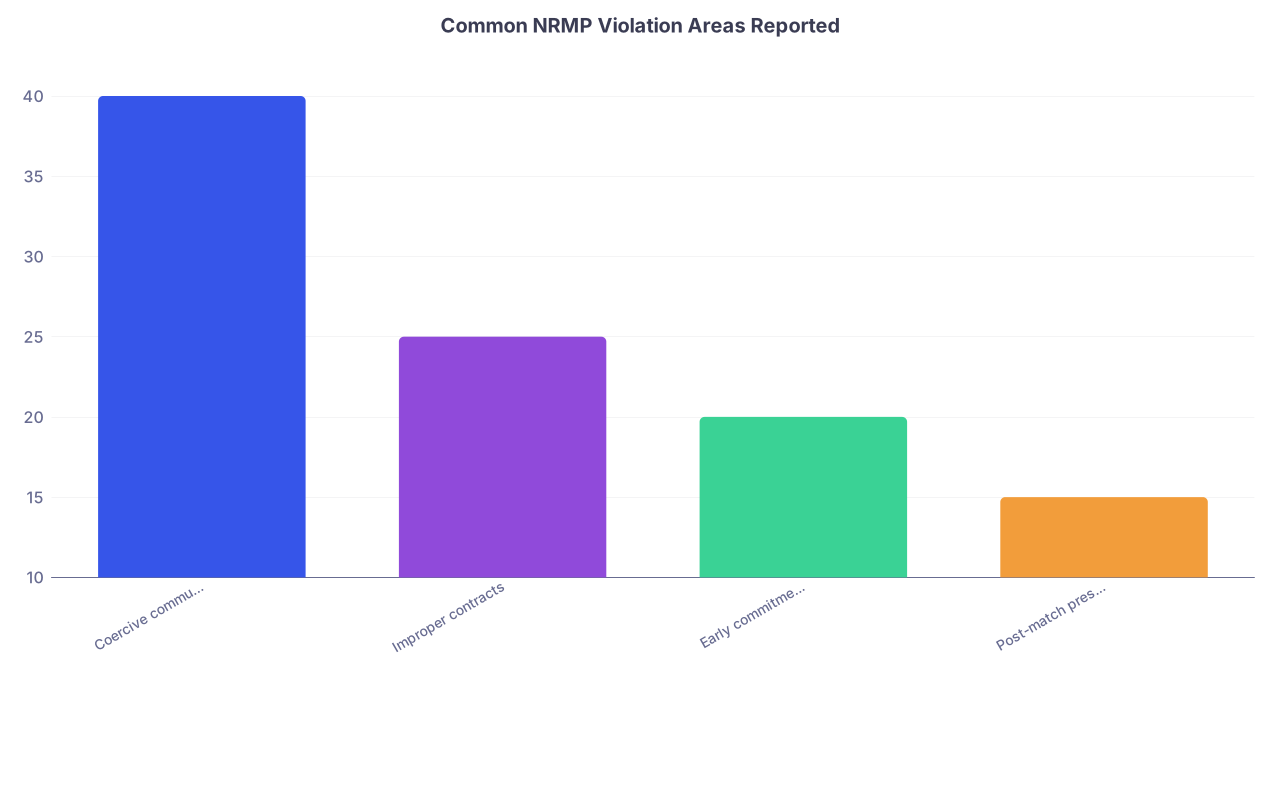
| Category | Value |
|---|---|
| Coercive communication | 40 |
| Improper contracts | 25 |
| Early commitments | 20 |
| Post-match pressure | 15 |
PDs are very aware that NRMP violations carry teeth:
- They can be barred from the Match for a cycle.
- They can get public “match violation” labels.
- Their institution can take political damage in GME circles.
So even the aggressive ones usually dance right up to the line but try not to step over.
What they expect you to know:
- You signed a binding agreement too. If you violate (like accepting a position outside the Match inappropriately, or not honoring a match), you can be sanctioned as well.
- Reporting a program is possible, but it’s serious. You’re not filing a Yelp review.
- You don’t get “bonus points” with NRMP for being litigious. They’re there to enforce rules, not to champion individual applicants.
This is not to scare you away from reporting actual coercion. But understand: you’re in a professional world now. There’s memory. There’s gossip. There are emails that get forwarded, right or wrong.
So if you’re going to hit that report button, make sure it’s real:
- Explicit pressure over rank order.
- Conditional statements linking your rank to disclosure.
- Threats, documented in writing.
“I felt a little pressured by their enthusiasm” is not a violation.
The Process Map PDs Think You Should Be Following
Here’s the honest flow of how PDs assume a savvy applicant will think about communication and the Match:

| Step | Description |
|---|---|
| Step 1 | Finish Interview Season |
| Step 2 | Reflect on Program Preferences |
| Step 3 | Decide True Rank Order |
| Step 4 | Send Targeted Thank You Notes |
| Step 5 | Optionally Tell #1 They Are First Choice |
| Step 6 | Skip Explicit #1 Messaging |
| Step 7 | Limit Further Emails |
| Step 8 | Submit Rank List Based On Preference |
| Step 9 | Ignore Attempts To Coerce Rank Info |
| Step 10 | Have Clear #1 Program? |
That’s the mental model PDs wish you had. Not:
- Rank based on “where I think I’ll match.”
- Email 10 programs claiming they’re all top choices.
- Panic every time a PD doesn’t reply.
They expect you to internalize: Your best strategy is honesty about your preferences and composure in the face of noise.
The Bottom Line: What PDs Expect You To Actually Remember
Let me strip this down to the bones.
- You are allowed to express interest. They are allowed to express interest. Nobody is allowed to bargain rank position.
- You don’t gain leverage by trying to “negotiate” the Match with PDs. The algorithm doesn’t care what you talked about; it cares what you submit.
- One clear, honest signal beats five manipulative or desperate ones.
You focus on ranking programs in the order you actually want them. You send measured, genuine communication. You ignore the bait for coercive conversations.
That’s what the grown‑ups in this process—on both sides—expect you to do.


