

It is late January. You just finished a second‑look day at a program you actually like. Walking out, the PD smiles and says, “We hope to see you here in July.” You reply, without thinking: “You’re definitely going to be really high on my list.”
Door closes. Your stomach drops.
Did I just violate NRMP rules? Did I commit a match violation? Can they report me? Can I fix this?
Let me be direct: you are not the first person to blurt something dumb about your rank list. You will not be the last. The key is what you do in the next 24–48 hours.
This is a problem you can manage—if you act deliberately.
1. Understand What You Actually Did (And Did Not Do)
Before you start imagining Match violations and revoked positions, get clear on what the NRMP cares about and where you likely stand.
A. What the NRMP rules really say
The NRMP has two big principles around communication:
No soliciting or requiring commitments about rank order lists
Programs cannot:- Ask you to reveal where you will rank them.
- Condition ranking or acceptance on your ranking behavior.
- Pressure you into promises.
No binding commitments outside the Match
Neither side can create an agreement that overrides the Match process. No backroom deals, no “If you rank us #1, we promise to rank you to match.”
There is also clear language that both applicants and programs may express interest, but any statement must not be considered a binding commitment.
So where does “You’ll be high on my list” fall?
B. What your comment probably was
Most “oops” comments fall into 1 of 3 categories:
| Type of Comment | Risk Level |
|---|---|
| Vague enthusiasm (“you’re a top choice”) | Low |
| Semi-specific (“you’ll be high on my list”) | Low–Moderate |
| Explicit ranking (“you’re my #1”) | Moderate |
Your statement was likely:
- Non‑binding
- Non‑solicited (they did not ask you directly “Where will you rank us?”)
- Non‑contractual (no mention of conditions, guarantees, or deals)
That usually means:
- You probably did not commit a formal NRMP violation.
- You may have created awkward expectations.
- You may need to repair or clarify to protect yourself and the program.
The real risk is not that the NRMP shows up at your door. The risk is:
- Misunderstanding or resentment if you match elsewhere.
- A program interpreting your statement as more concrete than it legally is.
- You feeling trapped into ranking them higher than you want—because of guilt.
We are going to fix that.
2. First 24 Hours: Stop, Assess, Then Decide If You Need To Act
Do not immediately fire off a panicked email. Over‑correcting can make a small problem bigger.
Step 1: Write down exactly what you said
Memory gets fuzzy when you are anxious. Sit down and write the actual words as close as you can recall:
- “You’re definitely going to be high on my list.”
- “I’m pretty sure I’ll rank you #1.”
- “You’re my top choice.”
The exact phrase matters. Vague vs. explicit changes what you should do.
Step 2: Consider the context
Ask yourself:
- Did they ask a direct question like “Where will you rank us?”
- If yes: they are the ones skating closer to a violation.
- If no: you volunteered it.
- Who was present?
- PD only? Faculty group? Residents at dinner?
- Was this:
- In a formal interview room?
- During a social event?
- In a casual hallway chat?
The more “official” the setting and the more specific your words, the more you should consider a gentle clarification.
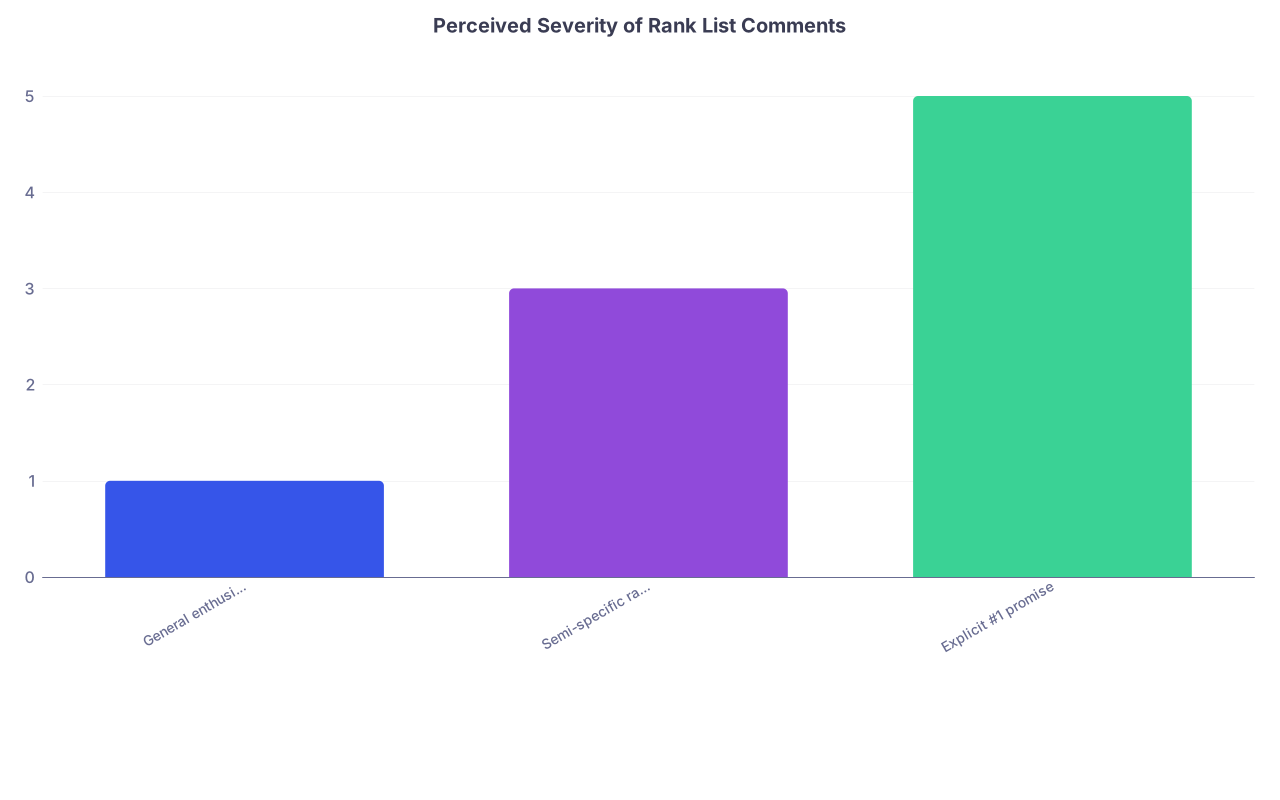
Step 3: Rate your statement on this scale
Use this quick self‑audit:
| Category | Value |
|---|---|
| General enthusiasm | 1 |
| Semi-specific rank hint | 3 |
| Explicit #1 promise | 5 |
- 1–2 (Low) – “Really like your program,” “You’re a great fit for me.”
→ Do nothing. You are fine. - 3–4 (Medium) – “You’ll be high on my list,” “You’re near the top.”
→ Consider a light clarification email if you are worried. - 5 (Higher) – “You’re my number one,” “I will rank you first.”
→ Strongly consider a clarification, especially if it is no longer true.
If you are borderline between “medium” and “high” and losing sleep, act. Anxiety will make you do dumb things later.
3. How to Clarify Without Making It Worse
If you decide to clarify, you must:
- Be brief.
- Be professional.
- Avoid bringing up NRMP rules explicitly like a lawyer.
- Re‑center the communication on appreciation, not negotiation.
A. General principles for the email
Do:
- Thank them for the interview / visit.
- Emphasize genuine positives about the program.
- Use language that expresses enthusiasm without ranking specificity.
Avoid:
- Repeating the problematic phrase word‑for‑word.
- Over‑explaining or sounding legalistic.
- Suggesting they did anything wrong.
B. Templates you can adapt
Scenario 1: You said, “You’ll be high on my list”
Use a very light touch.
Subject: Thank you again
Dear Dr. [Last Name],
Thank you again for the opportunity to visit [Program Name] on [date]. I appreciated our conversation about [specific topic—curriculum, research, resident support, etc.], and it reinforced my strong interest in your program.
I also wanted to clarify that while I am very interested in [Program Name], I understand that the Match is designed for both applicants and programs to submit their rank order lists independently, without any commitments.
Thank you again for your time and consideration.
Sincerely,
[Your Name], [AAMC ID]
What this does:
- Signals you know and respect the rules.
- Softens any implicit “promise” without making a big scene.
- Keeps the tone positive and grateful.
Scenario 2: You explicitly said, “You’re my #1” (and that may not be true)
Here you need to be clearer. Not dramatic. Just direct enough to avoid misleading them.
Subject: Follow‑up and clarification
Dear Dr. [Last Name],
Thank you again for the interview day at [Program Name]. I truly enjoyed meeting the residents and faculty, and I was especially impressed by [concrete detail].
In our conversation, I expressed very strong interest in your program. On reflection, I want to be sure that I am not creating any appearance of a commitment about my rank list, since the NRMP Match depends on both applicants and programs completing rank lists independently and without agreements.
I remain very interested in [Program Name] and appreciate your consideration in this process.
Sincerely,
[Your Name], [AAMC ID]
No drama. No confession. Just a polite “reset.”
C. When not to send anything
Skip the clarification if:
- All you said was enthusiasm without rank language.
- You only used phrases like “I could really see myself here” or “This is a great fit.”
- The interaction was group‑based and fleeting, and you are not actually changing your perspective on the program.
Over‑communicating puts “rank list” in their mind more than your original comment probably did.
4. How to Answer Future Questions Without Trapping Yourself
You are not done. You still have interviews or post‑interview communication left. You need a script that keeps you inside NRMP rules and out of trouble.
Here is the core rule:
You never need to answer questions about your rank order list. Ever.
If a program presses, that is on them. You protect yourself with rehearsed, neutral phrases.
A. Safe phrases that express interest without ranking
Use these to show genuine enthusiasm but avoid hierarchy:
- “I am very interested in your program.”
- “I could see myself thriving here.”
- “Your program is one of the places I am strongly considering.”
- “You are absolutely a top program for me in terms of [training style / location / culture].”
Notice:
- “Top program for me” is not the same as “I will rank you at the top.”
- “Strongly considering” is honest and not binding.
B. How to respond when they ask directly, “Where will you rank us?”
This still happens. I have seen PDs ask this in exactly those words. It is not appropriate, but it happens.
Prepare one of these:
Option 1 – Policy‑based response
“I have a lot of respect for your program, but I want to follow NRMP guidelines, which ask us to keep rank lists independent. So I will submit my list honestly when the time comes.”
Option 2 – Interest + boundary
“I am very interested in your program and you will definitely be on my rank list, but I want to make sure I am following Match rules and not making any commitments about specific positions.”
Option 3 – Deflection to fit
“I am still finalizing my list, but I can say that your program is an excellent fit for me, and I appreciate being considered.”
None of these make you look evasive if delivered calmly. They make you look ethical and informed.
5. How Programs Typically See These Comments
You are probably imagining that your comment is pinned on a board with “NRMP VIOLATION” in red letters.
Reality is less dramatic.
A. Most programs know applicants overstate interest
Program leadership has seen every version of:
- “You are my first choice.”
- “I will rank you to match.”
- “I am sure I will end up here.”
They know:
- Students panic.
- Students over‑signal.
- Not everyone who says “#1” actually ranks them #1.
They are not shocked. They are not calling NRMP every time.
B. When they might care
They care if:
- Your statement was very explicit.
- They take it seriously and rank you highly.
- You match elsewhere after promising you would not.
Does that lead to formal consequences? Almost never. The more likely outcome:
- Mild annoyance.
- A story they tell next year’s residents about “why you do not believe everything applicants say.”
What your clarification does (if you send it) is:
- Reduce the chance of them feeling deceived.
- Demonstrate professionalism.
6. Protect Yourself: How to Think About Honesty and Strategy
There is an ethical layer here that actually matters for your career beyond the Match.
A. NRMP rules aside, promises create pressure—for you
If you tell three programs “You are my #1,” you create:
- Cognitive dissonance when you are ranking.
- Guilt that can distort your actual preferences.
- Anxiety about being “caught” if the outcome is inconsistent.
I have seen students rank a program higher than they should purely because they said something bold on interview day. That is a terrible way to choose where you train.
Anchor on this:
Your rank order list should reflect your true preferences. Not your past attempts to impress people.
B. When is it reasonable to say, “You are my #1”?
Only if:
- You are 95%+ sure that will be true on certification day.
- You are prepared to stand by it even if something later tempts you otherwise.
- You understand there is still no guarantee of matching there.
If you are going to use that language, use it exactly once, late in the season, and only for the program that really is your top choice.
And even then, phrase it carefully:
“I wanted to let you know that I plan to rank [Program Name] first on my list.”
Then do it.
7. Fixing the Emotional Fallout So You Do Not Spiral
Let us be blunt: the bigger danger after a minor slip is not the NRMP. It is you spiraling and over‑correcting.
You start:
- Rewriting emails six times.
- Calling your dean in tears.
- Changing your rank list out of fear instead of logic.
Do this instead.
A. Quick reality check exercise
On a blank page, answer:
Did I sign anything or agree to anything outside the Match?
- If yes, talk to your dean / advisor immediately.
- If no, keep going.
Did my statement include explicit conditional language?
- Examples: “If you rank me highly, I will rank you #1”; “We have a deal.”
- If yes, consider a stronger clarification and talk to your dean.
- If no, you are in the “minor slip” category.
Is my anxiety about rules, or about potentially upsetting someone?
- If it is mainly guilt, remind yourself: the Match is built assuming imperfect communication.
Most of the time, when students walk through those questions, they realize:
- This is uncomfortable, not catastrophic.
- At most they need a short email and then to move on.
B. Talk to someone who actually understands the Match
Not your panicked classmate. Not Reddit.
Talk to:
- Your dean of student affairs.
- Your school’s NRMP advisor.
- A trusted upper‑year resident who matched recently.
Describe:
- Exact wording you used.
- The program.
- Your current level of interest in that program.
Ask directly:
“Would you send a clarification email or leave it alone?”
Then follow their advice. They have seen the actual outcomes.
8. How to Build a Clean Communication Strategy for the Rest of the Season
Use this situation as a forcing function to tighten your overall approach.
A. Set clear personal rules
Write these down and stick to them:
- I will not state explicit numeric rank positions except, at most, for true #1.
- I will express interest using “very interested,” “strong fit,” not “you’re my top.”
- I will not answer direct rank questions with numeric details.
- I will not change my rank list purely to align with something I said under pressure.
Having rules written before future interviews makes you far less likely to slip again.
B. Standardize your post‑interview emails
Instead of custom rambling, use a consistent, safe template. For example:
Dear Dr. [Last Name],
Thank you again for the opportunity to interview at [Program Name] on [date]. I enjoyed learning more about [specific detail], and I was particularly impressed by [resident culture / educational structure / specific track].
I remain very interested in [Program Name] and appreciate your consideration as I prepare my rank list.
Sincerely,
[Your Name]
Notice:
- “Remain very interested” is strong but non‑binding.
- Nothing hints at rank order.
Create one or two versions of this, then reuse.
C. Keep a simple log
After each interview, jot down:
- Date.
- PD / APD names.
- Any comments you made that could be interpreted as rank hints.
Something like:
| Program | Date | Comment Made | Clarification Sent? |
|---|---|---|---|
| City Med IM | 1/20/26 | “You’ll be high on my list” | Yes (1/21) |
| Riverline Peds | 1/25/26 | “Very interested, great fit” | No |
| Metro Surg | 1/28/26 | Standard thank you email only | No |
This helps:
- Avoid accidentally escalating with repeated comments.
- Ground your memory in reality, not anxiety.
9. If Things Escalate (Rare but Possible)
Very rare scenario: a program contacts you saying something like,
“You told us we were your #1. We ranked you highly. You matched elsewhere. This feels like a violation.”
Here is what to do.
A. Do not respond defensively in writing
You are not going to resolve this over a heated email exchange.
You can send something bland and professional:
Thank you for reaching out. I appreciate the opportunity to have interviewed with your program. My understanding is that the NRMP Match is based on independently submitted rank lists without commitments. If there is a concern about a possible violation, I want to ensure it is addressed appropriately and transparently, so I would defer to NRMP processes for any formal review.
Then:
- Contact your dean / NRMP advisor immediately.
- Share the full email thread.
- Let them guide you.
B. Know what actual NRMP investigations look like
If an NRMP violation is alleged:
- NRMP conducts a fact‑finding process.
- They look at written evidence, patterns, not one off‑hand comment without proof.
- They focus on agreements and coercion, not every awkward interview phrase.
Most of the “we were misled” complaints never even reach NRMP. Programs know the threshold is higher than “they said something nice and matched elsewhere.”
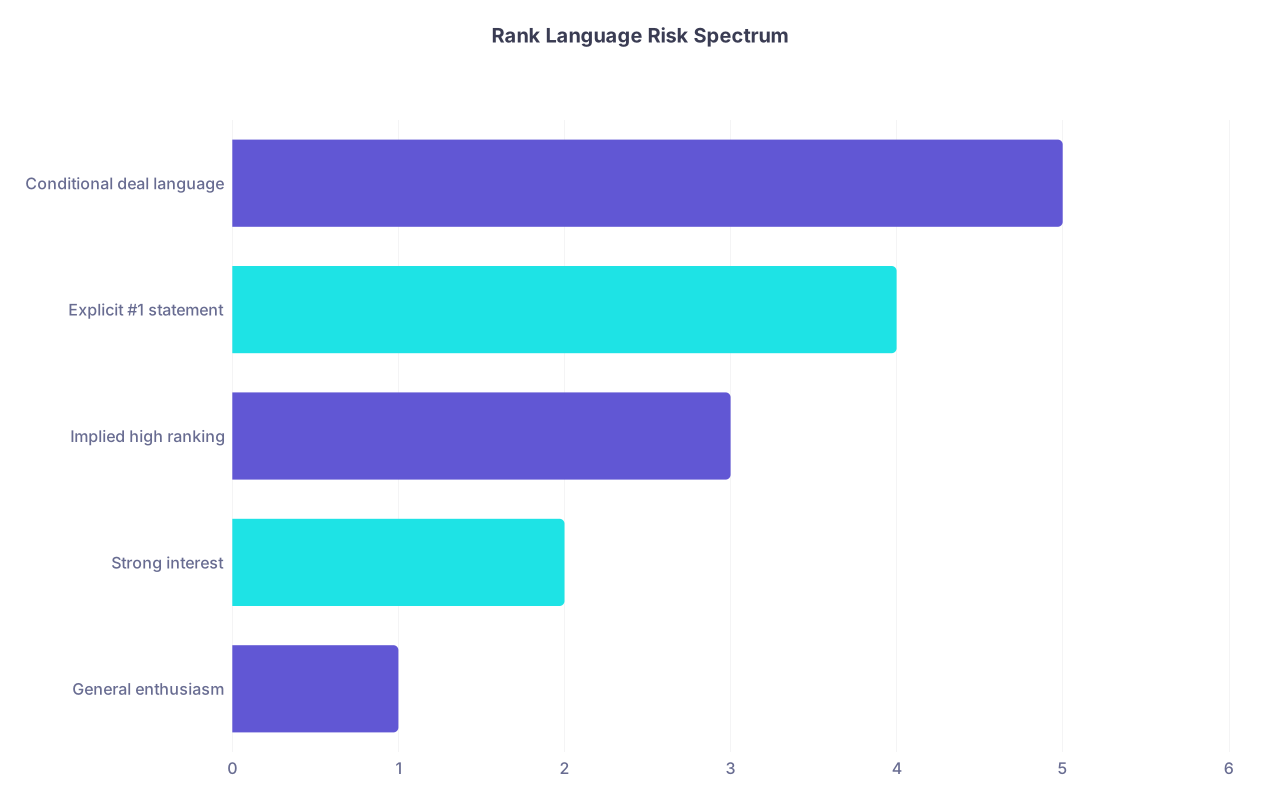
10. Quick Visual: The Safe vs Risky Language Spectrum
It helps to see the gradient from safe to risky.
| Category | Value |
|---|---|
| General enthusiasm | 1 |
| Strong interest | 2 |
| Implied high ranking | 3 |
| Explicit #1 statement | 4 |
| Conditional deal language | 5 |
Aim to live in the first two categories for 95% of your communication.
11. Putting It All Together in a Simple Protocol
Here is your practical, step‑by‑step “I accidentally hinted at my rank list” protocol.

| Step | Description |
|---|---|
| Step 1 | Realize you hinted at rank list |
| Step 2 | Write down exact words and context |
| Step 3 | Classify severity - vague, semi specific, explicit |
| Step 4 | Do nothing further |
| Step 5 | Optional brief clarification email |
| Step 6 | Send clear nonbinding clarification |
| Step 7 | Document what you sent |
| Step 8 | Adopt safe language script for future |
| Step 9 | Build honest final rank list based on true preferences |
That is it. You do not need a 10‑page policy manual. Just this flowchart and some judgment.
12. Two Final Safeguards For Your Actual Rank List
You still have to certify your list. The part that actually matters.
A. Build your list before you look back at your emails
When you sit down to rank:
- Use your own priority criteria: training quality, geography, gut feeling, partner’s job, etc.
- Make a provisional list of your true preferences without thinking about:
- What you said to whom.
- Who seemed the most eager.
- Who you “owe” something to.
Only after that, glance at your communication log and ask:
- “Does any email I sent meaningfully misrepresent my final ranking?”
- If yes and it bothers you, consider a gentle clarification.
- If no, certify and move on.
B. Remember how the algorithm actually works
The Match algorithm:
- Favors applicant preferences when there is any tie or ambiguity.
- Does not reward “being nice” to programs.
- Does not punish you for telling more than one program “I really like you.”
So the rational move:
- Rank programs in true order of preference.
- Let the algorithm do its job.
Not rank them to match what you blurted out in a hallway.
Key Takeaways
- Most accidental hints like “You’ll be high on my list” are awkward, not catastrophic. They rarely rise to NRMP violation territory.
- If you are concerned, a brief, professional clarification email that reaffirms interest but emphasizes independent rank lists is enough—then stop.
- Protect yourself going forward: use safe enthusiasm language, never feel obligated to reveal ranking, and build your final rank list based on your actual preferences, not on past comments made under pressure.


