

It’s 11:47 p.m. after a long interview day. Your brain’s fried, your Zoom background is still up, and you’re staring at a draft email that says:
“Thank you so much for the interview today. This program is my top choice and I will rank you number one.”
You hover over “Send.”
This is exactly the moment people tank themselves with NRMP violations, professionalism red flags, or just plain bad optics. Not because they’re malicious. Because they’re tired, anxious, and trying too hard to impress.
Let me walk you through the landmines in post-interview thank-you communications that actually intersect with NRMP rules—and the subtler ones that won’t technically get you sanctioned but can still hurt you.
You’re not crazy to worry about this. I’ve watched smart applicants get reported to their school, called “concerning” in rank meetings, or quietly dropped down a list over one badly worded email.
Let’s make sure that’s not you.
1. The Big Line You Cannot Cross: Violating NRMP Communication Rules
Start with the hard boundary: NRMP Match Participation Agreement. It’s boring legalese until someone reports you.
Here’s the core reality:
Post-interview thank-yous are allowed.
Certain content inside them is not.
The NRMP rules aim to keep both sides from pressuring each other about ranking. They do not ban expressions of interest. But they do prohibit:
- Soliciting information about how you’ll be ranked
- Making or soliciting “commitments” about ranking
- Coercive or misleading communication around rank lists
Programs and applicants both screw this up.
Concrete mistakes applicants make in emails
Do not send anything that clearly tries to box a program into a commitment or treat the Match like a side deal.
The ugly examples I’ve actually seen:
- “If you can assure me I’ll be ranked to match, I will definitely rank you #1.”
- “Can you tell me approximately where on your list I’m sitting?”
- “I’m choosing between you and [Program X]. Can you let me know if I’m competitive enough to match so I can decide?”
- “If you rank me to match, I promise I’ll come.”
That’s textbook NRMP-problem territory.
Even if NRMP never hears about it, you’ve signaled three things:
- You don’t understand the rules.
- You’re willing to pressure the program.
- You might be high-maintenance or risky to deal with.
None of those help you.
What you can say vs what you cannot
You are allowed to:
- Thank people for their time
- Express strong interest
- Tell a program they are your top choice (carefully—more on that later)
- Clarify questions about the curriculum, schedule, support systems, etc.
You are not allowed to (NRMP-wise and common-sense-wise):
- Ask how you’ll be ranked
- Ask for promises (“Will I match if…”)
- Offer promises contingent on their rank behavior
NRMP doesn’t have time to chase every dumb email. But if you irritate the wrong PD or coordinator, don’t be surprised if it gets forwarded to your dean with a “FYI this is not okay.”
2. The Slippery Words That Sound Harmless But Get Misread
You might think, “I’m not asking for rank info, just feedback.” Be careful. Certain phrases look innocent to you and manipulative to them.
Bad patterns I see over and over:
- “I’m trying to finalize my rank list and would appreciate any insight into how competitive my application is for your program.”
- “Can you share whether I’m someone you typically rank in the match range?”
- “I’d like to know whether I’m being seriously considered before I make my rank list decisions.”
These are all fishing for rank info and put the program in a bind. Many will ignore you. Some will remember your name in a very bad way.
If you truly want feedback for self-improvement, that’s what the post-Match period is for—not the middle of rank season.

3. “You’re My #1” – How to Say It Without Lying or Creating NRMP Drama
This is where people get confused fast.
No, NRMP does not ban you from telling a program they’re your top choice.
Yes, you can do it.
You just need to avoid two big mistakes:
Mistake A: Lying to multiple programs
The ethical mistake first: telling three different places they’re your #1 is dishonest. If a PD finds out you blasted the same “you’re my #1” template all over the country, that “lack of integrity” comment will follow you.
Programs do talk. Especially within the same region or specialty. I’ve heard, word-for-word:
“He told us we were number one. Heard from [other PD] he told them the exact same thing. Hard pass.”
They don’t need proof. The suspicion alone is enough to drop you a tier.
Mistake B: Framing it as a “commitment”
Saying, “I will be ranking you #1,” is allowed on your side. Where it starts to feel sketchy is when it reads like a binding promise or a demand for reciprocal assurance.
Dangerous wording:
- “I am committed to matching with your program and will rank you #1—please rank me highly as well.”
- “I have decided I will match with your program and not consider others.” (You do not actually control that.)
- “You have my word I will rank you first; I hope you will do the same.”
These blur into “mutual commitment” territory, which is exactly what NRMP was designed to stop. Programs are not allowed to ask for that or offer it. You don’t want to drag them there.
Safer, honest phrasing if you really mean it
If a program truly is your #1, you can say something like:
- “I remain extremely enthusiastic about your program and plan to rank [Program Name] as my top choice.”
- “After all my interviews, your program stands out as my first choice, and I will be ranking you #1.”
Key points:
- You’re sharing your intention.
- You’re not asking for anything back.
- You’re not implying there’s a side deal.
If you’re not 100% sure they’re #1?
Do not say they are. Say you’re “very interested” or “strongly considering ranking you highly.” Be honest.
4. Program Games: Don’t Let Their Bad Behavior Drag You Into a Violation
Programs violate NRMP rules more often than applicants. Some do it subtly, some not so subtly.
You’ll see things like:
- “If you rank us highly, we will rank you highly.”
- “You are in a very strong position to match here if you rank us to match.”
- “We intend to rank you very highly; we hope that you will do the same.”
Those types of statements are a problem for them, not you. But you can make it a problem for yourself if you respond badly.
The mistake: Matching their language
An email you should not send back:
- “Thank you so much! I will definitely rank you #1 if you rank me to match.”
- “I appreciate the reassurance. I’ll commit to you as my first choice if you can confirm I’m in your match range.”
- “That’s great to hear—so can I assume I’ll match there if I rank you #1?”
They’re already flirting with the line. Don’t join them.
Better response if you feel compelled to reply:
- “Thank you for the update and for the opportunity to interview. I continue to be very interested in your program.”
That’s it. You don’t need to mirror their semi-illegal communication.
And if a program is clearly pressuring you (“We expect people we rank to match to commit to us verbally”), that’s something you can quietly share with your dean or advising office later. Do not escalate it directly in your email. You gain nothing by picking that fight mid-cycle.
5. Content That Won’t Get You Sanctioned but Will Get You Downranked
Not every mistake is an NRMP violation. Some are just…bad judgment. And honestly, these tank people more often than formal rule-breaking.
Overly long, desperate emails
If your thank-you is one paragraph of genuine thanks and one quick detail tying back to your conversation—that’s fine.
If it’s 900 words with your life story, three new personal statements, and ten reasons they should pick you? It screams neediness and poor judgment.
Programs are reading hundreds of these. Don’t be the “oh no, not this one again” email.
Sounding entitled or evaluative
One PD showed me this line from an applicant:
“I’m confident I would be an excellent fit and am curious how you see my competitiveness relative to your typical residents.”
He rolled his eyes and said, “We’ll let the algorithm deal with him.”
Thank-yous are not your chance to evaluate them or yourself. Do that privately.
Name-dropping and awkward flattery
Bad versions:
- “I spoke with Dr. X who said I’d be a great fit and that you strongly consider applicants like me.”
- “This is clearly the top program in the region and would elevate my career more than other options I’ve seen.”
Programs hate sycophantic fluff. They especially hate when you try to leverage internal contacts in a clumsy way.
6. Timing, Tracking, and the “Did I Email Everyone?” Trap
This part isn’t about NRMP. It’s about not looking unprofessional or creepy.
Common timing mistakes:
- Mass same-day blasts that all sound identical, sent 2 hours after your last interview. It looks robotic.
- Way too late emails—like sending “thank you for the interview” three weeks after rank lists lock. Pointless.
- Multiple follow-ups when they don’t respond. Thank-yous don’t need replies.
Reasonable approach:
- Send within 24–72 hours after the interview.
- One message per interviewer, or one to the PD + one to the coordinator, depending on the culture.
- No chasing replies. Silence is normal.
If you’re overapplying and interviewing everywhere, track it. A simple spreadsheet beats accidentally sending Program A’s email to Program B.
| Situation | Red-Flag Phrase | Safer Alternative |
|---|---|---|
| Expressing strong interest | "You are my #1 no matter what" | "I plan to rank your program very highly" |
| Talking about ranking explicitly | "I will rank you #1 if you rank me to match" | "Your program is my top choice" |
| Asking about competitiveness | "Am I in your match range?" | "Thank you again for the opportunity to interview" |
| Responding to program reassurance | "So I can assume I will match there?" | "I appreciate the update and your consideration" |
| Seeking feedback | "How do I compare to other candidates?" | (Ask after Match season, not now) |
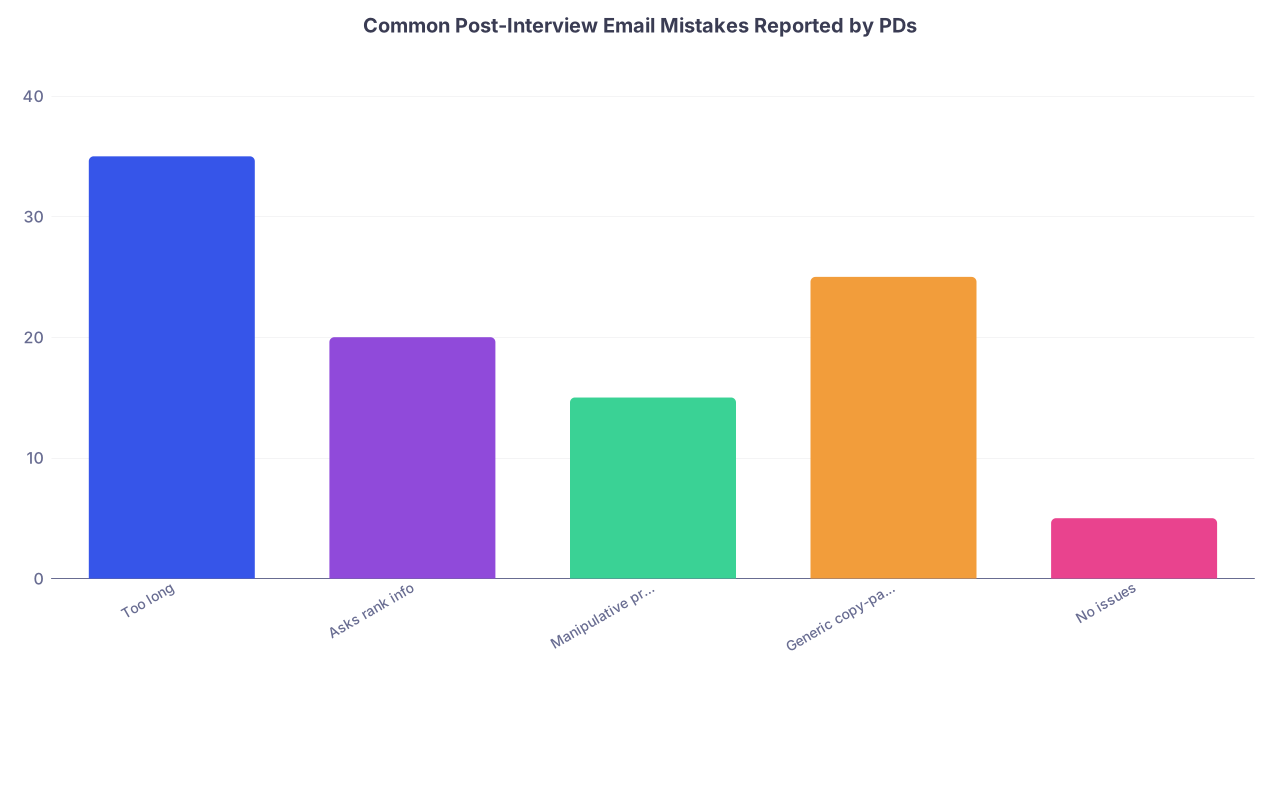
| Category | Value |
|---|---|
| Too long | 35 |
| Asks rank info | 20 |
| Manipulative promises | 15 |
| Generic copy-paste | 25 |
| No issues | 5 |
7. NRMP vs ERAS vs Programs: Don’t Confuse the Rulebooks
Another mistake: mixing up which system governs what.
- NRMP – governs Match rules, ranking behavior, coercive communication, contracts.
- ERAS – application platform. Technical stuff, document transmission, tokens, etc.
- Individual programs/institutions – codes of conduct, professionalism expectations, school-specific policies.
NRMP does not micromanage your thank-you content beyond rank coercion/commitment issues. But programs will absolutely interpret that same content as a professionalism signal.
So your question isn’t just “Will NRMP care?”
It’s “Will this make me look unstable / dishonest / difficult?”
If the email could be screenshot into a PD WhatsApp group with the caption “What is this kid doing?”—delete it.
8. A Simple Framework: What Your Thank-You Email Should Look Like
Let’s keep this practical.
Safe, smart structure (3–5 sentences)
- Subject: “Thank you – [Your Name], [Specialty] interview on [Date]”
- Line 1 – Direct thank you.
- Line 2–3 – One specific thing you appreciated or learned, tying you to the program.
- Optional line – Genuine enthusiasm/interest (honest intensity).
- Sign-off – Professional, done.
Example that won’t hurt you:
Dear Dr. Smith,
Thank you for taking the time to speak with me during my interview at [Program Name] on January 10. I really appreciated our conversation about your program’s focus on resident autonomy in the MICU and the strong mentorship for career development. Our discussion reinforced my interest in training at [Program Name], and I would be excited to contribute to your resident team.
Sincerely,
[Your Name]
Notice what’s missing:
- No rank talk.
- No pressure.
- No weird promises.
If this program is genuinely your #1, you could adjust that third line to:
“…Our discussion reinforced that [Program Name] is my top choice for residency, and I plan to rank your program first.”
Once. To one place. When you’re sure.

| Step | Description |
|---|---|
| Step 1 | Just finished interview |
| Step 2 | Want to send thank you |
| Step 3 | Send simple thank you |
| Step 4 | Express strong interest only |
| Step 5 | State top choice without conditions |
| Step 6 | Delete and rewrite |
| Step 7 | Talking about ranking? |
| Step 8 | Program truly #1? |
| Step 9 | Asking for ranking info? |
FAQ (Exactly 5 Questions)
1. Can I tell more than one program they’re my “top choice” if I phrase it slightly differently?
Do not play word games with this. If you’re telling multiple programs they are your “first choice,” “top choice,” or “number one,” you’re lying. People get caught more than you think—especially within competitive specialties where PDs compare notes. If you’re genuinely torn, say you’re “very interested” or “strongly considering ranking you highly.” Save “top choice” for one program, when you mean it.
2. What if a program emails me saying I’m “ranked to match” or “very high on their list”?
That’s their problem with NRMP, not yours. You’re not obligated to answer anything about your rank list. The safest response is a short thank-you: “Thank you for the update and for the opportunity to interview. I remain very interested in your program.” Do not mirror their rank language, don’t ask for more details, and definitely don’t send back conditional promises.
3. Is it an NRMP violation if I ask whether I’m “competitive” for their program?
If it’s clearly code for “tell me where I stand on your rank list,” it’s risky and unprofessional, even if NRMP never knocks on your door. PDs interpret these questions as fishing for rank info, which they’re not supposed to give. You gain nothing and may annoy them. If you’re genuinely seeking feedback, that’s a conversation for after Match Day with mentors, not mid-season thank-you emails.
4. Do I have to send thank-you emails at all? Will it hurt me if I don’t?
Most programs don’t dock you for skipping thank-yous. Some PDs don’t read them at all. A few still like them as a courtesy, but they’re rarely rank-deciding. You’re more likely to hurt yourself by sending a bad email than by sending nothing. If you’re tight on time or overwhelmed, prioritize sending clean, simple notes to your top programs only, and skip the rest without guilt.
5. What should I do if I realize I sent a questionable email already?
Don’t panic and definitely don’t send a second, weirder follow-up trying to “correct” it. At this point, more attention is the last thing you want. Leave it alone. If you think you genuinely crossed into NRMP-problem territory (e.g., you offered a conditional ranking deal), quietly discuss it with your dean or advisor, not the program. Then stop making it worse. Your next move is to send only clean, neutral communication going forward.
Final Takeaways
- Do not use post-interview emails to talk about rank lists, solicit rank information, or create “commitments.” That’s where NRMP problems live.
- Keep thank-you notes short, specific, and honest—especially about “top choice” language. One program. One truth.
- When in doubt, say less. No one ever got pushed down a rank list for sending a simple, boring thank-you. Plenty have for desperate, manipulative, or rule-skirting ones.


