

The most dangerous NRMP violations you face are not dramatic—they are subtle questions in a nice interview room that you feel pressured to answer.
You need a script. Not vibes. Not “I’ll just wing it.” A literal, rehearsed, word-for-word script.
Below is exactly that: a step-by-step script for responding to improper NRMP questions, with variations you can plug in immediately. I will also show you how to recognize a violation in real time, keep your cool, protect yourself, and document it without blowing up your chances.
1. Know What Counts as an Improper NRMP Question
If you cannot recognize a violation in the moment, you will answer it. That is how people get trapped.
Here is the core rule you must internalize:
- Programs cannot request or require:
- Your rank order list (ROL)
- Whether you will rank them first / in your top X
- Whether you have applied/interviewed elsewhere
- Whether you will accept a position if offered
- Any quid pro quo tied to ranking (e.g., “If you rank us highly, we will…”)
They also must not ask discriminatory or coercive questions (gender, family planning, visa status outside what is needed for employment, etc.).
Use this quick mental check:
“Is this asking me to commit to something about my rank list, my other interviews, or my personal life that is not directly necessary for employment?”
If yes → red flag.
To make this concrete:
| Topic | Improper Question Example | Proper Alternative Example |
|---|---|---|
| Rank order | "Will you rank us number one?" | "What factors are most important in your rank list?" |
| Other interviews | "Where else are you interviewing?" | "What type of programs are you interested in?" |
| Commitment | "Will you come here if we rank you to match?" | "Do you see yourself thriving in a program like this?" |
| Personal life/family | "Are you planning to have kids during residency?" | None – this is off-limits |
| Visa (for non-citizen) | "Will you stay here long-term after visa expires?" | "We sponsor J-1 visas; would that meet your needs?" |
You are not there to be the NRMP police. But you are absolutely allowed to protect yourself and still be professional.
2. The 3-Step Playbook When You Hear an Improper Question
You need a simple mental algorithm so you do not freeze.
Use this three-step approach every time:
- Pause and buy 1–2 seconds
- Redirect with a neutral, positive statement
- Answer the underlying concern without breaking NRMP rules or over-disclosing
Let us break that down.
Step 1: Micro-Pause Script
The moment you hear something sketchy:
- Take a breath.
- Slight nod.
- Then:
“That is a thoughtful question…”
Or:
“I appreciate you asking about that…”
You are not agreeing it is appropriate. You are giving yourself half a second to think and not panic.
Step 2: Neutral Redirect Line
Next, you pivot away from the exact question.
Core redirect templates you can memorize:
- “Under the NRMP rules, I am not able to discuss specific ranking or commitments, but I can tell you…”
- “I am trying to be careful to follow Match guidelines, so I avoid talking about specific rank order. What I can share is…”
- “Because of Match rules, I cannot get into details of my list, though I am very interested in programs that…”
These lines do two things:
- Signal you know the rules.
- Stay polite. Calm. Non-accusatory.
Step 3: Address the Underlying Concern
Programs ask bad questions for predictable reasons:
- They want to know if you are serious about them.
- They are trying to gauge “fit” or your priorities.
- Occasionally, someone is just careless or poorly trained.
You respond to the need, not the literal question.
Examples of needs and how to answer them:
- Need: “Are we your top choice?” → You respond about strong interest and fit factors.
- Need: “Where else are you interviewing?” → You respond about types of programs and locations you value.
- Need: “Will you come here if we rank you?” → You respond with enthusiasm and that you would be thrilled to match here.
3. Word-for-Word Scripts for Common Improper NRMP Questions
Now the part you actually want: scripts you can rehearse.
Memorize a few of these. Then customize to your personality.
Scenario 1: “Will you rank us number one?”
This is the classic violation.
Do NOT answer directly.
Script 1 (direct but warm):
“Because of NRMP rules, I cannot discuss the specifics of my rank list. What I can say is that I have been very impressed with this program—especially the strong mentorship culture and the ICU exposure—and I could absolutely see myself thriving here.”
Script 2 (if they push a little):
Interviewer: “Sure, I understand, but are we at least near the top of your list?”
You:
“I really do need to be consistent with Match guidelines and not describe the order of my list. I can tell you this program will be very competitive for a top spot based on everything I have seen today.”
Scenario 2: “Where else are you interviewing?”
This one is extremely common. It is also not necessary for them to know.
You can answer type of program, but avoid naming specific institutions.
Script 1 (general type answer):
“I am mainly interviewing at academic programs in medium-to-large cities with strong exposure to complex cases and a track record of fellowship placement. Your program fits that extremely well.”
Script 2 (NRMP-anchored pivot):
“Under Match guidelines, I try not to get into the specifics of where else I am interviewing. I am focusing on programs with a similar profile—strong teaching, diverse patient population, and a collegial culture—which is why I was excited to interview here.”
If they insist on names, do not cave.
Pushback version:
“I hope you understand if I stay away from specific program names. I want to be very careful to follow NRMP expectations, and they encourage us not to share details that might distort the Match process.”
Then stop. Let the silence work.
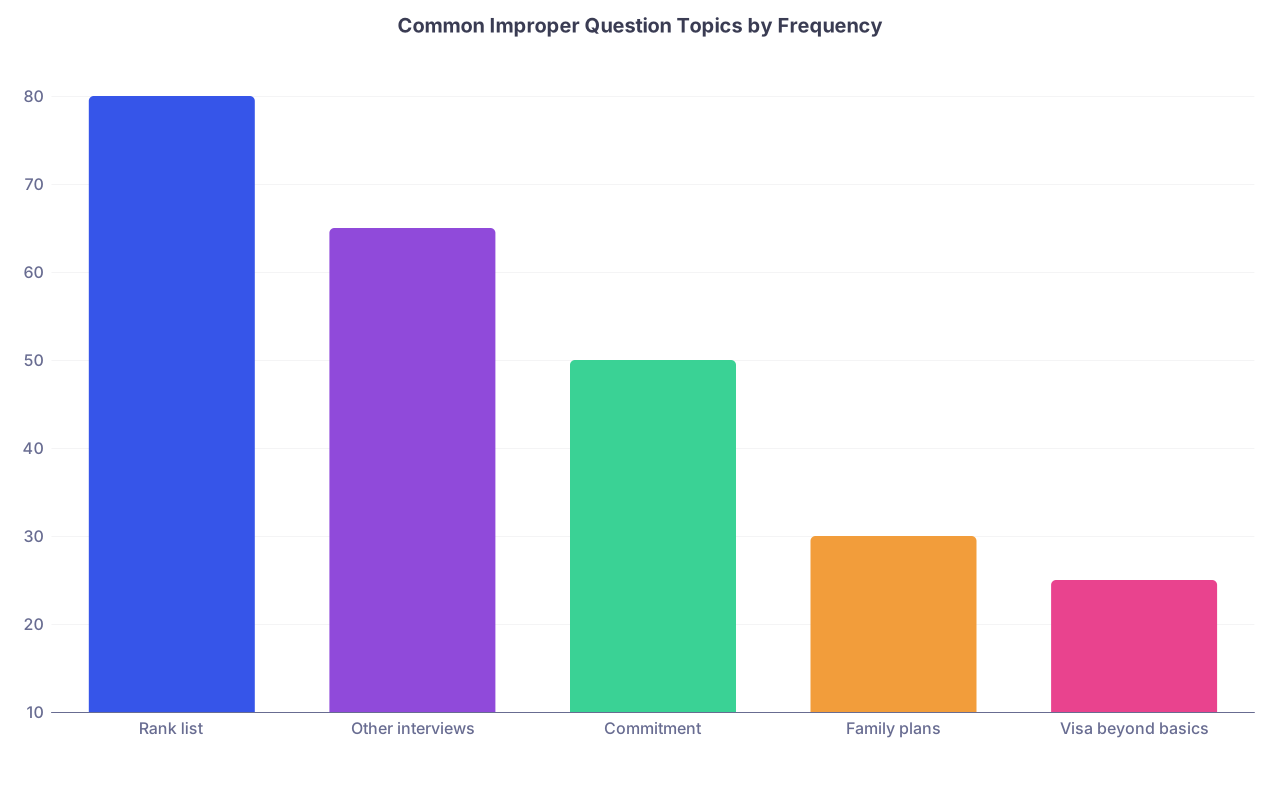
| Category | Value |
|---|---|
| Rank list | 80 |
| Other interviews | 65 |
| Commitment | 50 |
| Family plans | 30 |
| Visa beyond basics | 25 |
Scenario 3: “If we rank you to match, will you come here?”
This is pressure. Also a violation.
Core script:
“My understanding is that under NRMP rules, I should not make any specific commitments about how I would rank programs or respond to hypothetical ranks. I can say that I would be very happy to match here. The training, faculty, and resident culture are all things I am looking for.”
If they follow with: “So is that a yes?”
You hold the line:
“I will certify my rank list after I have completed all my interviews and careful reflection. I want to respect the Match process. I can honestly say I would be excited to train here.”
You have:
- Not promised anything.
- Clearly expressed enthusiasm.
- Stayed within rules.
Scenario 4: “Are we your top choice / top three / top five?”
Different packaging, same violation.
Quick script:
“I am not able to share the exact positioning of programs on my rank list, but you are absolutely among the programs I am strongly considering. The emphasis on [X and Y] aligns very well with what I am looking for.”
You may substitute:
- “strongly considering”
- “highly interested in”
- “very enthusiastic about”
All safe. None commit to rank position.
4. Scripts for Personal and Discriminatory Questions
Some questions are not just NRMP issues. They are illegal or clearly inappropriate.
You are not obligated to educate them, but you do need a plan.
Category: Family Plans, Marriage, Children
Examples:
- “Are you planning to have kids during residency?”
- “Do you have a partner? Where do they live?”
- “Who will take care of your children during call nights?”
You decide how hard a boundary you want. I will give you three levels.
Level 1: Soft Deflection (Most commonly used)
“My family and personal life are stable and well supported. I am confident I can meet the demands of residency. I am very focused on discussing how I can contribute here.”
Short. Clean. Signals you are not going into detail.
Level 2: Policy-Based Redirect
“In general, I try to keep my family life separate from the interview conversation. I can assure you I have a strong support system and the bandwidth to meet the expectations of this program.”
Level 3: Clear Boundary (When it feels truly off)
“I am not comfortable discussing family planning or personal life details, but I can assure you it will not interfere with my ability to perform as a resident.”
You choose the level based on your safety, comfort, and the vibe in the room.
Category: Religion, Politics, “Background” Questions
Examples:
- “What church do you belong to?”
- “How do your political views align with this patient population?”
- “You have a foreign name—where are you really from?”
Again, use the three-level system.
Soft deflection:
“My personal beliefs are private, but professionally I am committed to providing excellent care to every patient and working well with a diverse team.”
If you do want to share a neutral, high-level piece (for instance, about cultural background), you can, but you are not required.
Category: Visa and Immigration Status
Programs are allowed to clarify what they can sponsor (e.g., J-1 vs H-1B). They are not allowed to badger you about long-term immigration plans beyond what is needed.
Reasonable:
- “We sponsor J-1 visas only. Would that meet your needs?”
Improper tone:
- “So how long do you actually plan to stay in the US?”
- “Are you going to leave when your visa ends?”
Script:
“I am currently on [visa type] and I am eligible for [J-1/H-1B as appropriate]. My goal is to complete residency training here, and your program’s sponsorship policies would allow that.”
If they press harder into long-term immigration:
“I am still working through long-term personal plans, but I am fully committed to completing my residency training in the United States.”
5. Handling Pressure or Repeated Violations in the Same Interview
Sometimes one poorly worded question is just ignorance. Multiple pushy questions is a pattern.
Your goals:
- Protect yourself.
- Avoid escalation in the room.
- Document it later.
If They Repeat the Same Type of Question
For example, they keep circling back to rank order.
You can escalate your language slightly:
“I truly want to respect the NRMP guidelines, which is why I am being careful not to talk about rank order or relative positioning of programs. I hope you can understand my need to follow that standard.”
If they still continue after that, you have learned something important about the program’s culture. Make a mental note.
If You Feel Cornered
Do not lie. Lying undermines your own leverage if there is ever an investigation.
Your emergency line:
“I am not comfortable answering that directly, but I am very interested in the opportunity to train here and I am taking my rank list decisions seriously.”
Then stop. Firm but respectful.

6. What To Do Immediately After an Improper Question
You are not done when the interview ends. The paper trail matters.
Step 1: Write Down Exactly What Happened
Within 10–15 minutes of the encounter (between interviews, during a break, or that evening):
- Who asked the question? (Name, role: PD, APD, faculty, resident)
- Exact wording, or as close as you can get
- Your response
- Any follow-up or added pressure
- Date and time, and whether it was:
- Zoom vs in-person
- 1:1, panel, or group setting
You want this written before your memory gets fuzzy.
Step 2: Separate “Mildly Awkward” from “Serious”
Use this internal scale:
- Level 1 – Poorly worded but clearly benign, you deflected, they moved on.
- Level 2 – Direct request for rank list / commitment, one time, no real pressure.
- Level 3 – Repeated violations, coercive tone, implied consequences.
For Level 1, your script and internal note are usually enough.
For Level 2–3, you may want to seek advice (more on that next).
7. Who You Can Talk To – Without Blowing Up Your Career
You are allowed to ask for help. Quietly and strategically.
Option A: Your Home Program Leadership
- Clerkship director
- Program director
- Dean of student affairs / career advising
How to phrase it:
“During my interview at [Program], I was asked several questions that seemed inconsistent with NRMP rules, like [example]. I wanted your advice on how to handle this and whether it is something that should be reported.”
They have seen this before. They know what rises to the level of formal reporting.
Option B: Your School’s GME or Legal/Compliance Office
Some institutions have a very clear process for NRMP concerns. Ask your dean who the right contact is.
Option C: NRMP Policy Office (For Serious Cases)
If the behavior was egregious or repeated, you can contact NRMP directly. They have a violation reporting mechanism.
You do not have to decide this immediately. You can discuss with trusted faculty first. But detailed notes (from Section 6) give you leverage if you go this route.

| Step | Description |
|---|---|
| Step 1 | Hear questionable question |
| Step 2 | Answer normally |
| Step 3 | Pause and redirect |
| Step 4 | Use script to answer underlying concern |
| Step 5 | Finish interview professionally |
| Step 6 | Write detailed notes after |
| Step 7 | Keep notes, adjust rank list |
| Step 8 | Discuss with dean or advisor |
| Step 9 | Consider NRMP or institutional report |
| Step 10 | NRMP / discriminatory? |
| Step 11 | Severity? |
| Step 12 | Serious pattern? |
8. Practicing Your Scripts So They Sound Natural
If you only read these responses once, you will forget them in the middle of an anxious interview day. You need minimal rehearsal.
10-Minute Practice Protocol
Pick 3 core scenarios you are most worried about:
- Rank list question
- “Where else are you interviewing?”
- Family / partner question
Choose one script for each that sounds most like you.
Practice out loud:
- Stand up.
- Look at a point on the wall.
- Say the full script verbatim three times each.
Record yourself on your phone once, listen once. Fix awkward phrases.
Done. You now have a “muscle memory” response ready.
Small Tweaks To Make It Sound Like You
Change:
- “I truly want to respect the NRMP guidelines…”
→ “I really want to be careful to follow NRMP rules…”
Or:
- “I would be very happy to match here.”
→ “I would be genuinely excited to match here.”
Keep the structure, but update the words for your normal speaking style.

9. How This Affects Your Rank List
This part people rarely say out loud: you are allowed to penalize programs for violating NRMP guidelines. In fact, you probably should.
If a program:
- Repeatedly pressures you about rank order
- Asks discriminating questions
- Responds badly to your polite boundaries
That is data. About:
- Culture
- Respect for rules
- How they treat people with less power
You can:
- Move them down.
- Move them off your list entirely if it felt truly unsafe or unethical.
You do not owe anyone a top rank because “the clinical training is strong.” Culture and ethics matter as much as the patient volume.
10. Quick Reference Script Bank (Copy/Paste)
You can copy this block into a note on your phone and review before interviews.
On being asked how you will rank them:
“Because of NRMP rules, I cannot share specifics about my rank list, but I have been very impressed with this program and could absolutely see myself training here.”
On being asked where else you are interviewing:
“I try not to get into specific program names to stay aligned with Match guidelines. I am mainly looking at academic programs in [region/type] with strong teaching and diverse pathology, which is why I was excited to interview here.”
On being asked to commit if they rank you highly:
“The Match works best when we all avoid making specific commitments about rank order. I can say that I would be very happy to match here and that I am taking my rank list decisions very seriously.”
On family/personal life questions:
“My personal life and support system are stable, and I am confident I can meet the demands of residency. I prefer to focus our conversation on how I can contribute to your program.”
On discriminatory or uncomfortable questions:
“I prefer to keep my personal beliefs and background private, but professionally I am committed to excellent care for all patients and being a reliable member of the team.”
On repeated pressure:
“I really want to be consistent with NRMP guidelines, which is why I am avoiding talking about specific rank positions. I hope you can understand my need to follow that.”
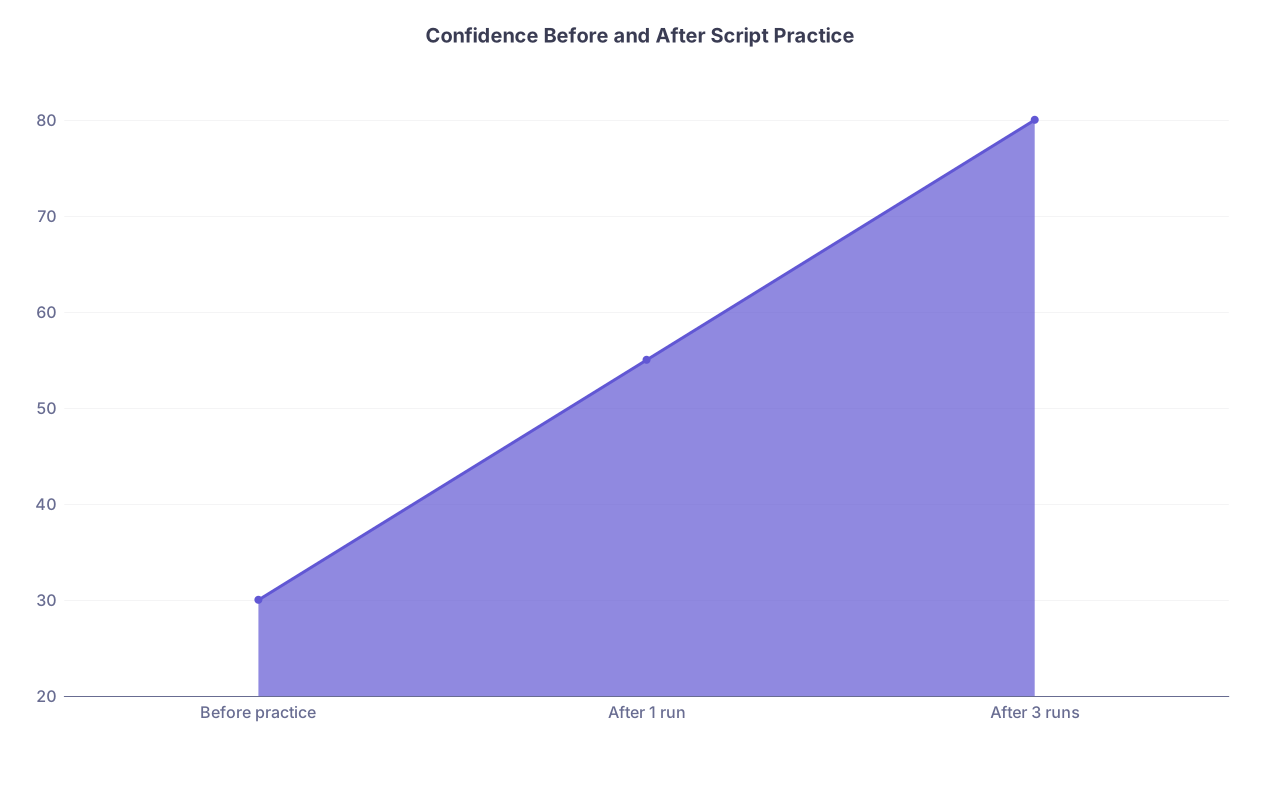
| Category | Value |
|---|---|
| Before practice | 30 |
| After 1 run | 55 |
| After 3 runs | 80 |
FAQ (Exactly 2 Questions)
1. Will pushing back on an improper NRMP question hurt my chances at that program?
Possibly at a bad program. Less likely at a decent one. But here is the hard truth: if a program punishes you for calmly following NRMP rules, that is not a place you want to spend the next 3–7 years of your life. Most reasonable faculty, when you say, “I am trying to follow Match guidelines,” will back off and sometimes even apologize. The ones who do not are sending you valuable information. Your job is not to please everyone; it is to match somewhere that respects basic ethics.
2. Should I ever email a program afterward to “clarify” that I am very interested if I deflected their question?
Yes, but in a controlled way and never making rank promises. You can send a post-interview thank-you that reinforces interest without committing: “After speaking with you and the residents, I remain very enthusiastic about [Program]. The combination of [X and Y] makes it a program where I could see myself thriving.” Do not say “I will rank you highly” or “You are my number one.” Let your rank list speak for itself. Your email is for professional courtesy and genuine interest, not secret deals.
Open your interview prep document right now and paste in three scripts: one for rank questions, one for “where else are you interviewing,” and one for personal life questions. Then say each of them out loud three times today.


