

Your advisor telling you to break NRMP rules is not “just how the game is played.” It is dangerous, unethical, and it can destroy your career before it starts.
I have seen this happen. A well-meaning clerkship director nudges a student to “just email and say you’ll rank them #1.” A program coordinator tells an applicant, “Go ahead and ask them where you are on their list; everyone does it.” Then months later, that same student is on the phone with NRMP compliance and institutional leadership trying to explain an “innocent” email.
You must be prepared for this. Because the harsh truth is: some advisors, attendings, and even program leadership either do not know the NRMP rules well, or they choose to ignore them.
This guide is the emergency protocol you follow when someone in authority suggests you do something that sounds like it might violate NRMP Match rules.
Step 1: Recognize a Potential NRMP Violation in Real Time
You cannot respond correctly if you do not recognize the problem. NRMP rules are very specific about what you and programs can and cannot say or do around the Match.
Here are the most common situations where advisors push students toward violations.
Red-flag phrases and scenarios
If you hear any version of these from an advisor, resident, or faculty, your alert level should spike immediately:
- “Just tell them you will rank them number one. That is how you signal interest.”
- “Ask the program director if they are going to rank you highly.”
- “Email them and say if they rank you here, you will definitely match.”
- “Call them and see where you are on their rank list.”
- “You can withdraw from the Match and sign outside with them; programs do it all the time.”
- “If they are offering a prematch, just accept it and tell NRMP later.”
- “You do not have to rank programs you are not truly committed to; just ghost the others after Match.”
- “You can hint that other programs are lower on your list so they push you up.”
Now, what actually violates NRMP policy? In practical terms:
You cannot:
- Ask any program:
- “Where am I on your rank list?”
- “Will I match there?”
- Make or solicit commitments about how you or they will rank.
- Ask programs about how they are ranking other applicants.
- Negotiate side deals outside the Match (like signing something binding before Match Day, except in specific, clearly defined exceptions such as certain urology or ophthalmology matches run separately).
- Ask any program:
Programs cannot:
- Require or pressure you to state how you plan to rank them.
- Ask you for a verbal commitment.
- Promise you a spot outside of the official Match if both are Match participants.
- Ask you to disclose other programs on your list or your ranking of them.
Quick mental checklist: Does this sound like a violation?
When someone suggests something, run it through this fast filter in your head:
Does it involve:
- How I will rank a program?
- How they will rank me?
- Where I stand on their list?
- Any kind of promise or guarantee about Match outcome?
Does it involve:
- Not honoring the Match results?
- Signing something outside of the NRMP process?
- Backing out after the Match?
If you answer “yes” to any of that, treat the suggestion as a probable NRMP violation until proven otherwise.
Step 2: Slow Things Down and Avoid Committing on the Spot
The biggest mistake I see? Students feel pressured in the moment and agree to something they know feels off.
You never have to agree to an NRMP-unsafe suggestion immediately. Buy time. Calm the situation. Protect yourself.
Scripted responses to use in the moment
Memorize something like this. Use it when an advisor, PD, or attending pushes you:
- “I appreciate your advice. I want to make sure I stay fully compliant with NRMP rules, so I am going to double-check the policy before I send anything.”
- “I have read the NRMP Match Participation Agreement, and they are very strict about communications. I would prefer to phrase things in a way that keeps everything compliant.”
- “My understanding is that asking or offering rank commitments can be a violation. I am not comfortable doing that.”
- “To be safe, I would like to stick to expressing interest without making any statements about rankings.”
Notice these tactics:
- You do not accuse anyone directly.
- You anchor to “NRMP rules” and “compliance,” not “I think you are wrong.”
- You do not send the email or make the call they are asking for.
If they push harder, repeat calmly:
- “I really do not want any risk of an NRMP violation attached to my application. I would like to avoid any language about rank lists.”
If they still push, that is your cue to escalate later (we will get there).
Step 3: Confirm the Rules Directly – Do Not Rely on Hearsay
Your advisor may be fantastic clinically and clueless about Match rules. That happens. Often.
You need the source of truth.
Where to verify NRMP rules quickly
Start here:
NRMP Match Participation Agreement (MPA) for applicants
The language you care about most is in the sections on:- Communication policies
- Commitments and statements about ranking
- Violations and sanctions
NRMP official policy on communication
They explicitly describe:- What is allowed: expressions of interest, thank you notes, program updates.
- What is prohibited: requesting ranking info, offering ranking commitments, coercion.
Your school’s Designated Institutional Official (DIO) or GME office
For med students: Usually through the Dean’s office / student affairs.
For residents: Institutional GME office.
You are looking to answer three concrete questions:
- Is what they suggested explicitly prohibited?
- Does it create an implicit commitment about ranking?
- Could it be interpreted as coercive or manipulative around rank lists?
| Type | Example Phrase |
|---|---|
| Safe | "I really enjoyed meeting your team." |
| Safe | "Your program is one of my top choices." |
| High-Risk | "I will rank your program number one." |
| High-Risk | "Will I be ranking high on your list?" |
| High-Risk | "If you rank me highly, I will match with you." |
If something is high-risk, treat it as off-limits. You do not need the NRMP to list every possible sentence to know it violates the spirit of the rule.
Step 4: Reframe Your Action into a Compliant Version
Sometimes the core idea behind the advice is reasonable (show interest), but the recommended method is wrong (promise rank). Your job is to translate it into something NRMP-safe.
Common advisor suggestions and how to fix them
Advisor says:
“Email the PD and tell them they are your number one. That helps.”Instead, you send:
“Thank you again for the opportunity to interview. I was especially impressed by your resident culture and [specific detail]. I remain very interested in training at your program.”- You expressed strong interest.
- You did not discuss specific ranking.
Advisor says:
“Ask them where you stand on their list so you know how to rank.”Instead, you do:
- Nothing of that kind. You do not ask.
- You rank programs based on fit, not hypothetical position.
Advisor says:
“Tell them you will absolutely match there if they want you.”Instead, you send:
“Your program is one of my top choices, and I would be thrilled to train there.”That is as far as you safely go. No guarantees. No ranking promises.
Advisor says:
“They hinted at offering a spot outside the Match. Take it.”Instead, you do:
- Confirm whether both you and the program are NRMP participants for that Match cycle.
- If yes: You do not sign or agree to anything outside the NRMP process.
- If unsure: Contact the NRMP or your DIO before you respond in any way.
Step 5: Document Everything – Protect the Future You
If something smells like an NRMP violation, treat the interaction like potential evidence. Because if this ever blows up, vague recollections will not help you.
What to write down (immediately after)
Create a contemporaneous note (email to yourself, secure note app, private document) with:
- Date and time
- Who was present (names and roles)
- Exact words or near-verbatim phrases used
- What you were asked or advised to do
- How you responded
- Any emails, texts, or written instructions you received
Keep copies of:
- Emails from advisors containing questionable suggestions.
- Draft messages they edited that included NRMP-unsafe language.
You are not documenting this to go nuclear. You are documenting it in case your professionalism or compliance is ever challenged.
Step 6: Decide Whether and How to Escalate
Sometimes you can quietly ignore bad advice and do the right thing. Other times, the suggestion is serious enough—or repeated enough—that you need backup.
When you probably should escalate
Consider escalating if:
- The advisor is in a position of authority over your evaluation or letters and is pressuring you to violate NRMP rules.
- The program or faculty member is conditioning opportunities (“We will rank you highly if you promise to rank us first.”).
- There is talk of:
- Prematch offers in an NRMP-participating specialty/program.
- Backing out after Match Day.
- “Helping” you get a spot by ignoring the algorithm.
Who to talk to (in order of safety)
A trusted, NRMP-savvy faculty / advisor not involved in the problem
- Purpose: sanity check, strategy.
- Ask: “Here is exactly what was suggested to me. Does this conflict with NRMP rules? How would you recommend I handle it?”
Your med school Dean of Students / Student Affairs / DIO
- They are responsible for institutional compliance.
- They have likely handled NRMP issues before.
- They can intervene if a faculty member at your institution is out of line.
NRMP directly (confidential inquiries)
- Yes, you can contact them and ask about hypothetical scenarios.
- Be factual: “If an applicant were asked to do X, would that be considered a violation?”
Do not post about it publicly. Do not blast it on social media or group chats. That never ends well.
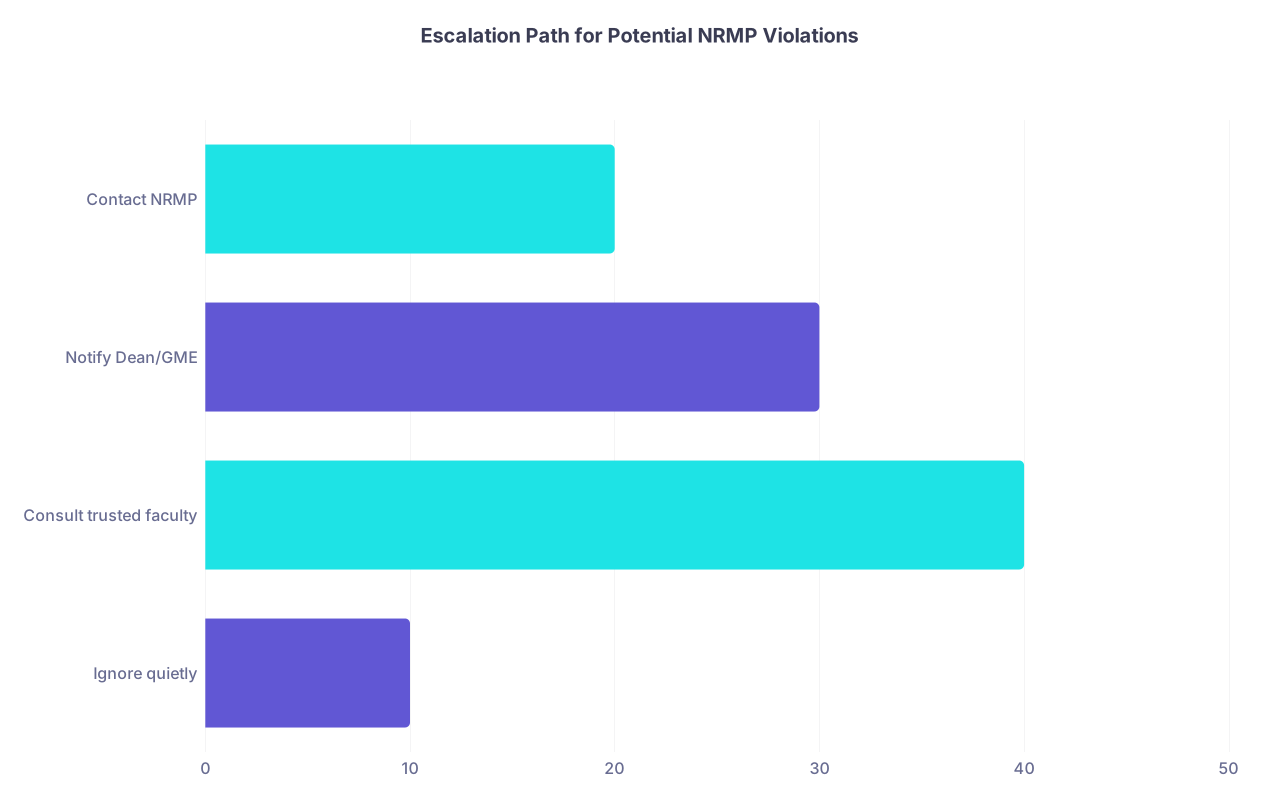
| Category | Value |
|---|---|
| Ignore quietly | 10 |
| Consult trusted faculty | 40 |
| Notify Dean/GME | 30 |
| Contact NRMP | 20 |
(Those numbers are illustrative: in practice, most issues should at least reach the “trusted faculty” step.)
Step 7: Handle Program-Driven NRMP Violations Without Blowing Yourself Up
Sometimes it is not your advisor. It is the program itself.
A PD emails you:
- “If you rank us number one, I can basically guarantee you will match here.”
- “You are at the top of our list. Can you confirm we are also your first choice?”
- “We are offering you a position outside the Match if you commit now.”
You cannot control their behavior. You can control your response.
How to respond to program emails that cross the line
Option 1 – Noncommittal, compliant reply:
- “Thank you very much for your message and for your consideration. I remain very interested in your program and truly enjoyed meeting your team. I will be finalizing my rank list based on the best overall fit.”
You did not:
- Confirm rank order.
- Make any promise about ranking.
- Ask about their rank list.
Option 2 – No reply (sometimes appropriate)
If a program’s email is blatantly inappropriate, you may choose not to respond at all. That is a judgment call, but you are not obligated to engage in a conversation that pushes violations.
Option 3 – Discuss with your Dean / advisor before responding
If the email is particularly bad (e.g., explicit outside-the-Match offer), show it—verbatim—to someone in authority at your institution. Get institutional advice on next steps and whether to involve NRMP.
Step 8: Clean Up If You Already Sent Something Questionable
This is the uncomfortable part. Maybe you already emailed a program: “You are my number one.” Or asked, “Where am I on your rank list?” because your advisor told you to.
You cannot un-send it. But you can stop making it worse and, if needed, preemptively protect yourself.
Immediate damage control steps
Stop. Do not repeat the behavior.
- No more ranking assurances.
- No more questions about their list.
Do not try to “correct” it by sending another email confessing.
That can create a bigger, clearer trail of problematic communication.Document what happened for yourself.
- Save the sent email.
- Note who advised you to send it and any written evidence of that advice.
Talk to a trusted, NRMP-competent faculty or Dean.
- Show them the exact communication.
- Ask directly: “Do we need to do anything about this with NRMP, or is it best left alone now?”
In most individual, isolated cases where no one reports it and the program does not escalate, there is no further action. But you need to understand: repeating the behavior, sending multiple such messages, or tying it to explicit quid-pro-quo can cross into sanction territory.
Step 9: Build an NRMP-Safe Communication Template Library
Make your life easier. Stop freestyling every email.
Create a small set of safe templates for:
- Thank you emails
- Updates after significant achievements
- Expressions of strong interest
Safe thank you / interest email template
Dear Dr. [Last Name],
Thank you again for the opportunity to interview at [Program Name]. I enjoyed learning more about your [specific feature: curriculum, patient population, resident culture].
I remain very interested in your program and could see myself thriving in your training environment.
Sincerely,
[Your Name]
You can tweak “very interested” to “highly interested” or “strongly interested,” but do not specify numeric rank order.
Safe update email template
Dear Dr. [Last Name],
I wanted to share a brief update since my interview on [date]. I recently [submitted a manuscript / presented at a conference / received an award] related to [brief detail].
I continue to be strongly interested in [Program Name] and remain grateful for the chance to interview.
Best regards,
[Your Name]
Notice the pattern:
- Objective update.
- Polite, positive interest.
- No ranking talk. No pressure.

| Step | Description |
|---|---|
| Step 1 | Need to contact program |
| Step 2 | Use safe template |
| Step 3 | Do not send |
| Step 4 | Check for rank language |
| Step 5 | Rewrite as interest only |
| Step 6 | Send |
| Step 7 | Topic |
Step 10: Understand the Real Risk – And Why You Must Take This Seriously
NRMP violations are not slap-on-the-wrist events. They can result in:
- Being barred from future Matches for a period of time.
- Being listed publicly as having violated NRMP policy.
- Institutional scrutiny of your professionalism.
- Programs getting sanctioned, which they will not appreciate.
And here is the brutal irony: many of the “everyone does it” behaviors do not help you anyway. The Match algorithm is built so that honest ranking of true preferences is your best play. Promises and positioning games usually backfire, even when they do not trigger NRMP problems.
So why do people keep suggesting violations?
Because:
- They matched years ago under different norms.
- They confuse non-NRMP matches (SOAP, off-cycle hiring, independent specialties) with NRMP rules.
- They care about “winning” for their program or their mentee more than about compliance.
- They are simply ignorant of the written policies.
Your job is not to fix the culture. Your job is to get through this process with your integrity and eligibility intact.
Step 11: Long-Term Strategy – Make Yourself Violation-Proof
You cannot stop others from suggesting dumb things. You can make yourself immune to being dragged into them.
Here is the practical protocol:
Read the applicant section of the NRMP Match Participation Agreement in full.
Not a summary. The real thing. It will take you 20–30 minutes. Do it once.Decide on your personal red lines.
For example:- “I will never state specific numeric rank commitments.”
- “I will never ask a program about their rank list.”
- “I will never participate in any offer or agreement outside the Match if we are NRMP participants.”
Prepare 2–3 stock phrases to decline unsafe advice.
So that in the moment, you do not freeze and nod.Keep a tight circle of people you ask about NRMP strategy.
Identify the 1–2 people at your school who actually know the rules cold. Listen to them. Not the random attending who matched in 2005 and has not read a policy since.Assume everything written can be forwarded.
If you would be uncomfortable seeing your email in front of an NRMP compliance officer, do not send it.
What You Should Do Today
Open a blank document and write down three things:
- One phrase you will never write or say to a program (for example: “I will rank you number one.”)
- One safe phrase you will use instead to show strong interest.
- One sentence you will use when an advisor suggests something NRMP-unsafe.
Then, before you sleep, pull up the NRMP applicant agreement and skim the communication and violations sections. That 20–30 minutes of actual rule-reading will do more for your Match safety than any half-remembered hallway advice.


