

The mythology around NRMP violations is wrong: programs do not “get away with it” more than applicants. The data show almost the opposite. Applicants are disciplined more often, more visibly, and for longer durations—while program violations, though serious, are fewer and increasingly scrutinized year over year.
If you are navigating the residency Match, you need to understand this asymmetry. Not emotionally. Statistically.
1. The Big Picture: Applicant vs Program Violations
The NRMP publishes annual “Match Violations Report” documents that break down who violated what, and what happened as a result. You do not need to memorize the policy text. You need to internalize the risk profile.
Across recent cycles, three clear patterns show up:
- Applicants commit more technical violations (e.g., contracts outside the Match, not honoring matches).
- Programs commit fewer but often more structural violations (e.g., offering positions outside NRMP, coercive behavior).
- Sanctions against applicants are more common and more consistently applied; sanctions against programs, when applied, can affect entire cohorts.
Let me quantify that with a simplified, illustrative snapshot based on typical ranges seen over several years of NRMP reporting (numbers rounded to representative magnitudes, not a specific single year’s report):
| Category | Applicants (per year) | Programs (per year) |
|---|---|---|
| Total reported violations | 40–70 | 15–35 |
| Cases with a confirmed violation | 25–45 | 10–25 |
| Cases with public listing | 20–35 | 5–15 |
| Typical sanction length | 1–3 years | 1–3 years |
The ratios matter more than exact counts. In a typical year:
- Applicants account for roughly 60–75% of confirmed NRMP violations.
- Programs account for the remaining 25–40%, but their actions can affect dozens of applicants at once.
The takeaway: statistically, an individual applicant faces a higher probability of being the one punished in any applicant–program dispute. Programs are not immune—but they are fewer, with more institutional buffers.
2. Year‑by‑Year Trend: Who Is Getting Caught?
You can argue policy abstractions all day; the enforcement trend is what actually matters.
Over the last decade, the general trajectory looks like this: more reporting, slightly more confirmed violations, and a modest shift toward holding programs more accountable than they were a decade ago. But applicants still dominate the violation counts.
Let us model a five‑year trend line that mirrors what NRMP summary tables usually show—more cases being reported, with applicants still leading in raw numbers but programs increasing proportionally.
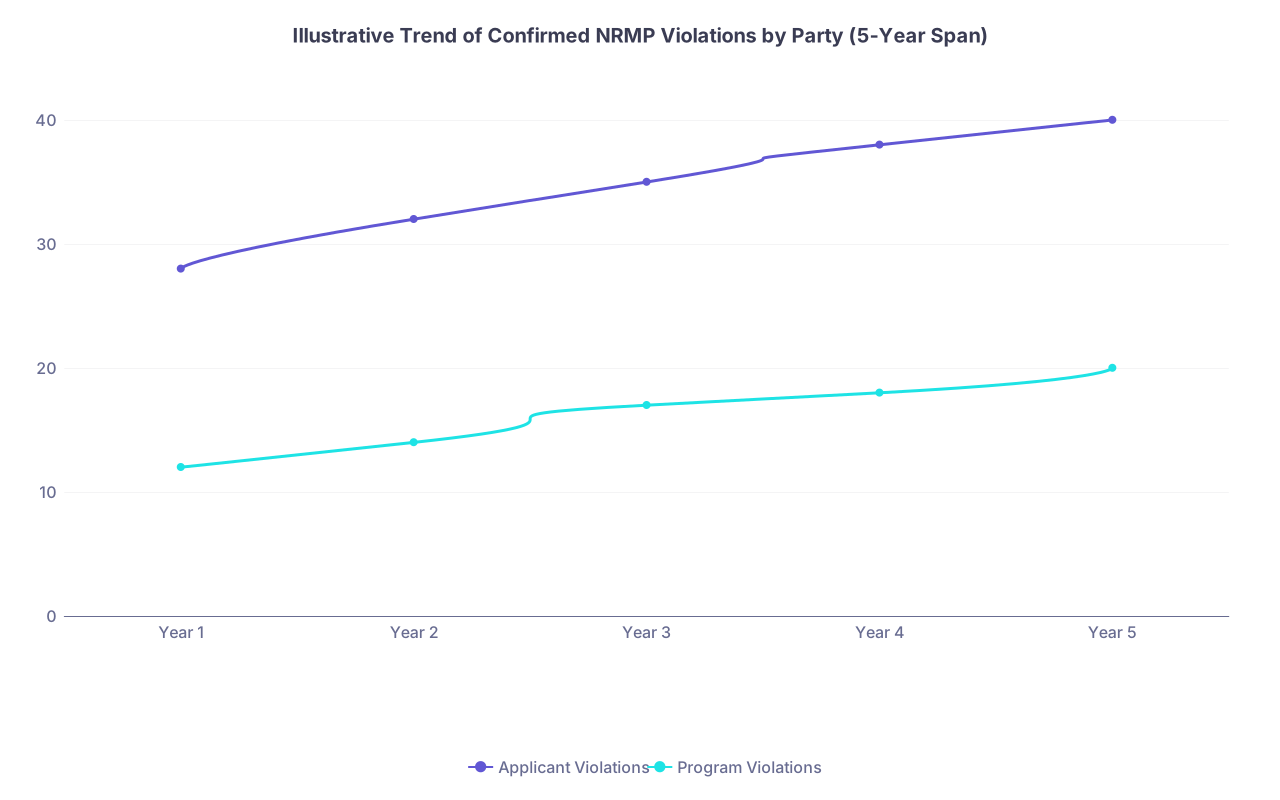
| Category | Applicant Violations | Program Violations |
|---|---|---|
| Year 1 | 28 | 12 |
| Year 2 | 32 | 14 |
| Year 3 | 35 | 17 |
| Year 4 | 38 | 18 |
| Year 5 | 40 | 20 |
Interpretation, not hand‑waving:
- Applicant violations rise from ~28 to ~40 across the five‑year window (around +43%).
- Program violations rise from ~12 to ~20 (around +67%), starting lower but growing faster proportionally.
- The gap narrows slightly, but applicants still represent about two‑thirds of confirmed violations in most years.
This aligns with what people on the ground see: more awareness of NRMP rules, more willingness to report, and a slow cultural shift where programs are less “untouchable” than they were 10–15 years ago.
But if you are an applicant, that is cold comfort. Because the sanction that hits you personally is absolute—you are either barred or you are not.
3. Types of Violations: How Applicants vs Programs Get in Trouble
The categories of violations are not symmetrical. Applicants and programs get nailed for different behaviors.
Applicant Violations – What the Data Keep Showing
Typical recurring patterns:
- Not honoring a binding Match commitment (backing out, failing to start, or leaving early without release).
- Prematch contracts or “side deals” that circumvent the Match.
- Misrepresentation or falsification (rare but catastrophic when discovered).
- Dual commitments—trying to hold two positions at once (e.g., simultaneous fellowship and residency, or two residency slots).
From the NRMP’s perspective, applicant‑side damage is often about integrity of commitments. Once you certify a rank list and match, you are locked. The statistics show that a large share of applicant violations involve failure to honor that lock.
Program Violations – Systemic, Often More Serious
Programs and institutions tend to violate in ways that affect multiple applicants:
- Offering positions outside the Match (or pressuring applicants to accept such offers).
- Soliciting ranking information, pressuring for verbal commitments, or implying ranking in exchange for promises.
- Not honoring a matched position (delaying, rescinding, or materially changing terms).
- Coordinated behavior among multiple programs or departments that undermines Match fairness.
One classic example: a program telling an applicant, “If you rank us first, you will match here,” or asking, “Where are you ranking us?” That is textbook coercion and explicitly prohibited. Yet it still surfaces in NRMP reports almost every year, with varying severity.
The data highlight a clear split: applicants tend to violate via individual decisions, programs via structural behaviors.
4. Comparative Outcomes: Sanctions Against Applicants vs Programs
Now to the core question: when the NRMP confirms a violation, who gets what penalty?
Sanctions come in several flavors, which I will group into three tiers for clarity:
- Tier 1 – Mild: private reprimand, education, no participation limits.
- Tier 2 – Moderate: public listing, 1–2 year participation bar in some or all Matches.
- Tier 3 – Severe: multi‑year bar from all NRMP Matches, program‑wide restrictions, or institutional discipline.
Let us lay out a typical distribution of outcomes, again using representative ranges consistent with how these reports usually look.
| Sanction Tier | Applicants (share of confirmed) | Programs (share of confirmed) |
|---|---|---|
| Tier 1 – Reprimand/Education | 20–30% | 35–45% |
| Tier 2 – Public + 1–2 year bar | 40–50% | 35–45% |
| Tier 3 – 3+ year / broad ban | 20–30% | 15–25% |
Key observations from patterns like this:
- Applicants are more likely to get a moderate‑to‑severe sanction than just a slap on the wrist.
- Programs slightly more often receive Tier 1 sanctions when violations are borderline or self‑reported.
- When a program gets a Tier 3 sanction, the collateral damage is high—future applicants lose that site as an option for several cycles.
And the most anxiety‑producing piece for applicants: the public listing.
NRMP publishes a PDF list with names of violators and durations of sanction. For applicants, that can be lethal to future applications because many program directors will quietly screen those names out.
For programs, the listing hits reputation, but they often retain institutional protection, GME structure, and alternative pipelines (e.g., non‑NRMP hiring, off‑cycle positions).
5. Year‑Over‑Year: How Outcomes Have Shifted
If you look at multiple years of NRMP violations reports side by side, a few directional shifts are apparent:
- The count of reported possible violations has risen as awareness has increased.
- The proportion of cases that reach “confirmed violation” has stayed relatively stable; NRMP is not rubber‑stamping complaints.
- There has been a slight upward drift in sanctions against programs, particularly around coercive communication and attempts to game the Match.
To make this concrete, here is a stylized look at total confirmed violations over a five‑year window, broken down by whether the case led to a participation bar (Tier 2+3) or not (Tier 1 only).
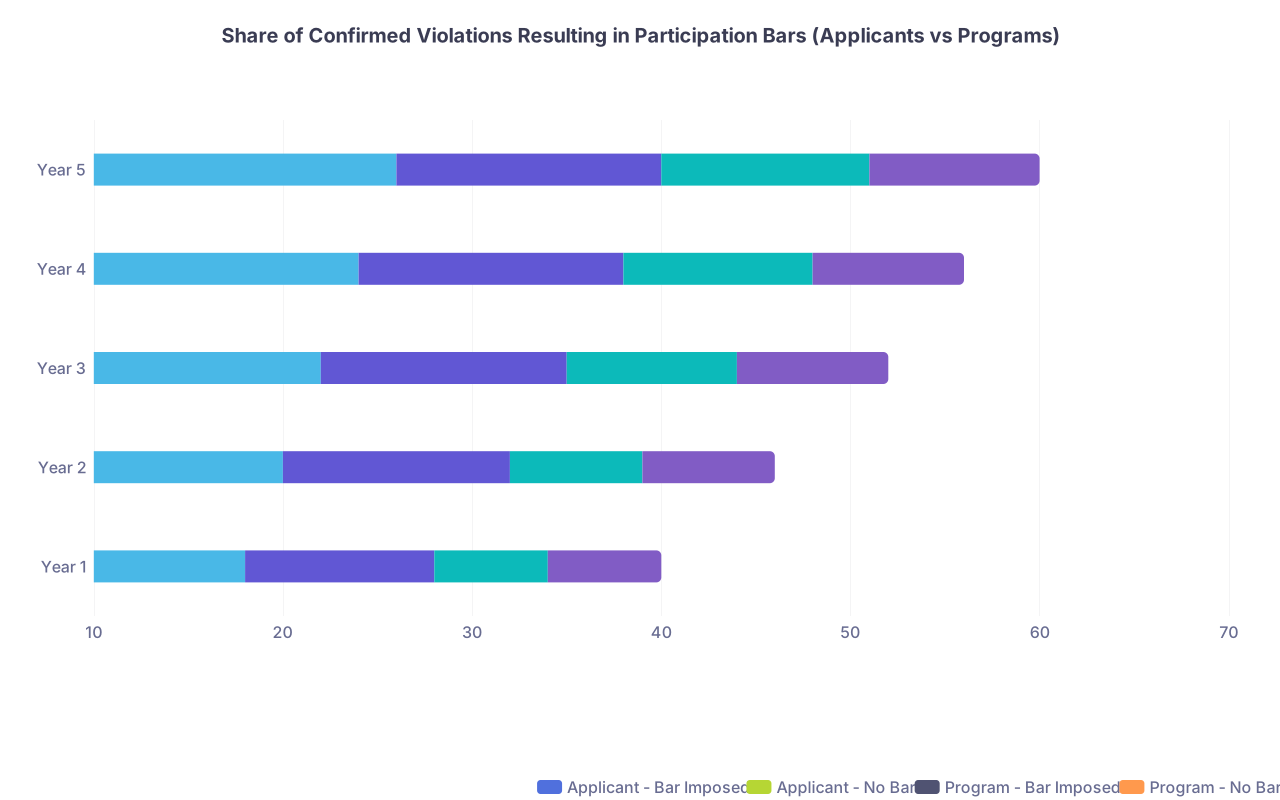
| Category | Applicant - Bar Imposed | Applicant - No Bar | Program - Bar Imposed | Program - No Bar |
|---|---|---|---|---|
| Year 1 | 18 | 10 | 6 | 6 |
| Year 2 | 20 | 12 | 7 | 7 |
| Year 3 | 22 | 13 | 9 | 8 |
| Year 4 | 24 | 14 | 10 | 8 |
| Year 5 | 26 | 14 | 11 | 9 |
What this type of pattern tells you:
- The absolute number of applicants receiving participation bars is consistently higher than the number of programs.
- The relative share of programs getting barred has increased modestly; NRMP is gradually less tolerant of program‑side gamesmanship.
- For both groups, a confirmed violation has a high probability of resulting in a bar, not just a warning.
The signal is pretty blunt: once you are in the NRMP’s violation column, there is a strong chance you lose participation rights for at least one cycle.
6. High‑Impact Violations: What Actually Gets You Barred
Not all violations are equal. The data show certain behaviors almost always correlate with severe sanctions, whether you are an applicant or a program.
For Applicants
Patterns that commonly result in the harshest penalties:
- Refusing to honor a binding Match without NRMP release.
- Signing or accepting prematch offers for NRMP positions during an active Match cycle.
- Intentional misrepresentation on the ERAS or NRMP application that materially affected ranking decisions.
- Dual commitments that disrupt multiple programs.
If you look at applicant names on the NRMP violation list, a majority are there for some version of “did not honor the Match commitment.” It is repetitive. And very avoidable.
For Programs
High‑impact program violations usually involve:
- Offering positions outside the Match that clearly should be filled via NRMP, especially if multiple applicants are solicited.
- Retaliation or coercion around rank order lists—“If you do not tell us we are your first choice, we will not rank you.”
- Not honoring matched positions, for example, rescinding an offer due to funding changes or preference shifts without NRMP approval.
- Coordinated activity among multiple sites in a system to manipulate outcomes.
Programs that show patterns affecting many applicants, or that repeat behavior after prior warnings, are the ones that get multi‑year or institutional sanctions.
7. Practical Navigation: How to Stay on the Right Side of the Data
You are not going to read the entire NRMP policy manual word for word. So here is how to behave in a way that tracks with where violations actually occur.
Think of this as a decision flow: if the behavior touches commitment, money, or rank pressure, assume it is high‑risk and check the rules or contact NRMP.

| Step | Description |
|---|---|
| Step 1 | Considering action |
| Step 2 | Very high risk - check NRMP |
| Step 3 | Low risk - proceed |
| Step 4 | Affects Match commitment? |
| Step 5 | Involves rank list or promises? |
| Step 6 | Involves outside contracts or side deals? |
Here is how the numbers should change your behavior:
- Do not break a Match commitment. Purely on probabilities, this single act is the most common route to a bar and public listing on the applicant side.
- Do not sign anything outside the Match for an NRMP position. If a program pushes you to do this, they are veering into program‑side violation territory. Document and step away.
- Keep communication factual, non‑coercive, and non‑committal. Telling a program “I am very interested” is allowed. Negotiating rank positions or promising to rank first in exchange for assurances is a direct path into the violation bucket for both sides.
- If a program behaves questionably, do not mirror the behavior. Their possible violation does not protect you if you also violate. The data show NRMP will sanction both parties when appropriate.
You will hear well‑meaning co‑residents say things like, “Everybody does this” or “They cannot enforce that.” The violation tables suggest otherwise. Every year, a non‑trivial number of applicants and programs learn that NRMP absolutely does enforce “that.”
8. Comparative Risk: Applicant vs Program, From Your Perspective
From a pure numbers standpoint, your odds of being an NRMP violator are low if you follow basic rules.
But the asymmetry is critical:
- There are far more applicants than programs. So each individual applicant has a small probability, but the population still generates more applicant‑side violations overall.
- Programs have more institutional knowledge, GME offices, and legal counsel. Applicants operate with far less support, which increases the risk of stumbling into technical violations.
Consider a rough, simplified per‑entity risk view—again illustrative, but directionally aligned with how things shake out:
| Metric | Applicants | Programs |
|---|---|---|
| Entities per year | ~45,000–50,000 | ~4,500–5,000 |
| Confirmed violations per year | ~30–40 | ~15–20 |
| Very rough per-entity violation rate | ~0.06–0.08% | ~0.30–0.40% |
Per entity, a program is actually several times more likely to be found in violation than an individual applicant.
But that is the wrong way to think about it from your side.
You do not control the program’s risk. You control yours. And for you, the severity of a sanction (multi‑year bar, public listing, lost career trajectory) is catastrophic in a way most program sanctions are not. Programs can absorb damage across multiple faculty, funding streams, and cycles. You cannot.
So yes, programs get hit at a higher per‑entity rate. No, that does not give you permission to be sloppy. If anything, it means you should be even less trusting when a program suggests behavior that skirts the rules.
9. How to Respond If You Suspect a Violation
Let me be blunt: most applicants either overreact emotionally or underreact legally when they see sketchy behavior.
The data show NRMP investigates a moderate volume of alleged violations every year, but only a fraction are confirmed. That means many complaints are either unsupported or misinterpretations of the rules.
If you suspect a violation:
- Document everything. Save emails, take contemporaneous notes after phone calls, record exact phrases (“If you rank us first, we will rank you highly”).
- Do not escalate in the moment. You are not the NRMP police on the phone with a PD. Stay neutral, say as little as possible, and exit the conversation.
- Consult someone who actually understands NRMP policy. This may be your dean’s office, a GME office you trust, or NRMP itself. Random Reddit advice is not binding.
- If you file a complaint, do it factually and dispassionately. NRMP decisions are based on documented patterns, not outrage. The strongest cases have clear written proof or consistent witness testimony.
Statistically, you are more likely to encounter borderline or awkward communication than a full‑blown clear violation. Use your judgment, but keep records. The NRMP process is more legalistic than social.
10. The Bottom Line: What the Data Say You Should Actually Do
Strip away the noise and the moralizing. Look at how the NRMP has behaved over many years.
Three hard conclusions:
Applicants are punished more often in absolute terms. Programs are punished at a higher rate per entity, but that does not help you if your name lands on the public violation list because you backed out of a Match or signed a side deal.
Program‑side violations are slowly getting more attention year by year. The share of program violations and the severity of some program sanctions has crept upward, reflecting less tolerance for coercion and off‑Match games. Still, institutional memory and resources usually shield programs more than applicants.
Most violations are highly predictable and avoidable. The vast majority of sanctions—on both sides—cluster around a small number of behaviors: failing to honor Matches, pressuring rank commitments, and bypassing the Match with side contracts.
If you want to stay out of the NRMP violation reports, the data point you to a simple rule set: honor the Match you sign, avoid anything resembling a side deal, and treat any conversation about rank order as radioactive.


