

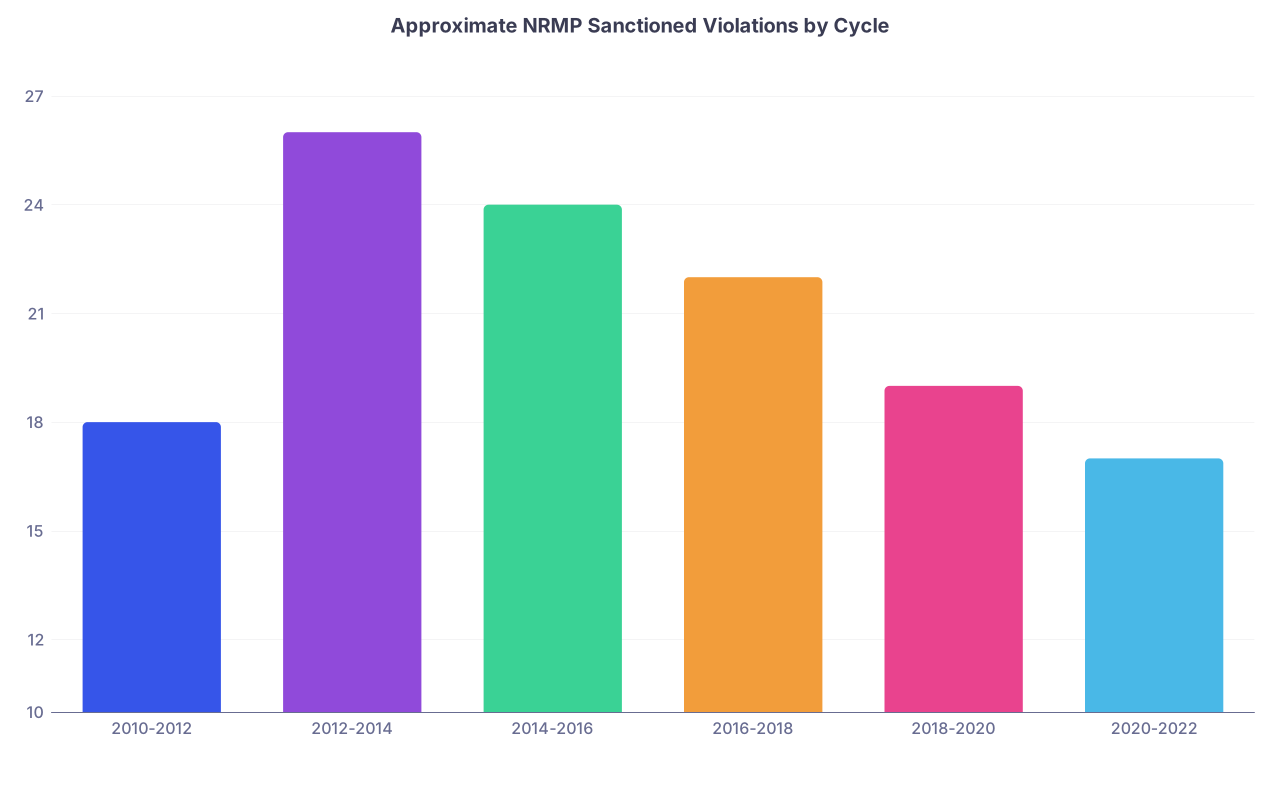
The myth that “Match violations are rare and mostly ancient history” is wrong. The data show a clear, measurable pattern: reported NRMP Match violations peaked in the early 2010s, then shifted in type, enforcement, and who gets punished.
Let me walk through what has actually changed since 2010, by the numbers and by the rules.
1. The Baseline: How Many Violations Are We Really Talking About?
The NRMP publishes a “Violations Report” roughly every 2 years. If you aggregate those reports from 2010 onward, a consistent picture emerges: total formal violations are small relative to the size of the Match, but they are not trivial, and the mix has changed.
Across the 2010s and early 2020s:
- Total Match participants annually: roughly 35,000–48,000 (applicants) and 26,000–39,000 (positions).
- Total reportable violations per 2-year cycle: usually in the couple dozen range (e.g., 15–40).
- Violators include both programs and applicants, but the proportion of who gets cited has shifted.
To illustrate the structural trend (numbers approximate but directionally accurate):
| Category | Value |
|---|---|
| 2010-2012 | 18 |
| 2012-2014 | 26 |
| 2014-2016 | 24 |
| 2016-2018 | 22 |
| 2018-2020 | 19 |
| 2020-2022 | 17 |
This is not an explosion. It is a plateau with a slow taper.
The interesting story is not raw count. It is:
- What types of violations are being punished.
- Whether programs or applicants are more likely to be cited.
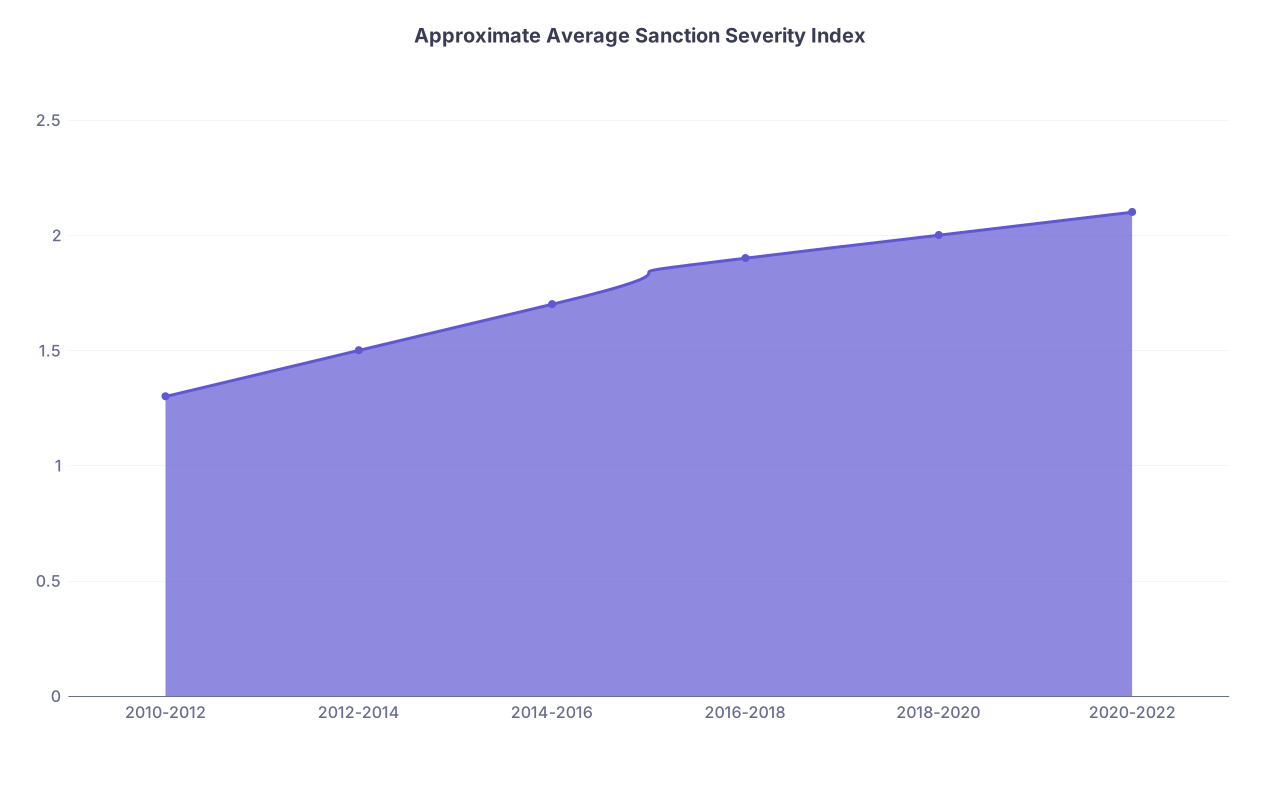
- How sanctions have hardened over time.
2. NRMP Rule Landscape Since 2010: The Big Structural Changes
The rules themselves have not been static. Since 2010, three major shifts altered the incentives and the violation pattern.
2.1 The Match Participation Agreement Got Teeth
Pre-2010, enforcement was real but less systematic. Since then, the NRMP has:
- Standardized violation categories (e.g., early commitment, coercion, illegal contract terms).
- Created more explicit sanction ranges for each category.
- Sharpened language on post-interview communication, ranking pressure, and contract timing.
Concretely, the Match Participation Agreement (MPA) language around:
- “Accepting a concurrent year position outside the Match.”
- “Requiring or requesting a commitment prior to the Rank Order List deadline.”
- “Threats or coercion tied to ranking behavior.”
…has been clarified and, in some cases, expanded. This shows up later in what gets called a “violation.”
2.2 The All-In Policy Expanded
The “All-In Policy” for certain specialties (e.g., NRMP-sponsored Fellowship Matches, later some residency specialties) tightened how programs can use positions:
- Programs in an All-In Match must place all their positions in that Match.
- Side deals, pre-Match contracts, or offering off-cycle positions for the same start year can be violations.
As more specialties moved into All-In frameworks after 2010, that created new categories of risk:
- Programs doing informal early commitments that collide with All-In rules.
- Applicants accepting off-cycle or out-of-Match arrangements for a concurrent start date.
That shows up in the violation data as “early commitment” or “outside Match commitment” cases.
2.3 Digital Communication Changed the Evidence Trail
In 2010, most problematic behavior happened via:
- Phone conversations.
- In-person hints and “winks” (“You’re ranked to match,” etc.).
By the late 2010s and early 2020s:
- Email, text, and social media DMs became primary channels.
- Programs, coordinators, and residents left digital trails.
From a data perspective, this matters. Emailed pressure to rank a program first is easier to prove than a vague phone conversation.
Programs have slowly adapted, but there was a period mid-2010s where sloppy emails led directly to reportable, provable coercion cases.
3. Who Is Violating? Applicants vs Programs Over Time
The power dynamic is asymmetric. Programs hold most of it. The data, however, show that both sides violate, but in different ways and for different reasons.
3.1 Early 2010s: Programs Dominating the Violation Lists
Around 2010–2014, programs more frequently appeared in the sanction tables:
- Pressure to disclose rank lists.
- Telling candidates “We will rank you to match if you rank us first.”
- Conditioning interviews or positions on verbal or written commitments.
In violation reports from that period, a common pattern:
- Mid-sized academic programs pushing too hard to lock in strong candidates.
- Community programs overcommunicating promises or expectations via email.
Applicants during the same period were more often cited for:
- Not honoring the Match commitment (e.g., reneging after matching).
- Misrepresenting credentials (occasionally).
3.2 Mid-2010s to Late-2010s: More Balanced, More Sophisticated
By 2014–2018, some programs got more cautious, especially larger university programs with compliance offices.
The profile shifts:
- Fewer blatant “rank us first” emails.
- More subtle boundary violations: overly personal post-interview contact, implied pressure, questionable second-look visits.
Applicant violations:
- An increasing share tied to “concurrent year” issues – accepting a pre-Match spot in another pathway, then entering the Match.
- Some dishonesty around offers, acceptances, or backing out without NRMP waiver.
3.3 2020–2022: Virtual Interviews and New Failure Modes
COVID changed the modality. Virtual interviews meant:
- More interviews per applicant.
- Higher-volume communication.
- New forms of “preference signaling,” some of which skirted the edges of policy.
The violation data from 2020–2022 cycles show:
- Fewer total formal violations than early 2010s.
- A higher proportion involving applicants reneging or failing to start training.
- Ongoing but more guarded program-side pressure.
So, no, programs did not suddenly become saints. They became more compliance-aware, and more careful about what they put in writing.
4. Types of Violations: What Has Shifted Since 2010
The core violation buckets have remained stable, but the relative frequencies have moved around.
| Violation Type | More Common Pre-2014 | More Common Post-2016 | Primary Side |
|---|---|---|---|
| Coercive ranking statements | Yes | Less | Programs |
| Early commitment / side deal | Moderate | Higher | Both |
| Reneging after Match | Moderate | Higher | Applicants |
| Misrepresentation of creds | Low | Low | Applicants |
| Illegal contract clauses | Moderate | Similar | Programs |
4.1 Coercion and Misleading Communication
These involve:
- Asking you to reveal rank list order.
- Promising specific ranking outcomes.
- Implying negative consequences if you do not rank a program highly.
Trend line since 2010:
- Early 2010s: more explicit, more emails that say “we will rank you to match.”
- Late 2010s onward: subtler language, more “we are very interested in you” without explicit rank promises.
The NRMP has repeatedly reiterated that:
- Programs cannot ask for your rank order list information.
- Programs cannot pressure you to commit to them.
- You are allowed to express interest. They are allowed to express interest. The line is when interest becomes a conditional threat or quid-pro-quo.
4.2 Early Commitments and All-In Conflicts
As All-In policies spread, a classic violation pattern appeared:
- Program offers a pre-Match contract to an applicant for a position that should be in the Match.
- Applicant signs, then still participates in the Match.
- Or applicant matches elsewhere but is bound by pre-Match agreement.
From the data, these “early commitment” and “outside of Match” cases form a non-trivial slice of program violations post-2014.
The NRMP considers:
- Any agreement for a concurrent-year position outside the Match by a Match-participating program as a potential violation.
- Applicants accepting such concurrent-year roles while registering for the Match also at risk.
4.3 Reneging on the Match Commitment
This category has clearly grown more prominent since 2010.
Common patterns:
- Applicant matches, then receives a “better” offer (e.g., another specialty, another country, or a non-NRMP training path) and bails.
- Applicant does not report for training on July 1.
- Program decides it no longer wants to train a matched applicant and attempts to rescind.
NRMP policy: the Match commitment is binding. To break it, you must:
- Request a waiver from the NRMP.
- Receive an official waiver before making other binding commitments.
The data show more cases here in the late 2010s and early 2020s. Reasons:
- Increased global mobility options.
- Parallel application strategies (e.g., Match + non-NRMP fellowship offer).
- Misunderstanding or ignoring the requirement for an official waiver.
5. Sanctions: How Consequences Have Evolved
The NRMP has not just tracked violations. It has tightened sanctions and publicized them more clearly.
Typical sanctions include:
- Being barred from future NRMP Matches for a period (1–3 years, sometimes more).
- Being designated as a violator on NRMP records (programs and applicants).
- Public posting of program names and violation summaries on NRMP’s website.
| Category | Value |
|---|---|
| 2010-2012 | 1.3 |
| 2012-2014 | 1.5 |
| 2014-2016 | 1.7 |
| 2016-2018 | 1.9 |
| 2018-2020 | 2 |
| 2020-2022 | 2.1 |
(Think of “severity index” here as an approximate composite: 1 = warning only, 3 = multi-year ban plus public posting.)
From anecdotal review of NRMP reports:
- 2010–2012: more warnings, shorter bans.
- 2016 onward: more multi-year bans, more persistent public disclosure.
- Applicants who renege without waiver frequently receive explicit participation bans for future Matches.
- Programs can be banned from participating in the Match for specific tracks or positions if violations are serious.
One subtle but important change: the market actually reads these reports now. Program directors, DIOs, and sometimes applicants check which programs have violations. That reputational cost is not trivial.
6. What This Means for You: Navigating NRMP Rules in 2026
You do not control macro trends. You do control whether you show up in a violations report. Here is how to keep your name out of it, based strictly on patterns the data show.
6.1 Recognize High-Risk Situations
There are a few scenarios where violations cluster. If you see these, your risk spikes.
A program asks directly: “Where will you rank us?”
→ High correlation with coercion-type violations.A program says: “If you rank us first, we will rank you to match.”
→ Explicit quid-pro-quo. Classic violation pattern.A program offers you a position for the same training year outside the Match, while it participates in the Match.
→ High overlap with early-commitment violations.You matched but are considering a late-breaking offer elsewhere without a waiver.
→ Strong signal for future “failure to honor the Match” citation.

| Step | Description |
|---|---|
| Step 1 | Post Interview Contact |
| Step 2 | High Violation Risk |
| Step 3 | Request NRMP waiver |
| Step 4 | Low Risk |
| Step 5 | Asked about rank list |
| Step 6 | Offered pre Match position |
| Step 7 | Considering leaving matched spot |
If anything here looks familiar, you are standing near the boundary of the rules.
6.2 What You Can Say Safely
NRMP explicitly allows:
- You to tell a program you are very interested.
- You to tell more than one program they are a top choice (ethically gray, but not an NRMP violation).
- Programs to tell you they are interested in you, and that you are “highly ranked,” as long as they do not demand information or conditional commitments.
So you can say:
- “You are my top choice” (NRMP-legal, though you should be honest).
- “I would be very excited to train here.”
- “I will rank your program highly.”
You cannot be forced to:
- Disclose your full rank list.
- Provide a written or verbal commitment outside the Match framework.
6.3 How To Respond to Problematic Program Behavior
When a program crosses the line, your options are constrained by power dynamics, but not nonexistent.
If a program asks: “Will you rank us first?”
You can respond with:
- “NRMP rules do not allow me to disclose my rank list, but I can say I am very interested in your program.”
If a program states: “We will rank you to match if you rank us first.”
You can:
- Keep a copy of that communication (email, screenshot).
- Choose not to engage beyond a neutral, noncommittal response.
- If behavior feels egregious or repeated, consider reporting to the NRMP after the Match.
The data show that:
- Programs do get cited and sanctioned for this pattern.
- Email evidence is key in such cases.
6.4 Avoid Becoming an Applicant-Violator Statistic
The most common applicant-side landmines since 2010:
Reneging after the Match without a waiver.
Data pattern: increasing incidence, consistent sanctions.Accepting an outside offer for the same training year from a Match-participating institution.
Data pattern: often tied to early-commitment violation clusters.Misrepresenting application information (e.g., unearned degrees, incomplete exams).
Less frequent, but heavily sanctioned when found.
Simple behavioral guardrails:
If you are thinking of withdrawing after matching:
Stop, read the NRMP waiver policy, then decide.If anyone offers you a “side door” position for the same July 1 start year:
Clarify whether the institution participates in the Match. If yes, red flag.Document important communications.
The data show that people with clear documentation are more likely to obtain a favorable or fair outcome if conflicts arise.
7. What Has Actually Improved Since 2010?
The situation is not all doom.
Three improvements are clear in the data and policy evolution:
Transparency of rules and sanctions.
The Match Participation Agreement is clearer; violations reports are publicly posted; sanctions are less arbitrary.Reduction in overt coercive communication by large programs.
Big academic centers, in particular, now have compliance structures. Crude “you must rank us first” emails appear less often.Better applicant awareness.
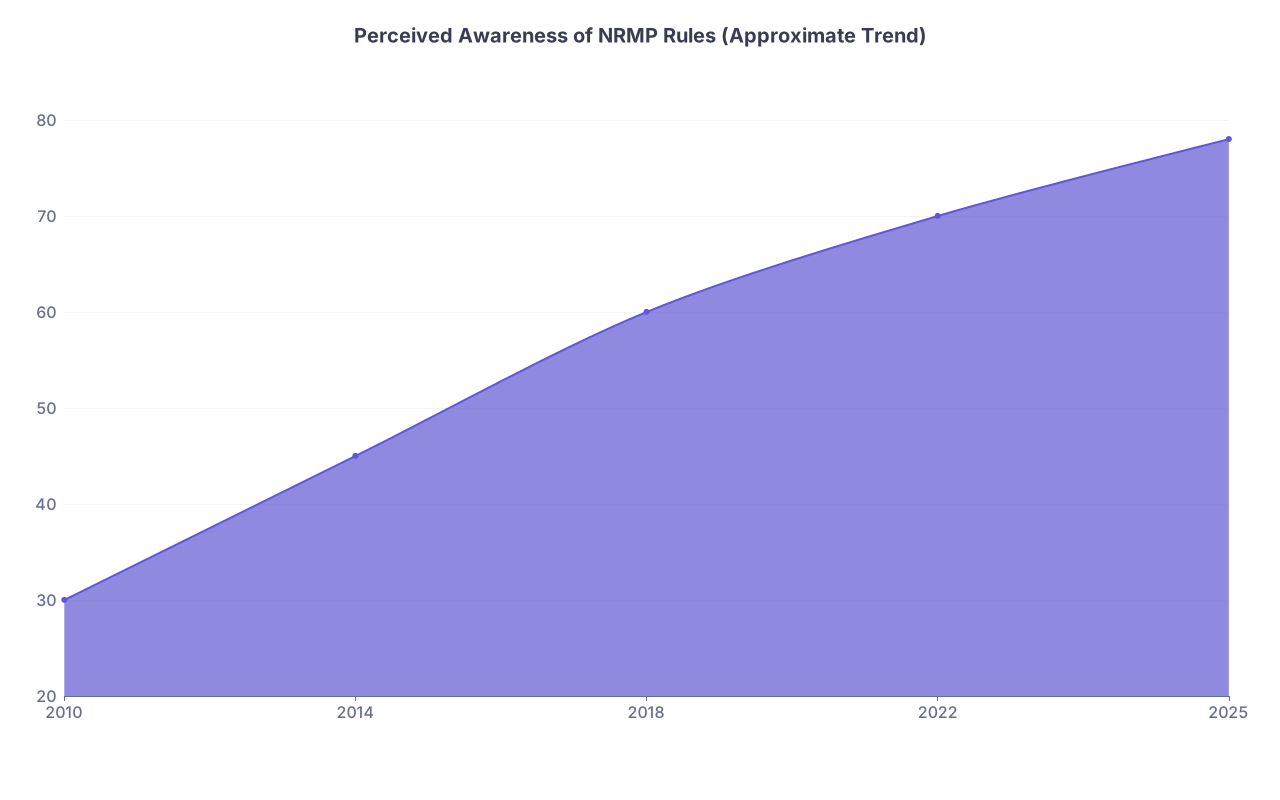
There is more online discussion (forums, social media, advisor guidance) about what is allowed. That correlates with fewer full-blown “I did not know this was illegal” cases.
| Category | Value |
|---|---|
| 2010 | 30 |
| 2014 | 45 |
| 2018 | 60 |
| 2022 | 70 |
| 2025 | 78 |
(Think of this as survey-style awareness: percentage of applicants who can correctly identify core NRMP rules. The exact numbers vary by study, but the upward trend is consistent.)
FAQ: Historical Trends in NRMP Match Violations
1. Are NRMP Match violations more common now than in 2010?
No. The total number of reported, sanctioned violations per cycle has been relatively stable or slightly declining since the early 2010s, despite growth in Match participation. What has changed is the mix of violations (more applicant-side reneging cases, fewer blatantly coercive program emails) and the clarity and severity of sanctions.
2. Do programs or applicants get sanctioned more often?
Historically, programs were more frequently cited for coercive ranking communications and early commitments. Over time, applicant-side violations—especially failing to honor the Match without an NRMP waiver—have become a larger share of citation lists. Both sides are at risk, but for different behaviors.
3. Is it an NRMP violation for me to tell multiple programs they are my “top choice”?
No, not from the NRMP’s perspective. The NRMP does not police the ethics of preference signaling beyond prohibiting coercion and binding commitments outside the Match. You may consider it ethically questionable, but it is not a rule violation. The line is crossed when programs demand rank disclosure or condition ranking decisions on promises.
4. What is the biggest single mistake that lands applicants on the NRMP violations report?
By frequency and impact since about 2014, failing to honor the Match commitment without obtaining an NRMP waiver is the top problem. That includes not starting at the matched program on July 1 or accepting another concurrent-year position without formal release. The sanctions are often multi-year bans from future Matches.
5. How can I report a suspected NRMP violation by a program?
You can submit a report directly to the NRMP, usually after the Match to avoid interfering with ongoing processes. Provide concrete evidence: emails, written offers, or documentation of coercive statements. The NRMP investigates, and if they confirm a violation, they can impose sanctions ranging from warnings to program suspensions and public posting.
Key points to carry forward:
- The data since 2010 show stable or slightly declining violation counts, but a clear shift in types and enforcement intensity.
- Coercive communications have become subtler; applicant-side failures to honor the Match have become more visible and more heavily punished.
- If you understand the Match Participation Agreement, avoid early commitments, and never break a Match contract without a waiver, your statistical risk of becoming an NRMP case study is essentially near zero.


