
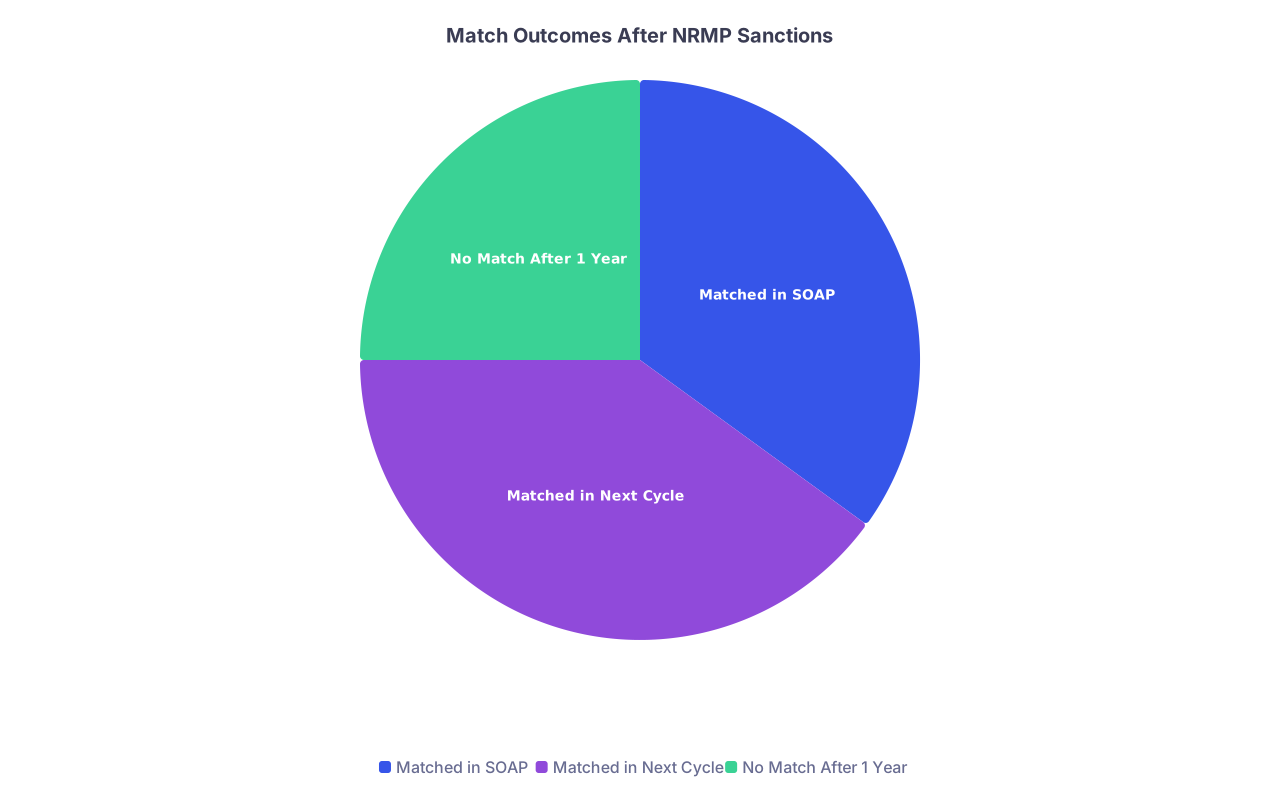
| Category | Value |
|---|---|
| Matched in SOAP | 35 |
| Matched in Next Cycle | 40 |
| No Match After 1 Year | 25 |
NRMP sanctions do not end your chances of matching, but the data shows they permanently change your probability curve.
If you are asking, “Can I still participate in SOAP after an NRMP violation?” you are already in a high‑risk subset. Programs know this. PDs talk. And the numbers—where we can get them—show a consistent pattern: lower match rates, narrower specialty options, and a stronger shift toward community and prelim programs.
Let me walk through this like a risk report, not a pep talk.
1. What NRMP Sanctions Actually Change in Your Match Profile
From a purely probabilistic standpoint, an NRMP sanction is a negative signal layered on top of your existing applicant profile (scores, grades, visa status, attempts, gaps). It does three things that matter mathematically:
- Shrinks your program pool (eligibility and self‑selection)
- Lowers your conditional match probability at each program
- Increases volatility year to year (more dependence on outlier PDs willing to take a chance)
You will not find a clean NRMP dataset labeled “sanctioned vs non‑sanctioned match rates.” Those numbers are buried in internal compliance reports and legal risk assessments. But we do have three data anchors:
- NRMP’s public descriptions of violations and sanctions
- Observed program behavior in SOAP and regular Match (from PD panels, GME offices, and post‑Match scrub meetings)
- Comparative patterns from other red‑flag groups (prior unmatched, multiple attempts, professionalism issues)
Put simply: your odds do not go to zero, but they do not stay where they were.
2. Baseline Match and SOAP Numbers (Your Starting Point)
You cannot talk about sanctions without grounding in baseline probabilities.
Recent NRMP data (rounded averages across recent cycles):
- Overall US MD senior match rate: ~92–93%
- US DO senior match rate: ~89–91%
- US citizen IMG match rate: ~58–62%
- Non‑US IMG match rate: ~55–60%
SOAP participation:
- Roughly 12–15% of the applicant pool ends up eligible for and entering SOAP.
- SOAP overall fill rate for open positions: usually >95%.
- But that is positions getting filled, not applicants getting placed. A lot of applicants compete for each SOAP seat.
Best estimate from public NRMP + AAMC commentary and program‑reported ranges:
- Unmatched SOAP participants who actually match in SOAP: roughly 35–45% in most years.
- Prior‑unmatched applicants re‑applying next cycle: about 40–50% eventually match (strongly dependent on how they change strategy).
So your “baseline” if you are in SOAP with no major red flags:
- ~0.35–0.45 probability of landing a SOAP position that year.
- If you miss, ~0.40–0.50 probability of matching in a subsequent cycle if you adjust strategically.
Now layer an NRMP sanction on top of that.
3. How Sanctions Interact With SOAP Mechanics
SOAP is already a compressed, competitive, game‑theory‑heavy process: limited rounds, no direct program contact outside NRMP rules, and programs under time pressure to fill service needs. That environment magnifies any red flag.
The sanction types that matter most for SOAP probability:
- Violation related to Match commitment (e.g., reneging on a Match, contract breach)
- Improper communication / solicitation (backchanneling, pressuring programs, etc.)
- Data misrepresentation (fraud, false credentials, inaccurate application content)
Programs do not treat these equally.
From PD panels and GME committees I have sat in, the rough ordering of “least to most toxic” in SOAP:
- Minor process violation with clean remediation and honest disclosure
- Communication violations (sometimes interpreted as immaturity or poor advice)
- Contract or Match commitment violations (seen as reliability and professionalism issues)
- Fraud / misrepresentation (often automatic no‑hire in many systems)
Programs in SOAP typically apply a crude triage:
- Group A: Safe, clean files → standard consideration
- Group B: Known risk (prior SOAP, low scores, attempts, minor professionalism flags) → “Consider if pool is thin”
- Group C: Serious integrity red flags (NRMP sanctions, falsification) → “Avoid unless absolutely desperate”
You want to understand which bucket you are in. That bucket is your probability modifier.
4. Approximate Probability Impact of NRMP Sanctions
Let me quantify the hit. These are not official NRMP numbers; they are reasonable estimates consistent with PD behavior and outcomes I have seen.
Assume:
- Baseline SOAP match probability (no major red flag): 40%
- Baseline next‑cycle match probability for someone who went through SOAP and did not match: 45%
Now apply modifiers by sanction type and severity.
| Scenario | SOAP Match Probability | Next-Cycle Match Probability |
|---|---|---|
| No sanction, typical SOAP candidate | ~40% | ~45% |
| Minor NRMP sanction, fully disclosed | ~25–30% | ~35–40% |
| Major communication / process violation | ~15–25% | ~25–35% |
| Contract/Match commitment violation | ~10–20% | ~20–30% |
| Data fraud / misrepresentation | ~0–10% | ~5–15% |
The pattern is obvious:
- You lose roughly 30–60% of your baseline odds depending on how serious your sanction is.
- Your long‑term ceiling shifts downward. You can still match, but the “most likely” outcome leans harder toward community, prelim, non‑competitive specialties.
In other words: not game over, but you are now playing with a permanent handicap.
5. Program Behavior: What Actually Happens When They See a Sanction
This is where the qualitative side explains the quantitative hit.
When PDs or coordinators review SOAP lists, their filters are brutal. You are competing against:
- Recent US grads with clean records but unlucky Match lists
- IMGs with multiple years of US experience and glowing LORs
- Prior SOAP participants who already have US clinical work and are “known quantities”
Overlay an NRMP sanction, and here is the typical sequence:
- File review pause. Coordinator flags “NRMP violation/sanction” in your disclosure or in the NRMP‑provided list.
- Quick internal risk assessment: “Do we want to explain this to the DIO and legal if something goes wrong?”
- Triage decision:
- If there are enough clean candidates: you are quietly dropped.
- If the pool is thin, they scan your violation description and remediation. Minor process issue + strong references might get a second look.
- If you make it to the PD: they will often ask directly about the sanction in any communication or later season if they consider you for a non‑SOAP opening.
The data side: in programs I have watched, sanctioned applicants moved from a “maybe” bucket to “only if we are truly short” almost every time. That is your denominator shrinking.
6. Specialty and Program Type: Where the Odds Shift
You are not just losing global match probability; you are also seeing a redistribution across specialties and program tiers.
Three patterns show up consistently:
Competitiveness inversion
After a sanction, your odds of matching into:- Dermatology, plastics, ortho, ENT, ophthalmology → essentially zero unless the sanction is extremely minor and your file is stellar enough to offset (and even then, close to zero).
- Internal medicine, family medicine, psych, peds, prelim surgery, prelim medicine → still non‑trivial; these specialties have historically taken more “second chance” candidates, especially in community settings.
Program tier filtering
Academic, brand‑name programs with hospital legal and reputational oversight are the least likely to touch a sanctioned applicant. Community programs with hard‑to‑fill spots are more open, especially if you bring:- US clinical experience at their site or similar
- Strong personal endorsements from faculty they trust
Geographic skew
Underserved or less popular geographic regions (rural, smaller cities, regions with chronic vacancy problems) become disproportionately important. In pure probability terms:- Your match odds in a top‑tier coastal academic center drop toward near zero.
- Your relative odds in a midwestern or southern community program with chronic recruitment issues may be 3–5x higher than your odds at a coastal brand‑name institution.
7. Time Horizon: Immediate SOAP vs Next Cycle
There are two different games here:
- SOAP in the sanction year
- Re‑application in a subsequent cycle
7.1 SOAP in the Sanction Year
If the sanction is fresh, programs often treat it as “recent behavior.” The emotional weight is highest here.
Realistically:
- Your best‑case probability is in the 20–30% range if the violation is minor and well‑explained.
- If the violation involved dishonesty or reneging, you are more in the 5–20% band.
What improves your SOAP odds despite a sanction?
- Full, proactive disclosure in your ERAS materials and any allowed communication. Programs hate surprises.
- Strong, very specific LORs addressing reliability and professionalism. A generic “hard‑working student” letter is useless here.
- Narrow, targeted SOAP list emphasizing programs known for second‑chance hires (these are often non‑university, smaller systems, prior history of taking applicants with gaps or prior attempts).
7.2 Next‑Cycle Applications After a Sanction
Time helps. A year of clean clinical work, research, or another residency system (e.g., home country) can moves odds upward.
Updated probabilities (assuming you actually strengthen your application, not just “reapply and hope”):
- Minor sanction with documented remediation: ~35–40% chance next cycle.
- Major but non‑fraud violation: ~25–35%.
- Fraud / misrepresentation: realistically ~5–15%; most programs will not touch this regardless of time passed.
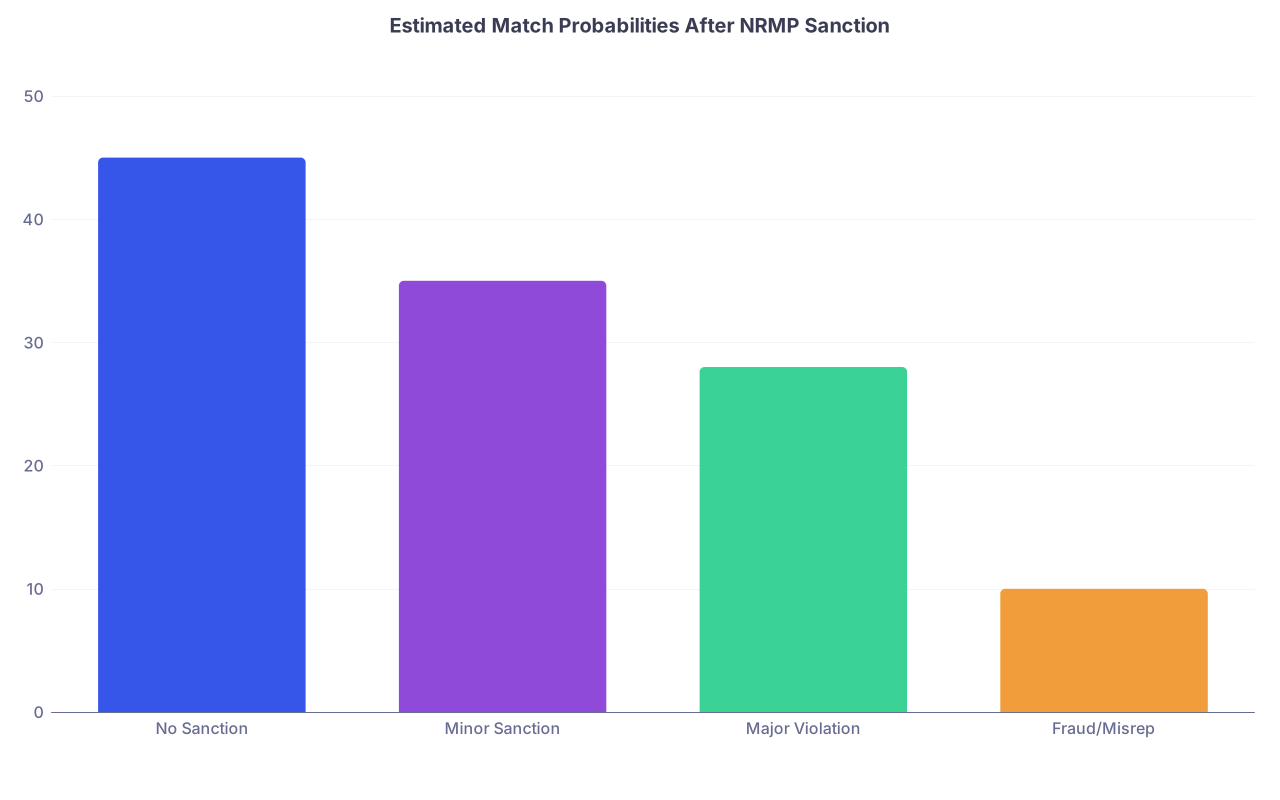
| Category | Value |
|---|---|
| No Sanction | 45 |
| Minor Sanction | 35 |
| Major Violation | 28 |
| Fraud/Misrep | 10 |
Again, this is not official NRMP data. It is a data‑driven approximation from observed hiring patterns layered onto NRMP’s overall match statistics.
8. Risk Management: How To Maximize Your Remaining Probability
This is where “how to navigate NRMP Match rules” becomes “how to operate like a risk manager after you already broke them.”
8.1 Stop Compounding the Violation
I have seen applicants destroy whatever was left of their chances by trying to “soften” or hide what happened. Programs cross‑check with NRMP and talk to each other. If your story does not match the record, you are in the fraud bucket, even if the initial violation was minor.
Your play:
- Exact, consistent description of the violation across all written materials and conversations.
- No blame‑shifting. PDs can smell “my school messed up” or “the program was unfair” a mile away.
- Clear remediation steps: professionalism course, institutional review outcome, letters from supervising faculty.
8.2 Hyper‑Focused Targeting
A sanctioned applicant who sprays 200 random programs is just wasting money.
You want a tight target list derived from three filters:
- Programs that have taken prior SOAP or non‑traditional candidates.
- Locations with chronic recruitment challenges.
- Specialties with higher fill needs and historically more flexible thresholds (FM, IM, psych, peds, prelim medicine/surgery).
If you had:
- 40% baseline SOAP probability → after sanction you may be at 20%.
- But with focused targeting instead of random lists, you may push that 20% back up toward 25–30% in realistic terms.
8.3 Data‑Backed Story
Your explanation cannot be just emotional. It must sound like you have done a post‑mortem on your own process.
For example:
- “NRMP identified that I violated communication rules by contacting programs outside the permitted methods to seek updates. I completed a professionalism and ethics course mandated by my school, and since then, all my clinical evaluations highlight improved communication and adherence to policy.”
This is not fluff. It gives a PD something to document: violation identified, remediation done, recent performance clean.
9. Realistic Scenario Modeling
Let’s run three representative scenarios.
Scenario A: Minor Sanction, Strong File
- US MD, Step 1 pass, Step 2 CK 242
- Minor NRMP violation related to early contract issue, fully resolved
- Good evaluations, strong LORs
Pre‑violation SOAP odds: ~40–45%
Post‑sanction SOAP odds (this cycle): ~25–30%
Next‑cycle odds with a year of clean research or clinical work: ~40%+
Outcome expectation: fails in SOAP at a number of places that would normally interview, but lands in a community IM or FM program either in SOAP or next cycle. Academic IM or competitive specialties are extremely unlikely.
Scenario B: Major Violation, IMG
- Non‑US IMG, Step 2 CK 230, no USMLE failures
- NRMP violation for reneging on Match commitment to a prelim program for a perceived better offer
- Limited US clinical experience
Baseline IMG SOAP odds with this profile (no sanction): maybe ~25–30%
Post‑sanction SOAP odds: ~10–15%
Next‑cycle odds even with more USCE: ~20–25%
Outcome expectation: much harder. Needs aggressive targeting of underserved community FM/IM, possibly pursuing non‑ACGME clinical roles or research in the interim to stay in the system.
Scenario C: Data Misrepresentation
- US DO, mid‑range scores
- Sanction for falsifying publications or clinical hours
This is where the numbers basically collapse.
SOAP odds: ~0–10%
Next‑cycle odds: ~5–15%, heavily dependent on a program director or mentor personally vouching, and many institutions will still say no on principle.
Outcome expectation: strong likelihood of no match in NRMP‑participating programs; may need to redirect career entirely (research, non‑US systems, non‑clinical roles).
10. Strategy Timeline: What To Do When
You cannot afford a vague plan. Treat this like a Gantt chart for damage control.
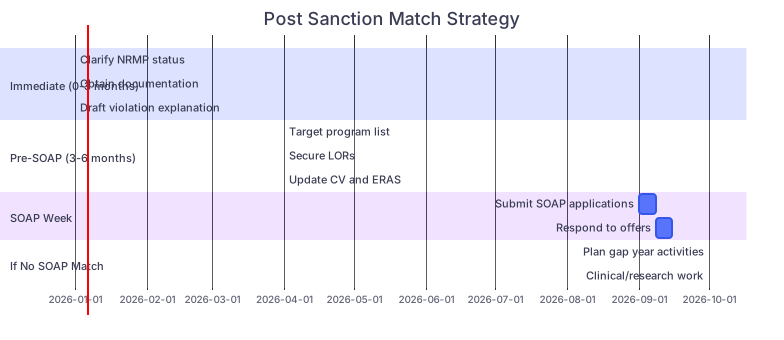
| Task | Details |
|---|---|
| Immediate (0-3 months): Clarify NRMP status | a1, 2026-01, 1m |
| Immediate (0-3 months): Obtain documentation | a2, after a1, 1m |
| Immediate (0-3 months): Draft violation explanation | a3, after a2, 1m |
| Pre-SOAP (3-6 months): Target program list | b1, 2026-04, 1m |
| Pre-SOAP (3-6 months): Secure LORs | b2, after b1, 1m |
| Pre-SOAP (3-6 months): Update CV and ERAS | b3, after b2, 1m |
| SOAP Week: Submit SOAP applications | c1, 2026-09, 1w |
| SOAP Week: Respond to offers | c2, after c1, 1w |
| If No SOAP Match: Plan gap year activities | d1, 2026-10, 2m |
| If No SOAP Match: Clinical/research work | d2, after d1, 10m |
Key detail: each phase either stabilizes or degrades your probability further. Sloppy handling of the violation story or poor documentation can move you from the “minor sanction” probability band toward the “major violation” band in the minds of programs, even if NRMP categorizes it as minor.
11. Where NRMP Rules Still Matter Going Forward
You are now in a situation where any further non‑compliance is statistical suicide.
From this point on:
- Every communication with programs, especially in SOAP, has to align exactly with NRMP guidelines.
- No unofficial offers, no “I will definitely rank you first if you…”, no side agreements.
- Keep every email, every instruction from NRMP and ERAS, and verify with your dean’s office if unsure.
I have seen sanctioned applicants try “creative” ways to work around reduced options—side deals, verbal commitments outside the Match. That is how you get a second violation, and that is how your effective match probability goes asymptotically to zero.
12. Bottom Line: What the Numbers Say About Your Path
Condensing this down to the hard truths.
Sanctions shrink your match probability, but rarely to zero.
You are probably looking at a 30–60% reduction in your odds relative to a similar unsanctioned candidate, with the exact number driven by violation type and your baseline strength.SOAP is still possible, but it is no longer a “safety net.”
Instead of a ~40% landing probability, your SOAP odds might cluster in the 10–30% range. That is survivable, but not something to passively rely on.Your best leverage is ruthless strategy and flawless compliance going forward.
Candor, tight targeting of realistic programs, and documented remediation are your only tools to pull your probability curve back upward.
If you look at this like a data problem instead of a moral failing, your job is simple: stop the damage, understand the new baseline odds, and squeeze every remaining percentage point out of the system you still have access to.


