

The blunt answer: you usually cannot just “withdraw from the Match” after submitting your rank list without consequences. But there are specific, narrow ways to back out correctly—and a lot of bad ways to blow up your career.
Let’s walk through exactly what’s allowed, what’s not, and what to do if you’re in trouble.
The Core Rule: The Rank List Deadline Is a Real Line in the Sand
Once the NRMP Rank Order List Certification Deadline passes, you’re effectively locked in.
Here’s the key principle the NRMP lives by:
If you’re in the Match and you submit a certified rank list, you’re obligated to accept a position if you match.
That obligation is:
- Binding under the NRMP Match Participation Agreement
- Enforceable across all NRMP-participating programs and institutions
- Taken very seriously—violations are reported and can follow you for years
So the realistic timeline looks like this:
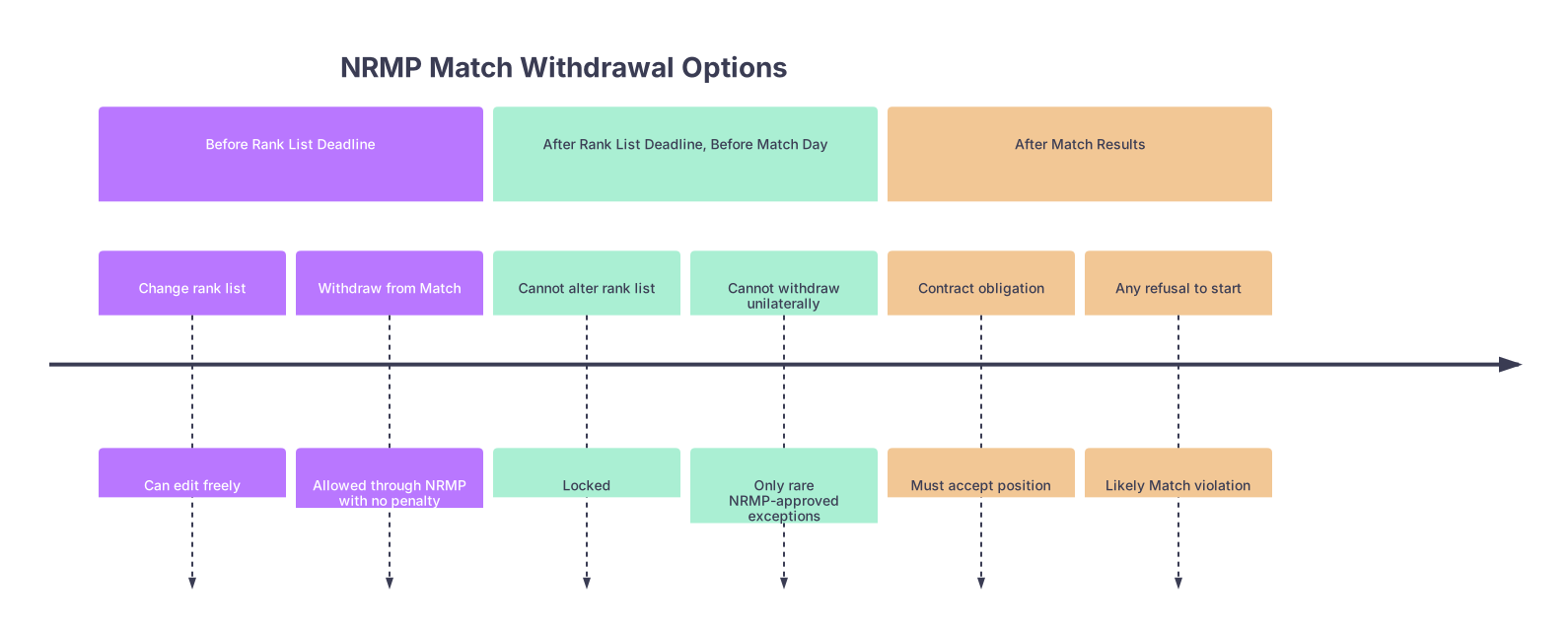
| Period | Event |
|---|---|
| Before Rank List Deadline - Change rank list | Can edit freely |
| Before Rank List Deadline - Withdraw from Match | Allowed through NRMP with no penalty |
| After Rank List Deadline, Before Match Day - Cannot alter rank list | Locked |
| After Rank List Deadline, Before Match Day - Cannot withdraw unilaterally | Only rare NRMP-approved exceptions |
| After Match Results - Contract obligation | Must accept position |
| After Match Results - Any refusal to start | Likely Match violation |
That’s the structure you’re up against.
Can You Withdraw After Submitting Your Rank List?
You’re really asking one of three different questions. Let’s separate them.
1. “Can I withdraw before the Rank List Certification Deadline?”
Yes. This is the clean withdrawal.
If you log into your NRMP account before the Rank Order List Certification Deadline, you can:
- Withdraw from the Match entirely
- Or leave yourself in, edit your list, or certify a new one
No violation. No drama. Programs won’t rank you higher because of it, but you aren’t breaking any rules.
If you’re even thinking about withdrawing, the safest move is to decide before that deadline.
2. “Can I withdraw after the Rank List Deadline but before Match results?”
Functionally: no—not in any normal, easy way.
Once the deadline passes:
- You can no longer edit or uncertify your list
- You can’t just log in and hit “withdraw”
- You are committed to whatever matching outcome happens
The NRMP does have an Extraordinary Circumstances Policy that allows withdrawal in rare, serious situations (e.g., catastrophic illness, visa denial, major legal/immigration barrier). But:
- You can’t self-withdraw
- Your school or institution usually has to be involved
- NRMP must approve it
- These are case-by-case and absolutely not guaranteed
If your “extraordinary circumstance” is:
- “I changed my mind about this specialty”
- “My partner matched somewhere else”
- “I got a non-clinical job opportunity”
- “I’m just not sure I want to do residency”
…that’s almost never going to meet the threshold for NRMP-approved withdrawal at this stage.
3. “Can I refuse my Match after Match Day?”
This is the dangerous one. You can physically refuse. But it’s almost always a Match violation.
What that looks like:
- You get your Match result (Monday or Friday, depending on main results vs SOAP)
- You decide not to sign the contract or not to start on July 1
- The program reports you to NRMP
- NRMP opens an investigation into a potential Match violation
NRMP generally sees this as:
- A “Failure to accept a position” violation
- A breach of the Match Participation Agreement
- Something they can (and do) sanction
Sanctions might include:
| Sanction Type | Typical Duration |
|---|---|
| Public posting of violation | 1–3 years |
| Bar from future Matches | 1+ cycle |
| Loss of ability to SOAP | 1+ cycle |
| Notice to med school | Variable |
| Notice to specialty boards | Case-dependent |
You don’t want any of that following you into fellowship or future licensing.
What Actually Counts as a Match Violation?
The NRMP has a formal list, but the big ones students hit in this situation are:
- Failing to accept an appointment: Not honoring the Match result
- Failing to start training: Not showing up or resigning before arriving
- Coercing or encouraging violations: A program or person telling you to break your Match obligation
NRMP is not bluffing here. I’ve seen residents get flagged for:
- Taking a “better” offer outside the Match after they’d already matched
- Backing out of a contract last-minute because of a partner’s job offer
- Trying to shop around their matched spot to other programs
Those stories make the rounds, and specialty PDs remember names.
Legitimate Reasons You Might Be Allowed to Withdraw
Let’s be precise. These are scenarios where NRMP may consider release:
Visa denial or insurmountable immigration barrier
You literally cannot start because of government restriction.Serious life event
Think new severe disability, terminal illness, major caregiving responsibility that makes relocation or full-time training impossible. Not “it would be hard” but “this is not feasible.”Program or institution closure / loss of accreditation
That’s on their side, and NRMP has mechanisms to deal with it.
But “I’m burned out” or “I want to reapply more competitively next year” does not usually qualify for release after the deadline.
What You Should Do If You’re Panicking Right Now
If you’ve already certified your rank list and you’re freaking out, here’s the calm, adult sequence:

| Step | Description |
|---|---|
| Step 1 | Feeling regret after certifying |
| Step 2 | Log in and withdraw officially |
| Step 3 | Talk to dean or advisor |
| Step 4 | Clarify your real issue |
| Step 5 | Dean contacts NRMP |
| Step 6 | Plan to honor Match and reassess later |
| Step 7 | Before rank deadline? |
| Step 8 | Extraordinary circumstance? |
Step by step:
Check the calendar
Make sure the Rank Order List Certification Deadline has actually passed. If not, log into NRMP right now and decide.Talk to someone who knows the rules
Your best bets:- Dean of Student Affairs
- Your school’s NRMP or Match advisor
- A trusted program director or faculty mentor (not gossiping co-residents)
Get brutally honest with yourself about your reason
Are you:- Just anxious? (normal)
- Having real doubts about medicine/residency entirely?
- Facing a concrete barrier (visa, health, legal, family crisis)?
If it might be an extraordinary circumstance
Your dean or institutional official should contact the NRMP. You don’t freelance this. You don’t email NRMP saying “I changed my mind, help.”If it’s not extraordinary
Your safest play, almost always:- Proceed with the Match
- Start the residency
- If it’s truly not workable after you start, resign properly through hospital channels instead of blowing up the Match
Is resigning from a program clean and risk-free? No. But it’s way less radioactive than a clear-cut NRMP Match violation.
What If You Want to Sit Out and Reapply Next Year?
Hard truth: the time to decide that is before ranking.
If you already certified and the deadline passed, your options are limited:
If you don’t match at all (you’re unmatched Monday of Match Week):
You can choose not to participate in SOAP and not scramble. That’s within your rights.If you do match:
- You’re expected to start that position
- If you refuse, you risk a violation that can hurt your chances of ever matching again
- Programs next year will see that you bailed and rightly worry
If you’re early enough in the process reading this and truly want to sit out a cycle, the cleaner path is:
- Withdraw from the Match before the rank list deadline
- Get formal advising on how to frame this gap year and next application
- Plan something structured for the year (research, MPH, structured work, etc.)
What About DO Students, Military Match, or Other Systems?
NRMP rules specifically cover:
- Main Residency Match
- Most fellowship matches run by NRMP
If you’re in:
- The military match (e.g., HPSP, USUHS)
- The San Francisco Match (ophthalmology)
- The AUA Match (urology)
- A non-NRMP specialty process
They each have their own binding rules and penalties. Different organizations, same basic idea: once you commit and match, you’re supposed to show up.
Still, if NRMP is involved at any point of your training, a violation anywhere can raise eyebrows.
How Programs View Withdrawals and No-Shows
Residency programs talk. PD listservs exist. Gossip travels.
From the program side, what really irritates them:
- Applicants who “ghost” after matching
- Trainees who accept a contract, then vanish in June
- People who leverage a Match result just to get a better outside offer
Programs invest money and effort in onboarding—credentialing, scheduling clinic, arranging call coverage. Backing out last-minute:
- Leaves them short-staffed
- Forces other residents to pick up the slack
- Can lead to real patient care disruptions
That’s why NRMP takes it seriously and why PDs remember names of people who walked away.
If You’re Miserable But Already in Training
This is the scenario no one explains well:
You matched. You started. It’s terrible. You want out.
At this point, NRMP is mostly out of the picture—your Match obligation was to start and accept the appointment. The rest is:
- A contract between you and the institution
- An HR and GME (Graduate Medical Education) issue, not an NRMP one
Better options than vanishing:
- Talk to your PD or APD honestly (yes, scary, I know)
- Loop in the Designated Institutional Official (DIO) or GME office
- Look into transfers, leave of absence, or switching specialties within the same institution
You might still take a reputational hit, but it’s much more survivable than a blatant Match violation.
Quick Decision Framework
You want something brutally simple? Use this:
Before rank list deadline?
- Unsure or leaning “no”? Strongly consider withdrawing.
After deadline, before results, no catastrophe?
- You’re riding this out. Prepare mentally and practically.
Matched and want to bail for non-catastrophic reasons?
- Expect possible NRMP violation. Don’t do this lightly, and only after real legal/advising input.
Already in residency and miserable?
- This is now a GME/contract problem. Talk to PD/GME, not NRMP.
FAQ: Can I Withdraw From the Match After Submitting My Rank List?
1. Can I log into NRMP and withdraw after the Rank Order List Certification Deadline?
No. Once the deadline passes, you can’t change or uncertify your list, and you can’t simply withdraw yourself. Any withdrawal after that point has to go through NRMP and usually requires an extraordinary circumstance and institutional involvement.
2. What happens if I match but refuse to sign the contract or don’t show up?
That’s usually treated as a Match violation: failure to accept an appointment. NRMP can investigate and impose sanctions like public posting of your name, barring you from future Matches or SOAP, and notifying your school and relevant organizations. Programs will also remember.
3. Can I get out of the Match if I have a serious family or health issue?
Maybe. Truly serious, documented issues—like major illness, disability, or life circumstances that make training impossible—might qualify for NRMP-approved withdrawal. This isn’t automatic. Your dean or institutional official should contact NRMP, and they decide case by case.
4. If I know I don’t want to start residency this year, what’s the safest way to handle it?
Withdraw from the Match before the rank list deadline. Then work with your school or mentors to plan your year and your reapplication. Sitting through the Match, then refusing your spot, is the worst way to do this and can damage your long-term prospects.
5. What if I don’t match—am I obligated to do SOAP or take any offer I get there?
No. If you’re unmatched, you’re not obligated to participate in SOAP, and you aren’t required to accept any SOAP offer. Your binding obligation is only to positions you match to through NRMP. If you stay unmatched, you can choose to sit out and apply again.
6. I started residency and hate it. Is quitting now an NRMP violation?
Usually no, as long as you accepted and started the position in good faith. At that point, your relationship is governed by your employment contract and institutional policies, not NRMP. You’d need to resign or negotiate with your program and GME office, but it’s generally not an NRMP Match violation unless something else shady is going on.
Bottom line: The time to safely withdraw from the Match is before the rank list deadline. After that, you’re essentially locked in unless something truly extraordinary happens and NRMP approves a release. If you’re panicking, talk to your dean or advisor now—don’t improvise your way into a Match violation.


