

Most applicants misunderstand NRMP rules for SOAP so badly they unintentionally flirt with violations.
Let me be blunt: the rule set for SOAP is not just “Match rules, but faster.” SOAP is a different legal and operational regime layered on top of the Main Match. Same contract (the Match Participation Agreement), but the way it bites you is very different hour‑to‑hour in Match Week.
If you treat SOAP like a frantic job fair, you will break rules. If you treat it like a highly scripted protocol with strict communication and offer rules, you will stay out of trouble.
I am going to walk you through this like I would a nervous MS4 in February: point‑by‑point, what changes between Main Match and SOAP from a rules and mechanics standpoint.
1. Core Framework: What Stays the Same, What Completely Changes
Start here: NRMP has one governing contract – the Match Participation Agreement (MPA). It applies to both the Main Residency Match and SOAP. But the way that agreement is enforced during SOAP is much more intrusive.
High‑level:
- Same:
- Binding nature of matches and SOAP acceptances
- Prohibition on coercion, side deals, and “contingent” ranking or acceptance
- Professionalism and no discrimination rules
- Different:
- Communication restrictions during SOAP (very tight)
- Offer mechanics (algorithmic vs manual)
- Applicant and program autonomy windows
- How “withdrawal” and “binding commitment” are operationalized
Let us put that into structure.
| Domain | Main Match | SOAP |
|---|---|---|
| Matching engine | Rank-order algorithm | Multiple timed offer rounds |
| Binding event | Match Day result | Acceptance of a SOAP offer |
| Communication rules | General professionalism | Strict, time‑limited contact restrictions |
| Application system | ERAS open season | ERAS opened in phases, capped programs |
| Program control | Via rank list | Via interviewing/screening + offers |
| Applicant control | Rank list submitted once | Real‑time accept/hold/decline decisions |
2. Eligibility and Participation: Who Is Even Allowed in Each
Main Match rules: broad participation, early cutoffs
For the Main Match:
- You sign the NRMP Match Participation Agreement (MPA) when you register.
- Once you certify a rank list and the deadline passes, you are fully committed to abide by the outcome.
- If you match, you are out of SOAP by definition. You cannot “shop around” in SOAP for a better offer.
For SOAP:
You do not “apply” to SOAP. You either become SOAP‑eligible automatically, or you do not.
You are SOAP‑eligible if:
- You registered for the Match and did not withdraw.
- You are unmatched or partially matched at the start of Match Week (after the algorithm runs).
- You are not excluded for disciplinary or policy reasons (NRMP or institutional).
You are NOT SOAP‑eligible if:
- You withdrew from the Match prior to the ranking deadline.
- You never registered for NRMP.
- You were matched to a preliminary AND an advanced position that fully covers your training path.
- You are in violation status with NRMP (rare, but it happens).
So the big difference:
- Main Match: you decide to participate months in advance.
- SOAP: NRMP decides, based on your status after the algorithm runs.
NRMP publishes SOAP‑eligible lists to programs. That list is not a suggestion. Programs cannot SOAP with anyone outside it.
3. Timeline and Process Mechanics: Algorithm vs Offer Rounds
The Main Match is a single, batch algorithm. SOAP is a multi‑round, semi‑manual process on a hyper‑compressed timeline.
Let me sketch it.

| Step | Description |
|---|---|
| Step 1 | Register with NRMP |
| Step 2 | Submit Rank Lists |
| Step 3 | Match Algorithm Runs |
| Step 4 | Main Match Binding Contract |
| Step 5 | SOAP Eligible List |
| Step 6 | SOAP Application Period |
| Step 7 | SOAP Offer Rounds |
| Step 8 | SOAP Acceptances Binding |
| Step 9 | Matched? |
Main Match mechanics
- Programs and applicants both submit rank order lists (ROLs).
- Algorithm runs once.
- Result is binding for both parties.
- No offers, no negotiation, no timed rounds. It is entirely algorithmic.
SOAP mechanics
SOAP replaces the old “Scramble.” It is tightly scripted:
- Monday of Match Week: You learn “Matched” vs “Unmatched/Partially Matched”.
- Unfilled program list opens to SOAP‑eligible applicants.
- ERAS limits how many programs you can apply to in SOAP (30 programs for most specialties in recent cycles, though check current NRMP/ERAS rules each year).
- Programs review applications, can contact you (within rules), and decide which applicants to list for offers.
Then:
- SOAP runs in multiple offer rounds (historically 4).
- In each round, programs submit preference lists for the unfilled positions.
- NRMP’s SOAP system generates offers to applicants, but only one offer per position per round.
- You either:
- Accept (binding, you are done for that track),
- Accept and withdraw from other applications in that specialty category, or
- Decline / let it expire and hope for later rounds.
Key difference: the Main Match algorithm optimizes globally across all preferences. SOAP rounds are much more local and sequential. It feels more like a controlled job fair than a true algorithmic match.
4. Communication Rules: Normal Professionalism vs Near‑Quarantine
This is the part where people get burned.
During the Main Match season, NRMP rules around communication are mostly about:
- No soliciting explicit rank commitments (“rank us first and we will rank you highly” type nonsense).
- No misleading statements.
- No coercion or conditional ranking promises.
- No asking for or requiring info about other programs on your list.
You can:
- Email programs.
- Take phone calls.
- Attend second looks.
- Clarify interest.
- Stay in regular, professional contact.
SOAP is nothing like that.
SOAP communication blackout rules
During SOAP, the NRMP and ERAS rules impose tight restrictions on:
- Who can contact whom.
- About what.
- At what time.
The short version:
- Programs cannot initiate unsolicited contact with applicants before they receive applications.
- Once SOAP starts, any contact has to be strictly recruitment‑related, not about offering positions outside SOAP.
- Programs cannot offer positions or “promise a spot” outside the SOAP offer process. Verbal side deals are violations.
- Applicants cannot ask programs to circumvent SOAP by “holding a spot” or creating some off‑the‑books arrangement.
There are also institutional intermediaries:
- Many schools require SOAP‑eligible students to coordinate communication through a dean’s office or designated SOAP advisor, especially early in the process.
- Hospitals and programs are specifically warned: do not contact applicants outside the permitted channels, especially not to make offers.
If you are unmatched and you email an unfilled program on Monday saying “I’m very interested in your position, can you consider me?”, that is typically OK once SOAP applications are open and you are using ERAS. If you email “Can you just take me now, I’ll withdraw from SOAP?”, that is a problem.
The main conceptual shift:
- Main Match: communication rules focus on ranking behavior and fairness.
- SOAP: communication rules focus on preventing chaos and back‑channel deals in a compressed emergency market.
5. Binding Commitments: Match Result vs SOAP Acceptance
This is the part people underestimate. A SOAP acceptance is just as binding under NRMP rules as a Main Match result.
Main Match binding rules
If you match to a program:
- You are contractually obligated to begin training there in the designated year.
- You cannot sign another contract for a position that overlaps in time with your matched start date.
- Programs are likewise obligated to train you for at least one year (barring usual employment issues like license problems, gross misconduct, etc.).
NRMP takes this seriously. Violations lead to:
- Bars from future participation.
- Public listing in violation reports (programs do check these).
- Potential institutional reporting.
SOAP binding rules
During SOAP:
- When you accept an offer in SOAP, that acceptance is binding in exactly the same sense.
- You cannot then accept a different position that conflicts with that acceptance.
- Programs cannot withdraw the position to offer it to someone else because a “better” candidate appeared next round.
And there is an extra layer:
- If you accept a SOAP position, you are immediately removed from further SOAP participation for positions of that type (e.g., same program type and training year). You are essentially “matched” through SOAP.
- If you decline or let offers expire, you remain eligible for later rounds, but there is no guarantee you will see new offers.
This is where people get into trouble. They mentally treat SOAP like a tentative negotiation. It is not. The moment you click “accept,” you are done, and NRMP treats that as your match.
6. Application and Program Limits: Open Season vs Strict Caps
Another technical difference: how many places you can target and how programs can manage those positions.
Main Match – wide open
- Through ERAS, you can apply to as many programs as you can afford.
- No NRMP cap on number of programs you can rank (practically, you hit 100+ and it is just noise, but it is allowed).
- Programs can rank any number of applicants.
SOAP – capped and structured
For SOAP:
- NRMP/ERAS limit the number of programs you can apply to during SOAP.
- Historically, that cap has been 30 programs total per applicant for the entire SOAP (not per round). Some specialties or years have nuances, but the presence of a cap is constant.
- You need to be strategic. You cannot shotgun 80 programs Monday afternoon.
Programs, for their part:
- Are restricted to offering positions only to SOAP‑eligible applicants via the SOAP rounds.
- Cannot create new NRMP positions during SOAP. They can only fill already registered, unfilled NRMP positions or officially added NRMP positions in a rule‑compliant way (details vary by year but always structured).
- Must abide by the NRMP list of unfilled positions; they cannot “hide” funded unfilled slots from SOAP to reserve them for off‑cycle hires during Match Week.
This is precisely why programs get edgy about communication during SOAP. They know NRMP audits patterns of offer/acceptance around unfilled positions.
7. Program Side Rules: Ranking vs Real‑Time Selection
From the program perspective, the rule environment shifts dramatically between Main Match and SOAP.
Program rules – Main Match
For Main Match:
- Programs must:
- Certify a rank list by the deadline.
- Not manipulate their rank order list in ways that violate NRMP rules (e.g., moving up applicants who say they will rank the program first – explicitly conditional ranking is prohibited).
- Not pressure applicants into signaling ranks.
Once lists are submitted:
- They cannot change them after the deadline.
- They have no further active control; the algorithm decides.
Program rules – SOAP
During SOAP, programs must:
- Use the SOAP system to extend offers.
- Submit preference lists for each round that determine who gets offers.
- Avoid any off‑system or pre‑arranged offers.
Two key rule contrasts:
No contingent offers.
A program cannot say, “If you reject that other SOAP offer, we promise you a spot in round 2.” They can communicate interest. They cannot promise outcomes.No dual‑tracking same position.
A program with an unfilled categorical IM spot cannot tell a candidate, “We will give you this as a non‑NRMP contract starting the same date if you do X.” That is a direct NRMP violation.
Once SOAP ends, any remaining unfilled positions can be filled outside NRMP, but only after the SOAP period formally closes.
8. Enforcement and Violations: Where NRMP Actually Cares More
NRMP has teeth, and SOAP is where you see them used because the chaos invites shortcuts.
Types of violations that look different in SOAP vs Main Match
Common Main Match violations:
- Dishonest ranking behavior, like telling multiple applicants they are “ranked to match” when that is mathematically impossible.
- Asking an applicant to disclose rank order of programs.
- Requiring pre‑employment contracts before Match results.
Common SOAP‑specific violations:
- Programs offering positions directly by phone/email, circumventing SOAP.
- Applicants agreeing to start at a program (written or verbal) outside the SOAP offer mechanism while remaining SOAP‑eligible.
- Institutions coordinating side arrangements between their own unmatched grads and affiliated programs that bypass the SOAP system.
- Premature communication before SOAP opens, especially around “reserved” spots.
NRMP can respond with:
- Match participation bars (for individuals or programs).
- Public shame (violation reports that live on the NRMP site).
- Requirements for institutional corrective plans.
I have seen residents discover their future program’s prior NRMP violation status on Google. It colors everything.
9. Practical Scenarios: Same Situation, Different Rules
Let us compare a few scenarios where people get confused.
Scenario 1: “We really want you here.”
Main Match (January email): Program emails you: “You are ranked highly, and we believe you will be an excellent fit.”
NRMP stance: Allowed, as long as they do not explicitly say “We will rank you to match if you rank us first.”SOAP (Tuesday phone call): PD calls: “We really want you here. If you see an offer from us, take it.”
NRMP stance: Generally OK optimism. The line is crossed if they say “We guarantee you an offer next round if you decline others,” which becomes a contingent promise around SOAP mechanics.
Scenario 2: Side agreement
Main Match (February): Program says, “If you do not match here, we will consider you for a non‑NRMP off‑cycle position for the following year.”
Risky, but if it is truly for a position not in NRMP and not overlapping the Match year, it can be OK.SOAP (Wednesday): Unfilled program emails: “We cannot do SOAP with you, but if you agree not to pursue SOAP offers, we will hire you directly for the same July start.”
Clear violation. They are circumventing SOAP rules and the unfilled list system.
Scenario 3: Multiple offers
Main Match: Not possible. You get one match result. No real‑time choice.
SOAP: You can get simultaneous offers in a round if they are for different program types (e.g., prelim vs categorical) depending on the rules that year. But accepting one will typically remove you from eligibility for others that conflict. You must understand the structure for that cycle.
10. Strategy Shifts: How You Should Behave Differently
This is not a “how to SOAP” guide. But the rule differences should change your behavior.
For Main Match:
- Focus on honest, professional communication.
- Ignore noise about “I will rank you highly” – it does not change the rules.
- Do not talk about how you are ranking others.
For SOAP:
- Do not initiate or entertain any side deals that sound like “off‑the‑books” offers.
- Route key questions through your dean’s office or advisor; they often have direct NRMP guidance.
- Treat the ERAS cap as real. Use it strategically based on realistic interest and interview experience.
- When an offer comes, decide quickly but understand: accept = binding contract, same as Match.
And mentally: SOAP is not a second‑class match. It is the same NRMP system with a different engine.
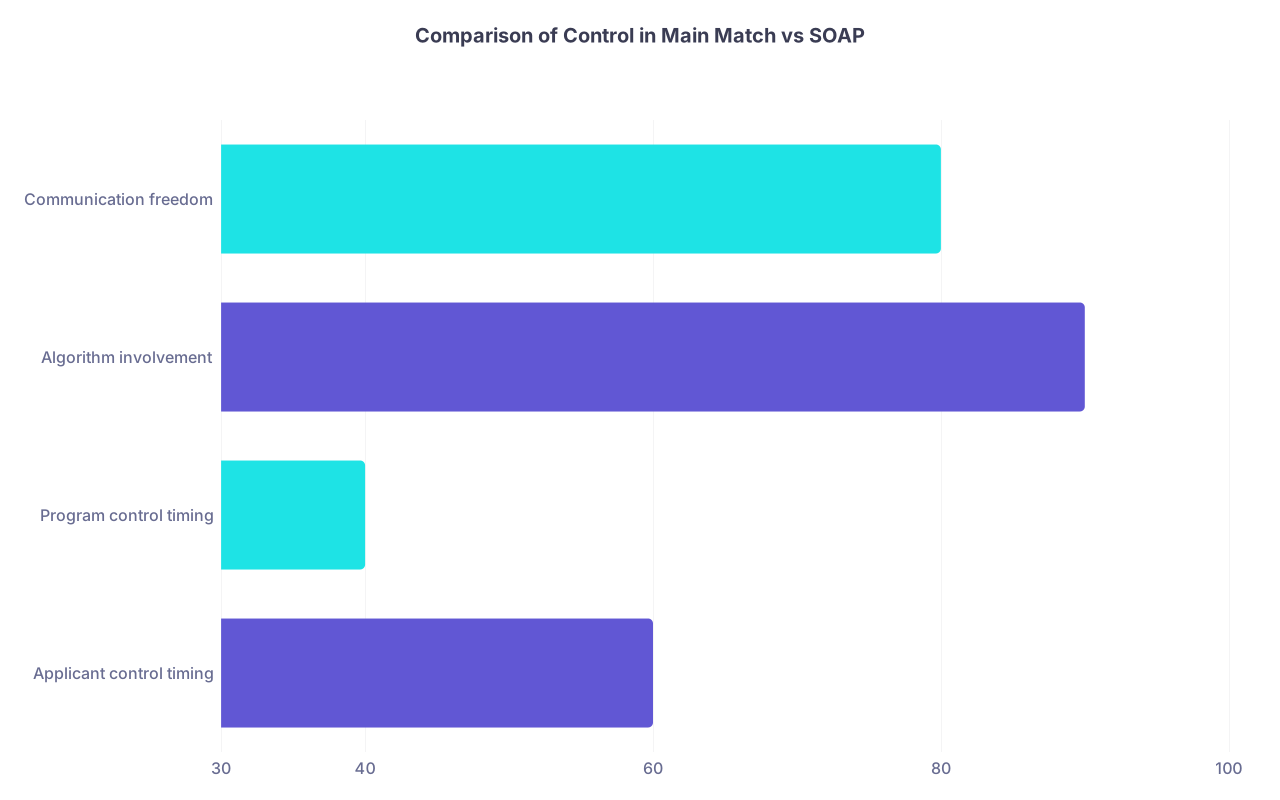
| Category | Value |
|---|---|
| Applicant control timing | 60 |
| Program control timing | 40 |
| Algorithm involvement | 90 |
| Communication freedom | 80 |
(Interpretation: Main Match is dominated by the algorithm with broad communication; SOAP shifts control in time and clamps down on freedom of contact.)
11. Advanced Technical Points People Rarely Explain Clearly
A few nuanced rule differences matter for edge cases.
Partially matched applicants
If you are partially matched (for example, matched to an advanced PGY‑2 position but no prelim PGY‑1 year):
- In the Main Match, your advanced position is already binding.
- In SOAP, you are only eligible to participate for the missing component (e.g., prelim year), not for new categorical spots that would conflict with your already matched position.
- You cannot SOAP into a different categorical that starts at the same time and abandon the advanced match. NRMP will treat that as a violation.
Different program types and “categories”
NRMP treats program types (categorical, prelim, advanced, physician‑only) and PGY levels as distinct buckets. During SOAP:
- Rules about how many simultaneous offers you can hold, and which acceptances remove you from other pools, depend on those categories.
- A common pattern: Accepting a categorical PGY‑1 position may remove you from eligibility for other categorical PGY‑1 SOAP offers but could leave you eligible for unrelated PGY‑2 physician‑only tracks, depending on the cycle’s rules.
You must read the current year NRMP SOAP handbook. Not a blog post. The actual handbook.
Post‑SOAP hiring
Once SOAP ends and Match Week closes:
- NRMP’s strict SOAP communication rules lift.
- Programs can fill remaining vacancies outside NRMP (e.g., via direct hire).
- However, they still cannot induce people to break binding NRMP commitments. Your SOAP or Main Match contract remains enforceable.

12. Quick Comparative Snapshot
For your brain, one more compressed comparison.
| Aspect | Main Match | SOAP |
|---|---|---|
| Match engine | Single algorithm | Multiple timed offer rounds |
| Entry decision | You choose to register | NRMP flags you as SOAP‑eligible |
| Communication scope | Broad, with rank‑talk limits | Narrow, anti‑scramble, no side offers |
| Binding event | Match result | SOAP offer acceptance |
| App volume | Essentially unlimited via ERAS | Strict NRMP/ERAS program cap |
| Off‑system hiring | Before/after Match, but constrained | Forbidden during SOAP for NRMP positions |

FAQs (Exactly 6)
1. If I accept a SOAP offer, can I later decline it if I get a better non‑NRMP position?
No. An accepted SOAP offer is a binding commitment under the NRMP Match Participation Agreement. Taking a different position that conflicts with that commitment, whether NRMP or not, can be treated as a match violation. Programs and state boards do see these violation reports.
2. Can a program tell me they will hire me directly if I skip SOAP?
During SOAP, no. Programs are prohibited from offering, promising, or arranging NRMP‑eligible positions outside the SOAP mechanism for the current Match cycle. If a program proposes that kind of side deal during Match Week, they are flirting with an NRMP violation. You should loop in your dean’s office before responding.
3. I am partially matched. Can I use SOAP to change specialties completely?
Practically, no. If you matched to any NRMP position (say, an advanced anesthesiology slot) you are bound to that. SOAP is meant to fill gaps in your training path (like a missing prelim year), not to replace an already matched position with a new categorical in another field. Using SOAP to escape a prior match is a violation.
4. Are SOAP interviews and calls recorded or monitored by NRMP?
NRMP does not sit on your phone line, but they very much audit patterns of offers and acceptances and investigate complaints. If there is evidence (emails, documented calls, consistent reports) of side deals or off‑system offers, they open formal violation investigations. Do not assume “no one will know” during SOAP; programs in particular are under scrutiny.
5. Can I apply to more programs in SOAP if I used fewer than my cap in the first round?
Yes, within the total cap for the entire SOAP period. If the cap is 30 and you send 18 applications in the first window, you typically have 12 “slots” left to use in later windows as new unfilled positions appear. You cannot exceed the total cap by spreading applications over multiple rounds.
6. Do the NRMP rules about post‑interview communication still apply during SOAP?
Yes, but the focus shifts. You still cannot be asked to reveal your ranking plans or pressured into specific commitments. During SOAP, the bigger issues are: no offers or promises outside SOAP, no coercion to decline other SOAP offers, and no conditional arrangements around future hiring. The same professionalism expectation holds, but the specific hazards change.
If you remember nothing else:
- The Main Match is an algorithm; SOAP is a controlled emergency marketplace with much stricter communication and offer rules.
- A SOAP acceptance binds you just as strongly as a Main Match result — do not treat it as negotiable.
- Any attempt by you or a program to go “off system” during SOAP is exactly what NRMP enforces against most aggressively.


