

It is mid-January. Your interview season is tapering off. Your inbox is a strange mix of “You were a pleasure to meet,” deafening silence, and the occasional “You are ranked to match” email that makes your stomach drop because you vaguely remember that might be… illegal?
You want to be honest with programs you liked. You want to ask where you stand. You want to show interest without violating NRMP rules or freaking out a program coordinator who forwards your email to GME with “Is this okay??”
This is where most applicants get into trouble: not with the match algorithm, but with the communication rules wrapped around it. And the real problem is nobody ever sits you down and translates the NRMP’s legalese into: “Here’s exactly what you can say” and “Here’s the line you do not cross.”
That is what I am going to do here. Line-by-line style. And every rule will have two things:
- A plain-English explanation.
- Safe example phrases you can copy, and dangerous phrases you should avoid.
The Core NRMP Rule: No Commitments, No Pressure
The NRMP’s match communication policies live inside the Match Participation Agreement and associated policies. The heart of it is simple:
Programs and applicants:
- May express interest.
- May not ask for or make commitments about ranking.
- May not pressure the other side to reveal their rank list.
Let me break down the big pieces.
1. You May Express Interest – But Not Commitments
The NRMP explicitly allows both applicants and programs to say they are interested. What it does not allow is any contractual or coercive element tied to the rank list.
What the rule means in practice
You are allowed to:
- Tell a program you liked them a lot.
- Say they are “one of your top choices.”
- Thank them and reiterate your interest.
You are not allowed to:
- Make a promise like “I will rank you number 1.”
- Demand a promise like “Will you rank me to match?”
- Turn any of that into a condition: “If you rank me highly, I will rank you number 1.”
Applicant-safe phrases (green zone)
These are boring, professional, and 100% safe:
- “Thank you again for the opportunity to interview. I remain very interested in your program and believe it would be an excellent fit for my training.”
- “After completing my interviews, your program remains one of my top choices due to your strong critical care exposure and resident camaraderie.”
- “I would be thrilled to match at your program and appreciate the chance to be considered.”
All of these express enthusiasm. None of them state or request rank positions. That is the key.
Risky phrases (yellow to red zone)
These edge toward or cross the line:
“You are my top choice.”
NRMP does not explicitly ban that sentence, but this is where I see trouble. Programs may interpret it as a commitment, and it places pressure on both sides. You will also change your mind on February 28 at 2:00 a.m., staring at your rank list.“I plan to rank you number one.”
This is effectively a commitment. The NRMP has historically discouraged “I will rank you #1” language, especially when there is any suggestion of quid pro quo. If you later change your list, you have broken your promise, which is not an NRMP violation per se, but it is dishonest and can come back to haunt you.“If you rank me highly, I will rank you number one.”
This crosses into quid pro quo territory. That is clearly incompatible with NRMP rules and with the spirit of the match.
Applicant policy takeaway:
Express enthusiasm and fit. Avoid numbers, promises, and conditional language.
2. Programs Cannot Ask How You Will Rank Them
This is one of the most important lines for you:
Programs may not require you to reveal your rank list, nor may they condition anything (interview, rank position, etc.) on you revealing it.
So when you get the classic question: “If we ranked you highly, how would you rank us?” that is a problem. They are not allowed to ask that.
How to handle illegal or uncomfortable questions
You need ready-made phrases, because your brain goes blank in the actual moment.
On the interview day (spoken):
- “I am still finalizing my rank list, but I can say that I am very interested in your program and could see myself thriving here.”
- “I am not prepared to discuss my specific ranking, but your program is a strong fit, and I would be very happy to train here.”
Post-interview (email reply):
- “Per NRMP policy, I am not able to disclose my rank list, but I can share that I remain very interested in your program and appreciate being considered.”
That last one does two things:
- It gently flags that you actually know the rules.
- It still signals interest, so you do not sound evasive or negative.
Do you report them?
If a program clearly pressures you or repeatedly asks you to disclose your rank position, that is an NRMP policy issue. You can:
- Document the interaction (save emails, write down what was said).
- Optionally contact your dean’s office or GME office for advice.
- Report to NRMP if it is egregious or systematic.
Most of you will not file a report. Fine. At minimum, do not get dragged into committing yourself over email because you felt cornered.
3. Programs Cannot “Guarantee” You a Position
You will see versions of this every season:
- “We will be ranking you to match.”
- “We intend to rank you very highly.”
- “We hope to work with you next year.”
Some programs skate close to the line out of habit, ignorance, or arrogance.
The NRMP prohibits programs from committing positions outside the match and from misrepresenting that someone is “guaranteed” a position. Saying “we will rank you to match” is risky on their side. For you, the danger is psychological: you start building your list based on promises that mean nothing.
How to interpret these “encouraging” emails
Let me be blunt:
Treat every “You are ranked to match” message as noise. It has no binding effect. It does not predict anything. Programs misjudge their rank lists every single year.
Your behavior should not change:
- Do not move a program higher just because they flattered you.
- Do not move a program lower out of spite if another did not email you.
- Rank based on where you actually want to train, full stop.
Safe ways to respond (if you choose to reply)
You are not required to respond. If you do, keep it neutral and non-committal:
- “Thank you for your kind message. I enjoyed meeting your residents and faculty and continue to be very interested in your program.”
- “I appreciate the update and the opportunity to be considered by your program.”
Notice:
No rank language. No reciprocal promises.
4. You Can Contact Programs After Interviews – Within Limits
Another common anxiety: “Is it allowed to send a post-interview thank you? What about an update email? A letter of intent?”
NRMP does not ban routine, professional communication. The restrictions are on content, not the act of emailing.
So yes:
- You can send thank-you emails.
- You can send an update (new publication, award).
- You can send a single, carefully worded “letter of strong interest.”
What you must avoid:
- Coercive or transactional language.
- Explicit rank statements that lock you in or pressure them.
Structuring safe post-interview emails
Think in three parts:
- Thank you and brief reference to your interview.
- Specific reasons the program fits you.
- Simple expression of enthusiasm.
Example for a program you genuinely love:
“Dear Dr. Smith,
Thank you again for the opportunity to interview at the XYZ Internal Medicine Residency. I enjoyed speaking with you and the residents, particularly about your curriculum’s emphasis on ambulatory care and the chance to pursue the clinician-educator track.
Your program aligns very well with my long-term goal of academic general internal medicine. I remain very interested in XYZ and would be excited for the opportunity to train with your team.
Sincerely,
[Name]”
That does the job. You do not need to say “I will rank you #1” for a normal, professional PD to understand that you are seriously interested.
The “Letter of Intent” question
Medical schools love teaching this as if it is law. It is not. NRMP has no category called “letter of intent.” They also do not police applicants telling programs, “You are my first choice,” unless that turns into some form of pressure or quid pro quo.
Here is my stance after watching match cycles for years:
- If you absolutely must tell one program they are your first choice, tell one program, one time.
- Use softened language to reduce the chance you regret it.
Safer version:
- “Your program is my first choice, and I would be thrilled to match there.”
I personally prefer:
- “Your program is my top choice, and I would be honored to train there.”
Still risky emotionally, but less transactional than “I will rank you #1.” If you later flip your list because something major changed, you have not lied in quite as concrete a way.
If you want zero risk: Do not use “first choice” or “top choice” at all. Use “strong interest,” “excellent fit,” and “would be thrilled to train there.”
5. What About Updates: Scores, Publications, Couples Match?
Updates are fine as long as they stay informational and do not drift into bargaining.
Safe update structure
Example:
“Dear Dr. Lee,
I wanted to share a brief update since my interview on December 15. I recently learned that my manuscript on sepsis outcomes has been accepted for publication in Critical Care Medicine. My interest in your program’s strong critical care training has only grown as I have continued my sub-internship.
Thank you again for considering my application. I remain very interested in the ABC Anesthesiology Residency Program.
Sincerely,
[Name]”
Notice the pattern repeating:
- Concrete update.
- Short, specific connection to the program.
- Simple “I remain very interested.”
Couples Match specifics
You are allowed to mention that you are couples matching and that your partner has applied or interviewed at a related/nearby program. That is not a violation.
Safe versions:
- “I am participating in the couples match with my partner, who has applied to Pediatrics programs in the same city.”
- “My partner and I are both very interested in training in [city], and we are participating in the couples match.”
Do not use this language:
- “If you rank me highly, my partner will rank [your affiliated program] highly.”
That is edging toward conditional, pressure-based language.
6. Timing: When Communication Becomes More Sensitive
The NRMP has a “quiet-ish” expectation but not a formal blackout like some people think. There are two real-world phases:
- Interview period – Almost anything professional and informational is fine.
- Post-interview / rank list period – Programs and applicants tend to get more anxious, and language drifts into ranks and promises. That is where NRMP violations arise.
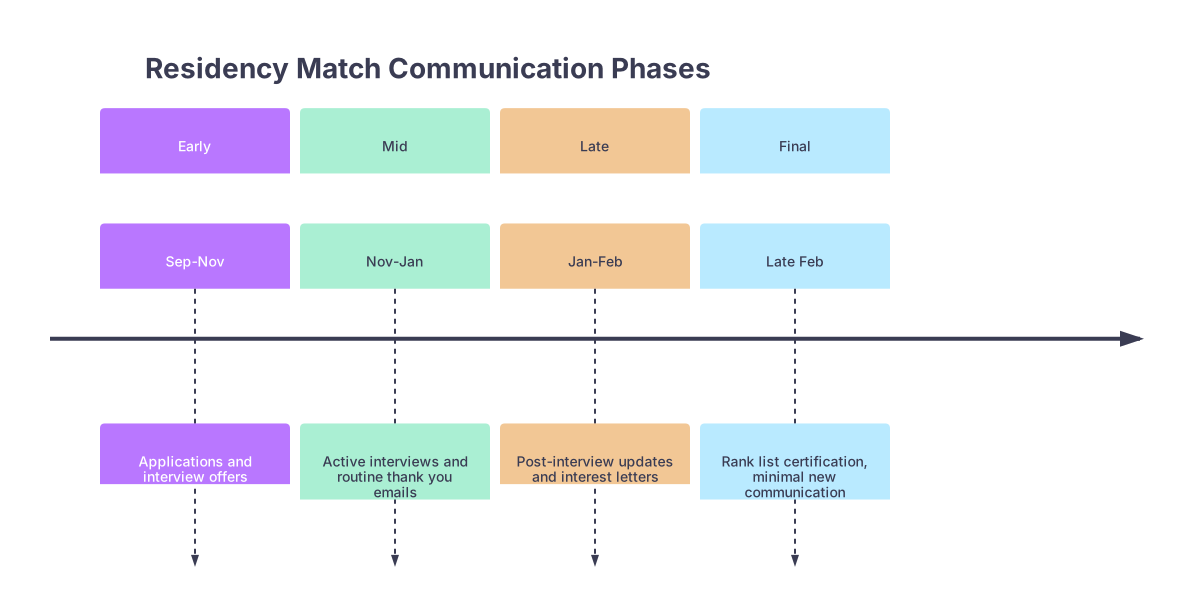
| Period | Event |
|---|---|
| Early - Sep-Nov | Applications and interview offers |
| Mid - Nov-Jan | Active interviews and routine thank you emails |
| Late - Jan-Feb | Post-interview updates and interest letters |
| Final - Late Feb | Rank list certification, minimal new communication |
Practical advice:
- Early and mid-season: thank-yous and brief updates are routine and completely safe.
- Late January–February: if you send anything, keep it short, professional, and clean of rank language. Many PDs are exhausted and irritable by then.
7. Clear Examples: Safe vs Risky Phrasing
Let us get very explicit. I will give you typical applicant situations and show you:
- What you probably want to write.
- How to rewrite it into NRMP-safe phrasing.
- What a red-flag version looks like.
Scenario 1: You want to show strong interest
You feel: “This program is amazing. I want them to know they are my first choice.”
Red-flag email:
“Dear Dr. Patel,
Thank you again for the interview. I want you to know that your program is my #1 choice and I will be ranking you first. I hope that you will also rank me to match.
Sincerely…”
Problems:
- Explicit rank commitment.
- Implied request for reciprocal ranking.
Safe rewrite:
“Dear Dr. Patel,
Thank you again for the opportunity to interview at your program. After reflecting on my interviews, I feel that your curriculum, patient population, and resident culture align extremely well with my goals.
I remain very interested in your program and would be thrilled to have the opportunity to train there.
Sincerely…”
You have conveyed the same thing emotionally without overt rank language.
Scenario 2: Program asks “Where will you rank us?”
On Zoom, PD says: “So, if we rank you near the top of our list, where do you think we fall on your list?”
Your panicked answer (do not say this):
“You would definitely be in my top three, maybe even first.”
Safe spoken response:
“I have not finalized my rank list yet, but I can say that your program is a very strong fit, and I would be very happy to match here.”
If they push again (they should not, but some do):
“Per NRMP guidelines, I am not able to discuss my exact ranking, but I do want to emphasize that I am strongly interested in your program.”
Calm. Firm. Professional. You are not obligated to do more.
Scenario 3: You are couples matching and want to reinforce that
Unsafe phrasing:
“If you rank me high, my partner will rank your affiliated Pediatrics program high as well.”
Safe version:
“I am participating in the couples match with my partner, who has applied to Pediatrics programs in [city]. We are both very interested in training in this area and would be excited to be part of your institution.”
No conditional, no bargaining.
8. Common Misconceptions About NRMP Rules
Let us kill a few myths I hear every single season.

Myth 1: “It is illegal to send a thank-you email.”
False. Totally false. NRMP does not care about routine courtesy emails, as long as they do not cross into commitments or coercion.
Myth 2: “You must send a letter of intent to match at a competitive program.”
No. There is no “must” here. Many applicants match at top programs without ever sending more than a short thank-you. Your application and interview carry far more weight than a last-minute email.
Myth 3: “If a program says ‘We will rank you high,’ that means I am safe to match.”
Also false. Programs:
- Overestimate how far down their list they will go.
- Sometimes send that line to dozens of applicants.
- Change their list late.
You can match at a place that never emails you and go unmatched at a place that tells you you are “ranked to match.” I have seen that happen multiple times.
Myth 4: “If I do not tell any program they are #1, I will look disinterested.”
Strong programs know the rules. They do not expect explicit rank disclosures. A well-written interest email that shows you understood their program and care about fit is enough.
9. Email Templates You Can Actually Use
Here are concise templates you can adjust. Keep them short. PDs and coordinators are not reading essays in February.
Template A: Standard thank-you (safe any time)
Subject: Thank you – [Your Name], [Specialty] Applicant
“Dear Dr. [Last Name],
Thank you for the opportunity to interview with the [Program Name] Residency Program on [date]. I enjoyed learning more about your curriculum and speaking with your residents, especially about [specific element].
I appreciate your time and consideration.
Sincerely,
[Your Name]
AAMC ID: [#######]”
Template B: Strong interest (without rank language)
Subject: Continued Interest – [Your Name], [Specialty] Applicant
“Dear Dr. [Last Name],
After completing my interviews, I wanted to reiterate my strong interest in the [Program Name] [Specialty] Residency. The combination of [specific strengths – e.g., community-based training with academic resources, diverse patient population, supportive resident culture] aligns very well with my goals for residency.
I would be excited for the opportunity to train at [Program Name] and appreciate your continued consideration of my application.
Sincerely,
[Your Name]
AAMC ID: [#######]”
Template C: Update email
Subject: Application Update – [Your Name], [Specialty] Applicant
“Dear Dr. [Last Name],
I hope you are well. I wanted to share a brief update regarding my application. Since our interview on [date], I [describe update: received my USMLE Step 2 score of XXX / had a manuscript accepted in Y journal / received the Z teaching award].
My interest in the [Program Name] Residency Program remains strong, particularly given [short connection to the program].
Thank you again for your time and consideration.
Sincerely,
[Your Name]
AAMC ID: [#######]”
10. Quick Reference: Safe vs Unsafe Concepts
| Topic | Applicant-Safe Approach | Risky / Problematic Approach |
|---|---|---|
| Expressing interest | “Very interested,” “Excellent fit” | “I will rank you #1 if…” |
| Describing rank position | Avoid numbers; use “strong interest” | Explicit numbers or promises |
| Responding to questions | Emphasize interest, defer rank specifics | Revealing exact rank list |
| Thank-you emails | Brief, professional, specific | Long, emotional, rank-focused letters |
| Updates | Objective info + brief interest statement | Using updates as bargaining tools |
| Couples match | State you are couples matching, city goals | Conditional ranking deals |
11. The One Thing That Actually Matters: Your Rank List
I am going to say what your dean probably said in a watered-down version:
The NRMP algorithm favors the applicant. It is designed so that your true preferences are what matter, not what you think programs want to hear.
So:
- Do not rearrange your list because of a flattering email.
- Do not punish programs for staying silent and not love-bombing you.
- Do not place a program higher than you truly want just because you promised them anything in an email.
Your responsibility is to:
- Rank programs in the exact order of where you want to train.
- Communicate in a way that is honest, courteous, and within NRMP rules.
That is it.
3 Key Takeaways
- You can and should express interest, but avoid numbers, promises, and conditional “if you rank me, I will rank you” language.
- If a program asks about your rank list, you are allowed to decline: emphasize strong interest without disclosing specifics.
- Write your rank list based on where you genuinely want to go, not on post-interview emails, promises, or pressure – the match algorithm is built to reward honest preferences.


