

It is early January. You and your partner just survived interview season, your ERAS spreadsheets look like crime-scene boards, and now you are staring at the NRMP site trying to figure out how this Couples Match thing actually works in real life. Not the vague “you can link your lists” explanation. The real scenarios: what happens if only one of you matches at your #1? What if one of you wants prelim+advanced and the other wants a categorical? Can the algorithm accidentally separate you?
Let me be direct: the NRMP Couples Match rules are very specific. They were written to anticipate particular scenarios and to prevent others. If you do not understand those scenarios cold, you will build a rank list that does not behave the way you think.
I am going to walk through the exact situations the rules are designed for – and the hidden traps I have watched couples fall into.
1. What “Couples” Means in NRMP Language (And What It Does Not)
First, strip away the romantic language. In NRMP terms, “couple” is a technical object:
Two applicants.
Each with their own NRMP ID.
Who choose to link their rank order lists (ROLs) so that the algorithm treats their pair of ranks as a unit.
The NRMP “couple”:
- Does not mean the algorithm will “try to keep you geographically close” in some soft sense.
- Does not mean “if one matches somewhere, the other will automatically be placed nearby.”
- Does mean: every attempt to place one of you is evaluated only in the context of a specific paired choice for the other.
The policy is built around one core rule:
The algorithm will only match you to a program if, at the same time, it can match your partner to the program (or outcome) paired with that rank.
No simultaneous success of the pair → no match on that line. It skips to the next pair.
That is the backbone. Every realistic scenario is an elaboration of that.
2. How the Couples Rank Order List Actually Works
You do not submit one joint list. You submit two lists of paired ranks that mirror each other line by line.
On the couples ROL screen, each “row” is:
- One program choice (or outcome) for Partner A
- Paired with one program choice (or outcome) for Partner B
The lines are evaluated in order from top to bottom. The algorithm asks, for each line:
“Can I place A into their program on this line and B into their program on this line, respecting all quota and preference constraints?”
If yes → it tentatively (or finally) assigns both.
If no → it moves to the next line.
This is not conceptual. Let me show you how this plays out.
| Pair Rank Line | Partner A Choice | Partner B Choice |
|---|---|---|
| 1 | A: IM - Program X | B: Pediatrics - Program X |
| 2 | A: IM - Program Y | B: Pediatrics - Program Y |
| 3 | A: IM - Program X | B: Pediatrics - Program Y |
| 4 | A: IM - Program X | B: Unmatched |
| 5 | A: Unmatched | B: Pediatrics - Program X |
Every line is all-or-nothing for that specific pairing.
3. Core Scenarios the Rules Are Designed To Cover
The policy writers were not thinking in abstractions. They anticipated very concrete couple behaviors. These are the main categories.
Scenario 1: “Same City, Same Institution If Possible”
Classic: both of you want to be at the same hospital. Maybe both in categorical programs (IM + Peds, Surgery + Anesthesia, etc).
The rules anticipate you will:
Pair same-institution options first
Example line:- A: IM – University Hospital
- B: Pediatrics – University Hospital
Then pair same-city, different-hospital options
Example line:- A: IM – University Hospital
- B: Pediatrics – County Children’s
Then add “one matches / other unmatched” lines as safety nets, if you are willing to tolerate separation.
Concrete evaluation:
Pair line 1:
- Algorithm checks if:
- A can be assigned to IM–University (considering that program’s own rank list and capacity)
- B can be assigned to Peds–University, simultaneously
- If both “yes” → couple tentatively matched there
- If either “no” → the line is ignored, go to line 2
What this rule is really doing:
It forces you to explicitly spell out “we prefer being at the same hospital over being in the same city over being separated,” line by line.
There is no hidden “keep couples close” magic. You have to encode that preference hierarchy yourself.
Scenario 2: “We Would Rather Both Match Somewhere Than Have One Unmatched”
NRMP anticipated couples who care more about both matching, even if separated, than about tight geographic coupling.
The rules allow you to express that with “Unmatched” as a valid choice.
You can rank:
- Partner A: Program
- Partner B: Unmatched
or
- Partner A: Unmatched
- Partner B: Program
or
- Partner A: Unmatched
- Partner B: Unmatched
This is not a hack; the policy explicitly supports it.
Example couple priority:
- Same institution
- Same city
- Both match somewhere (even if different cities)
- If not possible, they prefer “both unmatched” to “only one matched”
They build lines like:
- A: IM – University City 1 / B: Peds – University City 1
- A: IM – University City 2 / B: Peds – University City 2
- A: IM – Community City 3 / B: Peds – Community City 4
- A: IM – Community City 3 / B: Unmatched
- A: Unmatched / B: Peds – Community City 4
- A: Unmatched / B: Unmatched
How the algorithm reads line 6 is important. It is a genuine ranked outcome: “we prefer that both be unmatched over anything below this line.” The policy anticipates couples putting “Unmatched/Unmatched” at the bottom as an explicit floor.
I have seen couples forget to use Unmatched/Unmatched. They think “worst case, both unmatched anyway.” Not true. Without that line, the algorithm will never “choose” both unmatched as a preferred outcome. It will just run out of possible paired placements, which may leave one matched solo if you made bad line constructions.
Scenario 3: One Partner with Prelim + Advanced, the Other in a Categorical
This is where people start to break things.
NRMP absolutely anticipated the “Anesthesia/Neuro/Rads plus Medicine or Peds partner” pair. There are two core problems:
- One partner has two matches: a preliminary year (usually TY or IM Prelim) + an advanced position starting PGY-2.
- The other partner has one match: a categorical program.
The rules solve this by treating the advanced applicant as having two lists:
- Primary (categorical / advanced)
- Supplemental (preliminary / transitional)
Then the couples mechanism pairs your primary rank list choices, but previews whether the advanced partner can also secure a linked prelim (if required) in a compatible setup.
The NRMP anticipated multiple variants:
- Both of you in the same city, both with positions there
- Advanced partner willing to commute for prelim, or do prelim elsewhere
- Couple willing to prioritize advanced position over staying physically together during PGY-1
The policy forces you into clarity: you must encode on the primary rank list how strongly you care about each combination.
Scenario 4: “We Only Want to Match If We Are in the Same City” (Hard Constraint)
Some couples mean this literally: they would rather both fail to match than be in different regions.
The NRMP rules allow you to create ironclad joint behavior by simply never including a line where the outcomes are in different locations or where one is Unmatched and the other is not.
If every line of your joint ROL has:
- Same city (or same region by your definition)
- Or Unmatched / Unmatched
…the algorithm cannot separate you. It will only match you on lines where your defined condition holds, because there is no line where it is allowed to place you differently.
This is exactly the type of scenario the “outcomes-as-ranks” architecture anticipates: couples can turn soft preferences into hard constraints.
Is it risky? Yes. I have seen couples both not match who probably could have matched individually. But that is not a failure of the rules. That is the rules respecting the preferences as ranked.
Scenario 5: “We’ll Take a Separation If It Avoids a SOAP Disaster”
The opposite couple: “We prefer together, but if that is not possible, one of us in a solid program is better than both SOAPing.”
NRMP anticipates this too. You create descending lines that gradually allow more separation:
Example:
- A: IM – Top Program / B: Peds – Top Program
- A: IM – Top Program / B: Peds – Second Tier, same city
- A: IM – Second Tier, same city / B: Peds – Second Tier, same city
- A: IM – Top Program / B: Unmatched
- A: Unmatched / B: Peds – Top Program
- A: IM – Second Tier, far city / B: Unmatched
- A: Unmatched / B: Peds – Second Tier, far city
- A: Unmatched / B: Unmatched
Each line encodes a more painful scenario, but one you consciously accept in preference to the ones below.
The policy is built to respect that ordering exactly. No guesswork, no “NRMP will surely favor the both-match outcome”. If you rank “one matched / one unmatched” above “both unmatched,” the algorithm will give that outcome as soon as it is feasible.
4. How the Algorithm Actually Runs for Couples (Mechanics, Not Myths)
You need a mental model of how your lines are being processed. The NRMP’s couples policy is tightly coupled to the core algorithm design.
Simplified version:
- Each applicant (including those in couples) has an individual ROL. Couples add pairing constraints on top.
- The algorithm cycles through programs and applicants, trying tentative assignments based on applicants’ preferences, just like for solo applicants.
- When it reaches a couple, it only tentatively assigns one partner if the corresponding line for the other partner is also tentatively successful.
The key behavior: if one of you bumps another applicant out of a slot, but your partner cannot match their paired choice on that same line, the algorithm will not keep you in that spot. It will roll back that tentative assignment and try lower pairs.
This is exactly why couples sometimes “underperform” their individual competitiveness. The algorithm is not allowed to “park” one partner at a higher preference if the other partner cannot be simultaneously placed according to that line.
Let me encode this visually.

| Step | Description |
|---|---|
| Step 1 | Start with Pair Line 1 |
| Step 2 | Move to next pair line |
| Step 3 | Tentatively assign both |
| Step 4 | Final match on this line |
| Step 5 | No match for couple |
| Step 6 | Can Partner A match program on this line |
| Step 7 | Can Partner B match paired program |
| Step 8 | Any later conflicts in programs |
| Step 9 | More pair lines left |
You are not being “punished” by the algorithm. You are being constrained by your own pairings. Brutally literally.
5. Specific Edge Cases NRMP Anticipated (Where People Get Burned)
I am going to walk through some situations I have watched in real cycles. These are exactly the kinds of patterns the rules are written around.
Edge Case 1: Mismatched List Lengths
NRMP requires that couples:
- Have the same number of lines on both ROLs for the linked match.
- Each line must have a valid code (or Unmatched) for each partner.
The policy explicitly blocks:
- A having 20 distinct ranks, B having 10, and trying to “assume” the last 10 lines are A:Program / B:Unmatched.
- Or leaving blank / unpaired lines.
Why? Because blank space is ambiguous. The NRMP forces you to define every outcome. That is intentional.
Edge Case 2: Preliminary and Advanced Programs Not Logically Paired
Advanced positions (like Anesthesia PGY-2) often require a PGY-1 year. NRMP expects you to build:
- A primary ROL for the advanced spot (linked in couples)
- A supplemental ROL for the prelim/TY spots
The rules anticipate mistakes like:
- Ranking an advanced PM&R position in City A,
- But only ranking prelim years in City B,
- While your partner ranks categorical options only in City A.
In that scenario, your advanced partner might match advanced in City A, but not have any prelim in City A on their supplemental list. The algorithm then pairs them with a prelim in City B (if you ranked it). If your partner did not rank any programs in City B, you are now in different cities. By your own list design.
NRMP’s documentation actually calls this out. The rules allow it; they do not fix it for you.
If staying together PGY-1 and PGY-2 matters, you must:
- Rank prelims in the same geographic cluster as the advanced program
- And anticipate how far apart you are willing to be for one year
The policy’s design philosophy is consistent: it will not override your expressed preferences “for your own good.”
Edge Case 3: Over-using “Wildcards” (Any Program in City X)
There is no literal wildcard in NRMP (you cannot say “any IM program in Boston”). But couples sometimes simulate this with long lists of “A: all IM in Boston / B: all Peds in Boston” in every possible pairing.
The rules do not prevent you from creating massive, combinatorial lists. They do anticipate, however, that:
- The more pairs you create, the more likely weird lower-ranked pairings will become operative if your higher ones fail.
I have seen couples rank 80+ pairs and forget what the bottom 20 actually meant. Then they end up, for example:
- A in a very low-tier program they did not truly want,
- B in a moderate program,
- When individually they might have matched to better programs in different cities.
But they explicitly told the algorithm, via the lines, that “this painful pairing is still preferable to any outcome below.” The rules assume you meant it.
Edge Case 4: Last-Minute Preference Change That Was Not Re-encoded
Common: One partner gets scary interview feedback in late January. Couple decides, in conversation, “Ok, if you do not match at Top IM, but I match at Top Peds, we still want you to SOAP, not me go alone.”
They forget to go back into the couples ROL and alter the last lines. The list still reads:
- A: IM – Top Program / B: Peds – Top Program
- …
- A: Unmatched / B: Peds – Top Program
The algorithm must follow the written list, not your verbally revised priorities. It will happily produce “A unmatched / B at Top Peds,” because you ranked that above any joint unmatched outcome.
The rules are intentionally rigid here. They anticipate that people will change minds, which is exactly why the system freezes lists at the deadline. What is in the system at that moment is law.
6. What the Policy Explicitly Forbids (Scenarios You Cannot Force)
Equally important: what you cannot do, no matter how you try to twist the rules.
You Cannot: Have One Partner in Couples and the Other in SOAP for “Backup”
There is no conditional “if we do not both match by line 5, then release me to SOAP and keep my partner’s results.” Once you certify a coupled list, you are locked into:
- Either both matched via main match (to some paired outcome), or
- Both unmatched via main match (and then both can SOAP).
You can decouple only before the ROL certification deadline. The policy explicitly blocks dynamic coupling / decoupling during the algorithm.
You Cannot: Use Couples Matching to Game Quotas
Some fantasy: “What if we link so that if he bumps someone out at Program X, her link pulls an extra spot?” No. Program quotas are rigid; couples do not create extra positions.
For each pair line, both spots must exist within each program’s own quota and ranking behavior. If a program ranked you low, coupling will not raise you.
You Cannot: Have the Algorithm “Look Ahead” Across Lines for You
The algorithm processes in decreasing order of preference (your list order). It does not look down your list to see “a better both-match outcome” and retroactively rearrange.
If you put:
- A: Strong IM / B: Unmatched
- A: Mid IM / B: Mid Peds
You are telling the system: “We prefer A at Strong IM with B unmatched over both in mid-tier programs.” It will not overrule that. Even if, from the outside, you realize later that #2 was “emotionally better.”
7. Building a Couples List That Actually Behaves How You Think
Enough policy theory. Here is the practical approach that respects the rules and the scenarios they cover.

| Step | Description |
|---|---|
| Step 1 | List individual true preferences |
| Step 2 | Define joint priority rules |
| Step 3 | Group programs by city and tier |
| Step 4 | Construct ideal same-institution pairs |
| Step 5 | Add same-city different-institution pairs |
| Step 6 | Decide on separation tolerance |
| Step 7 | Add one matched one unmatched lines if desired |
| Step 8 | Place Unmatched Unmatched floor |
| Step 9 | Stress test bottom 10 lines together |
I am going to break this into discrete steps, because if you skip them, you will encode nonsense into your ROL.
Step 1: Write Individual Lists First, Ignoring Couples
Each of you privately lists programs in the order you, as individuals, would want them. No couples logic yet.
Why? Because the NRMP algorithm always respects true preference order. If you distort your order too early “for couples reasons,” you lose the benefit of the stable match design and end up with weird, self-inflicted compromises.
Step 2: Explicitly Rank Your Joint Priorities (Verbally, on Paper)
Decide, in words:
- Is “same city” always better than “different cities but both in very strong programs”?
- Is “one matched at dream, other unmatched” better or worse than “both in solid but not elite programs”?
- Is “one partner 2 hours away” acceptable for one year?
Write those as 3–5 clear rules. Because the NRMP rules expect you to encode them as pair lines. If you cannot state them out loud, you will produce an incoherent ROL.
Step 3: Build the Top of the List: Same-Institution, True Best Outcomes
Use your actual individual preferences and overlay your joint logic.
Example: You both agree your ideal is “both at University City 1” even though:
- A: ranks IM–University City 1 as #1
- B: actually likes Peds–University City 2 slightly more than Peds–University City 1, but is willing to sacrifice that for same-institution.
Your line 1 is:
- A: IM–Univ C1 / B: Peds–Univ C1
Yes, B is sacrificing a bit. That is the whole point of couples. But it is explicit.
Step 4: Expand to Same-City Combos You Actually Accept
This is where you will use a lot of table-space. For each city (or metro area) you are willing to live in, create:
- All acceptable A-programs in that city
- All acceptable B-programs in that city
- Then rank pairs from “jointly best” to “jointly worst”
Do not just cross-multiply blindly. If a particular combo is basically a no-go for you emotionally, do not put it anywhere. The algorithm cannot avoid a line you create.
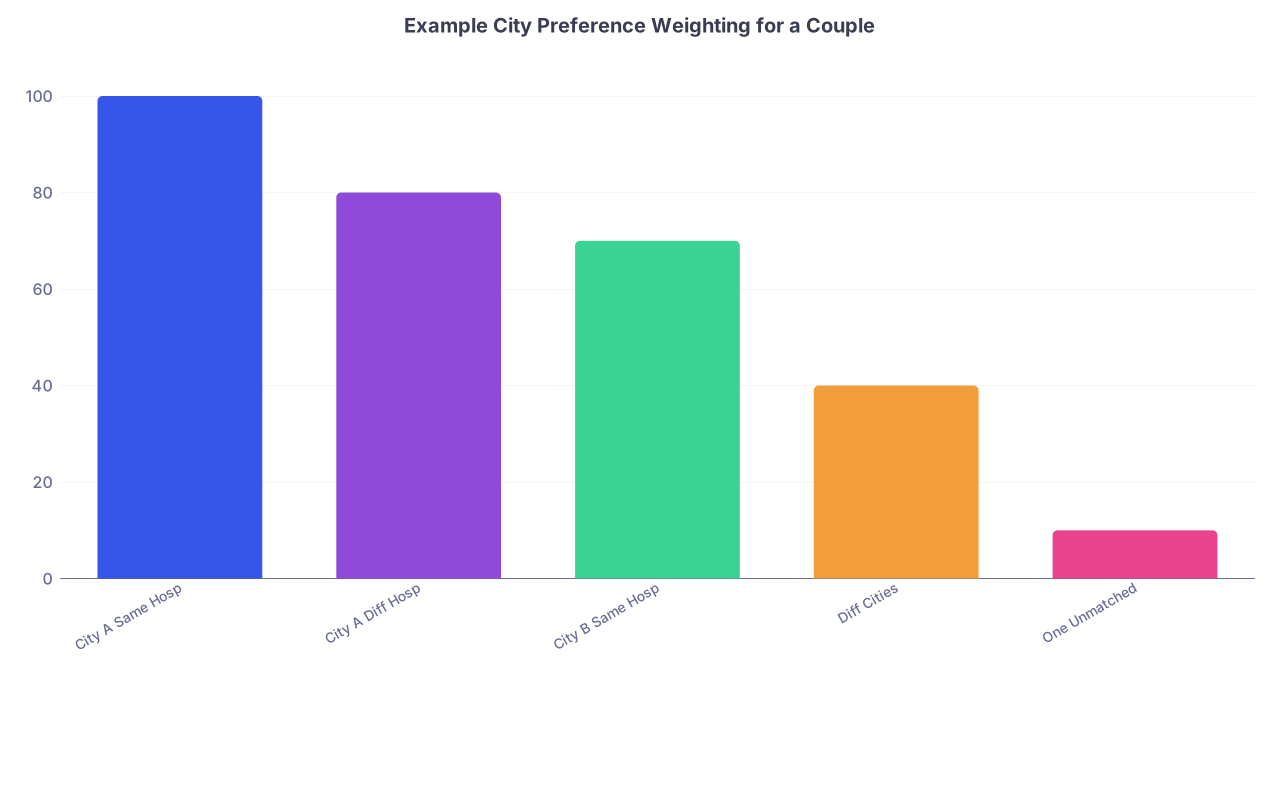
| Category | Value |
|---|---|
| City A Same Hosp | 100 |
| City A Diff Hosp | 80 |
| City B Same Hosp | 70 |
| Diff Cities | 40 |
| One Unmatched | 10 |
This is deliberately rough, but you see the idea: you are encoding joint utility.
Step 5: Decide If You Will Allow One-Matched/One-Unmatched Scenarios
This is the most emotionally loaded choice, and NRMP’s rules are specifically built to honor it.
If your answer is a hard “no – if we cannot both match, we want both unmatched,” then:
- Do not use lines with “Program/Unmatched” or “Unmatched/Program” anywhere.
- After all acceptable both-match lines, end with a single line: Unmatched / Unmatched.
The policy will then never produce a one-matched outcome for you. Period.
If your answer is “yes, but only if the matched person’s program is in our top tier,” then:
- Add lines like:
- A: Top IM / B: Unmatched
- B: Top Peds / A: Unmatched
- But do not add similar lines for your mid/lower-tier programs.
Now you have explicitly told the algorithm: “We’d accept a separation only if it anchors one of us at a very high preference.”
NRMP built the Unmatched option exactly for this.
Step 6: Put Unmatched / Unmatched at the True Floor
If you do not want to risk a match below some threshold, then that threshold belongs above Unmatched/Unmatched. Once you put Unmatched/Unmatched somewhere, you are saying:
“Anything below this is worse than both not matching.”
So your bottom of list might look like:
- A: Community IM far city / B: Community Peds far city
- A: Unmatched / B: Community Peds far city
- A: Community IM far city / B: Unmatched
- A: Unmatched / B: Unmatched
If you look at that and realize “we would honestly rather both SOAP than have only one at Community Far City,” then re-order:
- A: Community IM far city / B: Community Peds far city
- A: Unmatched / B: Unmatched
…and drop the one-matched lines.
This is exactly the kind of fine-grained preference the couples rules are intended to capture.
8. Common Misconceptions About NRMP Couples Rules (That Will Hurt You)

Let me quickly shoot down a few persistent myths.
“The algorithm tries harder to keep couples together.”
False. The algorithm only honors what is on your pair list. There is zero extra bias favoring collocation beyond what you encode.“If we rank the same programs, we will probably be fine.”
Not precise enough. The sequence and structure of pairings matters more than the set of programs.“If one of us is much stronger, couples matching will help the weaker partner.”
Sometimes. Sometimes the opposite: the stronger partner is “dragged down” to where a viable joint outcome exists.“We can fix minor issues in SOAP.”
No. SOAP is a different world with different rules. If main match couples logic gives you something you hate, you cannot “partially undo” it in SOAP.
9. Quick Reality Check: Risk vs Benefit for Couples
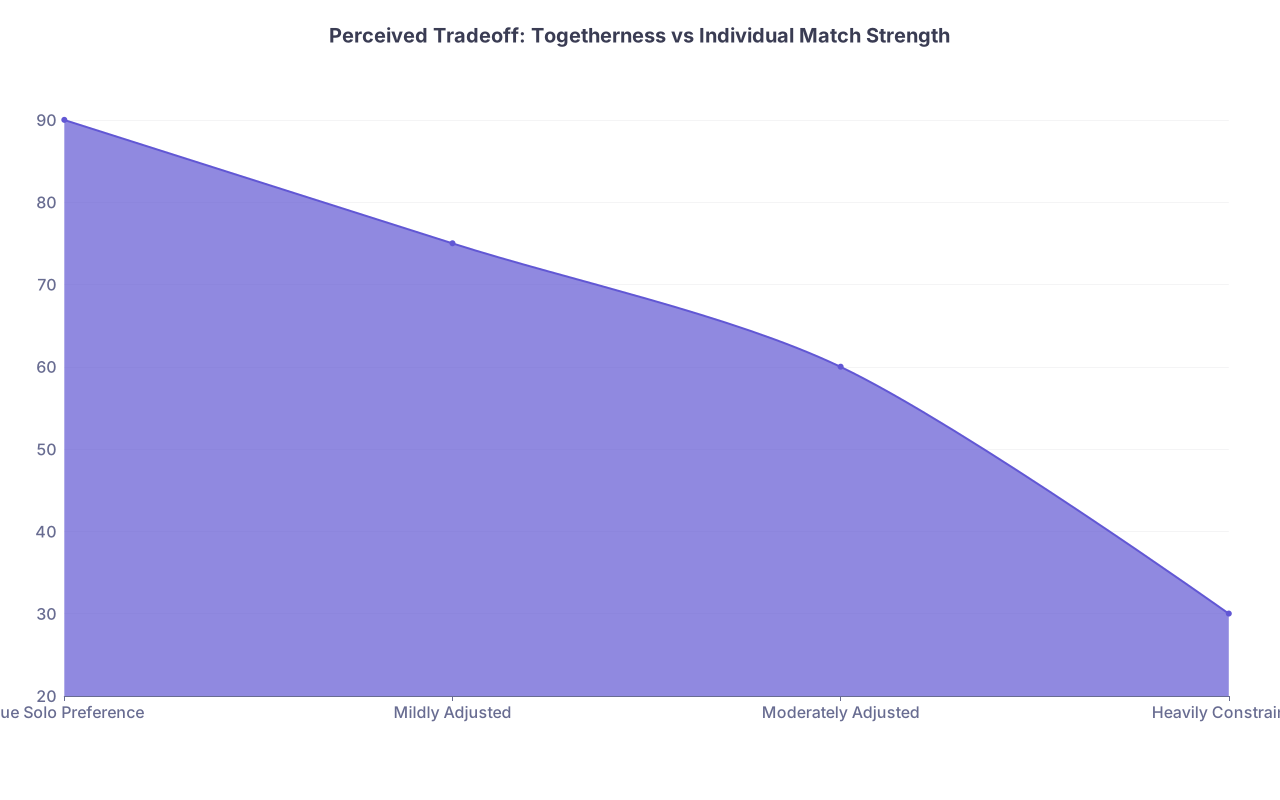
| Category | Value |
|---|---|
| True Solo Preference | 90 |
| Mildly Adjusted | 75 |
| Moderately Adjusted | 60 |
| Heavily Constrained | 30 |
You are trading off raw individual optimality for joint outcomes. The NRMP rules are very transparent about this, if you bother to read them correctly.
You gain:
- The ability to code “we prefer both in City 2 over separated in Cities 1 and 3.”
- The guarantee that if you say “never separate us,” the algorithm will comply.
You lose:
- Some flexibility for each person to land at their sole individually-best program.
- Some probabilistic safety margin if one of you is significantly weaker on paper.
That is not a flaw in the system. That is the nature of joint decisions.
10. Summary: How to Think Like the NRMP When You Are a Couple

If you want your result to make sense, you need to internalize three core ideas that the NRMP’s couples rules are built on:
- Every line on your joint list is a complete outcome, not just a pair of programs.
- The algorithm will never, under any circumstances, give you an outcome you did not explicitly rank.
- The algorithm will always prefer higher lines over lower ones, exactly as written, without second-guessing you.
So when you are building your couples list, you are not “listing programs.” You are ranking lives:
- Life A: both in City 1, different hospitals.
- Life B: both in City 2, same hospital.
- Life C: Partner A at dream program, Partner B SOAP.
- Life D: both SOAP.
The NRMP couples mechanism is blindly loyal to the order you put those in.
Use that for you, not against you.
FAQs

1. Can we rank different numbers of programs individually and still couples match?
You can apply to different numbers of programs. But for the purposes of the couples match, your paired rank lists must have the same number of lines, with each line containing one choice (or Unmatched) for each partner. If one of you interviewed at fewer places, you will simply use “Unmatched” on some lines for that partner or repeat certain programs in different pairings, depending on your intended outcomes.
2. What happens if we break up after submitting a couples rank list?
The NRMP does not care why you decouple, only that you do so before the rank list certification deadline. You can contact NRMP and request to be uncoupled before that deadline; afterward, the lists are locked and your fates are linked in the algorithm. If you break up late and forget to decouple, the algorithm will still treat you as a couple.
3. Can we be in different specialties and still couples match?
Yes. The couples rules are specialty-agnostic. You can link Internal Medicine with Dermatology, Surgery with Anesthesia, Psychiatry with Radiology, etc. The only complication comes when one partner has advanced/prelim structure; then you must be deliberate about how prelim locations and advanced positions interact with your partner’s categorical list.
4. Does couples matching hurt our chances compared to matching separately?
It often reduces each person’s chance of getting their top solo choice, because the algorithm must satisfy both of you simultaneously at each pair line. For strong pairs in less competitive combinations, the impact is modest. For uneven couples (one highly competitive, one borderline) or for hyper-competitive specialties, couples matching can significantly constrain outcomes. It is not “worse” or “better” in the abstract; it simply optimizes for joint outcomes rather than individual.
5. Are we allowed to discuss our couples strategy with program directors?
You are allowed to say you are participating in the couples match and to indicate interest in being in the same institution or city. You must not ask for, or expect, explicit guarantees or collusion on rank lists; programs are bound by their own NRMP rules. Ethically and practically, you can explain that you are couples matching, but you should assume programs will still rank you based on your merits, not on any behind-the-scenes coordination for the couple.


