

The most dangerous Match violations do not sound illegal. They sound polite.
If you are not careful, a single “innocent” sentence on Zoom or over email can cross the NRMP line and put both you and the program at risk. I have watched applicants panic after they realized that what felt like small talk was actually match-violation territory.
You are not going to be one of them.
This is the guide I wish more students read before interview season, not after they send a panicked screenshot to their dean.
Quick Reality Check: The NRMP’s Red Line
Before we dissect the seven phrases, you need the frame.
The NRMP rules are not about punishing friendliness. They are about preventing manipulation.
The two biggest buckets of trouble:
Soliciting ranking information
- Programs cannot ask how you will rank them.
- You cannot ask a program how they will rank you.
- Neither side can pressure the other into verbal “commitments.”
Coercion and undue influence
- No threats or pressure tied to how you rank (or whether you certify your list).
- No conditional promises: “If you rank us first, we will rank you highly.”
The NRMP uses boring legal language. Real life does not. Real life uses soft, friendly, seemingly-harmless phrases that sneak right over the line.
Those are the phrases you must recognize and avoid.
Phrase #1: “Where are you planning to rank us?”
This is the classic violation hiding in plain sight.
Why it is a problem:
Programs are explicitly prohibited from asking or attempting to obtain your rank list information. Full stop.
Here is how this usually shows up:
- “So, where do you think we’ll end up on your list?”
- “Are we in your top three?”
- “Just between us, are we your number one?”
- “Do you see yourself ranking us highly?”
Every one of those is the same question: Tell me your rank list.
If a faculty member asks you this in an interview, they are the one violating policy. But that does not mean you are safe if you respond and start making informal commitments that sound like deals.
How to avoid this trap:
When asked directly, do not answer with specifics. Do not say “I’m ranking you number one.” That sticks you in ethical quicksand.
Use a neutral, rule-respecting response:
- “I am very interested in your program and think it would be a great fit. I plan to finalize my rank list after all interviews are complete, in accordance with NRMP guidelines.”
If pressed again (yes, this happens):
- “I want to be transparent that I am following NRMP rules, which prohibit discussing the specifics of rank lists. I can say that your program is one I could see myself thriving in.”
You are allowed to express interest. You are not allowed to disclose or negotiate ranking positions.
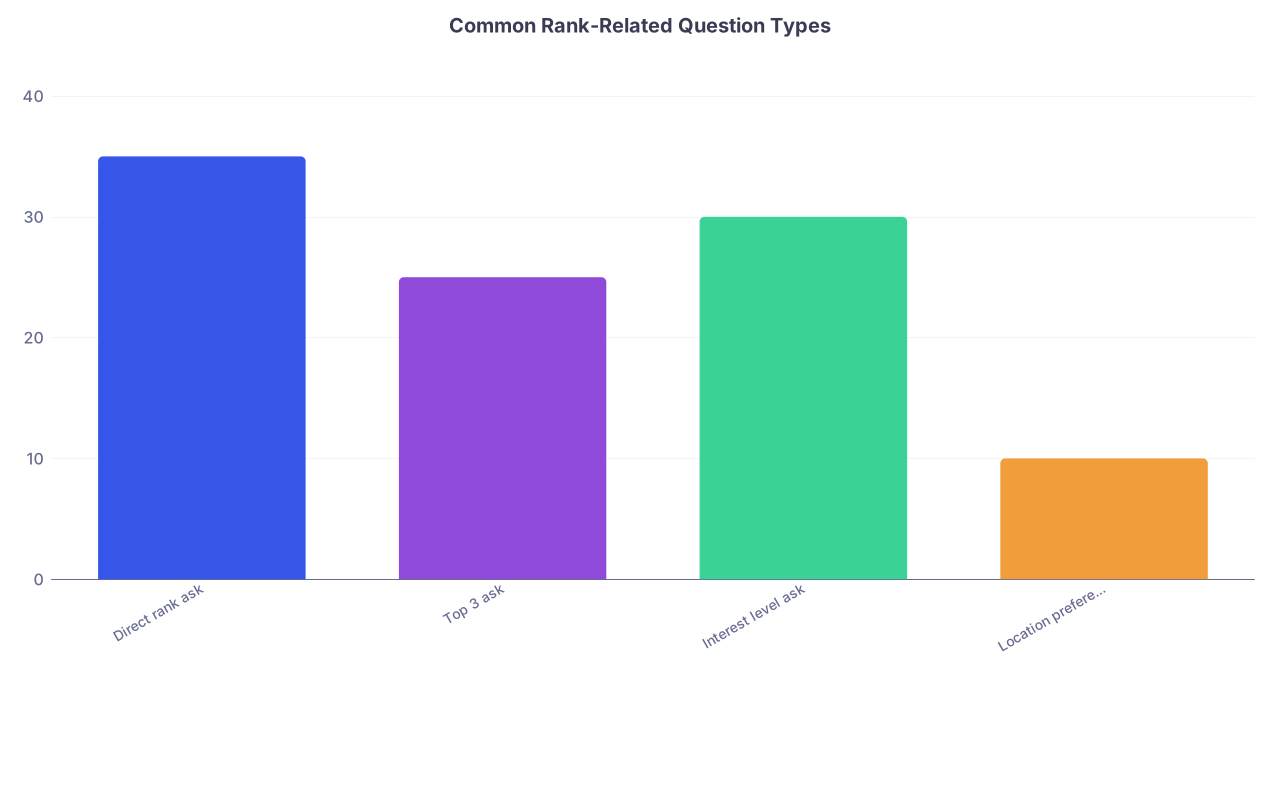
| Category | Value |
|---|---|
| Direct rank ask | 35 |
| Top 3 ask | 25 |
| Interest level ask | 30 |
| Location preference ask | 10 |
Phrase #2: “If you rank us first, we’ll rank you highly.”
This one is not just a red flag. It is a five-alarm fire.
Why it is a problem:
The NRMP forbids programs from making statements implying a commitment or offering a benefit based on how you rank them. That includes quid-pro-quo style talk:
- “If you rank us first, we will rank you to match.”
- “Rank us number one and you will be very happy with how we rank you.”
- “We take it very seriously when applicants tell us they’ll rank us first.”
Any suggestion that your rank list can “buy” you a ranking position is a violation. It is coercive by design.
Your mistake to avoid:
Do not respond with your own side of the “deal”:
- Wrong: “Yes, I will rank you first if you rank me to match.”
- Wrong: “You’re my number one and I hope you’ll rank me to match too.”
You are not negotiating a contract. You are participating in a blinded algorithm.
How to respond safely:
- “I am genuinely very interested in your program, and I will make my final decisions independently when I submit my rank list.”
- If they explicitly use “if you rank us first…” language, you can even say:
“I want to make sure we are both adhering to NRMP policies, which do not allow us to make commitments about rank lists.”
You do not need to confront them aggressively. But you also should not play along.
Phrase #3: “We plan to rank you to match.”
This one sounds flattering. It is also a classic problem phrase.
Why it is risky for programs:
Programs are prohibited from making statements that suggest a guarantee of ranking or matching. “Rank you to match” is the exact language NRMP warns about.
Here is how you will hear it:
- “You will be ranked to match here.”
- “We fully intend to rank you to match.”
- “You should feel comfortable ranking us highly; you will be ranked to match.”
Sometimes it is written in emails: “We are excited to let you know that we’ll be ranking you to match!”
Still not allowed.
Your mistake to avoid:
Do not treat these statements as a contract. Do not alter your rank list trying to “game” around them. And do not reply with promises of your own:
- Avoid: “Thank you, you are my number one and I will rank you first.”
- Avoid: “I am honored and will rank you to match as well.”
You are allowed to say you are enthusiastic. You are not expected to reciprocate a ranking “promise.” Frankly, you cannot verify if it was even true.
Safe response ideas:
- “Thank you for the kind words. I appreciate the feedback and enjoyed learning more about your program.”
- Then stop. No ranking language. No commitments.
If you feel strongly that an explicit “rank to match” statement crossed the line, you can later discuss it with your dean or your institution’s NRMP contact. Document the date, name, and exact wording while you remember it.
Phrase #4: “Will you tell us if you rank us first?”
This one is subtler. It looks like a favor. It is not.
Why it is a problem:
This is another way of fishing for rank list information. The program is asking you to signal your #1 spot. That still counts as soliciting ranking preferences.
You might hear:
- “Please let us know if you decide to rank us first.”
- “We appreciate emails from applicants who rank us number one.”
- “If we’re your top choice, we’d love to know.”
Even if they frame it as “optional,” it puts implicit pressure on you.
Your mistake to avoid:
Do not send an email that explicitly says, “You are my #1” because they asked for it. That turns your communication into part of an improper request.
Let me be very clear:
- You may send a voluntary, unprompted “you are my top choice” letter.
- You may not be pressured into disclosing your rank list because a program requested it.
This is a fine line, and the NRMP knows it. When in doubt, stay vague.
How to reply if they ask directly:
- “I will be finalizing my rank list in accordance with NRMP guidelines, but I can say I am very impressed with your program and could see myself training here.”
- Or, simpler: “I really enjoyed your program and it is one I am strongly considering.”
That satisfies their hunger for affirmation without giving them what they actually asked for.
Phrase #5: “We moved you up on our list after your email.”
Here is where post-interview communication gets messy.
Why this is dangerous:
Programs are not supposed to suggest that your post-interview communication has manipulated their rank list in a trade-like way. Comments like:
- “Your thank-you note helped us move you up.”
- “We adjusted your position on our rank list after hearing that we are your top choice.”
- “Your email confirming your interest improved how you will be ranked.”
Problems all over:
- It implies a direct tie between your communication and your rank position.
- It tempts you to believe you can “bargain” or “trade attention” for a better ranking.
- It feeds the toxic belief that if you do not send some magic email, you will drop on lists.
Your mistake to avoid:
- Do not engage in email arms races based on rumors like “Program X moves people up if they get love letters.”
- Do not reply with: “If that is the case, I will definitely rank you first.”
- Do not “double down” with multiple interest letters hoping to climb higher.
You can send a single, authentic, non-coercive note of interest. Fine. But the second you start writing with the mindset of “this will move me up their rank list,” you are halfway into the headspace the NRMP is trying to dismantle.
What you can safely say in emails:
- “Your program remains one of my top choices, and I would be excited to train there.”
- “I especially appreciated [specific aspect]. I believe your program is a very strong fit for my goals.”
Notice there is no math. No “#1” language. No bargaining.

Phrase #6: “If you do not rank us highly, we may not be able to rank you.”
This one is flat-out coercive.
Why it is a violation:
The NRMP forbids threats or implied negative consequences based on how you rank a program. That includes:
- “If you do not rank us highly, we may not be able to consider you.”
- “We prioritize applicants who commit to ranking us high.”
- “Applicants who rank us low are rarely ranked by us.”
Translation: Rank us high or we will punish you. That is coercion.
Your ranking choices are supposed to be made independently, without fear of retaliation. The algorithm exists precisely so this kind of pressure cannot dictate outcomes.
Your mistake to avoid:
- Do not let this phrasing scare you into altering your genuine preferences.
- Do not respond with promises like: “I promise to rank you in my top three so that you can rank me.”
If you get this kind of message, document it. Write down who said it, when, and exactly what was said. Talk to your dean or your school’s Match office. This is the kind of behavior NRMP wants reported.
Safe mindset:
- Rank programs in the true order of where you want to train.
- Assume any attempt to scare you about ranking order is more about their anxiety than your outcome.
Phrase #7: “Can you confirm you intend to match here?”
This one is sneaky because it sounds like logistics.
Why it is problematic:
Any phrase that asks you to “confirm intent to match” is essentially asking you to reveal your rank list priority. You will hear variants:
- “Do you intend to match here if possible?”
- “Can we count on you coming here if we rank you high enough?”
- “Are you committed to coming here if matched?”
The program is trying to get a verbal pre-match. That undercuts the blind, independent ranking system.
Your mistake to avoid:
If you answer “Yes, I intend to match here,” you have:
- Disclosed your effective ranking intentions.
- Potentially misled them if you later change your mind.
- Put yourself in a morally awkward position if things shift after other interviews.
Stop giving people promises about something you are not allowed (or able) to guarantee.
What you can say:
- “I would be very happy to train here if I match here.”
- “Your program is an excellent fit for my goals, and I would be excited to join if matched.”
Notice the difference:
- “If I match here, I will be happy” = acceptable.
- “I intend to match here / you are my #1 / I will come here” = effectively disclosing rank.
| Phrase Type | NRMP Risk Level |
|---|---|
| Expressing strong interest | Low |
| Saying “you are a top choice” | Medium |
| Saying “you are my #1” unprompted | Medium-High |
| Answering questions about rank order | High |
| Exchanging “rank to match” promises | Extreme |
The Grey Zone: What You Can Safely Say
Not everything is a violation. Some people swing so far the other way they sound robotic and cold. You do not need to do that.
Here is what is generally safe:
You may say:
- “Your program is one of my top choices.”
- “I would be thrilled to match here.”
- “I could see myself being very happy training here.”
- “I am very interested in your program.”
You may voluntarily (without pressure) say:
- “Your program is my top choice.”
- The NRMP allows this kind of voluntary disclosure, though many schools advise against it because it creates drama when people change their mind. But it is not, by itself, a violation.
- “Your program is my top choice.”
Where you get into trouble:
- When someone asks you for rank specifics and you answer.
- When a program conditions their ranking or treatment of you on your ranking of them.
- When “top choice” language is used like a trade or promise, not a statement of feeling.

| Step | Description |
|---|---|
| Step 1 | Someone asks about rank |
| Step 2 | Do NOT answer |
| Step 3 | OK to express strong interest |
| Step 4 | Stop and rephrase safely |
| Step 5 | Use NRMP guidelines response |
| Step 6 | Avoid numbers like #1 or top 3 |
| Step 7 | Specific rank position? |
| Step 8 | Just interest level? |
What To Do If You Encounter a Likely Violation
You will probably run into at least one of these scenarios. Programs are run by humans. Humans get anxious. They say dumb things.
Here is how not to make it worse.
In the moment: Stay calm and neutral.
- Do not argue.
- Do not lecture them about the rules in a confrontational way.
- Do not agree to what they are asking.
Use one of the stock phrases:
- “I am following NRMP guidelines and will finalize my rank list independently.”
- “I am very interested in your program, but I prefer not to discuss specific ranking.”
Immediately after: Write it down.
- Date, program name, person, exact language, context (Zoom, in-person, email).
- Save emails or screenshots.
Discuss with your advisor / dean.
- Let them help you decide if this should be reported, documented only, or ignored as a one-off slip.
-
- You can do so confidentially.
- The system exists to protect you, not to trap you.
Do not let fear of “ruining your chances” stop you from protecting yourself and others from coercive behavior. NRMP has seen all of this before.

High-Risk vs Low-Risk Behaviors: Side-by-Side
| Applicant Behavior | Risk Level |
|---|---|
| Sending a simple thank-you email | Very Low |
| Saying “Your program is one of my top choices” | Low |
| Saying “You are my number one choice” unprompted | Medium |
| Answering “Where will you rank us?” with specifics | High |
| Emailing “If you rank me to match, I will rank you #1” | Extreme |
Use this as your mental filter:
“Does this message reveal my exact rank list or create a trade based on ranking?”
If yes, back out.
FAQs
1. Is it always a violation if I tell a program they are my #1?
No. Voluntarily telling a program they are your top choice is not automatically an NRMP violation. The problem starts when:
- You do it in response to a request for your ranking details, or
- It is framed as a deal (“I will rank you #1 if you rank me to match”).
Even if it is technically allowed, many schools still advise against making #1 declarations to multiple programs or changing your mind later, because it becomes an ethical and reputational mess.
2. What if a program tells me, “We will rank you highly”?
That phrase alone is usually borderline but common. Programs are not supposed to imply guarantees (especially “rank to match”), but a vague “rank you highly” comment is often treated as inappropriate rather than catastrophic. Your safest move is:
- Do not treat it as a binding promise.
- Do not reciprocate with your own ranking details.
- Document it if it felt coercive or conditional.
3. Can I ask a program how competitive I am or whether I am still under consideration?
Yes. That is different from asking how they will rank you. Acceptable questions:
- “Am I still being considered for your rank list?”
- “Are there any concerns in my application that I could address?”
Not acceptable:
- “About where on the list will you rank me?”
- “Am I in your top five / top ten?”
Ask about status, fit, or feedback. Do not ask about rank list position.
Takeaway #1: Never discuss specific rank positions—yours or theirs. Interest is fine. Numbers are not.
Takeaway #2: Any phrase that sounds like a deal—“if you rank us X, we will rank you Y”—is radioactive. Do not participate.
Takeaway #3: When in doubt, default to: “I am very interested in your program and will finalize my rank list in accordance with NRMP guidelines.” Then actually do it. Rank where you want to train. Not where someone tried to push you.


