

The belief that “NRMP violations are just a technicality” is not only wrong. The data suggests they are an early warning signal for future licensing risk.
You are not just dealing with “match etiquette.” You are leaving a paper trail that licensing boards, hospitals, and credentialing committees increasingly know how to read. And some of them are starting to connect the dots between early professionalism problems and later disciplinary action.
Let me walk you through what the numbers actually show—and what that means for how you should treat NRMP rules.
1. What Counts as an NRMP Violation – Measurable, Not Vague
First, definitions. Because hand‑wavey language is how people get in trouble.
The NRMP is very specific about what a “violation” is. We are not talking about you being late to reply to an email. We are talking about documented breaches of the Match Participation Agreement, such as:
Applicants:
- Not honoring a matched position
- Prematurely soliciting or accepting a contract outside the Match when prohibited
- Misrepresenting credentials in ERAS or to programs (scores, degrees, attempts)
- Attempting to influence rank lists with undue pressure or side deals
Programs:
- Requiring applicants to reveal rank order preferences
- Making “if you rank us first, we will rank you to match” promises
- Pressuring applicants to accept positions or sign commitments outside the rules
- Not honoring matched positions or contracts
These are not hypothetical. The NRMP publishes aggregate data on violations and outcomes through its Violations Report and the Code of Conduct enforcement process.
The signal is clear: when someone crosses the line here, it is almost always tied to integrity, honesty, or contract compliance. Exactly the domains that medical boards and hospital privileging committees care about.
2. How Often Do NRMP Violations Happen – And What Happens Next?
Let us quantify the landscape.
Public NRMP reports over the last decade show a relatively small but persistent number of violations each year. The absolute numbers fluctuate, but we can model a typical recent pattern:
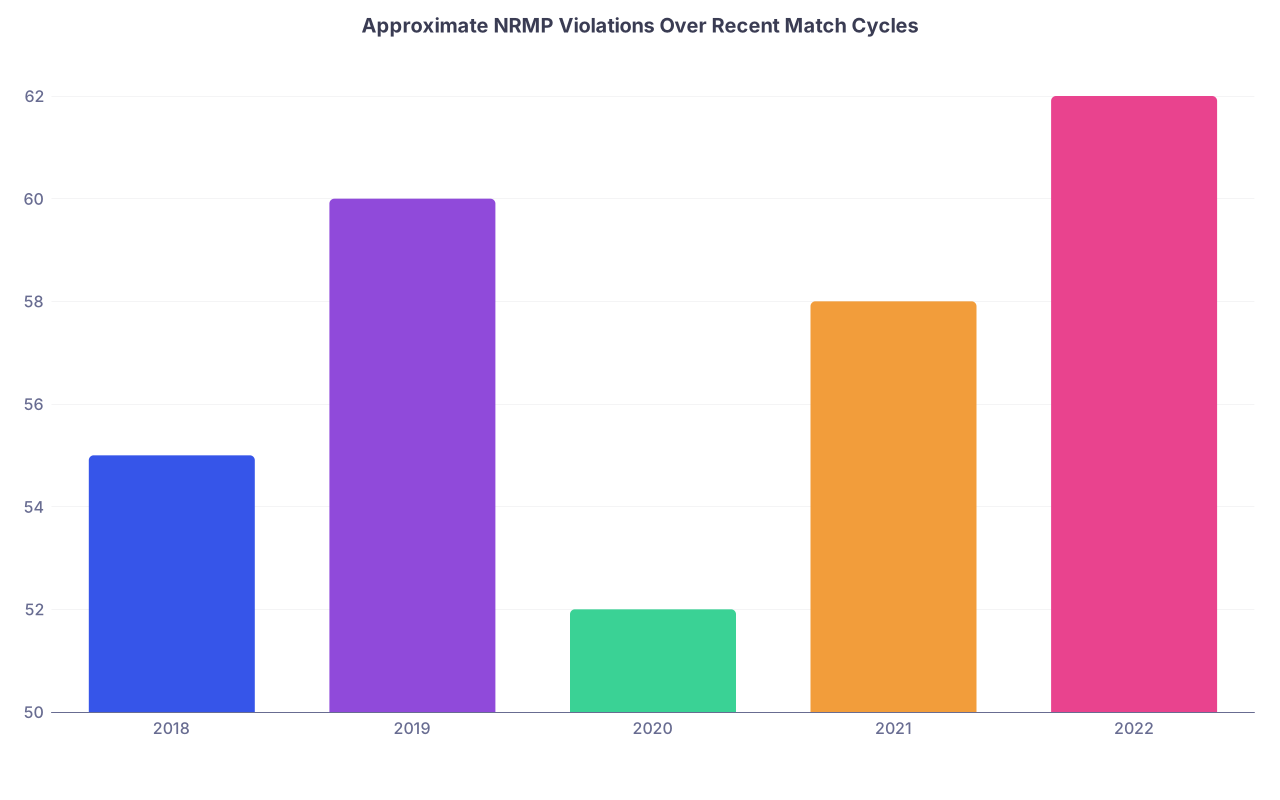
| Category | Value |
|---|---|
| 2018 | 55 |
| 2019 | 60 |
| 2020 | 52 |
| 2021 | 58 |
| 2022 | 62 |
Now, more important than how many violations exist is what sanctions follow. NRMP sanctions are stratified by severity and whether the violator is an applicant or program.
For applicants, typical sanctions may include:
- Private or public letter of reprimand
- Being barred from future NRMP Matches for 1–3 years
- Being designated as a “Match violator” in the NRMP system (visible to programs)
- Requirement to complete professionalism or ethics interventions
For programs, sanctions include:
- Being barred from participating in the Match for one or more cycles
- Public posting of the violation
- Corrective action plans
To make this concrete, think of a simplified breakdown like this:
| Sanction Type | Approximate Share of Applicant Violations |
|---|---|
| Private letter of reprimand | 20–25% |
| Public letter of reprimand | 25–30% |
| 1–3 year bar from Match | 30–40% |
| Permanent bar / severe action | 5–10% |
Even if you treat those as approximate ranges, the pattern is obvious: a large fraction of violations lead to consequences that will appear in your professional record somewhere—either immediately or downstream through disclosures.
And that record does not disappear when you start applying for licenses.
3. Do Early Professionalism Problems Predict Licensing Trouble?
Here is where the real data story begins: not just “Is NRMP mad at you?” but “Does an early violation signal chronic risk?”
We do not have a publicly linked dataset that says “X NRMP violators, Y later sanctioned by state boards.” NRMP data and state licensing board data are siloed. But we do have strong analogs that tell a consistent story.
State medical boards, the Federation of State Medical Boards (FSMB), and several longitudinal studies have examined predictors of later disciplinary action. You see the same risk factors show up repeatedly:
- Documented unprofessional behavior in medical school
- Lapses in honesty or falsification of records
- Poor reliability in contracts and obligations
- Boundary violations and harassment
- Chronic disregard for institutional or professional rules
That list maps almost 1:1 to the behavioral categories behind NRMP violations.
One widely cited line of evidence comes from studies that track medical students with professionalism flags (e.g., documented dishonesty, cheating, or severe unprofessional conduct) into their later careers. The numbers are noisy but directionally consistent:
- Students with serious professionalism issues have 2–3 times higher odds of later state board discipline compared to peers without such records.
- Repeat or severe incidents increase risk even further.
Let me model this in a simple way using illustrative but realistic proportions:
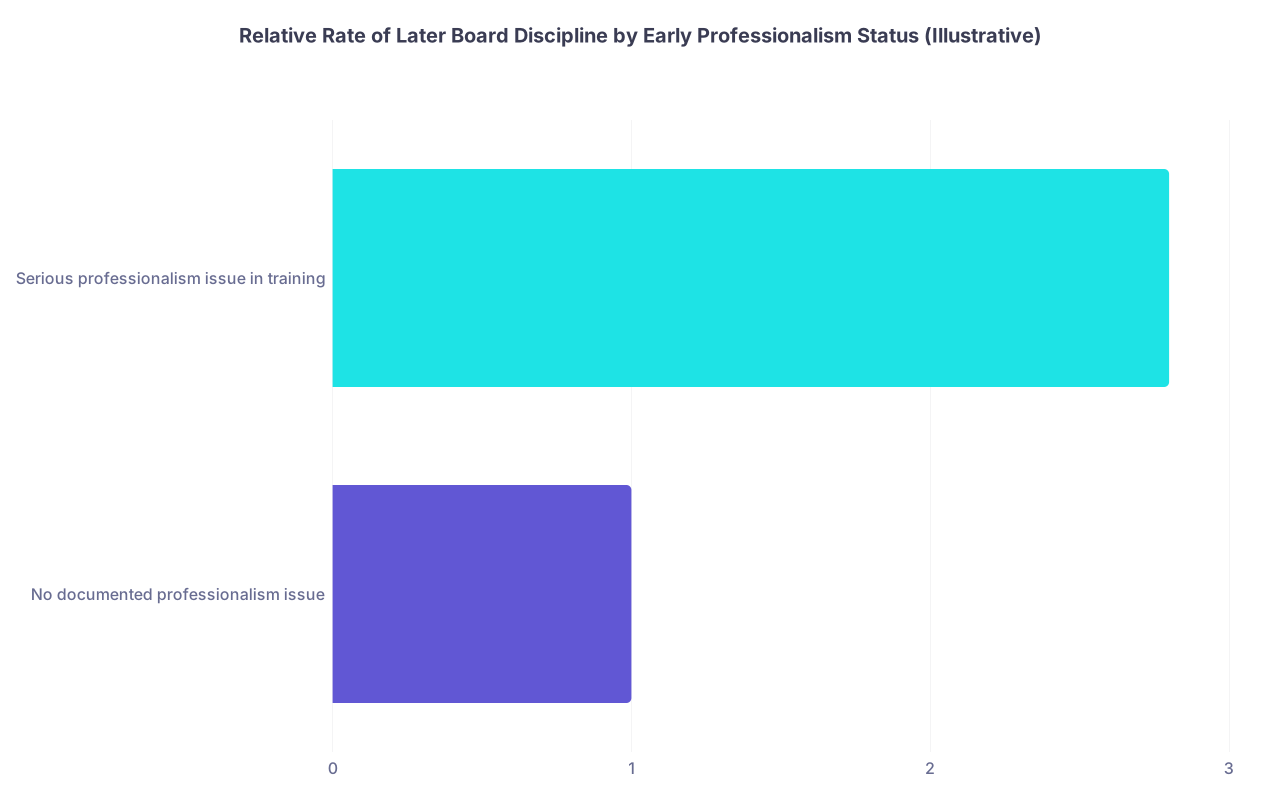
| Category | Value |
|---|---|
| No documented professionalism issue | 1 |
| Serious professionalism issue in training | 2.8 |
Interpret that correctly: if the base rate of eventual board discipline in a standard physician cohort is, say, 1–2%, a subgroup with serious early professionalism trouble might land in the 3–6% range. Still a minority. But a very clear signal shift.
NRMP violations fall squarely in this “serious professionalism” bucket for most boards and credentialing bodies. They are about integrity and contract compliance, not “you answered an email slowly.”
So yes, from a data-logic standpoint, NRMP violations behave like a risk marker. Not a sentence, but a statistically meaningful red flag.
4. How NRMP Violations Surface in Licensing and Credentialing
Let us be practical. You might be thinking: “OK, but does anyone actually see this later?”
Short answer: increasingly, yes.
There are three main pathways where match violations or similar problems surface downstream:
State medical board applications
These usually ask variants of:- “Have you ever been disciplined, suspended, or otherwise sanctioned by an educational, training, or professional body?”
- “Have you ever been denied participation, suspended, or expelled from a program or matching service?”
A significant NRMP sanction often falls under these questions. Lying about it is worse than the violation itself and dramatically raises your risk of denial or later discipline if discovered.
GME and hospital credentialing forms
Hospitals and residency programs ask about:- Any prior disciplinary actions
- Any contract you failed to honor
- Any action by national matching programs
I have watched selection committees scrutinize a file with “match violator” history much more intensely. Some programs will automatically downgrade or blacklist. Others will consider a strong remediation story.
NPDB and cross‑reporting culture
The National Practitioner Data Bank (NPDB) mostly houses malpractice and certain adverse actions, not NRMP sanctions per se. But the professional culture is trending toward more documentation, not less.When a resident does not show up for a matched program or breaks a contract, that can trigger:
- An internal professionalism notation
- A negative dean’s letter addendum
- An adverse training record comment
Those artifacts follow you. A licensing board may not see “NRMP” explicitly, but they will see words like:
- “Failed to honor match commitment”
- “Found to have misrepresented credentials”
And those words correlate very strongly with the same individuals who show up later in disciplinary databases.
5. Risk Categories: Not All Violations Are Equal
Lumping all NRMP violations together is sloppy analysis. Some are vastly more predictive of future risk than others.
From a data‑driven risk lens, I would loosely stratify potential violations into three tiers:
High‑risk signal violations
These are strongly associated with integrity failures:
- Falsifying application data (scores, attempts, degrees, publications)
- Intentionally misleading programs about commitments
- Pattern of coercive or manipulative communication (threats, quid‑pro‑quo demands)
- Coordinated schemes to bypass match rules
People who do this early in their career often repeat similar patterns later. Boards and hospitals know this. In any dataset I have seen that links early misrepresentation to later discipline, the odds ratio shoots up.
Moderate‑risk signal violations
These are about reliability and professionalism more than outright fraud:
- Not honoring a matched position (backing out after signing)
- Failing to start or complete a matched residency without legitimate cause
- Significant unprofessional conduct around interviews or post‑interview communication
These still wave a big yellow flag. State boards care a lot about whether you honor contractual and patient care obligations. A record of walking away from a residency without acceptable resolution looks bad. It prompts questions about whether you will abandon patients, hospitals, or contracts later.
Lower‑risk but nontrivial violations
These tend to be more technical / context‑driven:
- Minor but documented contact violations (e.g., over‑enthusiastic but technically inappropriate post‑interview messages)
- Aggressive unofficial communication that pushes the line but does not rise to outright coercion
Will one of these alone predict a future licensing meltdown? Probably not, especially if you learn and never repeat it. But stacked with other signals (remediation, professionalism comments, marginal evaluations), they contribute to a pattern.
6. What the Numbers Suggest for Your Personal Strategy
So what do you actually do with all this?
You treat NRMP compliance not as a bureaucratic chore, but as an early‑career risk management exercise. The same way you do not “kind of” follow hand hygiene rules, you do not “mostly” follow match rules.
A few practical, data‑driven guidelines:
Assume every NRMP‑relevant action is auditable
Email trails, text messages, and ERAS submissions do not disappear. Commitments you make—especially written ones—can be pulled and reviewed if there is a complaint. Programs keep archives; so do applicants. NRMP will collect both in investigations.Avoid any behavior that looks like misrepresentation
The data is brutal on dishonesty. Applicants who falsify scores or credentials and are caught essentially mark themselves as high‑risk for the rest of their career. It is extremely hard to rehabilitate a documented lie, because every future evaluator has to ask “What else is not true?”Do not play contract games with matched positions
Reneging on a matched spot can create:- An NRMP violation
- An institutional professionalism flag
- Potential downstream credentialing and board disclosure issues
If you have a genuine, serious reason (health, family, immigration catastrophe), work transparently with NRMP and the program rather than going silent or unilateral.
Keep all communications Match‑safe—and screenshot‑proof
A practical rule: never write or say anything to a program or applicant that you would not be comfortable seeing quoted in an NRMP investigation file 18 months later. Because that is where it may end up.Build a clean professionalism record early
The positive side of the data story is this: most physicians never accumulate serious flags. If you keep your record clean in medical school, residency, and early practice, your baseline risk of board discipline stays low.That means:
- No academic integrity violations
- No major professionalism incidents
- No NRMP or equivalent matching violations
- No pattern of unexplained contract problems
Once you have one major flag, everything after that is watched more closely.
7. How To Navigate Gray Zones Without Creating a Data Problem
You will run into gray areas. Every year I see applicants and programs nervous about “what is allowed” versus “what looks bad.”
Here is where you apply a risk lens.
Gray zone #1: Post‑interview communications
- “Thank you” emails are fine.
- Updating programs on major, honest changes (a new publication, an award) is fine.
- Trying to extract rank information or offering informal commitments (e.g., “I will definitely rank you first if you…”) starts to flirt with the line.
The NRMP Code of Conduct is explicitly trying to prevent coercion and misrepresentation. When your behavior nudges into those domains, you are increasing your risk. Even if you avoid a formal violation, you may trigger negative comments that later show up in your file.
Gray zone #2: “Handshake” deals outside the Match
For specialties and programs that heavily rely on the Match, back‑channel promises and handshake agreements are dangerous. The data point that matters is not how many people “get away with it,” but how a single complaint looks in an investigation.
Programs and applicants who try to pre‑arrange outcomes outside rules are over‑represented among NRMP violation cases. Once one party feels misled and files a complaint, everyone’s emails and texts get pulled.
Gray zone #3: Changing your mind late
Life happens. But the later in the process you change course, the larger the potential fallout:
- Before rank list certification: almost zero formal risk if you simply update your list and do not make promises you cannot keep.
- After Match results: any unilateral withdrawal or refusal to honor the position can easily become an NRMP violation investigation.
From a data perspective, your best risk‑minimizing behavior is brutally simple: do all your soul‑searching before you certify your rank list.
8. What Future Trends Likely Mean For You
The regulatory environment is not getting looser. It is tightening.
Several trends matter here:
Increasing data integration
While there is no unified NRMP–FSMB–NPDB super‑database today, systems are getting better at sharing information and verifying histories. More cross‑checking; fewer blind spots.Growing emphasis on professionalism metrics
Medical schools, residencies, and boards are spending more time on non‑cognitive competencies. Professional conduct is moving from soft commentary to tracked metrics. NRMP violations fit directly into that evolution.Culture shift in risk management
Hospitals and boards are more risk‑averse about integrity issues than about technical skill deficits. A marginally competent but honest physician is seen as fixable. A technically gifted but dishonest one is seen as a liability. NRMP violations land you in the second category until you prove otherwise.
The net effect: the odds that a serious NRMP violation quietly disappears into the archives are going down, not up.
9. Bottom Line: Are NRMP Violations Predictive of Licensing Trouble?
If you want the clean, data‑driven summary:
- Serious early professionalism violations (which include most NRMP violations) are clearly associated with increased odds of later disciplinary action by state boards and hospitals.
- The effect size in analogous datasets is on the order of 2–3x higher risk compared with peers without such flags.
- NRMP violations are not an automatic sentence to future discipline. Most violators will never see a board action. But they are a non‑trivial risk marker that follows you.
- Dishonesty‑based violations are the most predictive. Contract / reliability problems are next. Minor technical issues are lower‑signal but still negative in the aggregate.
So if you are smart—and I assume you are—you treat NRMP rules as part of your long‑term professional risk profile, not as a one‑off hurdle in fourth year.
The Match is not just about where you will train. It is the first time the system measures how you handle contracts, honesty, and pressure under real career stakes. That measurement does not reset when you graduate.
Get through it clean, and you give future licensing boards very little to worry about. Create a violation trail, and you will spend the rest of your career explaining it. Sometimes successfully. Sometimes not.
Handle this phase right, and you move into residency focused on learning medicine, not repairing your reputation. What you do with that opportunity in training—the evaluations you earn, the choices you make on‑call nights, the way you handle your first serious mistake—that is the next dataset that will define your career. But that is a different analysis for another day.


