

What do you actually say in the moment when an attending looks you in the eye and says: “So, where am I on your rank list?”
Not in theory. In real life. On rounds. With others listening.
Let’s walk through this like we’re standing next to you on that ward.
1. First, Understand the Line They Just Crossed
An attending pressuring you for your rank list is not just “awkward.” It’s a problem.
Under NRMP rules, programs and applicants cannot:
- Solicit information about rank lists
- Require, pressure, or coerce disclosure
- Make statements implying ranking is contingent on you doing something (“If you rank us highly, we’ll rank you highly”)
A casual “Hope you’ll consider us highly!” is annoying but common.
A direct “Tell me where you ranked us” is out of bounds.
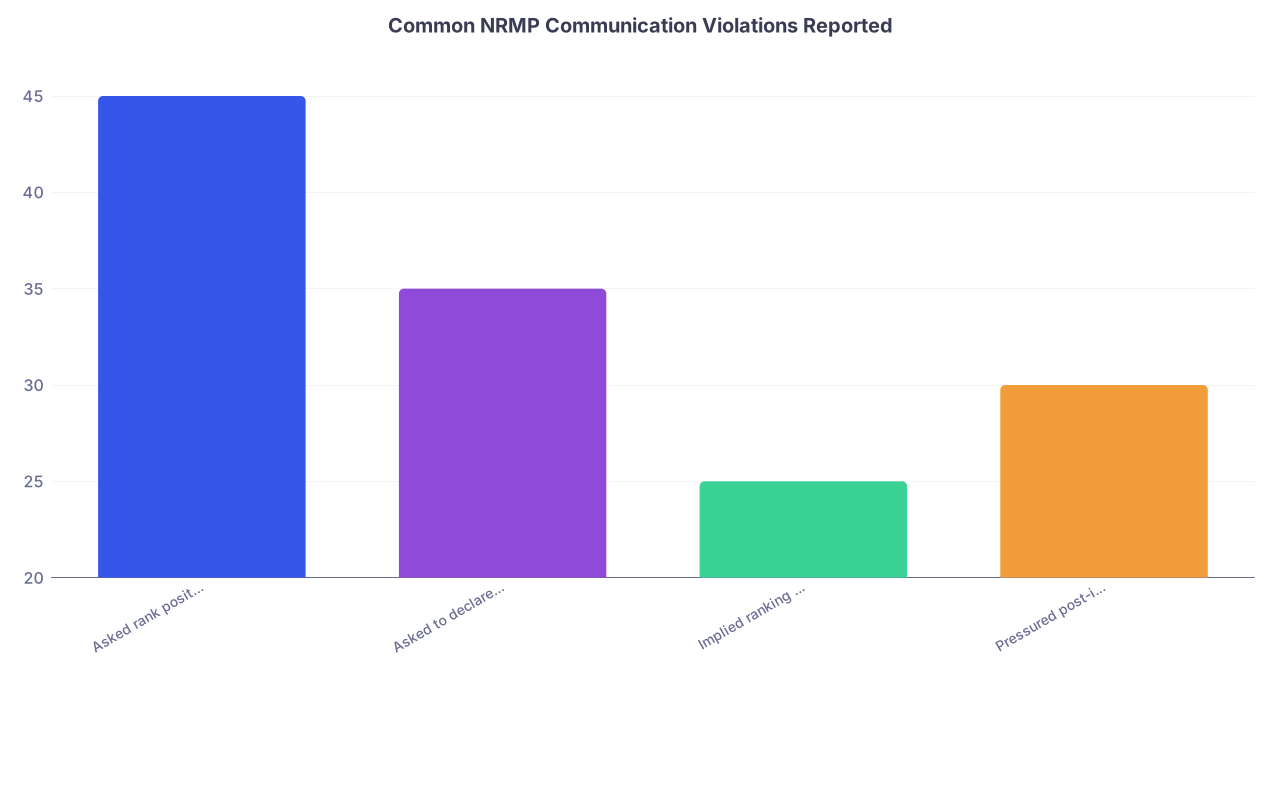
| Category | Value |
|---|---|
| Asked rank position | 45 |
| Asked to declare #1 | 35 |
| Implied ranking guarantee | 25 |
| Pressured post-interview contact | 30 |
Here’s the key:
You are not obligated to answer. At all.
And NRMP explicitly protects you if you refuse to answer or give a neutral response.
But I know the fear:
“This person writes my evaluation. They can torch my career with one sentence.”
So the strategy is:
Protect yourself legally/ethically and protect your evaluation and avoid escalating unless needed.
We’ll go by scenario.
2. In-the-Moment Scripts: What to Say Right Now
Scenario A: They ask directly, once, in a neutral tone
Example:
“So, where are we on your rank list?”
Or
“Are we in your top three?”
You do not need to launch into NRMP policy. Your job is to sidestep cleanly, not to win an ethics debate.
Use one of these:
Option 1 – The Policy Shield (polite, firm)
“I’m trying to be really careful to follow NRMP rules, so I’m not discussing specific ranking with anyone. But I really enjoyed this program and it’s definitely under serious consideration.”
Option 2 – The General Positivity
“I’ve decided not to share my rank list specifics with any programs, but I’m very interested here and I’ve had a great experience.”
Option 3 – The Deflection + Compliment
“I promised myself I wouldn’t talk specifics with any program to keep things fair. But I’ve been really impressed with the teaching and culture here.”
Pick one sentence. Say it calmly. Then shut up. Let the silence work for you.
Do not:
- Blurt out: “You’re number one!” when that’s not true
- Give an exact position
- Apologize repeatedly for not answering
You answered. You stayed within bounds. That’s enough.
Scenario B: They push again after you deflect
Now we’re in “pressure” territory.
Example:
“Come on, I’m not the NRMP. Just between us, where are we?”
Or
“I mean, I wrote you a strong letter. I’d like to know that it’s worth it.”
This is where you add a little more spine without blowing up.
Option 1 – Repeat + Boundary
“I really do want to follow the NRMP rules on this, so I’m going to stick to not discussing my list. I can say I’d be happy training here.”
Option 2 – Put it on principle, not them
“I decided to keep this private across all programs so I don’t feel like I’m favoring one over another in conversation. I hope you can understand that.”
Option 3 – Turn to future fit
“For my own sanity, I’m keeping my list to myself until it certifies. But I’ve seen residents here who look like the kind of colleagues I’d want to train with.”
If they keep going after that? They’re showing you who they are. And you should mentally drop them on your rank list even if you do not say it out loud.
Scenario C: They hint at a quid pro quo
Example:
“If you rank us highly, I’ll make sure your application is strong here.”
Or
“I can put in a word with the committee if I know you’re putting us first.”
This is now straight-up NRMP violation land.
You still don’t argue. You protect yourself.
Try:
“I really appreciate your support. I’ve been advised not to make or discuss any ranking commitments with programs, but I can say I’m genuinely interested here.”
Or, if you want sharper:
“I’m trying hard to do this by the book, so I’m not making any explicit promises about rank. I don’t want to risk any NRMP issues for either of us.”
You’re signaling: I know the rules. I’m not playing this game.
But you’re not screaming, “I’m reporting you right now.”

| Step | Description |
|---|---|
| Step 1 | Attending asks about rank list |
| Step 2 | Give neutral, non-specific answer |
| Step 3 | State NRMP-based boundary |
| Step 4 | End convo and move on |
| Step 5 | Document encounter after |
| Step 6 | Keep notes, consider lower ranking |
| Step 7 | Discuss with advisor or GME/NRMP |
| Step 8 | How direct? |
| Step 9 | Do they push again or imply quid pro quo? |
| Step 10 | Pattern or serious pressure? |
3. What If You Already Lied About Your Rank?
This is more common than anyone admits.
You got cornered. Panicked.
Said, “You’re my number one” to someone who absolutely is not.
Now what?
First: you haven’t violated NRMP rules by saying that. The violation is on the program side for soliciting or pressuring. The “lying” part is an ethical/comfort issue for you, not a legal one.
Your options:
Option 1 – Let it die
Most of the time, they won’t do anything formal with that info. Faculty hear “you’re my #1” all the time and half don’t believe it. Just do not repeat or escalate it. Don’t email, don’t confirm, don’t send gushy promises.
Option 2 – Walk it back if you feel you have to
This is delicate. If you truly cannot live with what you said:
You could send a very neutral follow-up weeks later that doesn’t admit lying but reframes:
“Thank you again for the opportunity to interview and rotate at [Program]. I wanted to reiterate that I’m very interested in your program and believe it would be an excellent place to train.”
Notice: no ranking position mentioned. You’re not re-litigating the conversation. You’re not saying “I changed my mind.” You’re just returning to safe ground.
Option 3 – Learn from it
The real fix is forward: prepare one or two neutral lines before future rotations and stick to them like a script. When you’re tired, on post-call, or anxious, your brain will try to bargain. Don’t let it.
4. How Much Risk Is There to Your Evaluation?
Here’s the quiet fear: “If I don’t tell them what they want, they’ll tank my eval.”
Will some attendings be petty? Yes. I’ve seen it.
Will most? No. Most will feel a moment of ego bruise and move on.
Your job is to:
- Stay utterly professional the rest of the rotation.
- Give them absolutely nothing else to ding you on.
- Document what happened, in case it truly becomes ugly.
Right after the shift, write yourself an email or note with:
- Date and time
- Who was present
- Exact phrases used, as close as you can remember
- Your responses
Save it to a personal account, not a work computer.
If you get a clearly out-of-character bad evaluation later, and you ever need to bring this up to administration, contemporaneous notes are your best friend.

5. When (and How) to Escalate
Most of these encounters should be handled with scripts, boundaries, and then moving on with your life.
But not all.
You should consider escalation if:
- They repeatedly ask despite clear refusal
- They hint that your evaluation or ranking depends on your answer
- They make explicit quid pro quo statements (“Rank us first and we’ll rank you to match”)
- There’s a pattern — others report the same attending doing this
Who to talk to:
- A trusted faculty mentor not tied to that program
- Your home institution’s Dean of Students / advising dean
- Your GME office if you’re already a resident
- NRMP, if this is clearly a policy violation pattern
| Option | When to Use |
|---|---|
| Trusted faculty mentor | First sounding board, gut check |
| Dean of Students | If student, for formal school support |
| GME Office | If resident, for institutional protection |
| NRMP | Clear, repeated or egregious violations |
| Program Director (home) | Context and advice, not formal complaint |
How to present it (to a dean/mentor):
“I had an attending at [Program] who repeatedly asked me to disclose where I ranked them, even after I referenced NRMP rules and tried to redirect. They said [exact phrase]. I’m concerned about the pressure and the potential impact on my evaluation. I documented the details that day. I’d like guidance on whether this rises to the level of a formal concern.”
You’re not going in screaming. You’re going in factual, calm, and specific.
6. How to Prepare Yourself Before It Happens
You know it might happen. So don’t walk in naked.
Do this before interviews and away rotations:
Decide on your “policy”
Example: “I do not discuss the specifics of my rank list with any program.”
Make that your mantra.Memorize 2–3 exact lines
Practice out loud. In the shower, in the car, wherever. You want them automatic.Decide your line in the sand
- One ask and you deflect? Fine.
- Second push and you mentally lower them on your list.
- Quid pro quo or threats and you consider documenting and maybe escalating.
Know the NRMP language
You do not need to quote chapter and verse, but having this concept handy helps:
Programs and applicants “must not request or require the other party to disclose ranking information and must not make statements implying a commitment to rank the other in a certain way.”
You can paraphrase:
“I want to be careful not to cross NRMP lines about discussing rank positions.”
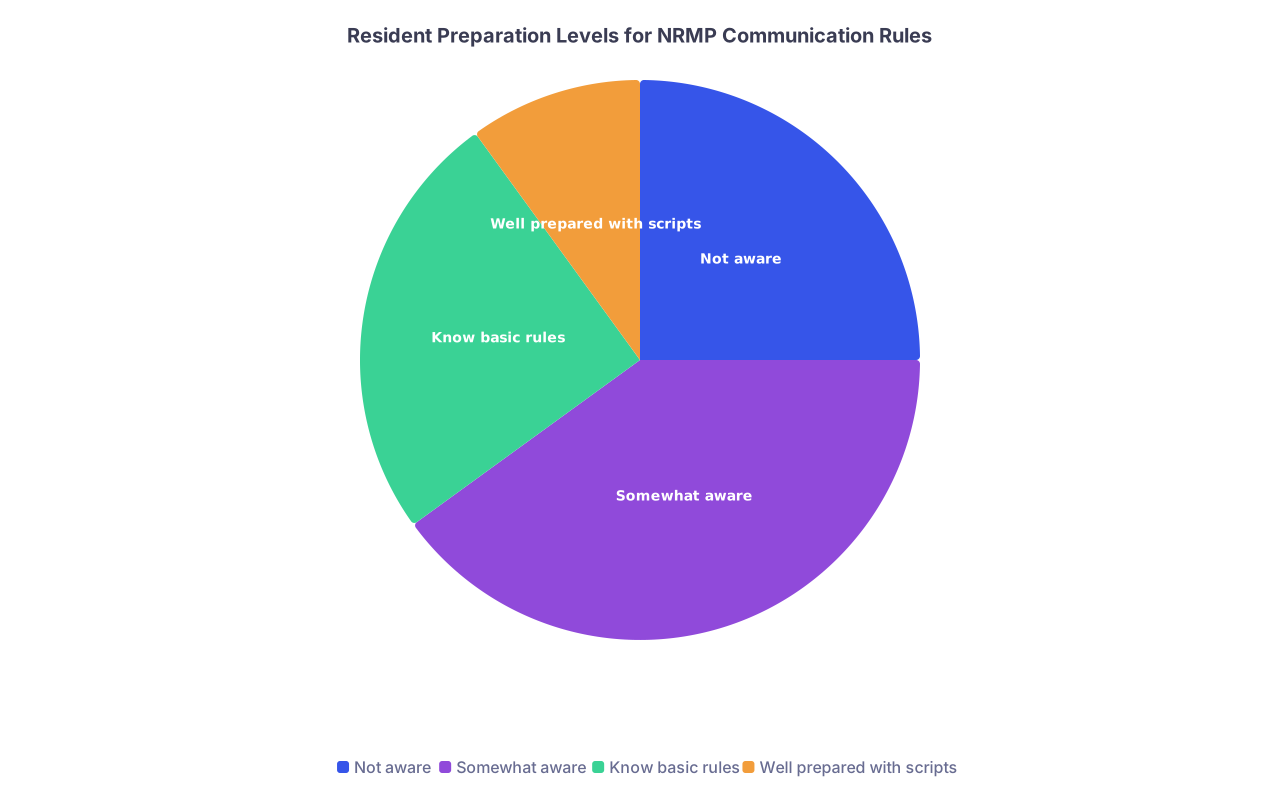
| Category | Value |
|---|---|
| Not aware | 25 |
| Somewhat aware | 40 |
| Know basic rules | 25 |
| Well prepared with scripts | 10 |
7. Special Situations: Subtle vs. Blatant Pressure
Not all pressure is obvious. Let’s separate gray from red flag.
The Gray Zone Comments
Things like:
- “We’d love to have you here.”
- “I think you’d fit in well with our program.”
- “I hope you’ll strongly consider us.”
These are usually harmless. You don’t need to correct anyone. You can say:
“I really appreciate that. I was very impressed with the program.”
No need to bring up rank lists at all.
The Yellow-Flag Comments
Stuff like:
- “We usually rank students highly if they show strong interest.”
- “Programs want to know who is really committed.”
They’re fishing. But not outright violating yet.
You respond with:
“I can say I’m honestly very interested in your program, but I’ve been advised not to talk about specific ranking, just to keep things fair and within NRMP guidelines.”
You’re signaling you know the rules.
The Red-Flag Stuff
- “Tell me where we are on your list.”
- “You’ll do better here if you commit to us.”
- “If you put us #1, we’ll rank you to match.”
- “I expect my letter writers’ students to put us high.”
Here, the steps:
- Use one strong boundary line.
- Document afterward.
- If repeated or egregious, talk to a dean/mentor.
- Drop them on your rank list if you have safer, solid options elsewhere.

8. How This Affects Your Rank List — For Real
Let me be blunt: if a program has attendings who routinely push NRMP boundaries with students, that’s data.
What it might mean:
- Culture may tolerate boundary-pushing behavior
- Power dynamics may not be handled well
- You may have less protection when you are vulnerable (PGY-1 at 2 a.m.)
Does one awkward attending doom a program? No. Every place has a few off people.
But a pattern across multiple faculty, residents, or interactions?
I’d seriously question ranking them highly unless you have no reasonable alternatives.
I’ve watched residents match into places where they “had a bad feeling” about the power dynamics, and 6–9 months later, they’re calling advisors in tears. Listen to your gut. It’s often picking up what your brain tries to explain away.
9. Quick Script Bank You Can Steal
Use these verbatim if you want.
When directly asked “Where did you rank us?”
“I’ve decided not to share specifics about my rank list with any program, just to stay consistent with NRMP rules. I can say I’ve been very impressed with what I’ve seen here.”
When pushed a second time
“I really need to stick to that for everyone. I’m keeping my list private, but I’d certainly be happy to train at a program like this.”
When they imply ranking depends on you committing
“I appreciate you saying that. I’ve been counseled not to make any explicit commitments about rank with programs, but I can say this is a place I’d strongly consider.”
When you want to graceful-exit the conversation
“I actually have to head back to check on [patient/task], but I really appreciate the opportunity to be here this month.”

FAQ (Exactly 5 Questions)
1. Is it ever okay to tell a program they are your #1?
Yes, you are allowed to say it. NRMP doesn’t ban applicants from volunteering information. The problem is when programs pressure or solicit that info, or make promises in return. My rule of thumb: only say “you are my #1” if it is 100% true and you would not be embarrassed if that statement were read out loud at any other program.
2. Can a program actually get in trouble if I report this?
Yes. NRMP can investigate and, in serious cases, sanction programs or individuals. That said, most reports get handled quietly via communication and education, not public punishment. You do not control the outcome, but you’re not overreacting by flagging repeated or egregious pressure.
3. Will refusing to answer hurt my chances at that program?
Possibly with that one insecure attending. But programs rarely base rank lists on one person’s bruised ego alone. And any place that seriously downgrades you for following NRMP rules is already revealing a culture problem. You’re protecting yourself; they’re the ones misbehaving.
4. Should I ever quote NRMP rules word-for-word to an attending?
Usually no. It tends to escalate and embarrass them, which is not your goal. Better to reference the idea loosely: “I’m trying to follow NRMP guidelines and not discuss my specific ranking.” If they keep pushing, you keep your professionalism and document it later.
5. What if this happens during a virtual interview instead of on a rotation?
Same playbook. Neutral, non-specific response. Example: “I’ve decided not to discuss specifics of my rank list with any programs, but I’m very interested in [Program].” After the interview, jot down what happened. If it was clearly pressured or tied to promises/threats, consider discussing it with your school or an advisor, especially if it seems like systemic behavior, not a one-off slip.
Key points to walk away with:
- You never have to disclose your rank list, and you’re protected when you refuse.
- Use short, practiced scripts to deflect pressure calmly and consistently.
- If pressure is repeated, coercive, or tied to promises, document it and seriously reconsider how high you rank that program — and whether escalation is warranted.


