

You are sitting on the couch with your partner, watching the NRMP Couples Match video for the third time. ERAS is submitted. Interview invites are rolling in. You both say, “We’ll just link our lists, how hard can this be?”
That sentence right there is how people accidentally violate NRMP policies. Not because they are unethical. Because they did not understand how specific, rigid, and unforgiving the rules really are when you match as a couple.
Let me walk you through the missteps I have watched couples make. The ones that quietly cross NRMP lines, threaten violations, or blow up rank lists days before the deadline.
1. Forgetting That You Are Still Two Individual Applicants
Couples Match makes people forget something basic: NRMP does not suddenly see you as “one unit.” You are still two separate applicants who have simply chosen to link your rank order lists.
The first big mistake: behaving as if “we” can do things that “I” cannot.
Typical bad scenarios I have seen:
- One partner emailing a program director and implying, “If you rank me, my partner will rank you too.”
- Both partners trying to coordinate offers between programs (“If I rank your program high, will you consider ranking my partner at your affiliated prelim?”).
- One partner speaking for both in communication: “We will rank you first if we both get offers.”
Here is the rule you are bumping against:
Programs and applicants cannot solicit or make any commitments about how they will rank each other. That includes, “If you do X, we will do Y.”
It does not matter that you are a couple. It does not matter that it feels “fair” to negotiate as a package. You are not a two-for-one deal. The algorithm does not care. The NRMP definitely does not care.
How to avoid this:
- Every applicant speaks only about their own interest, without conditions.
“I am very interested in your program” is fine.
“We will rank you highly if my partner interviews here” is not. - Do not try to leverage your partner’s interview or offer to influence a program’s behavior. That is exactly what NRMP calls “soliciting a commitment.”
- If a program asks about your partner, keep it descriptive, not conditional:
“Yes, my partner is applying in Internal Medicine, and we are participating in the Couples Match. We would be very happy to be in the same city.”
The second someone hears, “If you rank us…” you are drifting toward policy landmines.
2. Mishandling Post-Interview Communication as a Couple
Post-interview communication is already a minefield. Add two people trying to sync messages and it gets messy quickly.
I have seen couples do the following (all bad ideas):
- Both partners sending near-identical “You are our top choice” emails to different programs in the same city.
- One partner telling Program A “You are our top choice,” while the other tells Program B “You are our top choice,” and both messages imply a joint commitment.
- One partner explicitly saying, “We will rank you first as a couple if my partner also matches close by.”
NRMP’s position is consistent:
You cannot ask for, or offer, ranking commitments. You cannot pressure programs to disclose their rank intentions. You cannot misrepresent serious preferences in a way that suggests enforceable agreements.
Couples make this worse in two ways:
- Over-promising to multiple programs just to “keep options open.”
- Blurring individual preference and joint preference in writing.
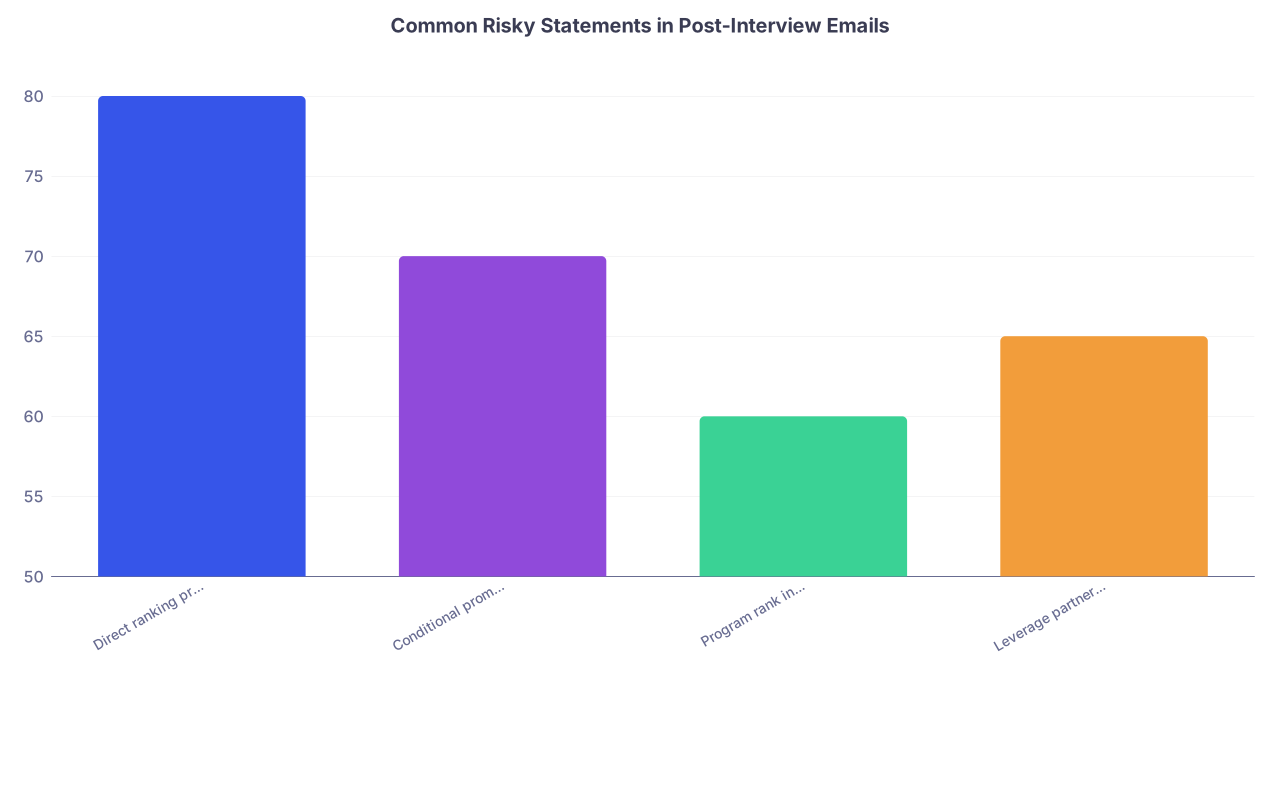
| Category | Value |
|---|---|
| Direct ranking promise | 80 |
| Conditional promise | 70 |
| Program rank inquiry | 60 |
| Leverage partner interest | 65 |
Those “conditional promise” emails are the sneaky ones. Things like:
- “If my partner receives an offer here, we will rank you first.”
- “We are really hoping to be in this city together, and if things work out with my partner’s interviews, your program would be our top choice.”
Read it the way a compliance officer reads it, not the way a stressed MS4 reads it: you are tying ranking behavior to a hypothetical and hinting at an agreement both sides know cannot be enforced.
How to avoid this:
- No one in the couple uses “top choice,” “number one,” or “we will rank you first.” Just stop. You do not need that language.
- Use interest language that is honest but not binding:
“Your program is one of my top choices,” or
“I could see myself very happy training here.” - Coordinate messages, but do not mirror them. If two programs in the same city receive nearly identical emails from each of you, it looks disingenuous at best, manipulative at worst.
- Never ask, even indirectly, “Where will you rank me/us?” That is explicitly forbidden.
You can express interest. You cannot turn interest into a trading chip.
3. Misunderstanding What Programs Can and Cannot Ask About Your Partner
Another place couples unintentionally get pulled into policy gray zones: interview day conversations about your partner.
Programs are allowed to know you are in the Couples Match. They are allowed to ask about your partner’s specialty, geography, and general situation.
They are not allowed to:
- Ask you to reveal where your partner is ranking other programs.
- Pressure you to commit to ranking them first as a couple.
- Suggest, “We will rank you higher if you rank us higher together.”
Bad conversations I have personally heard recounted:
- “If we rank both of you in our top 5, will you agree to rank us first as a couple?”
- “You know, if your partner ranks our prelim program #1, that could help you here.”
- “Where else are you two ranking? We are trying to plan our list.”
If you play along and start negotiating, you are participating in a conversation NRMP rules explicitly bar.
Your responsibility is not to fix the program’s mistake. But you do have to avoid adding your own violation on top of theirs.
How to respond safely:
If they ask about your partner’s plans:
- “Yes, we are participating in the Couples Match. My partner is also interviewing in this region, and we both like this area a lot.”
If they fish for rank info:
- “We plan to submit our rank list based on the best overall fit for both of us, but we will finalize that privately after interviews are complete.”
If they push for a commitment:
- “I am very interested in your program and appreciate your consideration. The Match rules ask that we not make specific ranking commitments, so we will submit our list honestly when the time comes.”
You are allowed to set that boundary. And you absolutely should.
4. Turning Away Offers or Interviews Based on “Backdoor Deals”
Another very quiet but very real NRMP issue: couples acting on “understandings” that were never supposed to exist.
Example pattern:
- Partner A interviews at Hospital X Internal Medicine.
- Partner B gets a last-minute interview offer at Hospital X’s Transitional Year or a nearby affiliate.
- Someone at Hospital X casually implies, “We really want to keep couples together. If you both show strong interest here, things will work out.”
- The couple takes that as a signal of safety and cancels other interviews, or drops other programs down their list prematurely.
Is this an explicit NRMP violation by the applicant? Usually not. But it encourages behavior based on the assumption of coordinated ranking plans, which the NRMP rules try very hard to prevent.
The bigger issue: if you start steering your choices based on “they kind of promised us…” you are misusing something that should never have been said in the first place.
And you may end up accusing a program of “breaking a promise” that was never allowed.
How to avoid playing yourself here:
- Assume no program is coordinating your ranks with your partner’s in any meaningful or reliable way, even if someone hints otherwise.
- Do not cancel solid interviews or lower good programs solely because a faculty member said, “We love couples.”
- Never tell one program, “We cancelled other interviews because you told us we would likely match here together.” That only turns a bad conversation into a documented one.
Programs can be “couples friendly.” They cannot make conditional ranking guarantees, and you should not behave as if they did.
5. Screwing Up the Mechanics of the Couples Rank List
Some NRMP “violations” are not ethical problems so much as technical ones that turn into compliance issues.
Couples Match rank lists are nasty. I have watched otherwise intelligent people completely misunderstand how combinations actually work.
Typical mistakes that get close to NRMP trouble:
- Submitting mismatched lists where the combination codes do not align properly.
- One partner changing their program order after the other partner has coordinated combinations, without double-checking line-by-line.
- Not realizing that “No Match” is still a rank option and failing to include it intentionally.
- Accidentally ranking a combination where one partner’s choice is a program they never actually interviewed at (yes, it happens when lists are long).
On their own, these are not sanctions-level violations. But they lead to angry emails, accusations, and “The algorithm must be wrong” complaints. Which is where the NRMP starts looking very carefully at correspondence and communication around your list.
| Error Type | What Goes Wrong |
|---|---|
| Non-parallel lists | One partner has extra ranks not matched on the other list |
| Wrong program codes | Couples combination points to a program you never meant to rank |
| Missing No Match option | Algorithm forces bad pairings instead of safe single matches |
| Last-minute unilateral edits | One partner changes order without updating combinations |
How to avoid the technical disasters that invite scrutiny:
- Simulate your list together on paper before touching NRMP. Manually write out combinations line by line.
- Verify every combination code matches an actual interview and correct program track (categorical vs prelim vs advanced).
- Use “No Match” intentionally where you would rather go unmatched than accept a particular pairing. Do not leave this to chance.
- Freeze the list 48 hours before the deadline. No last-minute solo edits. If you change anything after your “final review,” you both sit down and check every combination again.
You do not want to be emailing NRMP support frantically on the last day trying to prove the system “glitched.” It did not. Someone in the couple changed something without catching the consequences.
6. Mishandling Confidential Information Between You, Your Partner, and Programs
Another quiet way couples stumble near NRMP policy lines: mixing who knows what about whom.
There are three “information channels” here:
- Things you know about your partner’s interviews and offers.
- Things programs tell you that they expect to stay on your side of the conversation.
- Things your partner shares about their interactions with programs.
The problem shows up when:
- You repeat something one program told you directly to another program in the same city to “strengthen your hand.”
- You share your partner’s post-interview impressions with your own interviewers as if they are common knowledge.
- You describe “We both heard…” in ways that imply programs are coordinating, when they usually are not and should not be.
Does NRMP bar you from talking about programs with your partner? Of course not.
The violation risk appears when you start using inside conversations as bargaining chips:
- “My partner’s program told them they would rank them highly if I also ranked them high.”
- “The other hospital in this city said they want us as a package, can you match that?”
Now you are dragging one program’s potentially improper conversation into another’s. You are not just in policy trouble. You are now in the middle of an institutional problem you do not want associated with your name.
Safe rule of thumb:
- Talk to your partner freely about your own experience, preferences, and impressions.
- Do not quote specific program statements to other programs. Ever.
- Do not claim one program made ranking promises on behalf of you or your partner, especially in writing.
You cannot control what a program says. You can absolutely control whether you spread it and escalate it.
7. Misreporting Violations or Threatening NRMP Involvement as Leverage
Couples are stressed. They hear something that sounds wrong, and then one of them sends a scorched-earth email.
Terrible pattern I have seen more than once:
- Program says something inappropriate about ranks or couples.
- Applicant feels cornered, and instead of documenting calmly and reporting through NRMP channels, they email the PD saying, “What you are doing violates NRMP rules and I will report you unless you…”
- That “unless you…” part is where the applicant now looks like the one attempting coercion.
You are allowed to report suspected violations. You are not allowed to use NRMP as a threat to pressure someone into giving you a better outcome.
And if your partner is in the loop and also writes or forwards similar messages, now the couple looks organized and adversarial. NRMP will review everything. Not just what the program did.
Safer approach:
If you believe a program violated NRMP rules:
- Document exactly what was said, when, and by whom.
- Do not argue back in the moment. Do not “correct” them in a combative way. A neutral boundary (like the scripts above) is enough.
- Submit a report to NRMP through the official channel, calmly, factually, without embellishment or threats.
Dragging NRMP into it as a threat in your email thread with a program is a strategic mistake. Report quietly. Privately. Let the system handle it.
8. Letting External “Advisors” Push You Into Rule-Bending
Last one, but I have to call this out.
Couples get desperate. They start listening to:
- A senior resident who “got in” somewhere by “letting the PD know we were ranking them first.”
- A dean who casually suggests, “You might want to reassure them they are your top choice as a couple.”
- A friend who says, “Everyone does it, NRMP will never know.”
NRMP violations often happen because someone in a position of perceived authority gave bad advice, and the couple overrode their own discomfort.
You are the one whose name is on the application. You, not your dean. Not the resident. Not the Reddit comment.
If anyone encourages you to:
- Promise ranks.
- Ask for rank info.
- Hint at quid pro quo.
- Use your partner’s status to push a program for more than genuine consideration.
That is your sign to stop listening.

Run your question against the actual NRMP Match Participation Agreement and Code of Conduct. It is all public. If the advice conflicts with the plain language, the advice is bad. Full stop.
9. A Simple Decision Flow You Should Stick To
To keep yourself out of NRMP trouble as a couple, your mental flowchart should look roughly like this:

| Step | Description |
|---|---|
| Step 1 | Thinking of email or conversation |
| Step 2 | Stop - rewrite without rank promises |
| Step 3 | Stop - remove any questions about rank order |
| Step 4 | Stop - remove quid pro quo about couple |
| Step 5 | Send or say it |
| Step 6 | Mention ranks or commitments |
| Step 7 | Ask about program rank plans |
| Step 8 | Leverage partner interest |
If anything you say or write:
- Talks about exact rank positions.
- Asks where you or your partner will be ranked.
- Ties your ranking behavior to what a program does for your partner.
Then you do not send it. You rewrite it. Or you delete it entirely.
10. What You Should Focus On Instead
You are not in this to play amateur compliance lawyer. You are trying to match, together, into sustainable training spots.
So center your energy on the parts that are both high-yield and NRMP-safe:
- Make a brutally honest couples rank list that reflects what you actually want, in order, if no one had said anything to you post-interview.
- Communicate genuine interest without trading it as currency.
- Protect each other from panic moves: last-minute promises, desperate emails, or retaliatory messages.
- Treat every weird or uncomfortable comment from a program as a red flag, not as leverage.

If a program puts you in a position where staying inside NRMP rules feels hard, that is a huge data point about their culture. Believe it.
Key Takeaways
- Being in the Couples Match does not give you special permission to negotiate ranks, make promises, or ask for commitments. You are still two individual applicants bound by the same NRMP rules.
- Any time you tie your ranking behavior to your partner’s situation in communication with a program, you are drifting toward policy trouble. Keep interest genuine but non-conditional.
- The safest move is boring: follow the NRMP agreement literally, build an honest couples rank list, and ignore any advice that requires “bending” the rules to get what you want.


