You're staring at a 3.1 cumulative GPA on your transcript. Or maybe you spent four years getting an English degree, never touched a single science lab, and realized at 24 that you want to be an orthopedic surgeon. You know medical school admissions committees expect a high science GPA, a rock-solid MCAT score, and proof that you can handle rigorous coursework.
What do you do? You look at postbaccalaureate (postbac) programs.
Here's the reality: postbac programs are one of the most effective tools for turning a dead-end medical school application into an acceptance letter. But they are also a massive financial investment. Pick the right program, and you bypass years of trial-and-error with a direct pipeline into medical school. Pick the wrong one, and you'll burn $50,000 to sit in cash-cow master's classes that don't actually move the needle on your application.
I've seen applicants waste entire years because they picked a program based on a prestigious university name rather than how the AMCAS application system actually calculates GPAs. Let's break down how these programs work, which one fits your situation, and how to avoid the trap of paying for a degree medical schools don't care about.
This article is for educational purposes only. It is not financial advice, not legal advice, and not tax advice. Figures vary by individual circumstances, consult a qualified professional before acting.
The Core Challenge
The biggest mistake pre-meds make with postbacs is treating them like a one-size-fits-all product. They aren't. A postbac isn't just "extra school." It falls into specific categories designed for completely different applicant profiles.
If you sign up for the wrong category, you waste time and money. Period.
Pitfall #1: Confusing Graduate GPA with Undergraduate GPA
AMCAS (MD) and AACOMAS (DO) do not blend your graduate grades into your undergraduate GPA. They sit in two completely separate boxes on your application cover sheet.
If your undergraduate science GPA (BCPM) is a 2.8 after 120 credit hours, taking a 30-credit Master's in Physiology and getting a 4.0 gives you a 4.0 Graduate GPA. Your Undergraduate GPA stays a 2.8. Some medical schools screen out any application with an undergraduate GPA below a 3.0 using automated software filters. Your shiny new master's degree won't even be looked at if your file gets filtered out at step one.
Pitfall #2: Buying into Cash-Cow Master's Programs
Universities love launching "Masters in Medical Science" or "Biomedical Sciences" programs. Why? Because graduate students pay full tuition and don't qualify for the same institutional aid undergraduate students get.
Some of these programs boast "high interview rates," but when you look closely at the data, only 30% of their cohort actually matriculates into a medical school. You must demand hard data before enrolling:
- How many students entered the program?
- How many completed it?
- How many got into an MD or DO school within one year of finishing?
Pitfall #3: Ignoring the "Linkage" Golden Ticket
A linkage agreement is a formal partnership between a postbac program and a medical school. If you hit a specific GPA (usually 3.6 to 3.8) and an MCAT score threshold while in the postbac, you skip the standard glide year and get direct admission to the medical school.
If you're doing a Career Changer postbac without looking for linkage options, you're leaving the single most valuable advantage on the table.
The Three Types of Postbacs (and Who They're For)
Career Changer Programs (Formal)
- Who it's for: You graduated with a non-science degree and have zero (or very few) science prerequisites. Your undergrad GPA is good (3.5+).
- The Goal: Complete Bio, Chem, Orgo, Physics, and Biochem in 12-15 months.
- Examples: Bryn Mawr, Goucher, Johns Hopkins. High linkage rates. Excellent yield.
Academic Record Enhancer (Undergraduate Level / DIY)
- Who it's for: You took the science classes, but your GPA lands in the 3.0-3.4 range.
- The Goal: Take upper-level undergraduate science classes (Genetics, Cell Bio, Immunology) to push your undergrad BCPM GPA above a 3.5.
- How to do it: You can enrol in a formal postbac certificate or simply register as a non-degree student at a local 4-year university. Cheaper, highly effective.
Special Master's Programs (SMPs)
- Who it's for: Your undergrad GPA is below a 3.0, or you've taken so many undergraduate credits that taking 30 more undergraduate hours won't move your GPA math.
- The Goal: Take actual first-year medical school courses alongside medical students.
- The Risk: High risk, high reward. Get a 3.8+ in an SMP, and you prove you can handle med school coursework. Get a 3.2 in an SMP, and your medical career is essentially over.
Actionable Next Steps
If you need a postbac to salvage or build your medical school application, do not randomly apply to programs. Follow this exact execution plan.

Step 1: Calculate Your Math Before Spending a Dollar
Open Excel. Pull up your transcripts. Calculate your current BCPM (Biology, Chemistry, Physics, Math) GPA and total credit hours.
Run two scenarios:
- Scenario A: What happens to your undergrad GPA if you add 30 credit hours of 4.0 undergrad work?
- Scenario B: What happens if you add 40 credit hours?
If 30-40 credit hours of undergraduate work pulls your GPA above a 3.4, do not do an SMP. Do an undergraduate-level academic enhancement postbac (DIY or formal certificate). It's safer, cheaper, and directly fixes your primary metric.
If adding 40 credit hours barely moves your GPA from a 2.8 to a 2.95 because you have 140 credit hours already, an undergraduate postbac won't save you. You are the target candidate for a Special Master's Program (SMP).
Step 2: Audit Linkages and Fine Print
If you choose a formal program, ask the program coordinator these three exact questions before applying:
- "What percentage of entering students maintain the required GPA to trigger the linkage agreement?" (If they admit 50 students but only 3 hit the linkage threshold, the program is a meat grinder).
- "Is the linkage conditional on an MCAT score, and what is that score?"
- "Does the linkage allow me to skip the glide year, or do I still have to wait an full application cycle?"
Step 3: Map Out the MCAT Timeline
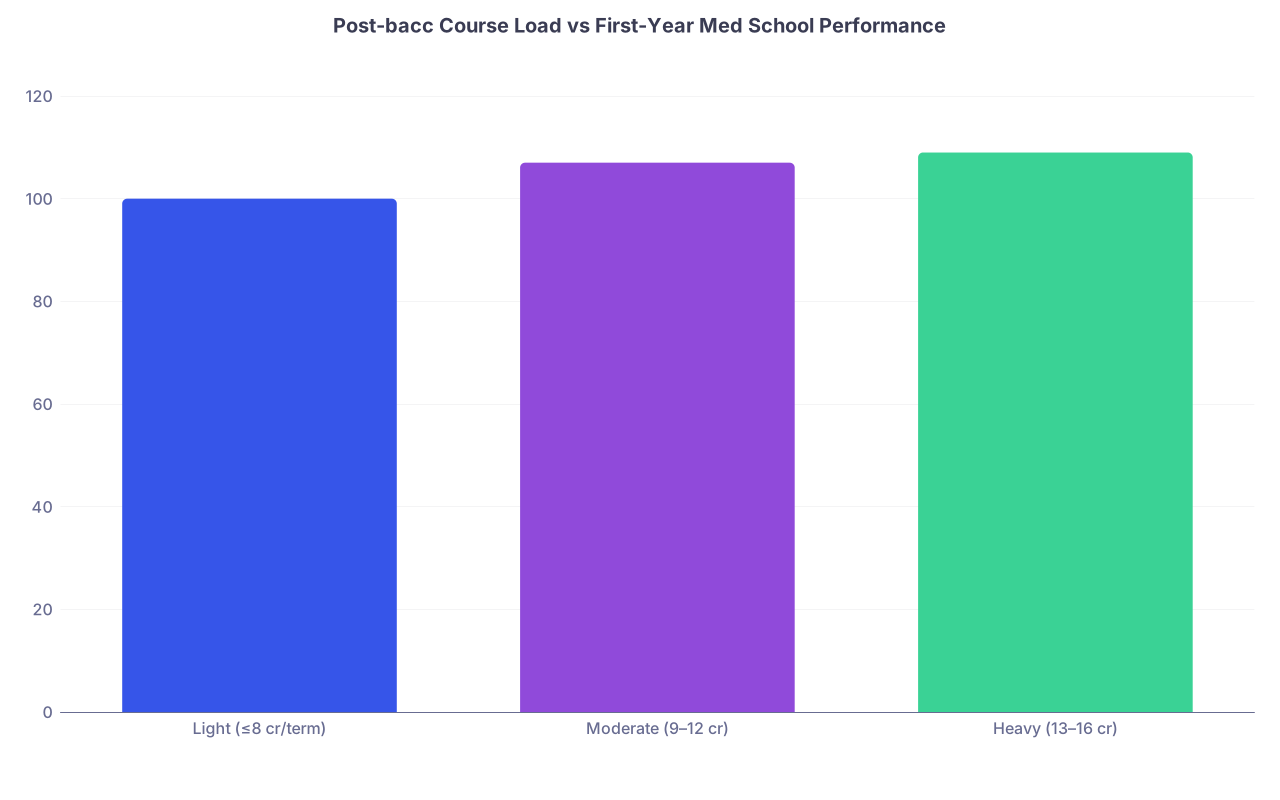
Never attempt to take heavy postbac science coursework while simultaneously studying for a first-time MCAT. It's a recipe for two mediocre outcomes.
- Career Changers: Complete your core chemistry and biology sequences first. Dedicate the summer post-program entirely to MCAT prep before taking the exam in late summer.
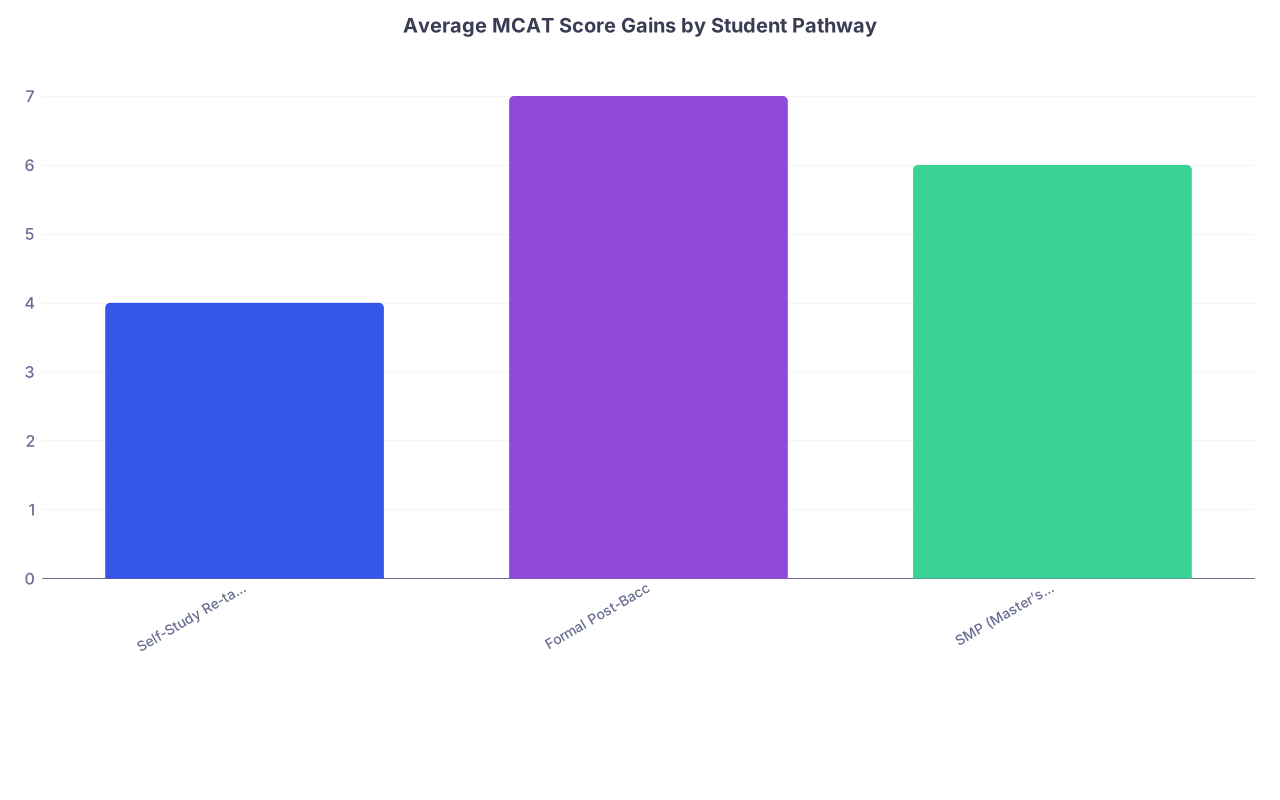
- Academic Enhancers: If you've already taken the prerequisite coursework once, do a deep-dive diagnostic MCAT right now. If your baseline score is poor, fix content gaps during your postbac coursework, then block out 12 weeks of dedicated study time post-coursework.
Key Resources
- AAMC Postbac Database: The official searchable directory of postbac programs across the US. Filter by program type (Career Changer vs. Academic Enhancer).
- MSAR (Medical School Admission Requirements): Use this to check the median undergraduate GPAs for schools you plan to target post-program.
- AACOMAS & AMCAS Grade Conversion Guides: Essential for understanding how retaken classes, community college credits, and quarter system conversions impact your final baseline GPA.
Key Takeaways
- Match the program to your specific deficiency. Use Career Changer programs for missing prerequisites, Undergraduate Postbacs for GPAs between 3.0-3.4, and SMPs only if your undergraduate GPA is mathematically unfixable.
- Graduate GPAs do not overwrite undergraduate GPAs. Medical school application services maintain them as separate lines. Know which one needs fixing before enrolling.
- Protect your GPA at all costs. A postbac is your last chance to prove academic capability. Do not take on extra extracurriculars, jobs, or research projects if they endanger your postbac 4.0.
- Demand real data on linkages. High-performing programs are transparent about their matriculation rates and linkage success statistics. Avoid programs that hide their numbers behind general promises.