The way most students use a post-bacc for MCAT prep is inefficient and backwards. Your post-bacc should not just “support” MCAT studying. It should be your MCAT study framework.
If you treat classes over here and MCAT prep over there, you will burn out, waste time, and score below your potential. The fix is to build a system where every course, assignment, and exam is deliberately wired into MCAT content, practice, and review.
Here is exactly how to turn any post-bacc—formal or DIY—into a built-in MCAT machine.
Step 1: Design Your Post-Bacc Around MCAT Content, Not Just Requirements
Most students ask, “What do I need for med school prereqs?” Wrong starting point. The better question is:
How do I cover and retain every MCAT topic with minimal duplication and maximum reinforcement?
Map your courses to the MCAT blueprint
Use the AAMC MCAT Content Outline as your backbone. Then map every planned course to that outline:
Biology
- MCAT: Cells, genetics, physiology, reproduction, nervous/endocrine systems, immune, metabolism.
- Courses that help:
- Intro Biology I & II
- Physiology (human or mammalian)
- Microbiology (helps immune + experimental passages)
- Genetics (if time allows)
General Chemistry
- MCAT: Stoichiometry, thermodynamics, equilibrium, acids/bases, electrochemistry.
- Courses:
- Gen Chem I & II with labs
Organic Chemistry
- MCAT: Structure, nomenclature, reactions, spectroscopy, lab techniques, biomolecules.
- Courses:
- Organic I & II with labs
- Biochemistry (bridge between orgo + bio)
Physics
- MCAT: Kinematics, forces, fluids, circuits, waves, optics.
- Courses:
- Physics I & II (algebra-based is sufficient; calculus-based is fine but not necessary)
Psychology & Sociology
- MCAT: Behavior, learning, memory, personality, mental health, demographic factors, social stratification.
- Courses:
- Intro Psychology
- Intro Sociology
- Social psychology or abnormal psychology (optional but useful)
Now check for gaps:
- No physiology? Make sure biology II is systems-heavy and plan extra MCAT-only review.
- Weak in social sciences? Take at least 1 psych and 1 soc course; do not rely solely on self-study if you struggle with memorization-heavy material.
- Did your undergrad bio miss genetics or immunology? Plan targeted MCAT content review blocks in those areas.
Sequence courses for MCAT advantage
You want synergy, not chaos. Sequence matters.
Ideal 4-semester post-bacc flow (with MCAT at the end):
- Semester 1
- Gen Chem I
- Bio I
- Psych
- Semester 2
- Gen Chem II
- Bio II
- Sociology
- Semester 3
- Organic I
- Physics I
- Biochemistry (if allowed) or an upper-level bio
- Semester 4
- Organic II
- Physics II
- Physiology or upper-level MCAT-relevant bio
- Take the MCAT right after Semester 4 (most content fresh).
- If you are very strong and disciplined, you can aim for between Semesters 3 and 4, but only if:
- You finish biochem by end of Semester 3.
- You can self-study remaining orgo/physics topics confidently.
The principle: arrange courses so big MCAT concepts are reinforced multiple times before test day. You should not be meeting key topics (acid-base, circuits, hormones) for the last time on your own with a prep book.
Step 2: Build a Weekly “MCAT-Integrated” System Around Each Class
Stop thinking “class, then later MCAT.” Every week of your post-bacc must feed directly into MCAT prep. Create a default weekly structure and stick to it.
Step 2A: Turn every lecture into MCAT notes
For each science lecture:
During or immediately after class (same day)
- Identify:
- Definitions → convert to concise flashcards.
- Equations → add units, when to use, and 1–2 quick examples.
- Mechanisms/Processes → convert to 1-page diagrams or flow charts.
- Quickly tag each concept:
- “High-yield MCAT” (e.g., acid-base, membranes, memory)
- “Course-only” (e.g., obscure derivations, instructor-specific minutiae)
- Identify:
Within 24 hours
- Create:
- 10–20 Anki cards (or your spaced repetition tool) based on that day’s high-yield material.
- 1–2 summary questions in your own words:
- “How does Le Chatelier relate to hemoglobin oxygen binding?”
- “How would increased aldosterone show up in an MCAT passage scenario?”
- Create:
The goal is simple: each lecture generates MCAT-ready, reusable content.
Step 2B: Use lab and problem sets as passage training
Labs and problem sets are not just for grades. Reframe them as MCAT passage simulations.
For each lab:
- Before lab:
- Predict 2–3 MCAT angles:
- “How could this turn into a graph or figure?”
- “What variables could they manipulate to test a hypothesis?”
- Predict 2–3 MCAT angles:
- After lab:
- Write 3–5 mini-passage questions:
- 1 about experimental design (control, independent variable)
- 1 about interpreting a graph
- 1–3 about underlying concepts (e.g., enzyme kinetics, pH)
- Write 3–5 mini-passage questions:
For problem sets:
- Do them under mild time pressure (e.g., 60–75 seconds per problem for conceptual items).
- For every missed or guessed problem:
- Log it in an “MCAT Concepts Error Log” with:
- Topic
- Why you missed it
- What rule or concept will prevent repeat mistakes
- Log it in an “MCAT Concepts Error Log” with:
Your professor is feeding you free MCAT practice. Most students ignore this.

Step 3: Use Each Semester as a Targeted MCAT Phase
You cannot “study for the MCAT” the same way in Semester 1 and the final 10 weeks before your exam. You need distinct phases.
Semester 1–2: Foundation + Light Integration
Focus: Learn the language of the sciences and build systems.
Your structure:
- Per week
- 5–6 days of Anki or spaced repetition (20–30 minutes, capped)
- 2–3 short sets of content-linked practice questions:
- Use Khan Academy, UWorld (if budget allows), Jack Westin, or free Qbanks.
- 5–10 questions at a time on topics you covered that week in class.
- Monthly
- 1–2 short mixed-topic sets (20–30 questions) to start blending subjects.
Do NOT worry about full-length exams yet. Your focus is:
- Understanding fundamental concepts.
- Building a durable review system.
- Learning to read graphs and passages slowly but accurately.
Semester 3: Intensified Integration
By Semester 3, a large portion of MCAT content should be in progress or complete.
Adjust your system:
- Per week
- 5 days of Anki (30–45 minutes).
- 2–3 passage sets (3–4 passages each) in the subjects you are actively taking.
- Example: Org I + Physics I → do passages mixing kinetics, energy, and reaction mechanisms.
- Monthly
- 1 half-length exam or 2–3 “mini-exams”:
- Example: 2 C/P sections on one weekend, then a CARS + psych/soc block another weekend.
- 1 half-length exam or 2–3 “mini-exams”:
By the end of Semester 3, you should:
- Have exposure to all major science concepts.
- Have completed at least:
- 500–800 discrete or passage-based questions.
- 2–3 simulated exam blocks.
Semester 4 + Dedicated MCAT Phase
Here you transition from “course-first” to “MCAT-first.”
Your weeks shift to:
- Non-exam weeks
- 4–5 days: 1–2 MCAT passage sets per day (including CARS).
- 3–4 days: focused content review blocks (1–2 hours) based on weaknesses.
- Every 2–3 weeks
- One full-length exam (AAMC or high-quality third-party) under near-real conditions.
Courses are still important, but you schedule around MCAT needs. This may mean:
- Studying MCAT content 6–8 am and 7–9 pm, and using midday for classes/labs.
- Sacrificing some “extra credit” or overkill studying for ultra-detailed course material that is not MCAT relevant.
You are explicitly using the semester as a pre-dedicated phase so that your final 6–10 dedicated weeks are for:
- High-yield targeted review.
- Practice test analysis.
- Strategy sharpening.
Not basic content learning.
Step 4: Turn Every Course Exam Into Mini MCAT Diagnostics
Course exams are wasted if you only care about the grade. They can act as extremely detailed MCAT diagnostics if handled correctly.
Before an exam: study like a scaled-down MCAT section
Do not cram by rereading notes 5 times. Use an MCAT-style approach.
Create a 5–7 day mini-plan
- Day 1–2:
- Review lecture summaries and Anki decks for the tested units.
- Day 3–4:
- Do 20–40 MCAT-style questions in that topic area.
- Write down recurring mistakes.
- Day 5:
- Light review, focusing on equations and conceptual trouble spots.
- Day 6–7:
- Fast mixed review. Sleep properly.
- Day 1–2:
Use MCAT-style practice even for course tests
- For orgo: substitution/elimination passages.
- For physics: energy, fluids, circuits problems in passage form.
- For bio: endocrine, genetics, cell bio passages.
Your course tests become practice for handling time pressure and reading scientific material efficiently.
After an exam: perform “MCAT-flavored” postmortems
Within 48 hours of every major exam:
- List all missed questions by topic:
- E.g., “Buffers and titration curves,” “DNA replication enzymes,” “Torque.”
- For each miss:
- Identify the root cause:
- Did not know the concept.
- Knew it but misread the question.
- Knew it but misapplied an equation.
- Identify the root cause:
- Convert each error into:
- 1–2 Anki cards.
- A one-sentence rule:
- “When torque is zero, net clockwise = net counterclockwise.”
- Tag it in your MCAT Error Log as:
- “Content” or “Strategy” issue.
Over multiple courses and multiple exams, this becomes a gold mine of where your MCAT will likely attack you. You are building a personalized blueprint of your weaknesses long before dedicated prep.

Step 5: Make CARS and Psych/Soc Non-Negotiable From Day One
Most post-bacc students say, “I’ll deal with CARS and psych/soc during dedicated.” That approach kills scores.
CARS: train like a language, not a subject
You cannot cram reading skill.
MCAT-integrated CARS protocol:
From Semester 1 onward
- 4–5 passages per week minimum.
- Use:
- AAMC CARS Qpacks (save some for later).
- Jack Westin.
- Other reputable CARS-only platforms.
Rules for every CARS session
- Full focus. Silence, no phone, timed conditions.
- After each passage:
- Log any question where:
- You were >70% sure but wrong.
- You changed from right to wrong.
- Write why:
- Misinterpreted author’s tone?
- Let outside knowledge intrude?
- Chose answer that was “true” but not supported?
- Log any question where:
You are building pattern recognition. Over a year, 4 passages per week becomes >200–250 passages. That is how you make CARS predictable instead of terrifying.
Psych/Soc: treat your courses as your primary MCAT resource
Intro psych and intro soc will cover a massive chunk of MCAT content if you manage them correctly.
For every chapter:
- Pull out:
- All named theories (e.g., Maslow, Piaget, Kohlberg, Mead).
- All key terms (e.g., cognitive dissonance, social facilitation, anomie).
- Create:
- 1–2 ultra-simplified definitions in your own words.
- A real-life example for each.
- Use:
- Anki decks aligned to MCAT psych/soc content (e.g., MilesDown, Ortho’s decks) but edit them down to:
- 5–10 cards per lecture that you truly need.
- Anki decks aligned to MCAT psych/soc content (e.g., MilesDown, Ortho’s decks) but edit them down to:
By the time you leave those courses, you should need minimal additional psych/soc content review. Just practice questions and fine-tuning.
Step 6: Build a Time Management System That Will Not Collapse in Week 5
The biggest failure mode in post-bacc MCAT integration is not intelligence. It is calendar collapse.
You cannot do “MCAT whenever I have time.” You need hard rules.
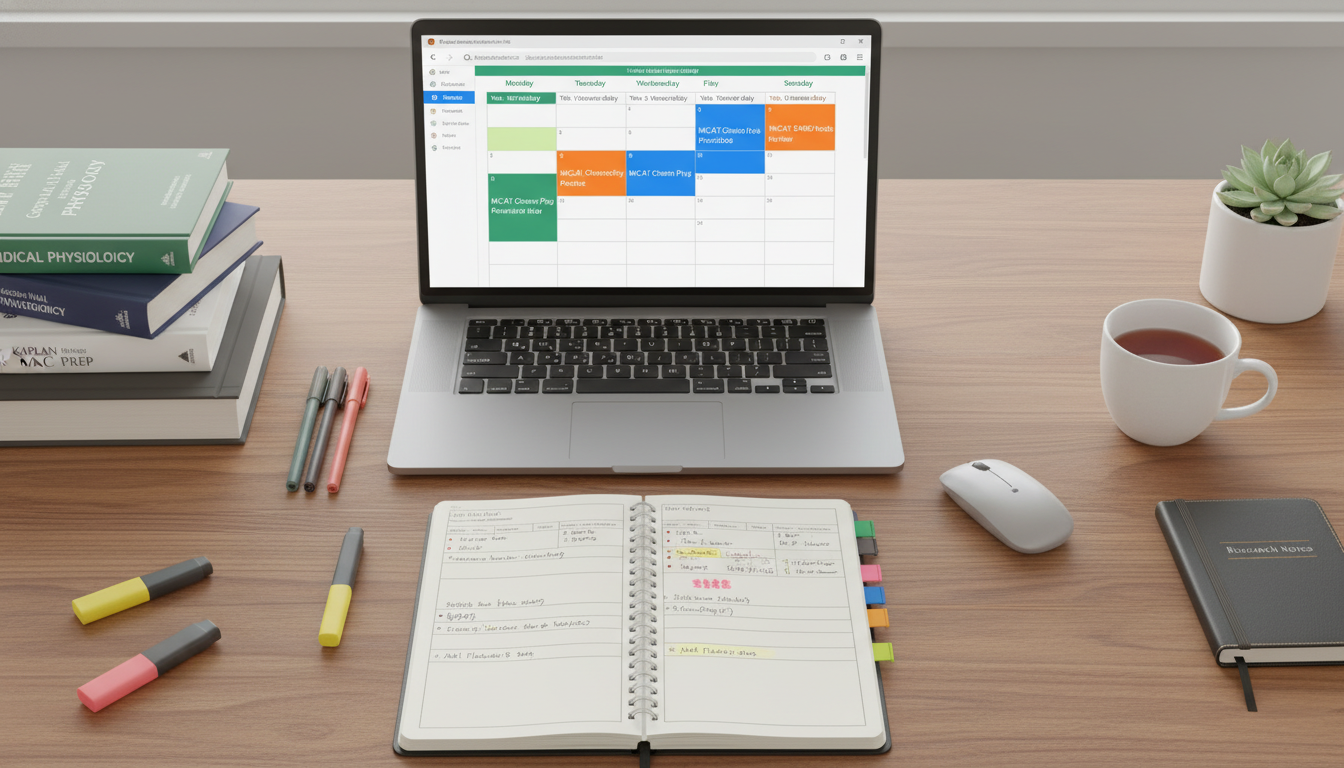
Create a non-negotiable weekly template
Design your week before the semester begins:
Example template for a full-time post-bacc (4 classes)
Monday–Friday
- 6:30–7:00: Wake up, quick breakfast.
- 7:00–8:00: Anki + error log review.
- Class / lab blocks during the day.
- 4:00–6:00: Course-specific studying (problem sets, lab write-ups).
- 7:00–8:30: MCAT integration:
- M/W/F: Passage sets in the subjects you had lectures in.
- T/Th: CARS + psych/soc.
Saturday
- 9:00–12:00: Longer MCAT sessions (mixed passages).
- 1:00–3:00: Deep dive into a weak topic from that week.
Sunday
- 1–2 hours max:
- Planning the week.
- Light review.
- Time off for recovery.
- 1–2 hours max:
Adjust numbers based on your schedule, but the key:
- MCAT work is on your calendar like a class.
- It happens even in lighter weeks.
- You do not stack everything on weekends.
Use “minimums” to survive bad weeks
When life hits (midterms, work, family), you fall back to minimum viable MCAT:
- 20 minutes of Anki.
- 1 short passage set (even 2 passages).
- That is it.
Prevent zero-MCAT weeks. Momentum matters more than intensity.
Step 7: Use Data From Your Post-Bacc to Set a Realistic MCAT Timeline
You should not pick an MCAT date out of thin air. Use the data your post-bacc gives you.
Track four key metrics across the program
Course exam performance in MCAT-heavy units
- Are you consistently >85–90% on:
- Chem equilibrium and acids/bases?
- Physics fluids and circuits?
- Bio endocrine and genetics?
- Or are you scraping by with memorization?
- Are you consistently >85–90% on:
Qbank performance over time (not just absolute)
- Start accepting 50–60% early on.
- Watch the 4-week moving average trend.
- You want a clear upward trajectory into the 70+% range on mixed sets near exam time.
Timing and stamina
- Can you:
- Finish a 59-question section without meltdown?
- Keep focus across 3–4 passages in a row?
- Can you:
Error patterns
- Are your errors mostly:
- “Did not know content” → you need more foundational work.
- “Misread / rushed / overthought” → you need strategy and pacing work.
- Are your errors mostly:
If, by the middle of Semester 4, you:
- Have done several half-length or full-length practice exams.
- Are trending towards your target score range (e.g., 508 → trending 504–506 in practice with clear fixable weaknesses).
- Have firm content coverage.
Then your planned MCAT date is probably realistic.
If not, you adjust. Better to push 2–3 months and score 5–7 points higher than rush for an arbitrary cycle.
Step 8: Common Post-Bacc MCAT Mistakes and How to Fix Them
A few patterns repeat in almost every post-bacc cohort. You can sidestep them.
Mistake 1: Ignoring MCAT until “after orgo”
Fix:
- Start low-intensity integration from Semester 1:
- Anki.
- Light Qbank.
- CARS weekly.
- At the latest, be in full integrated mode by the start of organic chemistry and physics.
Mistake 2: Over-focusing on class minutiae
Symptoms:
- You chase every obscure derivation for a 100% on the exam.
- You spend hours on topics that the MCAT barely touches.
Fix:
- Identify MCAT-required depth using:
- AAMC outline.
- High-yield lists from reputable MCAT resources.
- For each lecture topic:
- Mark “MCAT-core” vs “course-only.”
- Allocate:
- 80% of extra time to MCAT-core.
- Just enough time to pass course-only sections.
Your goal is A-/B+ or better in the course and strong MCAT retention, not perfect-but-fragile grades.
Mistake 3: Treating CARS as optional until dedicated
Fix:
- Establish a fixed CARS habit from month 1.
- Even when busy:
- Minimum: 2–3 passages per week.
- Work specifically on:
- Reading without subvocalizing every word.
- Identifying main point and author’s attitude.
Mistake 4: Full-length exams too late
Fix:
- Last 4–5 months before the exam:
- 1 full-length every 2–3 weeks.
- Last 8 weeks:
- 1 full-length every 1–2 weeks.
- Spend as much time reviewing as taking the exam:
- Classify every miss.
- Update error log and Anki.
You learn from the postmortem, not just the score.
Step 9: If You Are Working or Have Other Major Commitments
Many post-bacc students do not have the luxury of full-time study only. The framework still applies. You just compress and prioritize.
Principles for busy post-bacc students
Pick your battles
- Take 2–3 tough science courses per term, not 4–5.
- Space the heaviest combinations (e.g., do not start orgo, physics, and biochem simultaneously while working 30 hours).
Shrink but do not delete MCAT habits
- Anki: 15–20 minutes daily.
- CARS: 2–3 passages twice a week.
- 1–2 passage sets on weekends.
Use micro-blocks
- Flashcards on commute (if safe).
- 10–15 questions during lunch breaks.
- One short passage set after work before course homework.
Extend your MCAT timeline
- If you are working 20–40 hours and doing a post-bacc, expect:
- 18–24 months for post-bacc.
- MCAT after you have a lighter semester or a brief break.
- If you are working 20–40 hours and doing a post-bacc, expect:
The system still works; you just run it at a sustainable intensity.
The Bottom Line
Turn your post-bacc into a built-in MCAT framework by:
Designing everything around the MCAT blueprint
Map your courses, sequence them for reinforcement, and treat each semester as a defined MCAT phase.Integrating MCAT habits into daily classwork
Convert lectures, labs, and exams into MCAT notes, flashcards, passages, and diagnostics. Never study “only for the class” if the topic is on the MCAT.Maintaining consistent, data-driven progress
Track errors, performance trends, and reading skill across the entire post-bacc so the MCAT becomes a natural extension of what you have already built—not a separate, chaotic project at the end.