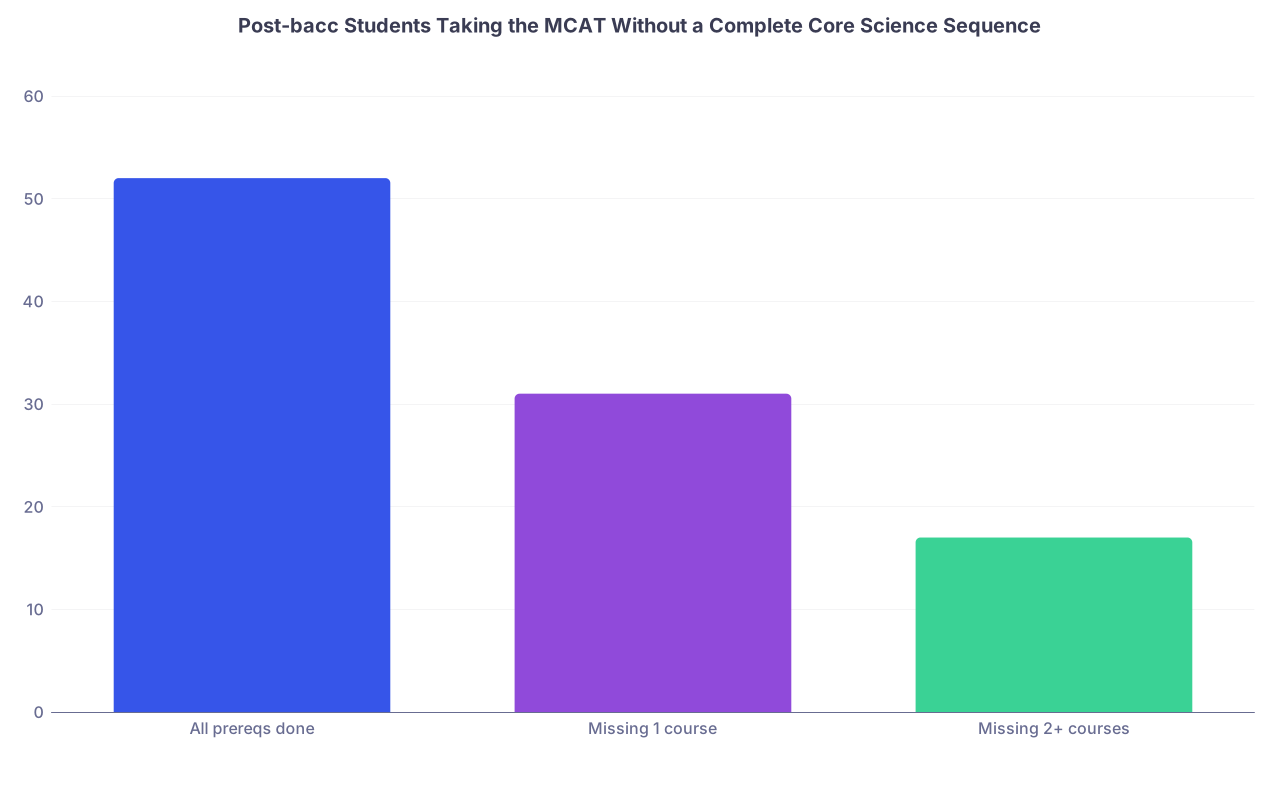
| Category | Value |
|---|---|
| All prereqs done | 52 |
| Missing 1 course | 31 |
| Missing 2+ courses | 17 |
Only 52% of post‑bacc students I see each year sit for the MCAT with all their core science prerequisites actually completed.
The rest are trying to “wing it” with gaps in physics, biochem, or orgo and then wondering why their FL scores flatline. The pattern is predictable: the problem is not effort. It is sequencing.
Let me walk through how post‑bacc course sequencing really impacts MCAT content mastery—down to concrete examples, not vague “take your prereqs first” advice.
The Hidden Physics of Course Sequencing
Post‑baccs often underestimate one thing: the MCAT is not four separate tests. It is a vertically integrated exam that assumes a specific order of learning.
Here is the dependency stack that usually gets ignored:
- General chemistry → organic chemistry → biochemistry
- Intro biology → cell/molecular → physiology → pathophysiology-style passages
- Physics + gen chem → physical chemistry-style reasoning in Chem/Phys
- Intro psych → research methods/statistics → MCAT-style experimental psych/soc passages
If your course sequencing fights this hierarchy, you pay for it in two places:
- Content gaps: entire AAMC topic buckets become “I’ll memorize this later” material.
- Cognitive load: you are decoding language and concepts during practice instead of applying them.
Most damaging patterns I see in post‑bacc schedules:
- Taking biochemistry before or without a solid year of general chemistry
- Taking MCAT “content review” before ever finishing the core sequence
- Doing minimal upper‑level biology and then getting crushed by dense experimental passages
- Taking psych/soc as a single “survey” course with no stats or research methods
Let me be specific.
If you take biochem in isolation—without strong gen chem and at least concurrent O‑chem—you will:
- Memorize pathways without understanding energy, redox, pH, or Henderson–Hasselbalch
- Struggle with enzyme kinetics graphs (Km, Vmax, Lineweaver–Burk)
- Have no intuitive grasp of ΔG, equilibrium, or Le Châtelier, which appear constantly in MCAT passages
On paper you “took biochem.” On the MCAT, you are guessing.
A Rational Post‑Bacc Sequence for MCAT Strength

| Step | Description |
|---|---|
| Step 1 | Start Post-Bacc |
| Step 2 | Gen Chem I + Intro Bio I |
| Step 3 | Gen Chem II + Intro Bio II |
| Step 4 | Organic Chem I + Physics I |
| Step 5 | Organic Chem II + Physics II |
| Step 6 | Biochemistry + Upper-Level Bio |
| Step 7 | Psych + Soc + Research Methods |
| Step 8 | Dedicated MCAT Prep + Full-Lengths |
Not all programs will let you follow this perfectly, but this is the conceptual backbone. Let me break down why each layer is placed where it is.
Year 1: Foundation – General Chemistry and General Biology
Core goal: stop being afraid of “science words” and start building schemas.
Typical sequencing:
- Fall: General Chemistry I, Biology I
- Spring: General Chemistry II, Biology II
Why this order matters for MCAT:
Chem/Phys section:
- The exam assumes: atomic structure, periodic trends, bonding, stoichiometry, gases, solutions, kinetics, equilibrium, thermodynamics, acids/bases are familiar, not brand new.
- If you push Gen Chem II late (or take MCAT mid‑sequence), key topics like buffers, titration curves, and solubility equilibria will be fragile. These underpin enzyme kinetics, blood gas questions, and biochem-heavy Chem/Phys passages.
Bio/Biochem section:
- Intro biology gives you the language: DNA, RNA, transcription, translation, cell organelles, mitosis/meiosis, membranes, transport, basic metabolism.
- Without that, biochem later becomes a blur of pathways with no anchoring.
Concrete impact: Students who stack MCAT prep before finishing Gen Chem II almost always plateau around 125–126 on Chem/Phys. They are brute‑forcing problems instead of pattern‑recognizing.
Year 2: Engine – Organic Chemistry and Physics
This is where a lot of post‑bacc schedules go sideways.
Ideal sequencing:
- Fall: Organic I + Physics I
- Spring: Organic II + Physics II
Where people get into trouble:
- Pairing Organic I with Biochem and skipping Physics I
- Doing Physics “later” because “I’m bad at math”
- Taking Organic II after the MCAT
Why this is a problem:
Organic chemistry feeds directly into biochem and MCAT passage structure
- Reaction mechanisms → understanding enzyme mechanisms
- Nucleophiles/electrophiles → mutation, DNA repair, drug design passages
- Spectroscopy → identification questions embedded in experimental setups
Physics is not “optional math torture” on the MCAT
- Kinematics and forces show up in biomechanics, blood flow, respiratory mechanics
- Electricity and magnetism underpin action potentials, ECG/EEG style setups
- Fluids are not just physics; they directly feed into cardiovascular and respiratory physiology questions
If Physics II sits after your MCAT, you are essentially choosing to forfeit a chunk of the exam’s conceptual clarity. You can try to self‑teach circuits, magnetism, optics, and fluid dynamics from prep books. I have seen students do this. It almost always remains shallow.
Biochemistry Timing: The Single Most Abused Decision
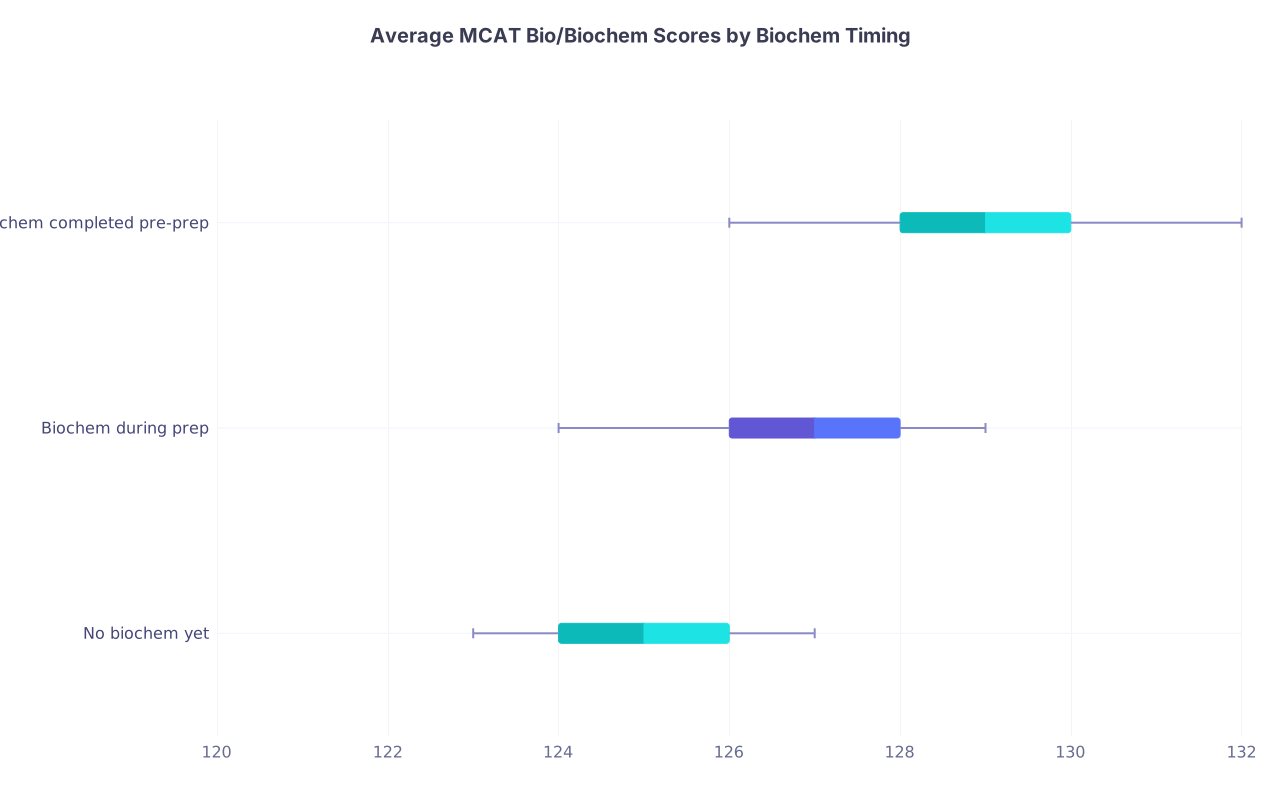
| Category | Min | Q1 | Median | Q3 | Max |
|---|---|---|---|---|---|
| No biochem yet | 123 | 124 | 125 | 126 | 127 |
| Biochem during prep | 124 | 126 | 127 | 128 | 129 |
| Biochem completed pre-prep | 126 | 128 | 129 | 130 | 132 |
Everyone knows biochem is “important.” Fewer people plan for when it needs to happen.
Here is my position after watching this play out for years:
If you are a post‑bacc, you should complete at least one semester of biochemistry before entering dedicated MCAT study. Not concurrent. Before.
Why?
Biochem is not just extra biology. It is the language the MCAT uses to test integration:
- Metabolic pathways are not being tested as “what does enzyme X do?”
- They are tested as: “Given this mutation in enzyme X, predict which metabolite accumulates and which lab value changes.”
- Or: “Given an inhibitor that doubles Km and leaves Vmax unchanged, what happens to substrate binding?”
For that to stick, you need:
- General chemistry acid/base, equilibrium, and thermodynamics.
- Organic chemistry understanding of functional groups, stereochemistry, and mechanisms.
- Intro biology understanding of cell structure, central dogma, and membranes.
Most harmful sequencing mistake I see:
Taking biochem early in the post‑bacc, before you have had organic chemistry and maybe even before finishing gen chem.
What happens then?
- You pass the course via memorization.
- By the time you hit MCAT prep, your mechanistic understanding is gone.
- You now have to “re‑learn” biochem but with a bad, shallow foundation.
Better pattern:
- Year 1: Gen Chem + Intro Bio
- Year 2: Organic + Physics
- Year 3 fall or summer: Biochem + 1–2 upper‑level bios
- Then MCAT
If you absolutely must take biochem early (structured program constraint), then plan for a dedicated, concept‑heavy revisit during your MCAT ramp‑up, not just “a quick review.”
Psych/Soc: The “Easy” Section That Is Not Easy
Many post‑baccs treat Psych/Soc as filler. One psych course, one soc course, check the box. This is how you end up stuck at 127 on a section where 130+ is very realistic.
The MCAT does not care about:
- Freudian theory details
- Intro sociology jargon for its own sake
It cares about:
- Research design
- Bias, confounders, experimental vs observational setups
- Interpreting data tables and graphs in social science contexts
- Core frameworks: conditioning, memory, learning, social identity, demographic patterns
The sequencing problem: Most post‑baccs never take:
- Psychological statistics
- Research methods / experimental design in psych
- Any upper‑level course with primary literature reading
Then they hit MCAT practice passages with Kaplan or AAMC material and say, “I memorized all the Anki cards; why am I still lost?” Because they do not recognize experimental design patterns.
Best-case psych/soc sequence for MCAT:
- Psych 101
- Sociology 101
- Research methods or psych stats (even if online or summer)
Then you use your MCAT prep period to map AAMC content lists to these frameworks, not to cram 300 random sociological terms.
Aligning MCAT Timing With Your Sequence
This is where strategy separates people who score in the low 500s from people who hit 512+.
Three anchor rules:
Do not take the MCAT before you have:
- Gen Chem I & II
- Org Chem I & II
- Physics I & II
- Biochem (at least one term)
- Intro Bio I & II
- Psych + Soc
Do not cram the MCAT during a semester with:
- Organic II
- Physics II
- Biochem
You can take the exam after or between them. Not during the heaviest conceptual load.
- Build a gap between finishing the heaviest courses and your test date:
- Ideal: 2–3 months of focused prep with no more than one light class or part‑time work.
- Minimum for most post‑baccs: 8–10 weeks of solid, structured study.
Classic bad scenario I have seen at least 30 times:
- Spring: Taking Organic II + Physics II + Biochem
- Also “starting MCAT prep” in February
- MCAT exam in late April
Result: chronic fatigue, shallow retention, and FL scores that never stabilize because your knowledge base is still shifting.
Better scenario:
- Spring: Organic II + Physics II
- Summer Session I: Biochem + Psych/Soc review or a light elective
- Early August to October: Dedicated MCAT prep, then test
- Applications the following cycle
Yes, that delays your application by a year. Often, that is the difference between a 503 and a 513. And that difference changes your school list dramatically.
How Sequencing Changes Section‑by‑Section Mastery

Let’s go section by section and tie this to actual MCAT content.
Chem/Phys
Ideal sequencing impact:
- You encounter acid/base, buffers, titrations, and solubility twice: once in gen chem, again in biochem context.
- You see fluids and gas laws in physics, then again in respiratory and cardiovascular physiology.
If you take Physics II late, you lose:
- Comfort with Bernoulli, Poiseuille’s law, continuity equations (A1v1 = A2v2)
- Circuits and RC time constants, which very often appear embedded in neuron or cell membrane analogies
Students who have:
- Completed full physics + gen chem + biochem before MCAT prep usually report Chem/Phys as “long but fair.”
- Skipped Physics II or took it after the test often describe it as “alien,” even if they did every question bank.
CARS
CARS is less directly tied to science sequencing, but there is an indirect effect.
If your heaviest science courses are stacked during your MCAT study, you:
- Have less mental bandwidth for sustained reading practice
- Treat CARS as an afterthought
The quietly strong CARS performers:
- Start cultivating reading stamina during their sequence: primary literature in upper‑level bio, psychology articles, dense assigned readings.
- Use semesters where science load is lighter to build a daily 30–45 minute reading habit.
So while CARS is not “sequenced” like orgo and biochem, your broader post‑bacc schedule either creates room for this or crushes it.
Bio/Biochem
This section is extremely sensitive to sequencing.
You want:
- Intro Bio: vocabulary, basic systems
- Upper‑level Bio (physiology, molecular, genetics, or cell bio): experimental setups and dense pathways
- Biochem: integrated metabolism, enzymes, regulation
Bad pattern:
- Only Intro Bio I & II
- Biochem taken early, then forgotten
- No upper‑level bio representing experimental methods
Then MCAT passages start including:
- Multi‑step signaling pathways
- Knockout mouse models
- Conditional alleles and transgenic constructs
- Enzyme regulation with allosteric inhibitors
If you have never been forced to decode primary data in a class, these passages feel like a foreign language.
At minimum, if you can add one upper‑level course—physiology or molecular/cell biology—between your basic sequence and MCAT, you dramatically change your comfort reading those passages.
Psych/Soc
Sequencing impact:
- Doing psych and soc early, then ignoring them for two years, leads to heavy re‑learning and shallow recall.
- Doing them too late (concurrent with MCAT) means you never get past memorizing terms to understanding study designs.
Decent compromise:
- Take Psych and Soc somewhere mid‑sequence.
- Take a research methods / stats course or at least an online methods module closer to MCAT prep.
- During MCAT prep, tie every new term back to a study design or real‑life example, not just a flashcard.
Special Situations: Career Changers vs. Academic Enhancers
Not all post‑baccs are the same. Sequencing advice hits slightly differently depending on your background.
Career Changers (No Science Background)
You are in the classic “formal post‑bacc” lane.
Key rules:
- Do not accelerate beyond what you can conceptually absorb. A 1‑year crash program covering Gen Chem, Bio, Orgo, and Physics looks efficient on paper and produces 500–506 scores in real life if you then rush the MCAT.
- Aim for a 2‑year sequence with a gap for MCAT:
Year 1: Gen Chem + Bio
Year 2: Orgo + Physics
Summer or Year 3: Biochem + upper‑level bio + MCAT
You are building schemas from scratch. You need repeated exposure.
Academic Enhancers (Some Science Already Done)
Common pattern:
- You took Gen Chem and maybe Physics during undergrad, got mediocre grades, and now you are re‑taking or building on them.
For you, sequencing pitfalls look like:
- Overestimating how much you remember from 5+ years ago
- Jumping straight into biochem and upper‑level bio without refreshing gen chem foundations
- Placing the MCAT “early” to apply ASAP, then watching scores stall
Better sequencing move:
- Retake or at least thoroughly review any core course in which you earned less than B or it has been >5–6 years.
- Do not treat “I technically completed this once” as equivalent to “I can apply it under MCAT time pressure.”
Building a Concrete Plan: How To Fix a Bad Sequence

| Step | Description |
|---|---|
| Step 1 | Current Plan Misaligned |
| Step 2 | Shift courses after MCAT |
| Step 3 | Delay MCAT 3-6 months |
| Step 4 | Self-study missing topics with structure |
| Step 5 | Rebuild sequence: finish core before prep |
| Step 6 | Extra practice on weak content areas |
| Step 7 | MCAT date fixed? |
If you are halfway through your post‑bacc and realizing your sequence is a mess, you are not stuck. But you will probably need to choose between two uncomfortable options:
- Move the MCAT later.
- Accept that you must self‑teach entire topics with near‑course‑level discipline.
Practical steps:
List, on paper, which of these you will have completed before your intended MCAT:
- Gen Chem I & II
- Org Chem I & II
- Physics I & II
- Biochem
- Intro Bio I & II
- Psych + Soc
For anything missing:
- Ask: “Can I truly self‑teach this to MCAT depth from a prep book?”
- Physics II and biochem are where most people are kidding themselves.
If ≥2 of those core items will be missing:
- Strongly consider moving the MCAT back by at least one testing window, often one full year for application timing.
If only 1 is missing and your background is strong:
- Accept that this becomes your structured self‑study subject with weekly goals, problem sets, and review, not just last‑minute cramming.
FAQs
1. Can I take the MCAT before finishing Organic Chemistry II if I am strong in self‑study?
You can, but I rarely recommend it. Organic II covers:
- Carbonyl chemistry
- Aromaticity and electrophilic aromatic substitution
- Advanced mechanisms and multi‑step synthesis thinking
MCAT passages on drug mechanisms, metabolism, and biochemical pathways assume this conceptual toolkit. Even if the exam does not explicitly test “name this reaction,” it constantly leans on your ability to mentally track intermediates and functional group transformations. Self‑teaching that level of mechanistic comfort under time pressure is possible but inefficient. If you must do it, you need months of deliberate practice, not a quick review.
2. Is biochemistry absolutely required before MCAT prep, or can I learn it from review books?
For a traditional undergraduate with a strong bio/chem foundation, self‑studying biochem might be tolerable. For post‑baccs, especially career changers, I view a real biochem course as close to mandatory. The MCAT’s heaviest experimental passages live at the biochem interface: enzymes, metabolism, signaling pathways, and molecular techniques. Learning that from a prep book alone, without ever being forced to solve problem sets or decode primary data, leaves your understanding brittle. You can memorize pathways, but you will fold when the exam twists them.
3. How many upper‑level biology courses do I actually need for MCAT readiness?
Strictly for the MCAT, you can survive with:
- Intro Bio I & II
- One strong semester of Biochemistry
- One additional upper‑level bio: physiology or molecular/cell biology is ideal
More than that helps primarily for medical school readiness and application strength, not for pure MCAT content. The critical thing is that at least one of those upper‑level courses should include: dense reading, primary article discussion, and data interpretation. That trains the kind of reading the MCAT demands.
4. If I am already registered for an MCAT date but my sequence is weak, is rescheduling viewed negatively by schools?
No. Schools do not care how many times you rescheduled or canceled a test date. They care about the scores that appear on your record. Taking a poorly prepared MCAT “just to see where I am” is a serious strategic mistake for borderline applicants; you are not doing a casual diagnostic, you are generating a permanent data point that committees will see. If your core sequence is incomplete and your FLs are not where they need to be, rescheduling is usually the smart move, not a red flag.
5. Does it matter where in the calendar year I place the MCAT relative to my courses?
Yes, but not for superstition reasons. It matters because of bandwidth and decay. Best positioning:
- Within 3–6 months after completing your heaviest courses (Org II, Phys II, Biochem).
- During a period where you can protect at least 20–25 hours per week for study.
Worst positioning:
- Deep in the middle of a semester where you are taking 10–12 credits of demanding sciences.
- More than a year after your last serious science course, without planned content refresh.
You want enough proximity that the material is still warm, but enough breathing room that you are not doing everything at once.
Key takeaways:
- The order you take your post‑bacc courses is not cosmetic; it determines whether MCAT prep feels like refinement or complete reconstruction.
- Finish the full core—Gen Chem, Org, Physics, Intro Bio, Biochem, Psych, Soc—before dedicated MCAT study whenever possible.
- If your current sequencing undermines that, change the MCAT date or the plan, not your standards for what “ready” looks like.