](https://cdn.residencyadvisor.com/images/articles_svg/chart-common-hidden-conditions-in-post-bacc-linkage-agre-6631.svg "Common Hidden Conditions in Post-Bacc Linkage Agreements")
| Category | Value |
|---|---|
| MCAT floor higher than advertised | 85 |
| Single-application requirement | 70 |
| Immediate matriculation only | 90 |
| No gap years allowed | 65 |
| Interview not guaranteed | 80 |
| [Minimum course load rules](https://residencyadvisor.com/resources/postbac-programs/using-post-bacc-research-opportunities-to-strengthen-academic-metrics) | 75 |
It is March. You just got your acceptance email to a well-known post-bacc program with “linkage options to top medical schools” splashed all over the brochure. You are calculating: one year of post-bacc, direct entry to med school, you skip the glide year, you save 12 months of your life.
(See also: Committee Letters from Post-Baccs for more details.)
Here is the part almost nobody tells you: the linkage is mostly a contract. And the contract is written by the medical school’s lawyers, not the marketing team.
Let me walk you through the fine print that quietly shifts the risk from the school onto you.
1. What a Linkage Actually Is — And What It Is Not
Strip away the glossy language. A linkage is:
A conditional, highly structured early assurance pathway from a specific post-bacc program to a specific medical school, with:
(Related: Evaluating Post-Bacc Grading Scales)
- Rigid timelines
- Non-negotiable academic thresholds
- Restrictions on applying elsewhere
- Very little room for life happening
It is not:
- A guarantee of admission
- A simple “if GPA X and MCAT Y then you’re in” formula
- Equivalent across schools, even if they use identical language
Some examples you will see in brochures:
- “Students who meet program criteria are eligible to apply to linkage schools.”
- “Students who meet all conditions may be considered for direct matriculation.”
- “Qualified students receive a guaranteed interview.”
Three very different promises. None of them are “you have a seat if you hit the numbers.”
The risk? You are restructuring your premed timeline around a process where the school keeps most of the flexibility, and you carry most of the consequence if something goes off-script.
2. MCAT Rules: The Hidden Tripwires
MCAT policies in linkage agreements are where I see the most nasty surprises for students.
A. The Real MCAT Floor vs. The Printed One
Programs will often say something like:
“Minimum MCAT 513 with no subsection below 127.”
The brochure language might stop there. The internal reality at the med school is often:
- The real competitive floor is 515–518
- A 513 with one 126 subsection quietly gets you screened out
- They “reserve the right” to be more selective year to year
I have seen students hit the posted minimum exactly and then get a cryptic “we cannot offer you admission through the linkage this year” while the class stats continue to climb.
If you are not at or above that med school’s matriculant median MCAT, linkage is a risk, not a safety net.
B. Timing Windows and One-Shot Rules
Most linkage policies contain wording like:
- “MCAT must be taken no later than [specific month]”
- “Only scores from [one or two test dates] will be accepted”
- “No more than one MCAT attempt during the post-bacc year”
Translation: you may not be allowed to:
- Retake a borderline MCAT in time for that cycle
- Use a stronger MCAT taken before the post-bacc, depending on the policy
- Schedule your exam when you are actually ready
Some schools explicitly ignore pre-post-bacc MCAT scores for linkage, even if they are higher. They want to see performance after your formal science reinvention.
So you get boxed into one test window, at the exact time you are juggling:
- Final exams in upper-level sciences
- Committee letters
- Linkage application paperwork
That is not an accident. It is a filter.
C. Section Cutoffs That Kill “Balanced but Borderline” Scores
Read this sentence carefully anywhere it shows up:
“Minimum MCAT [total] with no subsection below [X].”
Harmless on first glance. In practice, it does this:
- 516 (129/126/131/130) can be rejected
- 513 (128/128/128/129) can be accepted
Schools like to see no glaring weakness. Linkages amplify that preference into a hard gate. If your history suggests one weaker section (often CARS for nontraditional or international students), a linkage with subsection floors is a bigger risk than a standard cycle where some schools are willing to look at the full picture.
3. GPA, Course Load, and “No Slip” Rules
You will see a nice clean number: “Minimum GPA 3.6, science GPA 3.5 in the program.”
Here is what often sits behind it.
A. The “Every Semester Counts” Clause
Most linkages require something like:
- Minimum overall GPA in the program
- No single semester below a specific GPA (often 3.3–3.5)
- Minimum grade of B (or B+) in specified core courses
So your trajectory might look like:
- Fall: 3.9
- Spring: 3.4 (because you took biochem, physics II, and still worked part-time)
Result: you hit the overall GPA requirement, but that 3.4 semester disqualifies you from the linkage.
Programs rarely lead with that detail in recruitment sessions.
B. Minimum Course Load and “Full-Time” Technicalities
Many linkage policies require you to be:
- Full-time every semester of the post-bacc
- Enrolled in a minimum number of upper-division science credits
- Not taking significant coursework elsewhere concurrently
Which means:
- You cannot drop from 4 sciences to 3 mid-semester without risking eligibility
- You cannot downshift to part-time for personal reasons without consequences
- Taking one class at a community college might void linkage eligibility at some programs
You are trading flexibility for speed. For some people that is fine. For others, it backfires when they hit a crisis, burn out, or misjudge a semester’s load.
C. No Grade Replacement, No “We’ll Ignore That”
Linkage agreements almost never:
- Replace old grades
- Ignore prior poor performance at other institutions
- Treat your post-bacc GPA as if you are an entirely clean slate
They might emphasize your post-bacc performance. But if the policy mentions “patterns of academic performance” or “holistic review,” that is their legal door to reject you if your pre-post-bacc history is rougher than they like.
So if you are thinking, “I just have to crush these 30 credits and they will forget the earlier 2.8,” linkage is the wrong mechanism. You need the normal cycle and a longer record of sustained improvement.
4. Application Restrictions: Where You Lose Leverage
This is where risk management flips upside down.
Many linkage agreements include some version of:
- “Applicant may not apply to other medical schools during the linkage cycle.”
- “Applicant must commit to attend if accepted through linkage.”
- “Applicant must withdraw or refrain from AMCAS/AACOMAS applications.”
Let me be blunt. This can be brutal.
A. Single-Application or Blind Commitment Clauses
The school wants:
- Early commitment from candidates they like
- To avoid being a backup choice
- Control over yield
You agree to:
- Apply to that med school alone through the linkage
- Not submit a regular-cycle AMCAS until after the linkage decision
- Commit to attend if accepted (essentially an ED contract)
Worst case scenario:
- You are rejected or waitlisted through linkage
- It is late in the cycle
- You are now essentially applying “late” in the regular pool with no other apps in progress
You shrank your option space to chase one early decision.
If you are going to accept that trade, it must be a school where you are genuinely content to train. Not “well, it is ranked high.” Not “everyone in my cohort is trying for it.”
B. Timing Traps: Missed Primary Windows
Typical timeline with linkage:
- Summer/fall: complete first term of post-bacc
- Late fall/early spring: internal review for linkage eligibility
- Spring/early summer: linkage application, secondaries, interview
- Early summer: final decision
AMCAS opens in late May / early June. If your linkage decision lands after that, you will either:
- Wait for the decision and apply late if it is a rejection
- Or submit a full application while technically violating (or stretching) the “no other apps” clause
Some programs explicitly say:
“Students pursuing linkage are strongly discouraged or prohibited from submitting AMCAS until linkage outcomes are known.”
If you do it anyway, you may:
- Lose the linkage
- Damage your standing with your home post-bacc
- Burn relationships with advisors who have to sign off on your progress
I have seen students angrily surprised by this timing every year. It is in the fine print. The program just does not shout it from the rooftops.
5. Interview “Guarantees” That Are Not Guarantees
Language trick: “Linkage students who meet criteria are guaranteed consideration for an interview.”
“Consideration” is not the same as “interview.” At all.
You will see a hierarchy of phrasing:
- “Eligible to apply for linkage.”
- “Guaranteed review of application.”
- “Guaranteed interview if minimum metrics are met.”
- “Linkage admission is highly likely for students meeting criteria.”
Only #3 is an actual structural advantage, and even then there is usually a catch:
- They reserve the right to deny an interview based on professionalism concerns, letters, or “fit.”
- That “minimum MCAT/GPA” may float upward each year.
And #4 — “highly likely” — belongs in the marketing folder, not in your risk calculus. I have seen “highly likely” interpreted as “60–70% this year, maybe 40% next year if we have a strong applicant pool.”
If your post-bacc advertises “X% linkage success,” ask specific questions:
- Is that percentage for students who merely applied to linkage?
- Or only those pre-selected by the program as internal nominees?
- Over how many years? With what sample size?
You want clear denominators, not vibes.
6. Glide Year vs. No-Glide: The Time-Pressure Trade
The whole point of linkage (for many students) is “no glide year.”
You finish the post-bacc in May. You start med school in August. Clean, fast, efficient.
Here is what does not fit into that neat timeline:
- Time to recover from a bad MCAT
- Time to build a meaningful clinical or research track record
- Time to differentiate yourself beyond grades and a test score
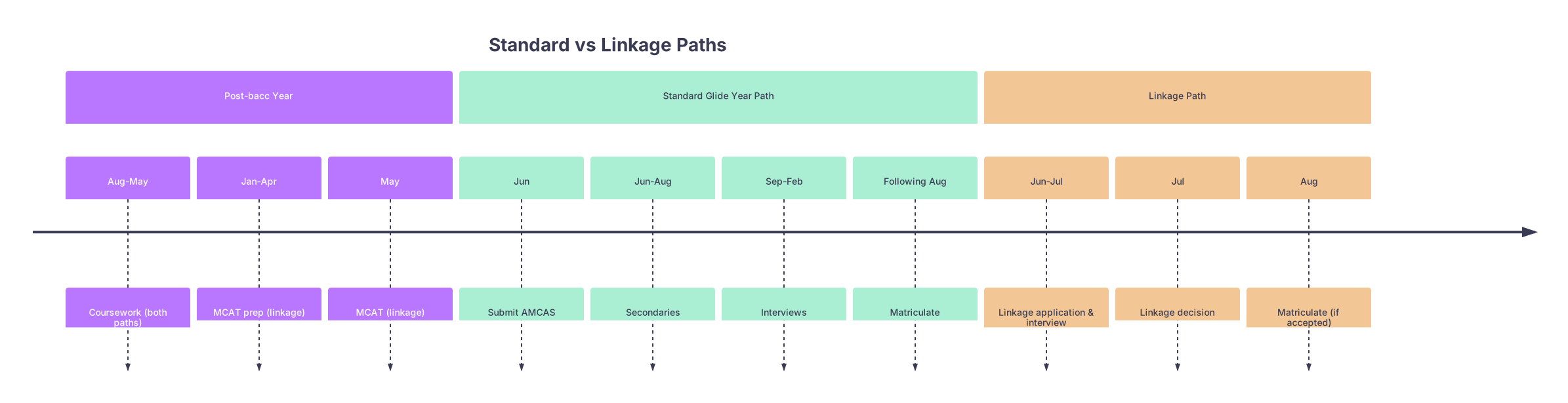
| Period | Event |
|---|---|
| Post-bacc Year - Aug-May | Coursework (both paths) |
| Post-bacc Year - Jan-Apr | MCAT prep (linkage) |
| Post-bacc Year - May | MCAT (linkage) |
| Standard Glide Year Path - Jun | Submit AMCAS |
| Standard Glide Year Path - Jun-Aug | Secondaries |
| Standard Glide Year Path - Sep-Feb | Interviews |
| Standard Glide Year Path - Following Aug | Matriculate |
| Linkage Path - Jun-Jul | Linkage application & interview |
| Linkage Path - Jul | Linkage decision |
| Linkage Path - Aug | Matriculate (if accepted) |
If any of the following apply to you, linkage pressure may hurt you more than help:
- Your clinical exposure is minimal or very recent
- You have no sustained non-clinical volunteering or community work
- You need time to show sustained upward trajectory after academic trouble
The standard glide year gives you that room. Linkage takes it away. Some people still benefit from the trade (career-changers with strong prior careers and clear narratives, for example). Many do not.
7. Behavioral and Professionalism Clauses: The “Character” Fine Print
Buried in almost every linkage agreement is wording like:
“Admission through linkage remains contingent on continued demonstration of professionalism, ethical conduct, and compliance with program policies.”
This is more than plagiarism and cheating.
Things I have actually seen trigger problems:
- Repeated unexcused absences from required seminars or advising meetings
- Unprofessional email behavior with staff or instructors
- Conflicts in clinical settings that escalate and get documented
- Social media issues that get reported
You are under a microscope. You are not just a future applicant; you are being evaluated as a quasi-early matriculant.
That can be good — if you thrive under that structure. It can be punishing if you are still learning how to function in professional environments or managing untreated mental health issues.
If the fine print mentions:
- “Professionalism concerns can result in withdrawal of linkage eligibility.”
- “Program reserves the right to revoke sponsorship at any time.”
Believe them. That is not decorative language.
8. Who Actually Benefits From Linkage (And Who Usually Should Not)
Let me be specific. Linkage is most appropriate for students who:
- Have a strong previous academic record or a very clear reason for past weakness
- Can realistically hit or exceed that med school’s current median MCAT
- Are fully committed to that school and geographic region
- Have already built clinical exposure and basic service experience before the post-bacc
- Can handle high course loads with limited flexibility
Common example: 30-something career-changer, prior strong non-science degree, solid work history, good time management, already volunteering in ED or hospice before starting the post-bacc. For that person, linkage can compress a path that is otherwise straightforward.
People for whom linkage is usually a bad bet:
- Students with major GPA damage (e.g., long-standing 2.7–3.0 undergrad) who need a longer rebuild
- Applicants who have not taken the MCAT and honestly are not strong standardized test-takers
- Those unsure about school/geography fit and likely to resent being locked in
- Students juggling major life stressors: caregiving, unstable housing, significant untreated anxiety or depression
Skipping the glide year is seductive. But if skipping it makes your entire application rushed, thinner, and fragile, you are essentially trading one year for a permanently weaker med school trajectory. That is a bad trade.
9. How to Actually Read a Linkage Policy Like a Lawyer
You want to behave like the policy will be enforced at its harshest possible interpretation. Because some years, it will be.

Concrete steps.
- Print the actual linkage agreement and the med school’s technical standards. Hard copy. Pen in hand.
- Circle every occurrence of words like “may,” “reserve the right,” “eligible,” “consideration,” “at the discretion of.”
- List out, explicitly:
- MCAT total and subsection rules
- GPA and per-semester requirements
- Course load and full-time enrollment language
- Application restriction language
- Interview guarantee (or not) wording
- For each, ask: “What happens if I fall just short of this?” Assume the answer is: “You lose eligibility.”
- Ask your post-bacc advisors blunt questions:
- “How many students were considered ‘linkage-eligible’ last year?”
- “How many actually matriculated via linkage?”
- “How many were blocked from applying because of a single semester or one MCAT section?”
- “What happens if I decide mid-year I no longer want linkage?”
If they dodge or blur specifics, interpret that as them protecting institutional interests, not yours.
You are not being cynical. You are being realistic.
10. Risk Management: How to Keep Linkage From Owning You
Here is how I would structure this if you are even considering linkage.
Build your plan as if the linkage does not exist.
- Timeline out MCAT prep, a realistic test date, and a standard application cycle.
- Assume you will need the glide year for experiences and MCAT margin.
Treat linkage as “bonus upside,” not “the plan.”
- If your grades are excellent, your MCAT comes in strong, and you love a particular med school’s linkage option, then step into it.
- But have your regular-cycle materials ready anyway, or at least mostly ready.
Protect your leverage.
- If allowed, do not agree to single-school exclusivity until you are extremely confident this is where you want to train and that your numbers are above, not at, the floor.
Be honest about your profile.
- If your past academics or life stressors make you fragile under pressure, building a two-year reinvention plus a glide year will almost always serve you better long-term than gambling on a one-shot linkage.
Walk away if the commitment language feels like a trap.
- “You must commit now, before you see your MCAT,” is not in your interest.
- If the program culture is “everyone aims for linkage,” be extra careful. Groupthink does not carry your loans or live your career. You do.
FAQ (Exactly 5 Questions)
1. If I meet all the published linkage criteria, am I basically guaranteed admission?
No. Even in the most structured linkages, “meeting criteria” usually guarantees review, sometimes an interview, but almost never admission. The school still reserves the right to make “holistic” decisions based on letters, interviews, professionalism, and the overall strength of that year’s applicant pool. Plan as if there is still a meaningful chance of rejection.
2. Can I back out of a linkage after I see my MCAT score or realize the school is not a good fit?
Usually yes, but it depends on timing and policy. Many agreements let you withdraw from the linkage process before a certain deadline, at which point you revert to the standard applicant pool (often in a later cycle). What you typically cannot do is accept a linkage offer and then shop around. If you have any doubt about fit, you should not sign anything that looks like a binding commitment.
3. Is it ever smart to pursue multiple linkages from the same post-bacc?
Most structured programs restrict you to one active linkage target per cycle, precisely to avoid “linkage shopping.” Some will let you switch your intended linkage school early in the year. Trying to hedge with multiple linkage targets in one cycle is rarely allowed and often logistically chaotic. A better approach: decide whether you are a linkage-type candidate at all, then pick the single school where the fit is strongest and the numbers are in your favor.
4. How do linkage outcomes affect my chances if I reapply later through the normal cycle?
If you handle it professionally, a failed linkage attempt is not inherently toxic. Committees know linkage is competitive. What hurts you is a pattern: marginal MCAT, rushed application, thin experiences, and then another rushed reapplication. If you miss on linkage, take the hint: use the extra time to strengthen your profile instead of immediately reapplying with the same weaknesses.
5. If I do not pursue linkage, is a formal post-bacc still worth it?
Yes. The core value of a post-bacc is the academic record it creates, the structure, and often powerful advising and letter support. Linkage is just one possible add-on. Many very strong post-bacc students ignore linkage entirely, apply in the standard timeline with stronger MCAT prep and more experience, and match at equal or better schools than the available linkage options.
Key points:
- Linkage agreements are risk-shifting contracts, not guarantees; the school keeps flexibility, you take most of the downside.
- The real constraints live in the fine print: MCAT timing and cutoffs, per-semester GPA floors, and application exclusivity clauses.
- Build your plan as if linkage does not exist, then use it only if your performance, timing, and genuine school fit make it a clear upside, not a desperation shortcut.