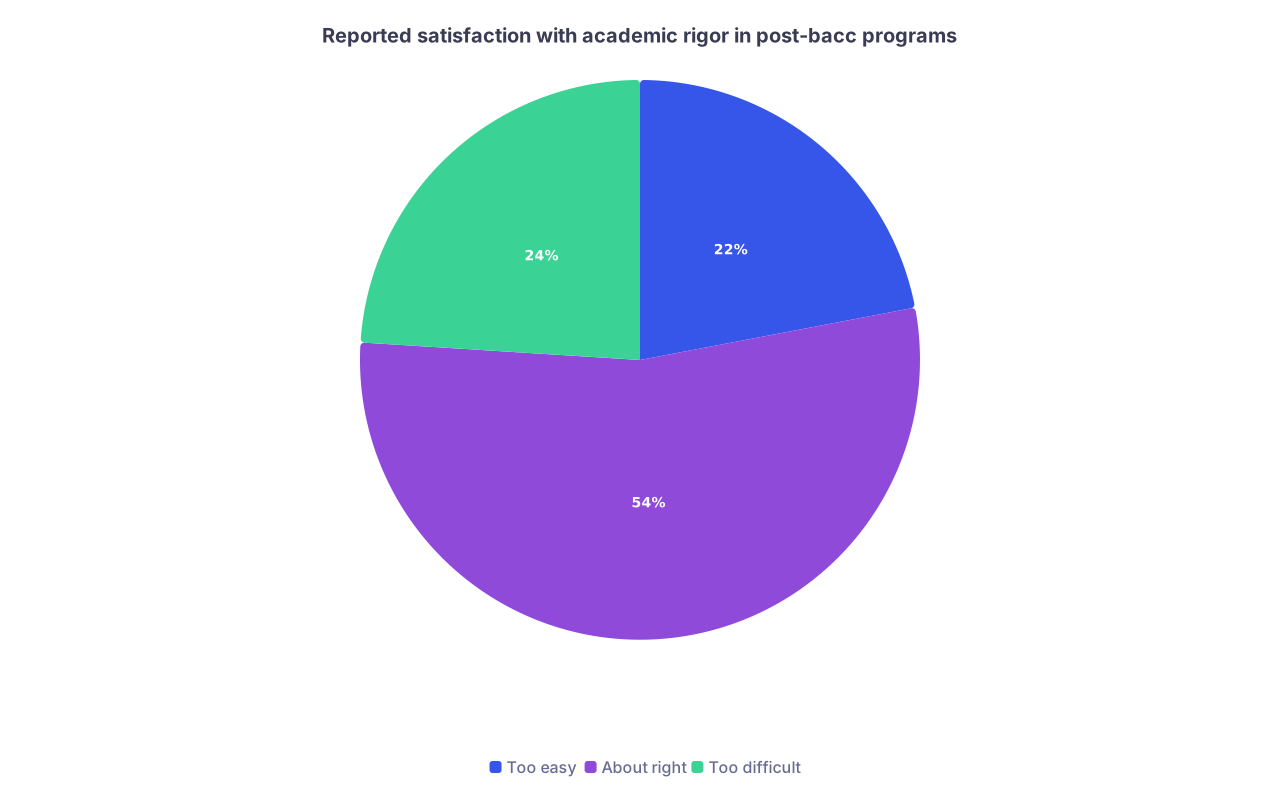
| Category | Value |
|---|---|
| Too easy | 22 |
| About right | 54 |
| Too difficult | 24 |
Evaluating Post-Bacc Grading Scales: Curves, Rigor, and Medical School View
Only 41% of post-bacc students can correctly explain how their program’s grading and curves will be interpreted by medical schools. The rest are guessing. Or relying on marketing blurbs and Reddit threads.
That guesswork is a problem, because the whole point of a post-bacc—especially a career-changer or academic enhancer program—is to create a clean, interpretable academic signal for admissions committees. If your transcript looks like an opaque mess of unusual scales, aggressive curves, and grade inflation, you just paid a lot of money to stay ambiguous.
Let me break down how this actually works from the adcom and faculty side, not the brochure side.
(See also: Post-Bacc Linkage Policies for insights on how linkage agreements can affect your application.)
1. What Med Schools Actually Want From Your Post-Bacc Grades
Forget the buzzwords for a second. Almost every MD and DO admissions committee is trying to answer three blunt questions with your post-bacc performance:
- Can this person handle a rigorous biomedical curriculum now, not five years ago?
- Are they consistently performing at a high level, or barely hanging on?
- Are their grades credible, or obviously inflated/curved into nonsense?
They use a handful of specific proxies to answer those:
- Overall post-bacc GPA
- Science-only post-bacc GPA (BCPM)
- Trend analysis (up, flat, or down relative to undergrad)
- Context: where you did it, what scale, what rigor, and against whom
If you want your post-bacc to “do work” for you, it must show three things simultaneously:
- High performance: Generally ≥3.6–3.7+ post-bacc GPA if you had meaningful academic damage before.
- Recent performance: Within the last 2–4 years of application.
- Credible rigor: Courses that admissions committees recognize as real science, graded in a way that suggests objective standards rather than participation trophies.
You cannot fix a 2.7 undergrad GPA with a 4.0 in a low-rigor, obviously-curved, lightly-graded certificate program. Adcoms are not that naive.
2. Grading Scales: Straight Scales, Plus/Minus, Competency, and Weird Hybrids
Most applicants obsess over GPA to the second decimal but have never thought carefully about how that GPA is produced. Med schools do.
Classic 4.0 With or Without Plus/Minus
The two most common systems you will see in post-bacc programs:
Straight 4.0, no plus/minus
- A = 4.0, B = 3.0, C = 2.0, etc.
- Often used in smaller programs or extension divisions.
- Looks clean, but hides nuance: 90% and 100% are both “4.0”.
4.0 with plus/minus
- A = 4.0, A− = 3.7, B+ = 3.3, etc.
- More granularity; adcoms are very used to this.
- Slightly punishes “borderline” exams, but gives credit for very strong performance.
From a medical school perspective, there is no inherent bias against either. They convert everything to AMCAS or AACOMAS scale anyway. What does matter is how that scale interacts with course difficulty and class rank (when available).
I have seen transcripts where “A” averages were sitting at 82% with heavy curves, and others where an 89.5% was still a B+ with no curve. Same letter grade, different reality. Committees look for clues which one you had.
Competency-Based / Pass-Fail “Reform” Systems
A few post-baccs (particularly at institutions proud of their “innovative” pedagogy) market competency-based or high-pass / pass / fail grading. Sounds nice. Often a trap.
Common structure:
- Honors / High Pass / Pass / Low Pass / Fail
- Or simply Pass / Fail with narrative evaluations
Here is the friction point: medical schools still rank you in their heads, even if your post-bacc pretends not to. If 95% of your cohort gets “Pass” and your transcript has no internal distinction, your performance signal is weak.
Some adcom realities:
- A well-known, rigorous institution using High Pass / Pass (e.g., a post-bacc attached to a top med school) can get away with this. Their reputation carries weight.
- A small, unknown program using Pass/Fail for key sciences is a liability, not a flex. It makes it harder to justify that you can handle high-stakes, graded medical coursework.
If you are an academic enhancer—trying to prove you are better than your past record—avoid pure Pass/Fail for core sciences. You need letter grades.
Strange Scales (7-point, 5-point, 1000-point)
Some universities use unusual internal scales (like 5.0 max, 7.0 max, or 1000-point system). That is fine as long as:
- The transcript clearly shows a conversion to 4.0
- The registrar sends a standardized explanation
- AMCAS/AACOMAS can map it consistently
Weird is not a problem. Ambiguous is.
If your program uses a special scale, find out exactly how it converts and whether prior students have had issues with AMCAS or AACOMAS conversions. If staff look confused when you ask, that is a red flag.
3. Curves: Necessary Evil or Signal Killer?
Here is the hard truth: most post-bacc students have no idea how aggressively their courses are being curved. They know their final letter grade and maybe the class average. That is it. But adcoms read between those lines.
Types of Curves You Will See
Standard deviation-based curve (true curve)
- Grades distributed along a bell curve centered on the class mean.
- Top X% get A-range, middle chunk B-range, etc.
- Common in weed-out courses for traditional undergrads, less so in small post-baccs.
Fixed scale with minor adjustments
- Professor sets A = 90+, B = 80+, etc., and then bumps borderline students.
- Or shifts the entire distribution up 2–3 points.
- This is the most common reality in post-bacc science classes.
Massive inflation disguised as a curve
- Exams are brutal; average is 50–60%.
- Instructor then converts 60% to a B or even A−.
- On paper, it looks like a difficult class. In practice, half the room gets an A.
Adcoms do not see your test distributions directly. But they see patterns: when a program routinely reports 70–80% of students with 3.8+ GPAs and a linkage placement of only 20–30%, something is off.
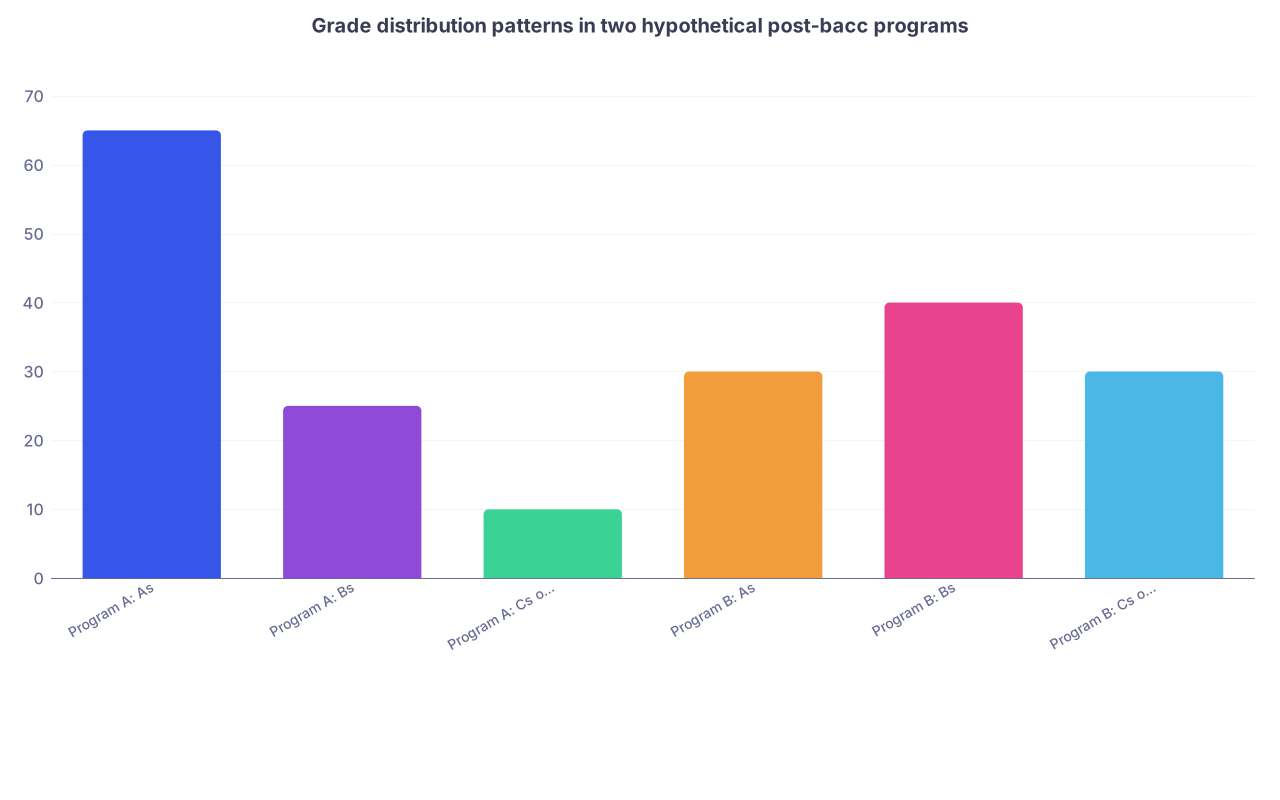
| Category | Value |
|---|---|
| Program A: As | 65 |
| Program A: Bs | 25 |
| Program A: Cs or lower | 10 |
| Program B: As | 30 |
| Program B: Bs | 40 |
| Program B: Cs or lower | 30 |
How Med Schools Infer Curves without Seeing Them
They use three indirect signals:
- Historical reputation. Places like Bryn Mawr, Goucher, Scripps, Columbia SPS, and top-state post-baccs have track records. Faculty on adcoms have seen their alumni. They know roughly what an A there means.
- Grade distribution vs outcomes. If a program sends grade distributions or has a consistent pattern (e.g., half the class to MD/DO each year), the signal is calibrated.
- Letters of evaluation. A letter that explicitly says “this A places the applicant in the top 10% of our post-bacc cohort over the past five years” carries more weight than an A with no narrative.
If your program’s curve is generous, you are not doomed. But you must pair those grades with either standardized test strength (MCAT) or very explicit faculty letters that describe you as top-tier within that specific cohort.
4. Rigor: What Counts as “Serious” Post-Bacc Coursework?
Rigor is not about how miserable you feel. I have seen students complain loudly about courses that would be considered moderate at any decent undergrad institution. Med schools are looking for comparability to upper-division undergraduate science, not pseudo-grad fluff.
Break it into three layers: content, context, and cohort.
Content: What You Are Actually Studying
Serious post-bacc science usually includes:
- General Chemistry I & II with labs
- Organic Chemistry I & II with labs
- Biology I & II with labs (or molecular / cell equivalents)
- Physics I & II with labs (algebra-based is fine; calculus-based is a slight plus)
- Often: upper-division coursework—Biochemistry, Physiology, Genetics, or Microbiology
Red flags for rigor:
- “Medical terminology” or “survey of health professions” marketed as “science” GPA boosters
- Excessive reliance on online-only, open-book, asynchronous assessments for core prereqs
- “Integrated science for health professionals” that replaces standard sequences with watered-down combined courses
If a course would not be accepted by your own state flagship university as the pre-req for its med school, it is suspect.
Context: Where and How You Take It
An A in Organic Chemistry at a community college with minimal lab and mixed major background is not equivalent to an A in Organic II at a research university in a cohort full of STEM majors. Admissions committees know this, even if they do not say it out loud in marketing statements.
Context factors:
- Institution tier: It is not that Harvard Extension always beats State U. It is that patterns over years tell adcoms how to interpret. A strong state university with a known premed pipeline is perfectly respectable.
- Format: In-person with structured labs and proctored exams reads as more rigorous than Zoom lectures with take-home multiple choice.
- Credit level: 300-/400-level courses (e.g., Advanced Physiology, Molecular Biology) signal depth beyond minimal requirements.
This does not mean “never use community college.” For career-changers testing the waters, CC for first semester chemistry is common. But if your entire academic repair is done at the least rigorous setting available, you are asking the committee to trust a very soft signal.
Cohort: Who You Are Competing Against
A post-bacc where most students are working full-time, took high school chemistry 10+ years ago, and are grade-averse is a different competitive environment from a university-based enhancer program where everyone already has a 3.4+ and is gunning for MD.
Admissions people understand that if you are top 5% in a very strong post-bacc cohort (say at Penn, Hopkins, or a powerhouse state program), that is more impressive than being top 5% in a program where half the class is casually “trying out” premed.
This is where letters matter again. A good letter writer will tell the committee exactly where you stand in that cohort.
5. How AMCAS and AACOMAS Actually Handle Your Grades
Many students seem to think adcoms are scrolling through your PDF transcript and eyeballing your A’s. They are not. They see the converted, standardized version.
High level:
- AMCAS (MD) converts every course into a category (BCPM vs non-BCPM) and a unified 4.0 scale, then calculates multiple GPAs: total, BCPM, post-bacc, etc.
- AACOMAS (DO) does something similar, but note that they discontinued grade replacement; every attempt counts.
Post-bacc transcripts are usually categorized as “Postbaccalaureate Undergraduate.” Their grades get folded into your overall undergraduate GPA and into a separate line for post-bacc GPA.
The key takeaway: letter grades and credit hours dominate; internal curve mechanics do not transmit directly. That is why reputational context and faculty letters matter so much.
6. Evaluating a Post-Bacc Before You Commit
Most people shop post-baccs on three dimensions: location, linkage promises, and brochure polish. That is how you end up in an expensive, vague program that inflates grades and underdelivers outcomes.
Here is how a more serious evaluation should look.
Ask About Grading Policies Directly
If you cannot get straight answers, walk away. Questions you should ask program staff or current students:
- Do core science courses use letter grades or Pass/Fail?
- Are plus/minus grades used?
- How often are exams curved, and how large are those curves typically?
- What is the typical distribution of final grades in Gen Chem, Org Chem, and Physics?
If the program brags that “almost everyone gets A’s,” that is not an advantage. That is evidence that the signal you generate will be devalued by any committee that has seen a few cycles.
Look at Outcome Data, Not Just Linkage Hype
Many programs wave around a “92% placement” statistic without clarifying:
- Over how many years?
- MD vs DO vs other (PA, nursing, etc.)
- How many students quietly disappear or do not apply?
Ideally, you want:
- Several years of outcome data
- Breakdown by GPA/MCAT bands if they have it
- Honesty about who these outcomes apply to (full-time enhancers vs casual cert seekers)

| Step | Description |
|---|---|
| Step 1 | Identify post-bacc programs |
| Step 2 | Request grading and outcome data |
| Step 3 | Review rigor and cohort |
| Step 4 | High risk for academic enhancers |
| Step 5 | Compare outcomes vs grade distribution |
| Step 6 | Consider applying |
| Step 7 | Cross off list |
| Step 8 | Letter grades for sciences? |
| Step 9 | Signal seems credible? |
Read Between the Lines of Marketing
Some common phrasing, translated:
- “Supportive environment where most students succeed” → Probably grade inflation, minimal academic weed-out.
- “Innovative assessment strategies beyond traditional exams” → Watch for projects and participation substituting for solid content exams.
- “Flexible online format for working professionals” → Convenience up, rigor usually down, labs may be weak or virtual.
There are exceptions. But if you already have an academic record that raises eyebrows, you should not be collecting more ambiguous signals.
7. How Adcoms Compare Post-Bacc Grades Across Different Settings
Imagine two applicants:
- Applicant A: 2.8 undergrad GPA 8 years ago in business. 4.0 in a structured, well-known one-year post-bacc (Bryn Mawr) with full-time load, MCAT 514.
- Applicant B: 3.1 undergrad GPA 3 years ago in biology. 4.0 from a piecemeal mix of largely online community college courses, MCAT 509.
Who looks more credible for a mid-tier MD? Almost every experienced committee will tilt toward Applicant A.
Why?
- A’s post-bacc is in a high-rigor, high-expectation cohort with clear grade meaning.
- A’s full-time load mimics med school strain more than B’s part-time online mix.
- A’s MCAT reinforces that the 4.0 is not a mirage.
That is how this game is actually played.
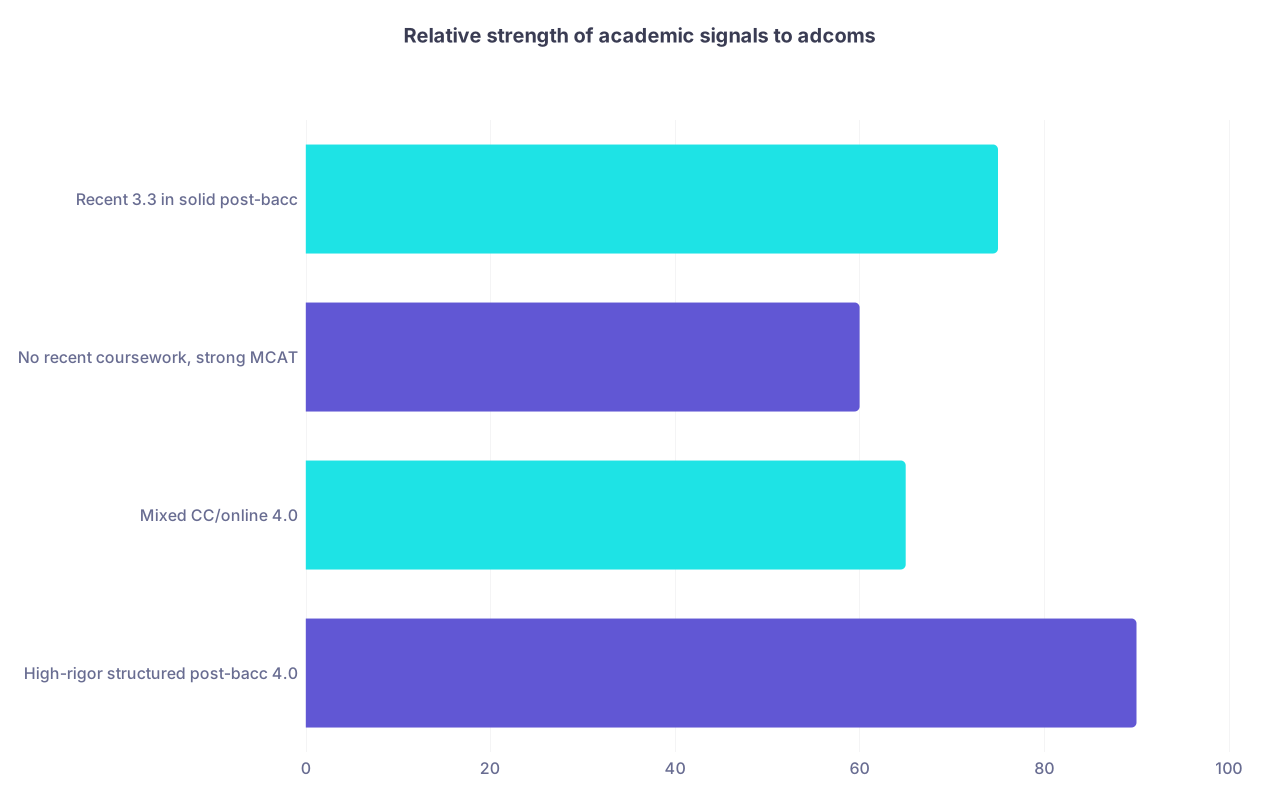
| Category | Value |
|---|---|
| High-rigor structured post-bacc 4.0 | 90 |
| Mixed CC/online 4.0 | 65 |
| No recent coursework, strong MCAT | 60 |
| Recent 3.3 in solid post-bacc | 75 |
The exact numbers are illustrative, but the hierarchy is real.
8. Practical Moves If You Are Already in a Soft or Curved Program
Maybe you are reading this halfway through a program whose grading feels… generous. You are seeing 95%+ class averages, open-note exams, and “group labs” where no one knows what a pipette is.
You are not doomed. But you need to compensate.
Strategy 1: Stack Rigor on Top
Take a few additional upper-division sciences at a more demanding setting once you finish: university extension, four-year state school, or reputable online courses with monitored exams and real prerequisites.
A pattern like:
- 4.0 in your softer post-bacc, plus
- A/A− in Biochemistry and Physiology at State U with tough grading
…is significantly more convincing than the soft 4.0 alone.
Strategy 2: Crush the MCAT
A very strong MCAT in the 513–518+ range (depending on your target tier) is the most portable rigor signal you can generate. If your coursework looks inflated, a mediocre MCAT confirms the committee’s worst suspicion. A strong MCAT counters it.
Strategy 3: Get Explicit Letters
Ask your best science instructors to be concrete:
- Where you ranked relative to the rest of the cohort
- How your performance compares to prior post-baccs who went on to succeed in med school
- Specifics about exam difficulty and your consistency
Vague “hard worker, pleasure to have in class” letters are useless in your position.
9. Specific Red Flags When Assessing a Post-Bacc
A non-exhaustive list, but if you see several of these, think very hard:
- Core sciences (Chem, Bio, Physics, Org) offered only Pass/Fail for post-baccs
- Labs fully asynchronous or simulated without any in-person component
- No clear historical placement data to MD/DO programs
- Program staff cannot tell you how GPA is calculated or how past students performed
- Marketing emphasizes “guaranteed interviews” or “linkage access” without disclosing that only a tiny subset of top students qualify
- Most students working >40 hours per week while taking “full-time” load and still boasting near-universal 3.8+ GPAs

10. How to Talk About Your Post-Bacc Grading and Rigor in Applications
Sometimes you need to help the committee interpret an unusual situation, especially if your program uses an odd scale, heavy curves, or nonstandard assessments.
Where To Clarify
- Secondaries: Many schools ask if there is anything else they should know about your academic record. Use that.
- Interviews: If asked about your post-bacc experience or academic turnaround.
- Advisor / committee letters: If your program does composite letters, make sure they explain context.
What To Say (And Not Say)
Good framing:
- “Our program used a traditional letter-grade system with plus/minus and full-length, in-person lab courses. I completed 32 credits of upper-level science with a 3.9 GPA while working 10 hours per week.”
- “Though our exams were often curved, I consistently scored in the top decile of the cohort; my instructors can speak to this in their letters.”
Bad framing:
- “The program was really hard but everyone got A’s because of the curve.”
- “We had to do a lot of group projects and participation, so the grading was kind of subjective.”
You are not trying to expose your program. You are trying to clarify that within that environment, you performed at the very top and can handle a rigorous curriculum.
11. Common Myths About Post-Bacc Grading and Med School Perception
Let me kill a few persistent bad ideas I hear from applicants and sometimes even advisors.
Myth 1: “Med schools do not care where you took your post-bacc, only the GPA.”
False. They will never say “we prefer Program X” in writing, but in the room, context constantly comes up. “This is another 4.0 from that very soft extension program” is a sentence I have heard more than once.
Myth 2: “Community college post-bacc work is viewed the same as university work.”
Not really. It is not disqualifying, especially for career-changers dipping a toe in, but if you are repairing bad undergrad performance, you should have some higher-rigor coursework in the mix.
Myth 3: “As long as I have a 4.0 post-bacc, the curve or scale does not matter.”
Ask the reapplicant with a 4.0 from a notorious grade-inflated program who still cannot break into MD interviews. The quality and credibility of the signal matter as much as the number.

12. Pulling It Together: How You Should Actually Choose and Use a Post-Bacc
If you strip away the noise, your job is simple:
- Choose a program whose grading scale is transparent, uses letter grades for core sciences, and offers enough credit hours to show a pattern, not a blip.
- Make sure the rigor and context are credible: recognizable institution, solid lab work, classmates who are not all tourists.
- Produce grades that are both high and believable, then reinforce them with a strong MCAT and explicit letters about your performance.
Do not chase the easiest A’s you can find. Chase the strongest signal you can send that you are ready for two preclinical years that do not pause, do not curve kindly, and do not care that your last biology course was 12 years ago.
That is what post-bacc grading scales, curves, and rigor are really about: not your ego, not your program’s marketing line, but the clarity of the story your transcript tells.
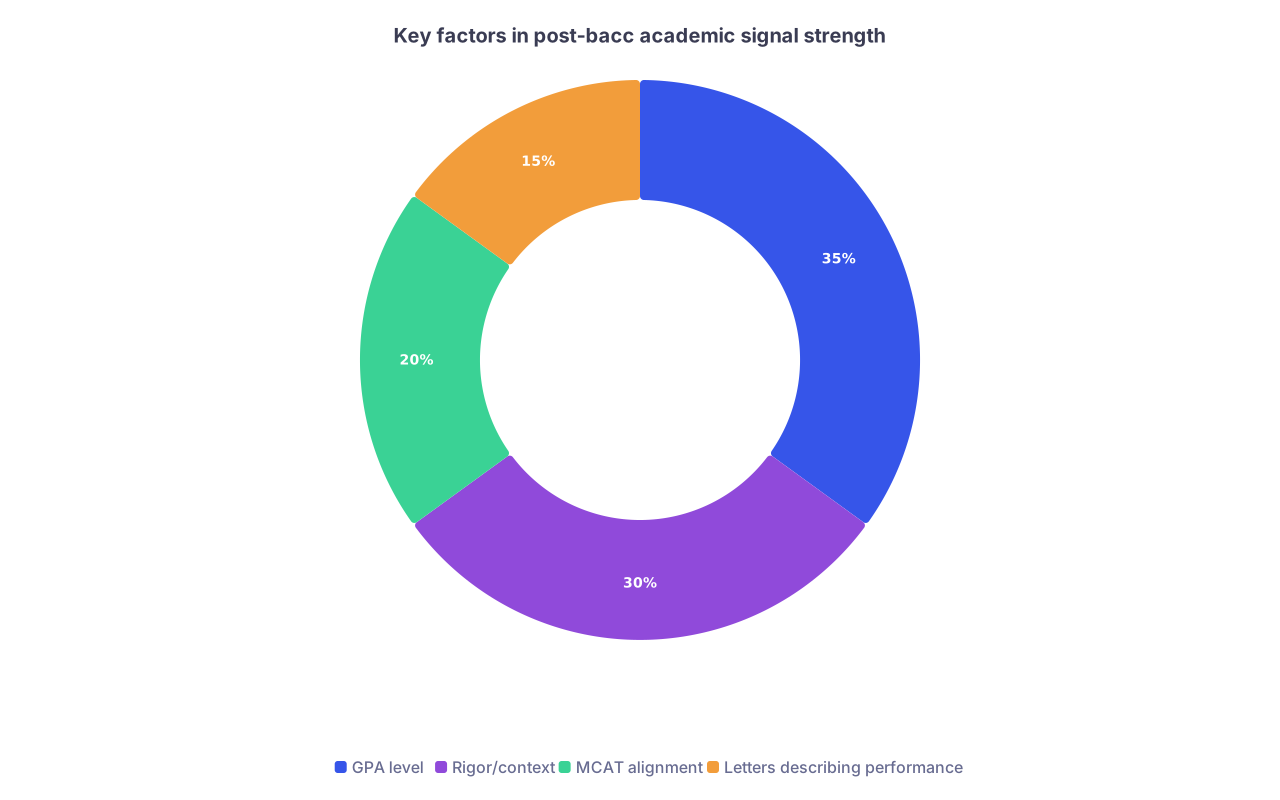
| Category | Value |
|---|---|
| GPA level | 35 |
| Rigor/context | 30 |
| MCAT alignment | 20 |
| Letters describing performance | 15 |
Key points to remember:
- Medical schools care less about the format of your grading scale and much more about the credibility and context behind your As.
- Obvious grade inflation, heavy undisclosed curves, and low-rigor coursework weaken your signal, even if your GPA looks perfect.
- The most effective post-bacc record pairs strong letter grades in real sciences, at a credible institution, with a strong MCAT and explicit faculty letters about where you stand in the cohort.