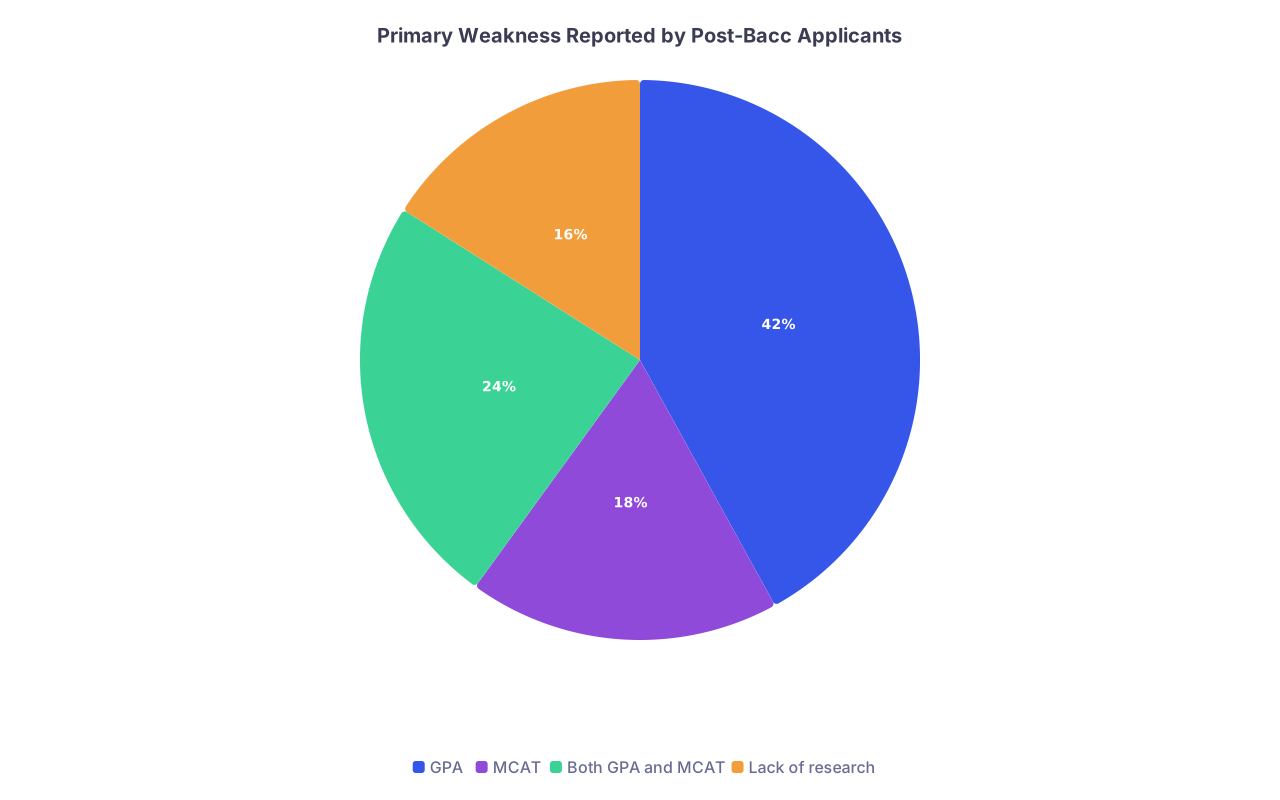
| Category | Value |
|---|---|
| GPA | 42 |
| MCAT | 18 |
| Both GPA and MCAT | 24 |
| Lack of research | 16 |
Only 16% of post‑bacc applicants list “lack of research” as their primary weakness—yet it quietly sabotages the other 84% who think their only problem is GPA or MCAT.
Most premeds treat research like a checkbox. Nice-to-have. Maybe helps for MD/PhD. Something you squeeze in around classes. That is a mistake.
Used correctly, post‑bacc research is a force multiplier for your academic metrics: GPA repair, MCAT performance, letters that actually say something, and a narrative that makes borderline numbers competitive.
Let me break this down specifically.
1. The Real Problem: Your Numbers Are Not Just “Low”
For post‑bacc students, “low numbers” almost never exist in isolation. I keep seeing the same pattern in advising:
- Cumulative GPA: 3.1–3.3
- Science GPA: often lower (2.8–3.2)
- MCAT: 498–506
- ECs: scattered volunteering, maybe some shadowing
- Research: a semester of dishwashing, no poster, no letter
On paper, that looks like: average ability, average work ethic, average trajectory.
(See also: Post-Bacc Linkage Policies for more details.)
Admissions readers connect dots very quickly:
- Weak GPA → questions about discipline, time management, or academic foundation
- Weak MCAT → questions about test‑taking skills, critical reasoning, and content mastery
- Weak or superficial research → no evidence you can handle the intellectual side of medicine or residency-level reading
Here is the part most people miss: good research involvement can actively compensate for, clarify, and reframe both GPA and MCAT. Not in some magical “3.0 becomes a 3.9” way, but in very concrete ways that matter during screening and committee discussions.
You are not using research as decoration. You are using it as evidence.
2. How Post‑Bacc Research Directly Supports GPA Repair
Post‑bacc students often treat research and coursework as competitors for time and energy. That is backwards when you set it up intelligently.
A. Cognitive benefits: research forces you to think like exams demand
Strong research roles routinely exercise the same muscles that your science courses and MCAT use:
- Analyzing messy data → better at multi‑step calculation questions
- Reading primary literature → better at critical reasoning passages on MCAT and NBME-style exams
- Learning a method deeply → better at mechanistic, “if X then Y” questions in biochem, physiology, pharmacology
I have watched students with a history of B‑minus organic chemistry suddenly start pulling A’s in their post‑bacc biochemistry after 6 months in a molecular biology lab. Why? Because they had to live inside concepts like Michaelis-Menten, inhibitors, and signal transduction while troubleshooting experiments.
If your post‑bacc GPA is not clearly higher (≥3.6, ideally ≥3.7) than your undergrad GPA, admissions committees will label your trajectory as “flat.” Research experience that has forced you to engage with material at a higher level can be a subtle but real driver of that stronger performance.
B. Behavioral structure: research as scaffolding for discipline
Strong labs do not tolerate chaos:
- You show up on time
- You maintain lab notebooks
- You follow protocols in sequence
- You prepare before lab meetings
That structure can stabilize students who previously underperformed because of disorganization, procrastination, or poor study habits.
The students who do best often use research to impose a weekly rhythm:
- Fixed lab blocks: e.g., M/W/F 9–1 PM
- Fixed study blocks: 1–4 PM coursework, 4–6 PM review or MCAT, evenings flexible
Post‑bacc students who flounder tend to treat everything as negotiable. Lab time slips. Study time shifts. Sleep moves around. Then they are surprised their new GPA is only a tiny fraction higher than their old one.
If you cannot protect your research and study blocks simultaneously, you are in the wrong lab or carrying the wrong number of credits.
C. Narrative synergy during review
Here is how a weaker academic record with strong post‑bacc research gets read in committee:
- “Undergrad: 3.1, rough first two years, then upward trend”
- “Post‑bacc: 3.7 over 30+ science credits”
- “Solid research with a clear role: helped design X, ran Y, analyzed Z, knows the project cold”
- “PI letter: says this person reads papers deeply, thinks critically, and is among the most reliable in the lab”
Now the numbers have context. The research convinces them your post‑bacc GPA is not a fluke. It is a new baseline.
3. How Research Positions You Choose Affect Academic Metrics
Not all post‑bacc research is created equal. A classic mistake: taking the first lab that says “yes” and assuming that “research is research.” It is not.
You want three specific features in a post‑bacc research opportunity if your main goal is to strengthen academic metrics.
A. Access to mentorship that focuses on your growth
You are not just looking for someone with an R01 or lots of publications. You are looking for:
- A PI or senior postdoc who actually meets with trainees
- A team where undergrads/post‑baccs present in lab meetings
- A lab that lets you own a small subproject, not just one step of a pipeline
Red flags I see too often:
- PI you never meet. Only see a grad student who is already overwhelmed.
- You are on the schedule mainly for dishwashing, genotyping, or basic data entry.
- They never ask you to read a paper. Or, worse, you “don’t have time” to.
If you are invisible in that lab, your academic profile does not benefit. You lose time for studying, and you gain almost nothing in return.
B. Intellectual demands that overlap with your weaknesses
Use research to attack your weakest academic domains.
Examples:
Weak in quantitative reasoning?
Look for labs heavy in statistics, modeling, or quantitative methods: health services research, epidemiology, bioinformatics, or any lab using R, Python, STATA, SAS.Weak in reading dense text and extracting meaning?
Aim for clinical research where you must read clinical trials, systematic reviews, or chart notes and extract structured data.Weak in mechanistic understanding of biology and chemistry?
Join a wet lab where you work directly with pathways, receptors, pharmacology, or physiology models.
If you are terrible at biochem and then join a very descriptive qualitative research project where your biggest intellectual task is coding interview transcripts, you are missing a chance. That work may still help with narrative skills and qualitative reasoning, but not in the way your GPA/MCAT need most.
C. Flexibility around exams and MCAT
You need a lab culture that respects academic priorities. Before committing, ask explicitly:
- “How do other undergrads or post‑baccs manage time during midterms and finals?”
- “Have you had people take a step back during MCAT studying? How did that work?”
Good mentors will say something like: “We ramp down for exams and MCAT as long as you communicate early and plan your experiments.” Bad ones will bristle or give vague answers.
You do not want to discover during MCAT crunch time that your PI expects 20 hours/week no matter what.
4. Concrete Mechanisms: From Research to MCAT Improvement
MCAT performance is not just “more Anki” and “more full lengths.” Research helps in targeted ways.
A. CARS and research reading
Students who read papers every week are forced to:
- Pull key questions from dense abstracts
- Identify hypotheses and limitations
- Interpret graphs and tables without overreading them
- Question methods and alternative explanations
These are exactly the skills CARS and the science passages use. If you routinely discuss papers in lab meetings, you are basically training for CARS and the critical analysis embedded in every science question.
I have sat in labs where undergrads present a single figure from a paper and the PI spends 30 minutes asking:
- “What is the real question underlying this figure?”
- “What would have been a better control?”
- “What confounders did they ignore?”
You cannot buy that kind of CARS training.
B. Psych/Soc and human subjects research
If you work on clinical or behavioral studies:
- You will see operational definitions of constructs (depression, adherence, health literacy).
- You will learn about bias, validity, reliability, and sampling.
- You will handle survey tools, scales, or structured interviews.
All of this maps directly to Psych/Soc content—and more importantly, to how exam writers think about that content. Understanding real-world application sticks better than memorizing hundreds of terms.
C. Bio/Biochem and lab troubleshooting
If you spend months in a bench lab:
- You watch reactions fail because of pH, temperature, enzyme kinetics, contamination.
- You see how changing a buffer or concentration alters results.
- You are forced to reason through pathways when your Western blot or PCR gives unexpected bands.
The MCAT loves mechanism. “If we inhibit enzyme X, what happens to intermediate Y and product Z?” That is just a sanitized version of what you do when your experiment fails.
D. Quantitative analysis and data-heavy questions
If your research involves:
- Running regressions
- Building models
- Running statistical tests
- Creating graphs or tables
You naturally get better at:
- Thinking in variables and covariates
- Understanding what a “significant association” actually implies
- Interpreting data presentations in passages
That means less cognitive load on exam day. When everyone else is struggling just to parse a Kaplan-Meier curve, you are three questions ahead.
5. Leveraging Research for Letters That Fix Your Record
Letters of recommendation from research mentors can do something your transcript cannot: reinterpret your academic history.
Strong PI letters for post‑bacc students with checkered records have specific functions:
Establish baseline:
“This student came to me after a difficult early academic record and explained it plainly.”Describe current performance in rigorous terms:
“They now read primary literature at the level of my senior grad students.”“Their poster presentation at [Conference] was among the best from our group this year.”
Show sustained reliability:
“Eighteen months in the lab. Zero missed deadlines. Data always reproducible. Lab notebook meticulous.”Directly address concerns about future performance:
“Based on my experience supervising dozens of medical and graduate trainees, I fully expect them to excel in a demanding medical curriculum.”
The weak version of this letter is useless: “Shows up, works hard, great attitude, would make a great doctor.” That does nothing for your numbers.
Your job: make it easy for your PI to write the strong version.
- Send them your CV, transcript, and personal statement draft.
- Tell them about your low GPA / MCAT frankly.
- Explicitly say: “I hope your letter can speak to how my current performance compares to typical medical students or graduate students you have trained.”
If that conversation feels terrifying, good. It should. But those are the letters that actually move the needle.
6. Strategic Pathways: Types of Post‑Bacc Research Setups
Let’s talk about concrete setups and how they interplay with academic metrics.
A. Formal post‑bacc research programs (NIH IRTA, university post‑baccs)
These typically offer:
- Full-time research employment (often 35–40 hours/week)
- Optional or required coursework at a nearby university
- Structured mentorship, seminars, and sometimes MCAT support
Pros:
- Strong letters, prestigious institutions, clear structure
- Built-in peer cohort; easier to stay disciplined
- Some programs are known to adcoms; that shorthand helps
Cons:
- Time‑intensive; you must be ruthless about when to study MCAT
- Limited flexibility in which lab you join
- You may not be able to take as many formal classes concurrently
This route is ideal if your GPA is already somewhat repaired (e.g., 3.4–3.5 with an upward trend) and you need to solidify your intellectual credibility, boost MCAT, and secure top-tier letters.
B. DIY research as part-time RA + part-time coursework
Common pattern:
- 15–20 hours/week in a lab or clinical research office
- 6–12 science credits/semester in a formal post‑bacc or as a non-degree student
- MCAT studying integrated around both
Pros:
- Maximum control over coursework. You can directly target weak content areas.
- Reasonable hours in lab make it easier to ramp down before exams.
- Potential for long-term involvement (2+ years) → depth of experience.
Cons:
- More responsibility on you to structure your life.
- Lab may be less familiar to adcoms; quality of letter matters more.
- If you choose a weak lab, you waste the opportunity.
This is the workhorse path for many successful post‑bacc applicants. It can transform both transcript and narrative if executed correctly.
C. Clinical research in hospital systems
Here your work often involves:
- Chart review
- Data abstraction from EMR
- Patient recruitment and consent
- Survey administration
- Possibly some basic statistics
Pros:
- Direct exposure to clinical language, workflows, and human subjects ethics.
- Very high yield for Psych/Soc and CARS.
- Lends itself well to meaningful clinical stories for essays and interviews.
Cons:
- Scientific “depth” varies; some projects are glorified data entry.
- You must push harder to get involvement in study design, analysis, or manuscript writing.
- Schedules may be less flexible (clinic days, recruitment windows).
Great fit if you want to build both your academic and clinical narratives together, but you must be aggressive about asking for responsibilities that exercise your brain.

| Step | Description |
|---|---|
| Step 1 | Start Post‑Bacc |
| Step 2 | Prioritize Rigorous Science Coursework |
| Step 3 | Prioritize MCAT Study Schedule |
| Step 4 | Balanced Coursework + MCAT + Research |
| Step 5 | Choose Lab That Reinforces Course Content |
| Step 6 | Choose Flexible Lab With Reading/Analysis Focus |
| Step 7 | Part-Time Research in High-Mentorship Lab |
| Step 8 | Stronger Post-Bacc GPA |
| Step 9 | Improved MCAT Critical Reasoning |
| Step 10 | Robust Letters + Upward Trend |
| Step 11 | Primary Weakness? |
7. How to Day‑to‑Day Design Research to Help, Not Hurt
The details matter. Here is what I push students to do in practice.
A. Build a weekly “research–study loop”
Example week for a post‑bacc with 8–10 hours of research and 8 credits of science:
Mon:
9–1 Lab work
2–4 Class / content
7–9 Review lecture + AnkiWed:
9–1 Lab work
2–4 Problem sets / practice questions
7–9 MCAT passages (CARS or science)Fri:
9–1 Lab work + read one paper for lab meeting
2–4 MCAT full‑length review or NBME-style questionsSat or Sun:
Longer MCAT block or exam review depending on phase
The loop is key: what you see in lab on Monday shows up in class on Wednesday and MCAT prep Friday. Your brain keeps revisiting and re-linking concepts.
B. Turn lab work into deliberate MCAT prep
Do not just “do the work.” Explicitly connect it:
- After a Western blot or ELISA: write a paragraph connecting this assay to MCAT‑relevant topics (antibody structure, enzyme reactions, signal detection).
- After reading a clinical paper: convert one figure or table into an MCAT-style question stem with 3–4 answer choices.
- After a lab meeting: pick one concept and review it using your MCAT resources that same week.
This is how research stops being a time sink and starts being a study asset.
C. Aggressively protect sleep and exam ramps
Post‑bacc students trying to “do everything” often destroy themselves with chronic sleep debt. Their GPAs stay mediocre, MCAT plateaus, and research quality suffers.
Non‑negotiables if your goal is metrics repair:
- 7+ hours of sleep on at least 5 nights/week
- 1–2 lighter lab weeks around major exams
- A clear ramp‑up phase 6–8 weeks before the MCAT where lab hours dial down if needed
Discuss this with your PI early. Not the week before the MCAT.
8. Presenting Research in Your Application to Highlight Metrics
If you do all this heavy lifting and then describe your research experience in one vague sentence on AMCAS/AACOMAS, you are wasting it.
Focus your descriptions on:
Intellectual tasks
- “Independently performed multivariate regression analysis to examine association between X and Y.”
- “Critically evaluated 2–3 new papers per week for journal club; presented and defended methods and conclusions.”
Evidence of mastery over time
- “Promoted from basic data collection to leading a subproject on [topic].”
- “Trained new undergraduates in [specific technique].”
Convergence with coursework / MCAT‑relevant skills
- “This work reinforced my understanding of enzyme kinetics and signal transduction, reflected in later A performance in advanced biochemistry.”
In secondaries and interviews, connect the dots explicitly. Do not make the committee guess:
- “My undergrad GPA does not reflect my current capability. In post‑bacc, I earned a 3.7 across 32 science credits while working 15 hours/week in a lab where I led a subproject on [mechanism]. The same mechanistic thinking I used to troubleshoot experiments helped me raise my MCAT from 501 to 511.”
That is the kind of integrated story that moves borderline metrics into the “acceptable with compelling trajectory” bucket.
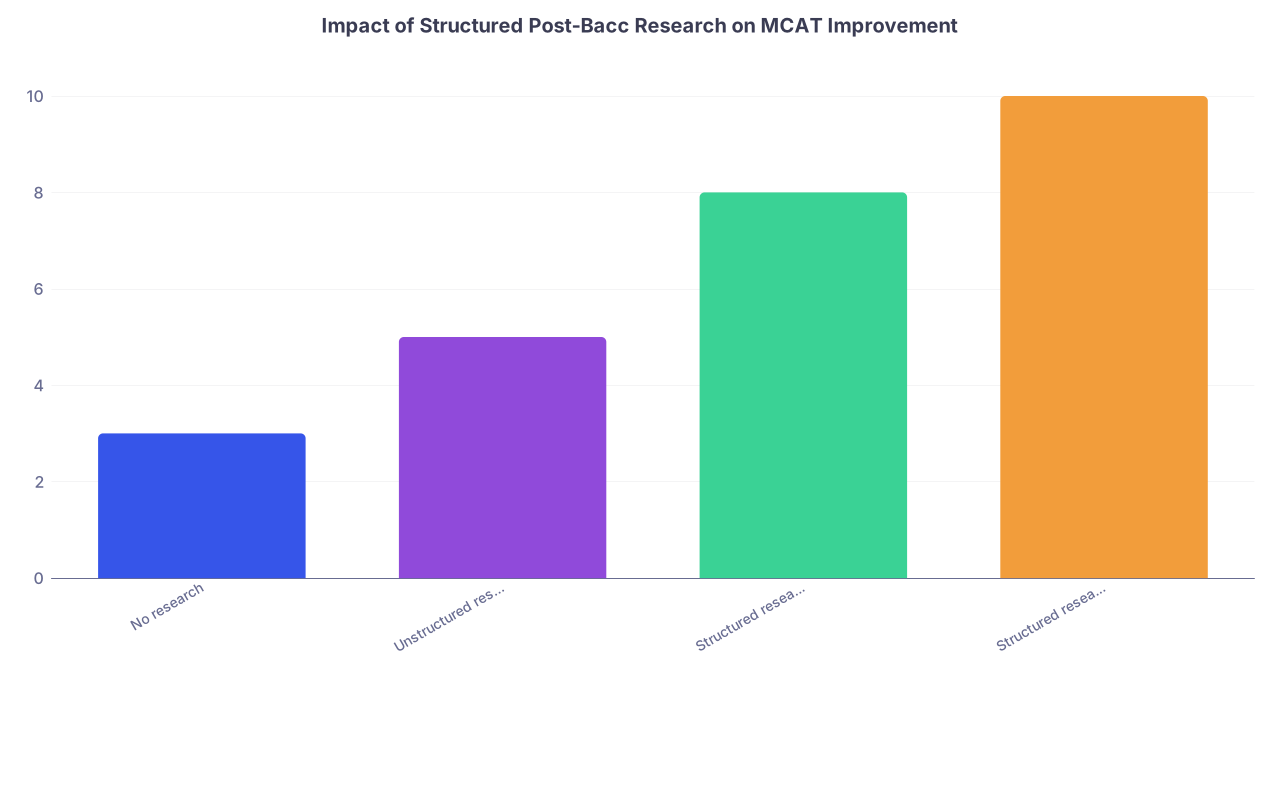
| Category | Value |
|---|---|
| No research | 3 |
| Unstructured research | 5 |
| Structured research + reading | 8 |
| Structured research + reading + presentations | 10 |
(Values above: typical composite score gains in real students I have worked with over a 6–12 month prep window; obviously individual mileage varies, but the pattern holds.)
9. Avoiding Common Traps That Destroy Both Metrics and Research Value
I see the same self‑inflicted wounds again and again.
Trap 1: Overcommitting.
18 credits, 20 hours/week in lab, MCAT in 4 months. This usually ends with a 3.0 semester, weak MCAT, and unimpressive research.Trap 2: Staying in a bad lab out of guilt.
If your lab gives you no mentorship, no real tasks, and no flexibility, you are not obligated to sacrifice your future for their convenience. Give notice, transition gracefully, find a better fit.Trap 3: Treating research as purely extracurricular.
If you never link what you learn in lab back to your courses and MCAT content, you are leaving a large amount of value on the table.Trap 4: Hiding your academic past from your PI.
The best letters require honesty. Let them see the full arc, not just a polished version.Trap 5: Doing last‑minute “CV padding” research.
Two months in a lab the summer before applying, no poster, no abstract, superficial involvement. Committees can smell it instantly. It does almost nothing for your metrics or story.
10. If You Are Starting Late: What Still Helps
Maybe you are already midway through your post‑bacc or close to your MCAT, and none of this is in place. You still have levers to pull.
Short timeline (≤6 months to MCAT):
Aim for a reading‑ and analysis‑heavy research role. Journal clubs, retrospective chart review, stats work. You want maximal impact on CARS and data interpretation with minimal time in the physical lab.Short timeline to application but longer runway for med school:
Even if research will not dramatically change your MCAT by this cycle, it can still generate the kind of letter that reassures committees about your ability to handle the medical curriculum. Do not discount that.Already in a weak lab:
Start asking for a defined subproject, literature review, or responsibility that demands more thinking. You may not change labs in time, but you can upgrade your role.
Key Takeaways
Research is not separate from academic metrics. Done well, it directly drives higher post‑bacc GPA, better MCAT performance, and letters that rehabilitate a weak record.
The lab you choose and the role you carve out matter more than the name brand. You want mentorship, intellectual responsibility, and enough flexibility to protect exams and MCAT.
You must connect the dots explicitly. In how you study, in how you live week to week, and in how you write your application. Research only strengthens your academic metrics if you make the relationship impossible to miss.