You are six months into your post-bacc. Your inbox pings: “REMINDER: Committee Letter Intake Form Due Friday.” You have no idea if this thing is a must-have golden ticket or just administrative theater. Your classmates are split—some are panicking to meet deadlines, others say they are skipping it and just using individual letters.
Here is where you are: you are in a post-bacc (formal or DIY) that offers some type of “committee letter” or “packet,” and you need to decide:
- Is this worth the hassle?
- How much does it actually matter to admissions?
- What exactly goes into it, and how should you use it strategically?
Let me break this down.
What a Committee Letter Actually Is (In Real Life, Not in Brochures)
Forget the glossy advising website language. In practice, “committee letter” means one of three different beasts. Programs use the terms loosely, which causes a lot of confusion.
1. True Committee Letter (Single Composite Letter + Embedded LORs)
This is the classic model you see at places like Bryn Mawr, Goucher, Scripps, and some strong undergrad premed offices.
Structure:
- One primary narrative letter written “by the committee” (often actually by a specific advisor, signed by the committee or office).
- Your individual letters (faculty, PI, physician, etc.) are appended or embedded behind it as a packet.
- Delivered as a single upload to AMCAS/AACOMAS/TMDSAS via your school’s prehealth office.
What is inside the narrative:
- A summary of your academic record, trends, rigor, and context (e.g., “completed a full-time career-changer program while working 10 hours/week as a scribe”).
- Commentary on professionalism, reliability, and interpersonal skills based on meetings, evaluations, sometimes mock interviews.
- Integration of themes from your individual letters (“Across three science letter writers, a consistent theme is her ability to…”).
- Sometimes a comparison line: “Among the 50 students we have supported in the past five years, he ranks in the top quartile in terms of academic performance and commitment to medicine.”
This is the strongest and most meaningful form. When admissions committees say “committee letter,” this is usually what they mean.
2. Committee Letter Packet (No Real Synthesis, Just Bundling)
Common at larger universities and many SMPs or post-baccs with limited advising bandwidth.
Structure:
- A very short cover letter from the prehealth office.
- All your individual letters bundled and sent together under the school’s letterhead / letter service.
- The cover is often bland: “This packet includes letters of evaluation for Applicant X from Dr. Y, Dr. Z, etc.”
Functionally, it is more of a mailing service plus a light stamp of institutional endorsement. It is not a true composite narrative.
Does it help? Some. It signals:
- You went through that school’s advising pipeline.
- You submitted required materials on time.
- You are considered appropriate to support.
But it does not carry the same interpretive weight as a robust, narrative composite letter.
3. “Letter of Support / Premed Advisor Letter” (Not a Real Committee Letter)
Some post-baccs or DIY setups will:
- Not have a formal committee.
- Offer instead a “premed advisor letter” that is 1–2 pages, more like an institutional endorsement.
- Or, worse, call something a “committee letter” that is literally just a 2-paragraph general statement about the program and a one-line endorsement of you.
Programs know the difference. Admissions folks see thousands of these. A generic “X completed our program and met professionalism standards” is not a substitute for a detailed composite letter.
How Medical Schools Interpret Committee Letters from Post-Baccs
You are probably wondering: how much does this move the needle? Let me be direct.
A strong, detailed committee letter from a reputable post-bacc can:
- Serve as a keystone document for your file.
- Frame your academic reinvention.
- Preempt doubts about your GPA, career switch, or timeline.
But it does not rescue a weak record. It contextualizes, it does not erase.
The Informal “Signals” Hidden in a Committee Letter
Admissions committees read more than the words.
Signals they pick up from presence and structure of a committee letter:
- Did you go through the formal advising process?
If your post-bacc clearly offers a committee process and you opted out without explanation, some schools will quietly ask: “Why?” They will not reject you solely for that, but it nudges doubts:
- Did the student not meet professionalism requirements?
- Did they have behavioral issues?
- Did they miss deadlines or disregard process?
- Does the program stand behind you?
A strong, detailed composite letter signals:
- The program knows you well.
- You performed reliably in a demanding environment.
- Multiple faculty have converged on positive assessments.
- How do you stack up in that specific ecosystem?
Committee letters often include comparative language, even when not explicit:
- “She is among the most engaged students we have worked with in this program.”
- “He has demonstrated consistent growth over the year.”
For post-bacc students, especially career-changers or reinvention candidates, that context matters more than you think. Committees read: “Top 10% at Goucher” very differently from “did fine in an unstructured DIY.”
Structure and Content: What Makes a Strong Post-Bacc Committee Letter
Let me sketch what a good one actually looks like. You should be able to recognize, from your advisor’s description or your classmates’ experiences, whether your program is closer to “high-yield” or “check-the-box.”
Core Elements of a Strong Post-Bacc Committee Letter
- Academic Narrative with Context
Not just your GPA. The letter should:
- Describe the program structure: “One-year, full-time, intensive science curriculum for career changers.”
- Clarify rigor: “Students enroll in back-to-back semesters of rigorous lab-based courses equivalent to upper-level undergraduate work.”
- Spell out your load: “Completed 30 credits of upper-division science in 12 months.”
For reinvention students:
- Address prior academic record directly but professionally: “Although his early undergraduate GPA was modest, his performance in this post-baccalaureate program demonstrates his current ability to excel in rigorous science coursework.”
- Specific Behavioral Observations
Medical schools care less about your charm and more about whether you are reliable and not a problem.
Strong letters will mention:
- Attendance and punctuality.
- Responsiveness to feedback.
- Collaborative behavior in labs or group work.
- Professionalism when dealing with staff, lab partners, or patients (if linked to a clinical piece).
Watch for: “No professionalism concerns” as the main praise line. That is lukewarm. You want more active description.
- Integration of Individual Letters
The better committees do not just attach letters; they synthesize:
- Identify recurring themes (e.g., “intellectual curiosity,” “teaching peers,” “ethical maturity”).
- Point out complementarity: science rigor from one letter, clinical empathy from another, research grit from a PI.
You cannot see the letter itself, but you can infer quality from:
- How detailed the intake process is.
- Whether faculty are asked for structured evaluations.
- Whether you have a formal committee meeting or interview.
- Concrete Examples, Not Vague Praise
Compare these two lines:
- Weak: “She is a hardworking and compassionate student.”
- Strong: “In our physiology course, she organized weekly peer review groups unprompted, and three separate classmates mentioned that her explanations helped them pass key exams.”
Admissions committees read vague adjectives all day. They tune out unless the writer anchors them with behavior.
- Program-Level Comparison (When The Program Has a Track Record)
Good programs use their history:
- “Over the past decade, our post-baccalaureate program has sent graduates to over 60 MD and DO programs nationwide. Within that cohort, he ranks solidly in the top third academically and at the top in terms of leadership in service initiatives.”
This matters especially if your original undergrad record is weak or scattered.
How Much Weight Do Committee Letters Carry Compared to Other Letters?
You are trying to allocate effort: Should you chase one more individual letter from Dr. Big Name, or invest in the committee process? Let’s be blunt.
Relative Weight in an MD/DO Application
Think of “letters package” as a whole. In most MD/DO reviews, the weight hierarchy is roughly:
- Recent, rigorous science faculty who know you well (often in your post-bacc).
- Composite committee letter that integrates your performance and behavior.
- Clinical supervisor/physician letters that show how you function around patients and staff.
- Research letters (if research is a major part of your story or you are aiming for research-heavy schools).
- Random “character” letters (old employer, coach, etc.) – usually lower yield unless unusually strong and recent.
A strong committee letter can:
- Amplify the impact of 1 and 2 by tying them together.
- Validate that what those individual writers say is consistent with how the program sees you as a whole person.
A weak committee letter can:
- Drag everything down if it is short, generic, or full of faint praise.
- Raise quiet questions if it feels like the writer barely knows you.
When a Committee Letter from a Post-Bacc Is High-Yield vs. Low-Yield
Not all situations are equal. Let’s walk through common scenarios.
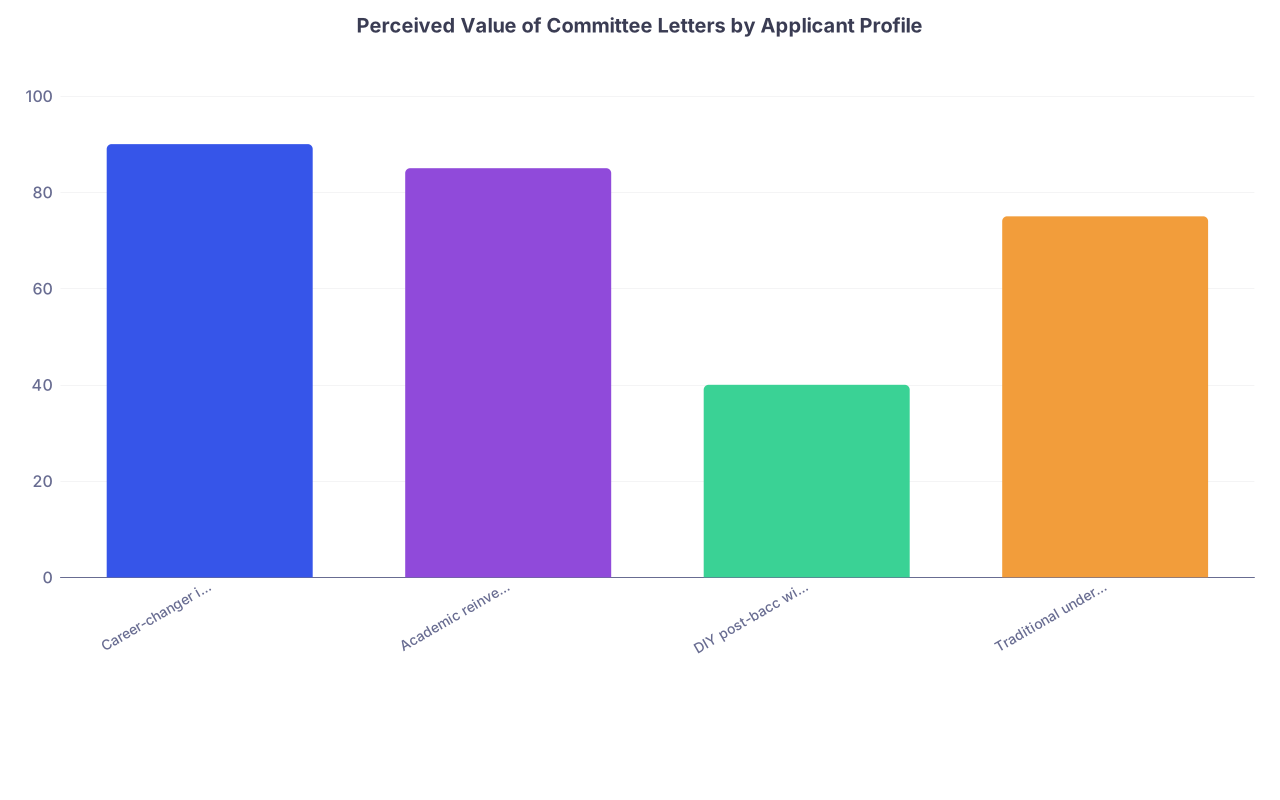
| Category | Value |
|---|---|
| Career-changer in formal post-bacc | 90 |
| Academic reinvention post-bacc | 85 |
| DIY post-bacc with minimal advising | 40 |
| Traditional undergrad with strong premed office | 75 |
(Values are conceptual “relative value,” not actual percentages, but this approximates how committees think.)
1. Career-Changer in a Formal Post-Bacc (Bryn Mawr / Goucher / Scripps Type)
You have no prior science background, a non-science major, and you just did an intensive, structured program.
Here, the committee letter is almost mandatory. Why:
- It provides the only standardized academic comparison for you as a science student.
- It reassures schools that your 4.0 in the post-bacc is not fluff coursework.
- These programs have reputations. A strong letter from them is heavily trusted.
Skipping the committee letter in this context is a bad move unless:
- You have a genuine conflict with the program (e.g., mistreatment, retaliation) and you are prepared to explain that in secondaries or in an advisor note.
2. Academic Reinvention in a Formal or Linkage-Oriented Post-Bacc
You had:
- A weak or mediocre undergrad GPA.
- You did a structured post-bacc for redemption.
The committee letter is one of your primary tools to:
- Address the “what changed?” question head-on.
- Demonstrate sustained improvement, not just a single fluke semester.
- Show that you handled a medical-school-like workload.
Again, skipping the committee process when it is available tends to look suspect.
3. DIY or Loose-Structure Post-Bacc (Community College + Local 4-Year Mix)
Here the calculus shifts. Maybe:
- You have no unified advising office.
- There is a “committee” in name only.
- The process produces a generic 1-page boilerplate.
In that case:
- You prioritize strong individual letters from:
- Your best recent science instructors.
- A clinical supervisor who actually watched you work.
- A PI if research was substantial.
- If the “committee” letter is optional and weak, it becomes a “nice to have” but not a pillar.
The exception: If your “DIY” is actually through a small program with a very engaged director who knows you extremely well, a personally written advisor letter can be valuable even if it is not called a committee letter. The key is depth and specificity, not the label.
4. You Already Have a Robust Undergrad Committee Letter
Some people:
- Did a decent undergrad with an established premed office and already have an undergrad committee letter.
- Then completed a post-bacc on top.
Question: Do you need a second committee letter from the post-bacc?
Best use pattern:
- Use the undergrad committee letter if it is not wildly outdated and reflects your early academic formation.
- Supplement with:
- 1–2 individual letters from post-bacc science faculty.
- 1 clinical letter reflecting your recent experience.
You generally do not need two full committee letters. It becomes redundant and logistically messy. Some schools cap institutional letters anyway.
Common Misconceptions and Bad Assumptions
I have watched a lot of post-bacc students tie themselves in knots over myths.
Myth 1: “If my program has a committee letter, I must use it or schools will auto-reject me.”
Wrong. Most schools do not have an automatic rejection trigger for “no committee letter,” especially for non-traditional and post-bacc applicants. They recognize:
- Many post-baccs are loosely structured.
- Some advising offices are overburdened or frankly ineffective.
However:
- If it is a well-known formal program and you clearly bypass the committee, that will raise eyebrows and you would be smart to have a coherent reason ready.
Myth 2: “Committee letters always carry more weight than individual letters.”
No. A bad committee letter is worse than a medium-quality individual letter because it seems “official.” It can encode weak support under the guise of neutrality:
- Excessive hedging (“seems,” “appears,” “has the potential to”).
- No concrete praise.
- Passive or generic language.
Admissions readers are very good at reading the subtext. A lukewarm institutional letter can sink an otherwise decent file.
Myth 3: “The committee letter is just admin; content does not matter.”
Also wrong. I have seen interviewers quote committee letters word for word during interviews:
- “Your committee letter says you had some initial difficulty adjusting to the rigor of the program but then adapted. Can you talk about that?”
- “Your advisor mentions that you took on a leadership role organizing service projects. What did that look like week to week?”
They do read them. Especially at schools that still emphasize holistic review.
How to Position Yourself to Get a Strong Committee Letter
You cannot write the letter, but you can heavily influence what the writer has to work with.
1. Treat Your Prehealth Office Like a Long Interview
From the first email:
- Respond to messages promptly.
- Meet deadlines.
- Show up to required workshops and meetings.
- Be polite to administrative staff; they talk to advisors.
You are building a professionalism dossier long before the letter is drafted.
2. Give Them Substance: A Real Portfolio
Most committee processes ask for:
- A CV.
- Personal statement draft.
- Short essays or a questionnaire about your path.
- Sometimes a list of “strengths and weaknesses” or notable experiences.
Do not phone it in. Use:
- Concrete details (hours, roles, challenges).
- Specific turning points (course, patient, family situation).
- Honest, non-dramatic discussion of weaknesses (poor time management early on; fixed by X, Y, Z).
Advisors can only advocate for what they understand. Vague fluff leads to vague letters.
3. Choose Your Individual Letter Writers Strategically
Your committee letter will rely heavily on the content and tone of your individual LORs. Choose:
1–2 recent science professors who:
- Taught you in rigorous courses.
- Saw you regularly (office hours, labs, recitations).
- Watched you handle difficulty, not just coast to an A.
1 clinical supervisor (nurse manager, PA, physician) who:
- Observed you with patients and staff.
- Can speak to reliability, humility, and teamwork.
If research was significant:
- 1 PI or senior researcher, ideally one who saw you work through setbacks.
Then communicate clearly with your committee office:
- Who these writers are.
- What roles they played in your training.
- Why their perspectives matter.
4. Take the Committee Interview / Meeting Seriously
If your program includes a committee interview:
- Treat it like a hybrid between a mock interview and an intake.
- Be honest about career switch, academic issues, and motivations.
- Do not recite a memorized script. Advisors can smell prepackaged nonsense.
They are not only evaluating you. They are collecting texture for the letter.
Best Use Cases: When and How to Deploy a Committee Letter Strategically
You submit applications through AMCAS/AACOMAS/TMDSAS. Those systems let you specify:
- Which letter types you are sending.
- Which schools get what.
You need a plan.

| Step | Description |
|---|---|
| Step 1 | In a post-bacc program? |
| Step 2 | Use individual letters only |
| Step 3 | Evaluate quality of committee option |
| Step 4 | Use committee letter as primary institutional letter |
| Step 5 | Skip or de-emphasize committee letter |
| Step 6 | Use as supplemental institutional endorsement |
| Step 7 | Formal, reputable program with real committee? |
| Step 8 | Short/generic letter? |
Scenario A: Formal, Reputable Post-Bacc with Strong Committee Process
Strategy:
- Use the committee letter as your primary institutional letter in AMCAS.
- Supplement with:
- 1–2 standout science letters (if not already embedded).
- 1 clinical letter.
- 1 research letter (if relevant).
You do not need a separate undergrad committee letter on top, unless:
- Your undergrad office insists on sending it automatically.
- Or it contains genuinely useful historical context.
Scenario B: Post-Bacc Committee Letter Is Available but Low-Quality / Minimal
Here you decide:
- Is it neutral but thin? Could be a harmless add-on.
- Is it actively weak (e.g., advisor barely knows you, process rushed, cookie-cutter)? Then you consider skipping.
Core package:
- Strong individual science letters (2–3).
- Strong clinical letter.
- Optional research letter.
If you still send the weak committee letter:
- Make sure it is clearly just a “school packet cover” in the description.
- Do not rely on it as the star.
Scenario C: You Have Both an Undergrad and Post-Bacc Institutional Letter Option
Most efficient:
- Pick the institutional letter that:
- Knows you better.
- Reflects your current academic ability.
- Then:
- Add targeted, recent letters from the other environment.
For example:
- Undergrad committee letter + 2 post-bacc science letters + 1 clinical. Or:
- Post-bacc committee letter + 1 undergrad PI letter + 1 clinical.
Try not to drown the reader in seven near-duplicate letters. They stop reading after four or five.
A Quick Word About DO vs MD and Committee Letters
DO schools:
- Are often more flexible about letter structure.
- Care deeply about clinical behavior and fit with osteopathic values.
- Some specifically want or prefer a DO letter.
In DO-heavy application strategies:
- A post-bacc committee letter that highlights bedside manner, work ethic, and humility can be very helpful.
- But an excellent direct letter from a DO you have worked with regularly can outweigh a bland committee summary.
MD programs:
- Are more likely to expect or be used to committee letters from structured programs.
- Use them more heavily for context and comparative language.
You adjust your emphasis based on where you are tilting your applications.
One More Pattern: When Not Getting a Committee Letter Is Actually Appropriate
There are legitimate reasons to bypass the committee route:
- Your program’s process is known to be dysfunctional, slow, or punitive.
- You clashed with an advisor in a way that would clearly bias the letter.
- You are applying on a timeline that conflicts heavily with the committee cycle (e.g., finishing post-bacc late, applying earlier than they support).
If any of these are true:
- Document your reasoning.
- Make sure your individual letters are excellent and timely.
- Be prepared, if asked in secondaries or interviews, to calmly explain: “The committee process at my post-bacc did not align with my application timing / would not have allowed my full set of recent experiences to be represented, so I chose to proceed with individual letters instead.”
Do not sound defensive. Just factual, composed, and intentional.

How to Reality-Check Your Specific Post-Bacc’s Committee Letter
Every program will tell you their letter is great. Some are lying. Or at least exaggerating. Here is how you quietly fact-check.
Ask upperclassmen / recent alumni:
- “Did you feel the committee letter added anything beyond your individual LORs?”
- “Did any interviewers mention your committee letter specifically?”
- “If you did this again, would you go through the committee process?”
Ask the advising office (directly):
- “Approximately how long is the typical committee letter?”
- “Do you primarily summarize and synthesize individual LORs, or is it more of a brief endorsement?”
- “Do you include any comparative language about performance within the cohort?”
Watch their answers. If everything is evasive and vague, adjust your expectations downward.
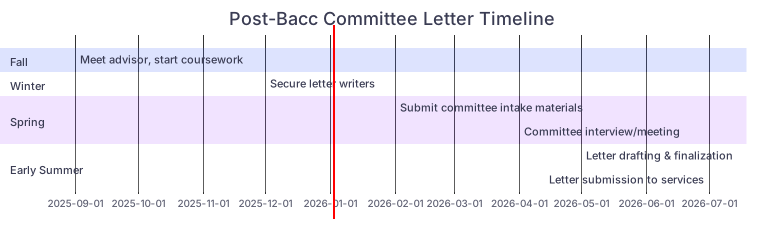
| Task | Details |
|---|---|
| Fall: Meet advisor, start coursework | a1, 2025-09, 3m |
| Winter: Secure letter writers | a2, 2025-12, 2m |
| Spring: Submit committee intake materials | a3, 2026-02, 2m |
| Spring: Committee interview/meeting | a4, 2026-04, 1m |
| Early Summer: Letter drafting & finalization | a5, 2026-05, 2m |
| Early Summer: Letter submission to services | a6, 2026-07, 1m |
If your post-bacc’s timeline is wildly slower than this and you are applying in the current cycle, that is another signal you may not want to hinge your entire application on their committee letter.
Key Takeaways
A strong, narrative committee letter from a reputable post-bacc can be a major asset, especially for career-changers and academic reinvention candidates. It contextualizes your performance and signals that the program genuinely stands behind you.
Not all “committee letters” are equal. A minimal or generic endorsement is low-yield and should not replace strong individual letters from recent science faculty and clinical supervisors.
Use the committee letter as one component of a deliberate letter strategy, not as a magic credential. Prioritize depth, recency, and specificity in all your letters, and only lean heavily on a committee letter if the process at your specific program actually produces something substantial.