What happens if you blew your undergrad with a 2.7 GPA, crush a post-bacc with a 4.0, and then discover med schools still care about the old number?
Let me ruin the fairy tale fast: a 4.0 post-bacc does not magically “erase” a low undergrad GPA. It never has. It never will. That’s not how the math – or admissions – works.
But. It can absolutely rescue you. If you understand what it actually does and stop believing the Reddit mythology that “GPA replacement” is a thing in MD admissions.
Let’s separate fantasy from what the data and committee behavior actually show.
The Biggest Myth: “If I Get a 4.0 Post-Bacc, Schools Won’t Care About My Old GPA”
(See also: Myth vs Reality: Do Post-Bacc Programs Guarantee Med School Interviews? for more details.)
This is the foundational lie a lot of struggling premeds cling to.
Here’s the reality:
- MD schools (AMCAS) do not replace GPA. They average everything: every college-level class you’ve ever taken that appears on a transcript.
- DO schools used to have AACOMAS grade replacement (retaken course could replace the old grade in GPA calculations). That ended in 2017. Now they also average.
So if your undergrad GPA is 2.7 and you do 30 credits of 4.0 post-bacc, your cumulative GPA doesn’t suddenly jump to 3.8. It crawls up. Slowly.
Quick example:
- 120 credits @ 2.7 GPA → 324 quality points
- Add 30 credits @ 4.0 → 120 more quality points
- New GPA: (324 + 120) / (120 + 30) = 444 / 150 = 2.96
That 4.0 “savior” post-bacc turned your record into… basically a 3.0.
Strong improvement? Yes.
Erased the past? Not even close.
And admissions committees can see your year-by-year GPA and post-bacc GPA separately. They don’t just look at one number and shrug. They care about trends, rigor, and recency. But the original low GPA doesn’t vanish.
What the Data Actually Show About Low GPA + High Post-Bacc
You’ll see people throw around vague lines like “adcoms love upward trends.” That’s not false. It’s just incomplete.
Let’s anchor this in what’s known from AAMC data and what I’ve seen on the ground.
GPA bands and acceptance rates
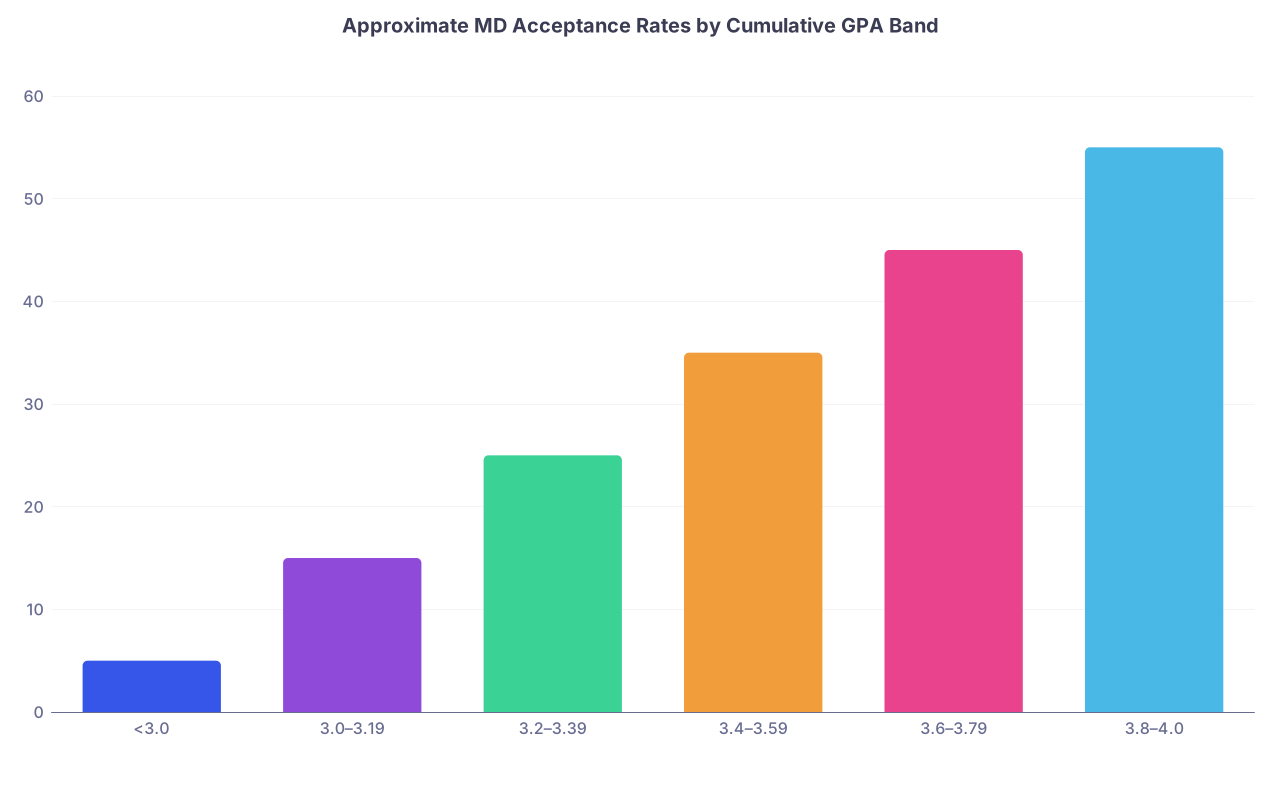
AAMC has long published tables showing acceptance rates by GPA and MCAT. It’s not perfect for post-bacc analysis, but it tells you the landscape.
For MD:
- Below 3.0 GPA: acceptance rate is very low (single digits).
- 3.0–3.19: still rough, but not hopeless with a strong MCAT.
- 3.2–3.39 / 3.4–3.59: increasingly viable territory.
- Above 3.7: dramatically better odds.
The issue: many students with 2.5–2.8 undergrads think a 1‑year post-bacc will dump them into the 3.5+ zone. It usually won’t. You’re fighting arithmetic.
| Category | Value |
|---|---|
| <3.0 | 5 |
| 3.0–3.19 | 15 |
| 3.2–3.39 | 25 |
| 3.4–3.59 | 35 |
| 3.6–3.79 | 45 |
| 3.8–4.0 | 55 |
These numbers vary with MCAT of course, but they make the point: the final cumulative GPA still heavily influences your odds.
Where post-bacc shines
Strong post-bacc performance does three big things:
- Shows academic rehabilitation – you’re not the same 19-year-old who slept through orgo.
- Boosts science GPA (BCPM), which many schools watch closely.
- Provides recent data on how you handle upper-division science that looks a lot like M1 content.
This is why you see people with:
- 2.7 undergrad → 3.4 post-bacc (40–60 credits) → 510–515 MCAT → acceptances at certain MDs and many DOs.
Not everywhere. Not most top-20s. But solid, real medical schools.
The pattern is consistent:
The worse your original GPA, the more credits of 3.7–4.0 you need, and the higher your MCAT has to be, to convince schools to take a chance.
How Admissions Committees Actually Read a “Messy” GPA
They do not stare at your 2.9 and press reject in 0.3 seconds. That’s a lazy caricature.
Here’s what they actually parse:
- Cumulative GPA (cGPA) – global view of academic performance.
- Science GPA (sGPA/BCPM) – biology, chemistry, physics, math.
- Trend – semester-by-semester: tanked early, improved later? Or chaos the whole way?
- Recent rigor – upper-division sciences, formal post-bacc, SMP (special master’s), etc.
- Context – non-trad, worked full time, severe life events, first-gen, etc.
If you have:
- 2.6 freshman/sophomore years
- Then 3.2 junior/senior
- Then 3.9 post-bacc in heavy sciences
They’re not blind to the story. They see growth. They also see risk: med school is harder than any post-bacc.
The key question in their heads
They aren’t asking “Did they get a 4.0 post-bacc?”
They’re asking:
“Given this full record, how likely are they to pass our curriculum and boards on the first try?”
A perfect 4.0 in 24 credits of light, part-time post-bacc while working 10 hours/week looks very different from:
- 45–60 credits
- full-time
- upper-division physiology, biochem, micro, anatomy
- 3.8–4.0 GPA
One says “I can succeed under med-like load.”
The other says “I can get As when my back isn’t against the wall.”
This is why I call the “any 4.0 post-bacc will fix everything” belief a myth. It ignores load, rigor, and volume – all of which committees care about.
MD vs DO: The Post-Bacc Reality Check
Another convenient myth: “If MD won’t take you, DO will for sure if you have a 4.0 post-bacc.”
Also wrong. Just in a different way.
MD Schools (AMCAS)
- No grade replacement. Everything averages.
- More GPA-sensitive, especially mid- to high-tier.
- Some schools have hard or soft GPA cutoffs (often around 3.0).
- More likely to take a chance on “reinvented” applicants who have:
- cGPA ≥ 3.2 after repair
- recent 3.7+ science work
- strong MCAT (510+ to really shift perception at allopathic schools).
You’ll find some mid-tier MD schools known to entertain reinvention if MCAT and story are excellent (think places like EVMS, Rush, some state schools). But a 2.9 final GPA with a 4.0 post-bacc and mediocre MCAT? You’re still in long-shot territory.
DO Schools (AACOMAS)
- Also no longer do grade replacement.
- Historically more open to reinvention and lower original GPAs.
- A 4.0 post-bacc and decent cGPA bump can be huge here, especially with MCAT ≥ 505.
If your final numbers look like:
- cGPA: 3.1–3.3
- sGPA: 3.3–3.5 (boosted by post-bacc)
- Post-bacc: 3.8–4.0 in 30–45 credits
- MCAT: 505–510
Your chances at many DO schools are very real. Your chances at most MD schools are still modest, though not zero depending on mission fit and state school dynamics.
The Part Everyone Ignores: Credit Volume and Diminishing Returns
The fantasy often goes like this: “I’ll do a 1-year post-bacc (24–30 credits), get a 4.0, and med schools will love me.”
Let’s do the math that almost no one bothers to run.
Say you’re at:
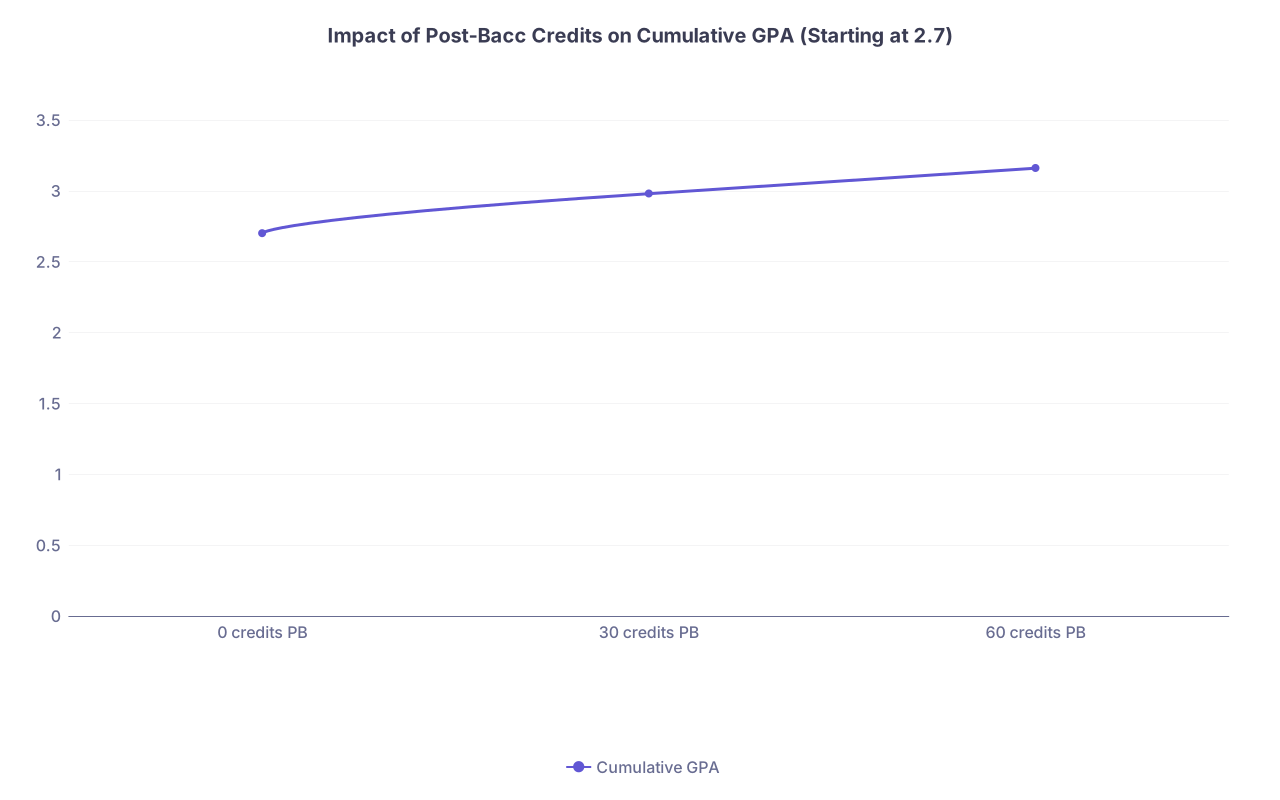
- 110 credits at 2.7 → 297 quality points
- 1-year post-bacc, 30 credits at 4.0 → +120 points
- New GPA: (297 + 120) / 140 = 417 / 140 ≈ 2.98
You’re still below 3.0.
On paper, that still throws you into the “risky” column for many MD schools.
What if you do another year?
- Another 30 credits at 4.0 → +120 points
- New totals: 80 credits post-bacc at 4.0? No. You now have 170 total credits and 537 quality points.
- 537 / 170 ≈ 3.16
Now we’re talking. 3.16 is not amazing, but it gets you above some auto-screens and looks much less dire when paired with high post-bacc and MCAT.
| Category | Cumulative GPA |
|---|---|
| 0 credits PB | 2.7 |
| 30 credits PB | 2.98 |
| 60 credits PB | 3.16 |
Notice something? Each extra block of 4.0 credits gives you a smaller bump. Diminishing returns. That’s just how weighted averages work.
The earlier your damage and the more credits at low GPA, the harder the mathematical climb.
So no, a small 4.0 post-bacc does not “erase” a low GPA. A large, sustained, rigorous one can offset it enough that schools reconsider you. Those are very different claims.
Special Master’s Programs vs Undergrad Post-Bacc: Not the Same Thing
Here’s another subtle myth: “If I do bad in college, a 4.0 graduate SMP will fix everything.”
Reality: graduate GPA is its own category. Med schools do not lump grad and undergrad together. AMCAS reports them separately.
So:
- 2.8 undergrad GPA
- 3.9 SMP (med-school-like curriculum)
Committees will see:
- Undergrad: weak
- Grad: excellent, but still cannot hide the undergrad trend.
Does a strong SMP or rigorous master’s help? Absolutely. In some cases, it helps more than generic undergrad post-bacc because the curriculum mirrors M1.
But some MD schools will still screen heavily on undergrad GPA. If their auto-screen cut is 3.0 undergrad, your shiny 3.9 grad won’t even get you read at those places.
What Actually Changes When You Get a 4.0 Post-Bacc
Let me reframe this properly. A strong post-bacc doesn’t erase. It reframes.
Here’s what it does well:
Destroys the “maybe they just can’t do hard science” argument.
A 4.0 in biochem, physiology, molecular cell, micro, genetics is hard to ignore. Especially if taken full-time.Creates a clear upward trajectory.
Adcoms like graphs in their heads: downward slope → bad. Flat mediocrity → meh. Clear upward slope → interesting.Buys you the right to be taken seriously with a low starting GPA.
Without that trend, you’re just another 2.7 who wants to be a doctor. With it, you’re “the 2.7 who turned it around and now pulls 3.9 in upper-level science.”Makes a strong MCAT believable.
If you jump from a 2.6 GPA to a 520 MCAT overnight, committees are skeptical. With a multi-year upward trend and a strong post-bacc, the big MCAT fits the story.
What it does not do:
- It does not wipe your AMCAS cGPA.
- It does not guarantee MD acceptance.
- It does not make a 498 MCAT okay.
- It does not let you apply to the same schools as someone who had a 3.8 all along.
Who Actually Gets “Rescued” by a 4.0 Post-Bacc?
I’ve seen three broad categories of people for whom a high post-bacc really works.
Early-disaster, late-bloomers
- Freshman/sophomores: 2.3–2.6
- Junior/senior: 3.4–3.7
- Post-bacc: 3.8–4.0, 30–50 credits
- MCAT: 510–520
These people can land both MD and DO. Especially if they get their cGPA into the low-3’s.
Non-trad career switchers
- Old humanities/arts GPA: 2.7–3.0 from 8–10 years ago
- Little to no science originally
- Formal post-bacc: 3.9–4.0, 40–60 credits of heavy sciences
- Strong MCAT
For them, committees often weigh the post-bacc and MCAT heavily because the old degree is ancient history.
DO-focused rebuilders
- Undergrad: 2.6–3.0, with some science damage
- Post-bacc: 3.7–4.0, 30–45 credits
- MCAT: 503–508
DO schools, especially those friendly to non-trads, can be receptive here.
Who doesn’t get magically saved:
- Students with 2.3–2.5 GPAs who think 20–25 post-bacc credits at 4.0 and a mid-400s MCAT will open MD doors. It will not. Most DOs will be a stretch too.
- Students who did “easy A” post-baccs (light load, low rigor, online fluff) and expect committees to treat that like a full-time hard-science curriculum. They don’t.
The Bottom Line: What You Should Actually Expect
Here’s the honest version.
A 4.0 post-bacc is powerful. It signals maturity, discipline, and ability. It tells a committee, “I’m not my 18-year-old self anymore.”
But it does not erase your low undergrad GPA. It coexists with it. On the same application. In front of the same skeptical eyes.
If you’re sitting at a 2.7–3.0 and dreaming of “fixing” it:
- Expect to need a lot of credits (usually 30–60+) of 3.7–4.0.
- Expect to need a good to great MCAT for your target tier.
- Expect some MD schools to still be off the table.
- Expect DO to be a more realistic path unless your repair is extensive and your MCAT is strong.
You’re not trying to erase your past. You’re trying to overwhelm it with a better, newer story – in enough volume that the old chapters matter less.
Years from now, no one will care whether you started at 2.6 or 3.6; they’ll care that you proved you could do the work when it counted and didn’t hide behind comforting myths about “GPA replacement” that never existed.